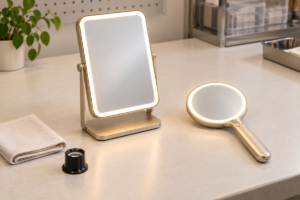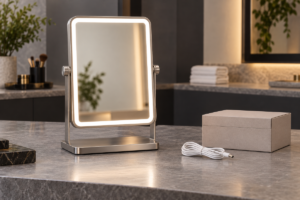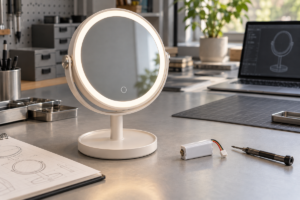

Beauty brands and retailers should source LED makeup mirrors by matching product format, lighting performance, power design, finish quality, packaging, and MOQ to the selling channel.
A reliable sourcing plan starts with the buyer deciding whether the program needs LED handheld mirrors, LED tabletop makeup mirrors, Hollywood vanity mirrors, or bathroom mirror lights, then narrowing the details through samples and QC checks.
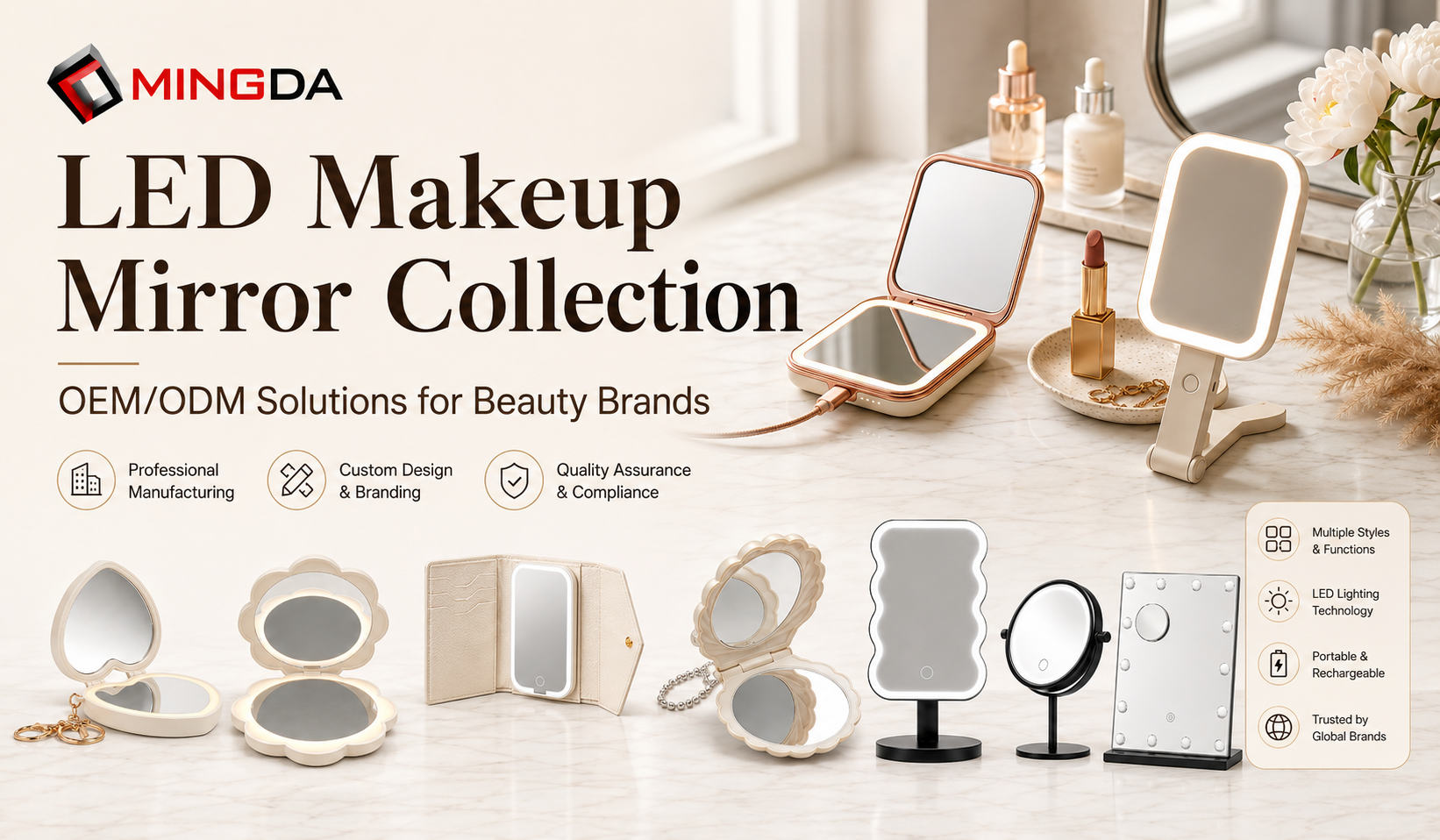
What Buyers Need to Decide Before Requesting Quotes
Most sourcing delays happen because the buyer asks for prices too early. If the factory receives only a reference photo and a target quantity, the quotation often comes back with assumptions that do not match the channel. Before requesting prices, confirm the target buyer type, the intended selling price band, the mirror format, the lighting expectation, the power preference, and the packaging route.
For a beauty brand, the mirror may need to reinforce brand identity and support premium packaging. For a retailer, the mirror often needs clearer price-band logic, simpler replenishment, stronger barcode and carton control, and a lower return risk across stores or e-commerce warehouses. Those differences should drive the spec from the start.
Channel-First Sourcing Framework
| Buyer type | Best-fit mirror style | Priority features | Main sourcing risk |
|---|---|---|---|
| Beauty brand | Rechargeable tabletop or compact LED mirror | Brand look, lighting quality, gift-ready packaging | Over-customizing before market validation |
| Retail chain | Tabletop LED mirror with proven structure | Stable cost, clear feature set, barcode/carton control | Too many SKUs with weak sell-through logic |
| Amazon or e-commerce retail | Rechargeable foldable or tabletop mirror | Packaging strength, easy charging, review-safe performance | Damage claims and battery-related complaints |
| Gift and seasonal program | Compact mirror or entry-level portable mirror | Logo area, MOQ fit, lightweight packaging | Choosing features that push cost above promo budget |
This framework matters because different channels reward different product strengths. Current consumer-facing demand signals also lean toward rechargeable, portable, and lighted formats, so buyers should treat USB charging, dimmable lighting, and travel-friendly use as commercial filters rather than optional extras when the channel supports them.
Choose Mirror Type by Selling Scenario
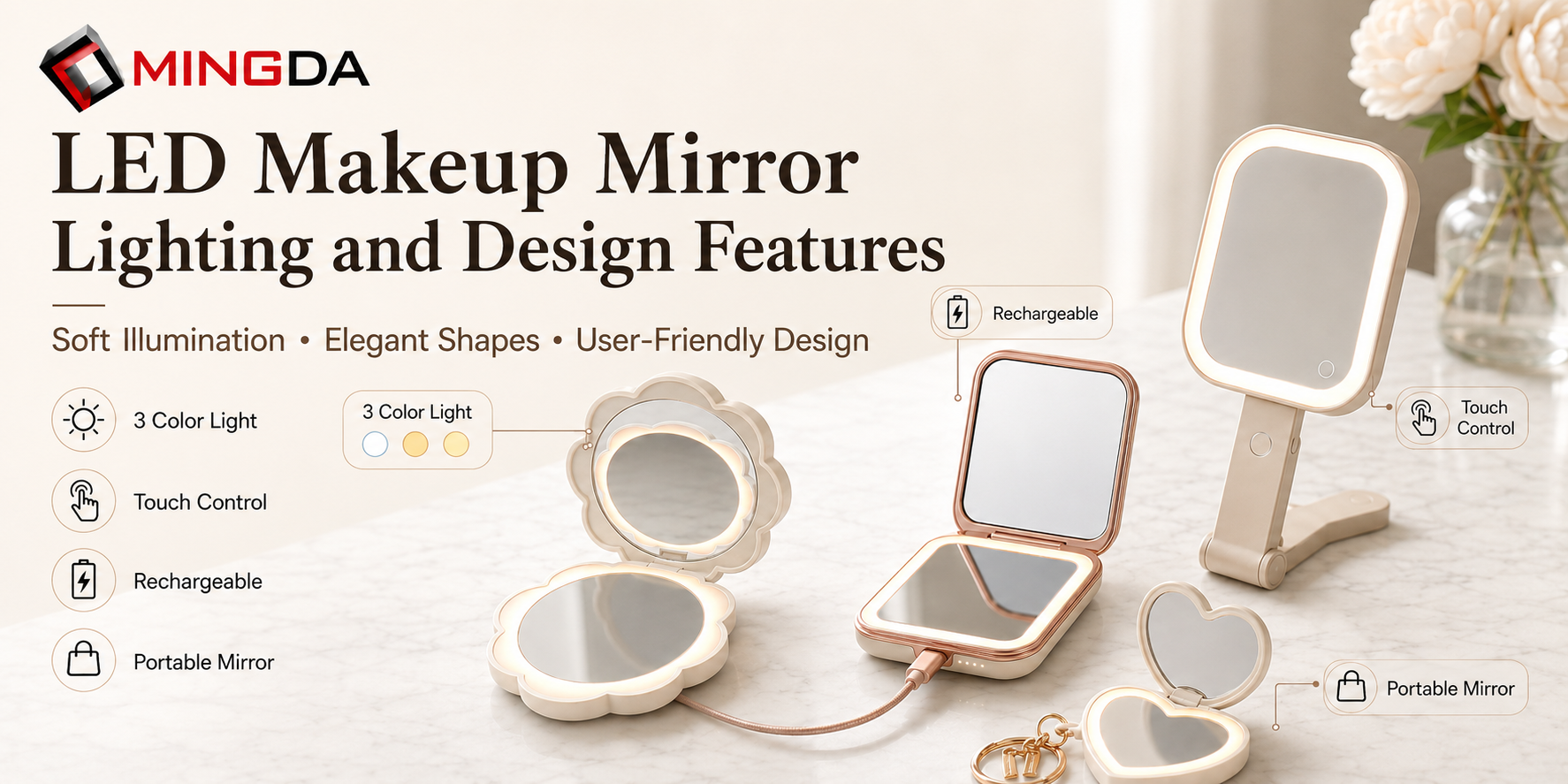
For beauty brands building a hero accessory, rechargeable tabletop mirrors usually offer the best balance of perceived value, repeatable packaging, and daily-use relevance. They photograph well, support 3-color lighting, and can carry a cleaner premium look than low-cost battery units. Compact mirrors and foldable travel mirrors work better for gift-with-purchase, holiday sets, and travel-focused assortments where portability matters more than countertop presence.
Retail buyers should be more disciplined about SKU count. Instead of buying every style, start with one proven tabletop model, one portable or compact option, and one premium upgrade path only if the retailer has enough shelf space and price segmentation. That lowers packaging complexity and reduces replenishment confusion.
Lighting Spec: The Feature That Most Affects Reviews
Lighting should be evaluated as a user-experience decision, not just a checkbox. Buyers should confirm color temperature range, color rendering quality, brightness stability, dimming logic, and light diffusion. For beauty use, the goal is even facial lighting without obvious glare or harsh point-source hotspots.
A common buying mistake is approving a mirror because the LED ring looks bright in a sample room. That can hide problems such as low color accuracy, inconsistent light around the edge, or touch controls that feel unreliable after repeat use. For beauty-brand programs, this becomes a brand-experience issue. For retail programs, it becomes a return-rate issue.
Buyers comparing portable and countertop models can also review rechargeable vs. battery-powered makeup mirrors and browse the broader Makeup Mirrors range before locking the assortment.
Magnification and Format: Avoid the Wrong Feature Mix
Magnification should match the user and the retail story. A 1X mirror is necessary for everyday use, but many buyers improve conversion by pairing it with 3X or 5X in a double-sided, side-panel, or compact format. Going too high in magnification can create distortion complaints if the consumer does not understand the viewing distance, so higher-power options should be reserved for clearly targeted SKUs.
Beauty brands usually benefit from a simpler, better-executed feature mix instead of a long spec sheet. Retailers should also avoid mixing too many niche magnification levels into the first order. A clean 1X plus 5X logic is easier to explain on packaging and easier to sell across mainstream channels.
Power Source, Battery Safety, and Channel Fit
Rechargeable makeup mirrors are usually the better fit for mid-range beauty and e-commerce channels because they reduce the friction of battery replacement and support a more modern value proposition. Plug-in designs still make sense for larger vanity mirrors or stronger-lighting formats, while dry-battery products remain relevant for low-cost travel, promotion, and impulse programs.
For sourcing managers, the key issue is not only convenience but risk control. Confirm battery type, charging port, charging cable spec, overcharge protection, transport marking requirements, and how the supplier tests charging performance. If the battery story is weak, the review story is often weak too.
Packaging and Drop-Risk Planning
Packaging should be decided with the sales channel in mind. Retail cartons need better shelf communication and barcode execution. E-commerce packaging needs better structural protection and clearer drop-risk planning. Beauty brands may need premium gift-box presentation, but the packaging still has to survive cross-border handling and final-mile delivery.
Before approving artwork, confirm inner protection, mirror fixation method, carton board strength, accessory placement, and whether the supplier can adjust packaging for mixed-channel programs. If packaging is weak, even a good mirror becomes an expensive problem.
For related packaging and supplier-capability checks, buyers can review what can be customized for LED makeup mirrors, important certifications for LED makeup mirrors, and how to choose the right LED makeup mirror for your brand.
Pre-RFQ Checklist for Sourcing Managers
- Define the main channel: beauty brand, retail chain, e-commerce, or gift program
- Set target price band and expected retail margin window
- Choose mirror type: tabletop, compact, foldable travel, or premium vanity
- Confirm 1X-only or 1X plus magnification combination
- Lock lighting spec: CCT options, dimming, diffusion, and control method
- Choose power setup: rechargeable, plug-in, or dry battery
- Confirm packaging route: shelf retail, e-commerce parcel, or gift box
- Prepare logo files, carton marks, barcode needs, and instruction-manual content
- Ask for MOQ, sample lead time, repeat-order lead time, and inspection process
What to Confirm With the Supplier Before Sample Approval
This is the section many teams skip. Before approving the sample, confirm whether the sample uses final lighting components, final hinge or stand structure, final charging parts, and final packaging protection. If the sample is only visually correct but not structurally representative, the approval is weak.
Retailers should also ask whether the factory can keep color, finish, and brightness stable across repeat orders. Beauty brands should ask how logo finish, carton finish, and accessories change MOQ or lead time. Mingda buyers with more developed private-label plans can also review Brand & Private Label Solution, Product Design Support, and Retail Chain & Supermarket Solution.
Bottom Line
The right makeup mirror program starts with a sourcing brief, not a product photo. Beauty brands and retailers should choose mirror type, lighting, magnification, power, and packaging according to the channel they need to serve, then validate those decisions through a representative sample and a clear supplier checklist. That approach reduces dead SKUs, protects review quality, and makes RFQs much more accurate.
FAQ
What is the best makeup mirror type for a beauty brand launch?
For most launches, a rechargeable tabletop mirror or a compact LED mirror is the safest starting point because it balances perceived value, daily use, and branding potential without the development cost of a fully custom structure.
Should retailers start with rechargeable or battery-powered makeup mirrors?
Rechargeable models are usually a better fit for mainstream retail and e-commerce because they are easier to market and align with current buyer demand, but battery-powered models still work for low-cost travel or promotional lines.
What magnification mix is easiest to sell?
A 1X plus 5X combination is usually the most practical because it covers normal daily use and detail work without creating too much consumer confusion on-pack.
What information should buyers send before asking for a quotation?
Send your target channel, estimated quantity, preferred mirror type, lighting requirement, magnification plan, power setup, target price band, packaging type, logo files, and destination market requirements.
How can buyers reduce returns on makeup mirrors?
Reduce returns by validating lighting quality, charging stability, stand or hinge durability, packaging protection, and clear feature communication before the first bulk order.
Next Steps for Makeup Mirror Buyers
Once the category direction is clear, most buyers should validate product risk in the next two steps: review the makeup mirror sample approval checklist before bulk production to tighten approval standards, then use the private label makeup mirror FAQ for brand buyers to align MOQ, packaging, branding, and lead-time questions before quotation.
CTA
If you are planning a makeup mirror line for a beauty brand, retail chain, or e-commerce program, contact Mingda Mirror to compare suitable models, confirm packaging options, and prepare a cleaner RFQ for sampling and bulk production.
Home | Makeup Mirrors | Sample Approval Checklist | Private Label Makeup Mirror FAQ | Contact