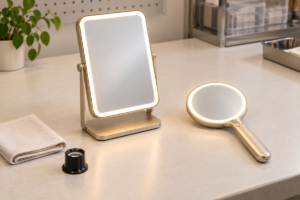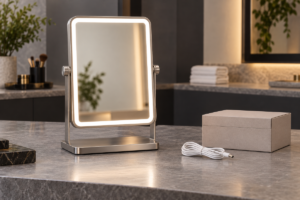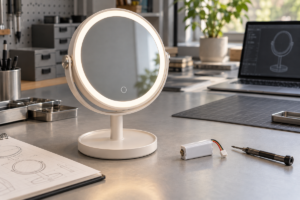

Brand buyers usually ask the same question before approving a private label LED makeup mirror program: how do you balance product appeal, reliable lighting, workable MOQ, and packaging that survives real retail or e-commerce delivery? The strongest private-label mirror projects start with channel fit, lighting specs, branding scope, and packaging risk before the quotation is finalized.
This FAQ is written for beauty brands, retailers, e-commerce sellers, and importers sourcing LED handheld mirrors, LED compact makeup mirrors, and tabletop LED makeup mirrors. Instead of broad product promotion, it focuses on the commercial questions that affect sample approval, launch timing, repeat orders, and return control.
Direct Answer: What Should Brand Buyers Confirm First?
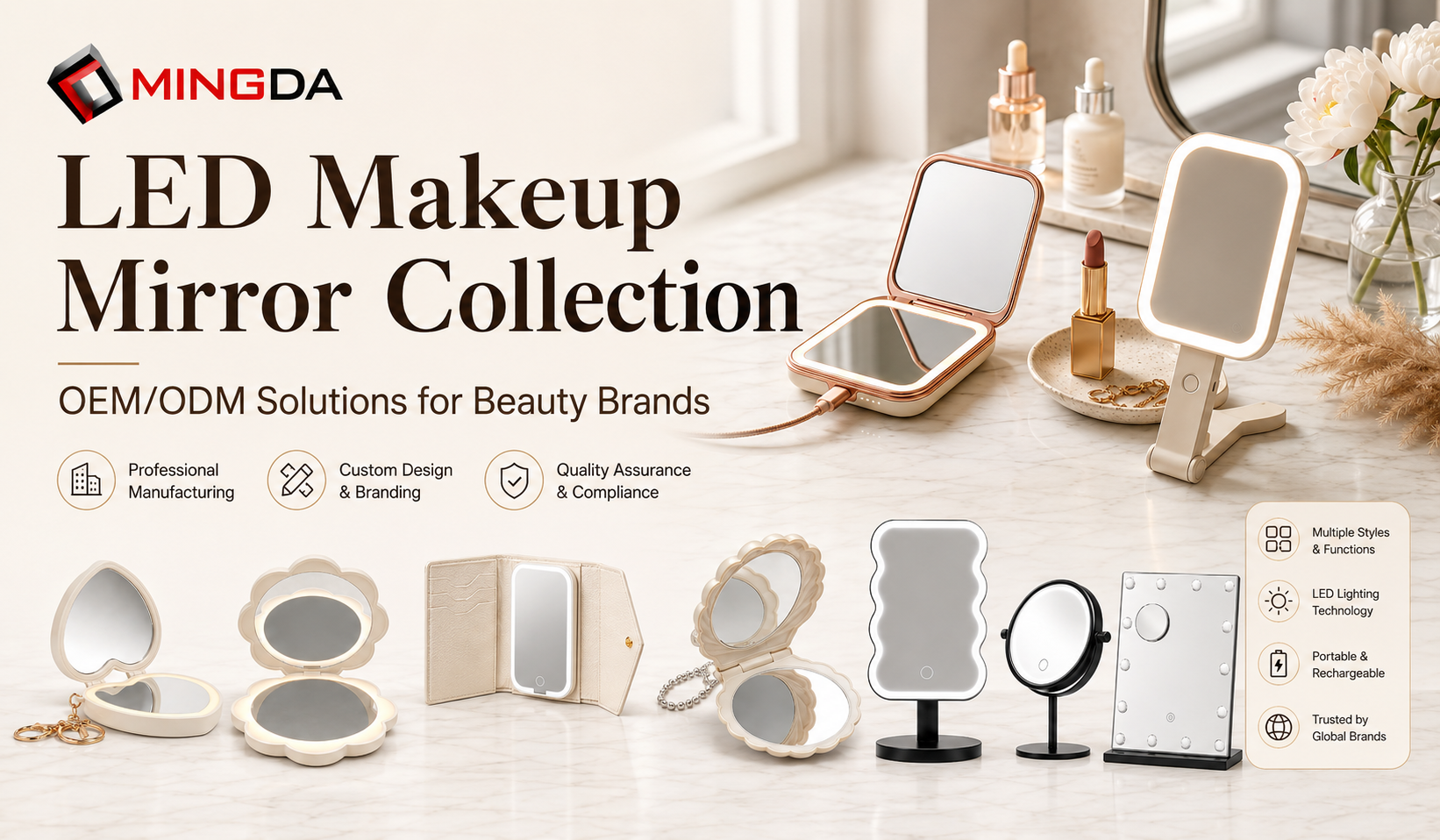
Start with four decisions: which buyer channel the mirror is for, what lighting and magnification experience it needs, how much branding and packaging customization is required, and what QC standard must be met before shipment. When these four points are clear, the supplier can recommend a more realistic mirror structure, MOQ range, packaging method, and production timeline.
FAQ 1: What does private label usually mean for makeup mirrors?
For makeup mirrors, private label usually means the buyer uses an existing or semi-custom product structure but applies brand-specific elements such as logo placement, color, packaging, insert cards, user manual, barcode labeling, and sometimes feature adjustments. It is often faster and less risky than starting from a fully new mold.
For most buyers, private label is the best balance between speed and differentiation. A brand can still create a distinct product presentation without taking on the tooling cost and development uncertainty of a fully bespoke mirror from day one.
FAQ 2: How should buyers choose the right mirror type for their channel?
The answer depends on the sales environment. A beauty brand selling gift-oriented products may prefer compact rechargeable mirrors. A retailer building a daily-use countertop assortment may need tabletop LED mirrors with broader mass appeal. A premium vanity line may justify larger mirrors, but those products require stronger packaging and tighter tolerance control.
| Buyer channel | Safer mirror format | Key reason | Main risk to control |
|---|---|---|---|
| Beauty brand gift line | Compact or foldable LED mirror | Easy branding and gift-box story | Hinge strength and battery consistency |
| Retail store assortment | Tabletop LED mirror | Broader user fit and clearer display value | Stand stability and lighting comfort |
| Amazon or e-commerce | Portable or medium tabletop model | Parcel efficiency and simpler listing promise | Breakage and overclaimed specs |
| Premium brand collection | Feature-rich vanity mirror | Higher perceived value | Packaging cost and return complexity |
Buyers comparing assortment direction can also review makeup mirror sourcing guide for beauty brands and retailers for the broader category framework.
FAQ 3: What MOQ should buyers expect?
MOQ depends on the base model, the amount of cosmetic customization, packaging changes, and whether special components are introduced. A standard mirror with only logo and packaging updates usually supports a lower MOQ than a mirror with custom color, structure changes, or new accessory requirements.
Brand buyers should avoid asking for an exact MOQ before the customization scope is defined. The practical RFQ sequence is: confirm target model, confirm branding scope, confirm packaging route, then ask for MOQ and price. That sequence reduces wasted quotations and makes supplier comparisons cleaner.
FAQ 4: What sample stages are worth paying for?
At minimum, buyers should distinguish between a reference sample, a pre-production sample, and a packaging-confirmation sample. A reference sample tells you whether the product direction is right. A pre-production sample checks whether the final materials and functions match the approved spec. A packaging sample validates protection, presentation, and carton logic before bulk shipment.
Skipping the packaging-confirmation stage is a common mistake. Mingda’s makeup mirror sample approval checklist before bulk production is especially relevant when the buyer wants to reduce launch risk.
FAQ 5: Which specifications affect buyer satisfaction most?
For private label orders, the most important specifications are lighting comfort, magnification accuracy, mirror size, power method, stand or hinge stability, material finish, and packaging protection. Buyers often focus too early on shape and color, but repeat-order performance is usually driven by function consistency and damage rate.
If the target market cares about daily-use convenience, smooth dimming and believable color temperature matter more than extreme brightness claims. If the channel is gifting or travel, foldability, charging consistency, and cosmetic finish often matter more than adding extra functions.
FAQ 6: What branding options are normally available?
Most private label programs can include logo printing, engraved or embossed branding, custom color matching, gift box artwork, insert card design, user manual updates, and barcode or carton label customization. The right choice depends on how the brand is sold. Retail shelf products often need stronger outer-box storytelling. E-commerce products need clearer spec communication and unboxing protection.
Buyers should also ask whether each branding element affects lead time, MOQ, or carton count. A low-cost artwork change may be easy, while a new surface finish or hardware color may change sourcing complexity significantly.
FAQ 7: How should buyers evaluate packaging for private label orders?
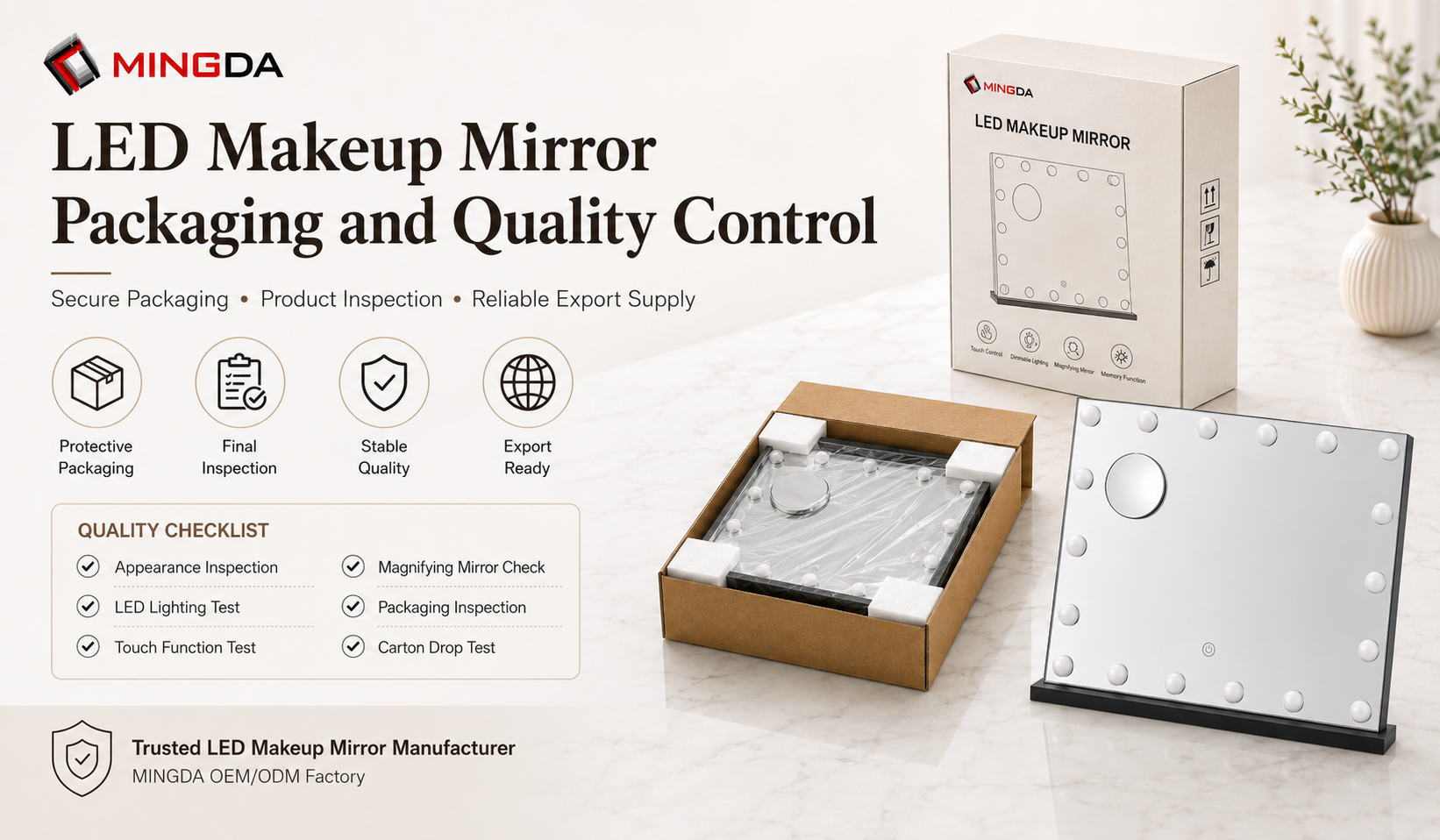
Packaging should be treated as part of the product specification, not a late-stage admin task. For fragile beauty accessories, the package must protect the mirror surface, stand, lights, accessories, and retail appearance at the same time. A giftable box that fails in transit is not commercial success.
- Confirm internal protection for glass, hinges, and accessories.
- Check whether the packaging is for retail shelf display, parcel delivery, or master-carton export only.
- Ask whether stronger packaging changes MOQ, carton quantity, or unit cost.
- Verify if the supplier supports drop-test logic or other transit-risk checks.
- Review whether packaging graphics still stay readable after adding compliance labels and barcodes.
For buyers managing export and parcel risk, Mingda’s Packaging & Logistics and QC Process pages should be part of the approval process.
FAQ 8: What production and lead-time questions should be asked before deposit?
Ask what is standard lead time for samples and mass production, which materials are long-lead items, whether peak-season capacity affects the project, and when branding files must be locked. Buyers should also ask how sample approval delays affect the shipment date. A supplier that cannot explain dependency points clearly is harder to plan around.
From a sourcing-manager perspective, the real question is not only lead time in days. It is whether the timeline includes artwork confirmation, spare-parts planning, packaging approval, and final inspection before shipment release.
FAQ 9: What QC checkpoints should be mandatory?
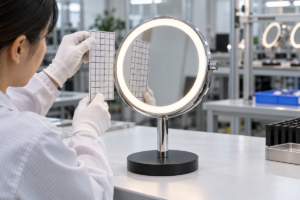
Private label buyers should require inspection of cosmetic finish, lighting performance, switch or touch response, charging or power reliability, hinge or stand stability, accessory count, packaging integrity, and carton marking accuracy. If magnification is part of the product story, that should be verified as well.
The biggest risk is approving a beautiful top sample while bulk production uses looser assembly standards. Buyers should ask for the exact final inspection checklist and clarify how defects are classified before the order enters mass production.
FAQ 10: What mistakes cause delays or poor sell-through?
The first mistake is trying to customize too many elements at once without a clear sales-channel reason. The second is approving a sample under studio conditions without testing packaging or daily-use lighting. The third is treating the mirror as a generic beauty accessory when it actually behaves like a fragile functional electronic product. The fourth is failing to align listing claims, packaging promise, and actual performance.
Pre-RFQ Checklist for Brand Buyers
- Define the main channel: retail, e-commerce, gifting, distributor, or beauty brand set.
- Choose one target mirror type before requesting multiple unrelated quotations.
- List must-have specs: lighting, magnification, size, power, finish, and accessories.
- Clarify which branding items are required now versus later.
- State whether the order needs retail packaging, export packaging, or both.
- Request sample stages and approval checkpoints in writing.
- Confirm MOQ, lead time, and QC scope only after the product brief is stable.
Bottom Line
A strong private label makeup mirror program is built on controlled decisions, not just attractive styling. Buyers should confirm channel fit, realistic specs, packaging logic, branding scope, and final QC before they lock the quotation. That approach reduces rework, avoids misleading claims, and makes bulk production easier to scale.
FAQ
Is private label faster than a fully custom makeup mirror project?
Usually yes. Private label programs often reuse an existing product structure, which shortens development time and reduces tooling risk.
What is the most important sample after the first reference sample?
The pre-production sample tied to final materials and the packaging-confirmation sample are both critical because they reveal bulk-order risk.
Can buyers request custom packaging without changing the mirror itself?
Yes. Many projects begin with standard mirror hardware and customized outer packaging, insert cards, and logo treatment.
Why is packaging such a big issue for makeup mirrors?
Because breakage, scratches, and accessory movement often create claims and poor reviews even when the mirror design itself is good.
How can Mingda support private label makeup mirror buyers?
Mingda can support product selection, OEM/ODM coordination, packaging planning, QC alignment, and RFQ preparation for beauty brands and retail buyers.
CTA
If you are planning a private label makeup mirror program, contact Mingda Mirror with your target channel, expected price range, branding scope, and packaging route so the sample and quotation process starts from the right commercial assumptions.