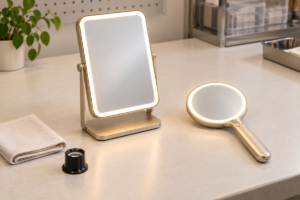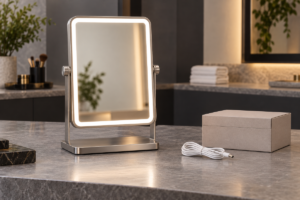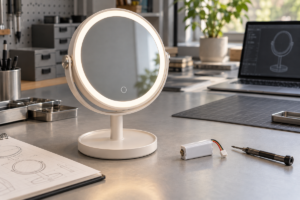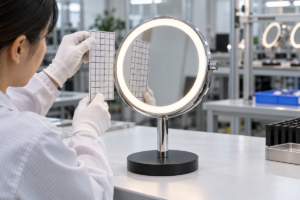

For most retail and e-commerce programs, 5x vs 10x LED makeup mirrors should not be treated as a simple “stronger is better” choice. Consider 5x for general detail work and 10x for close precision tasks; confirm the comfortable viewing range on each actual sample before choosing the assortment. 10x magnification is better for precision tasks, mature-skin customers, brow work, lash application, and premium detail mirrors, but it needs tighter optical QC, clearer packaging education, and stronger return-risk control.
A 5x main SKU with a targeted 10x option is one assortment to test, not a proven sales or return-rate advantage.
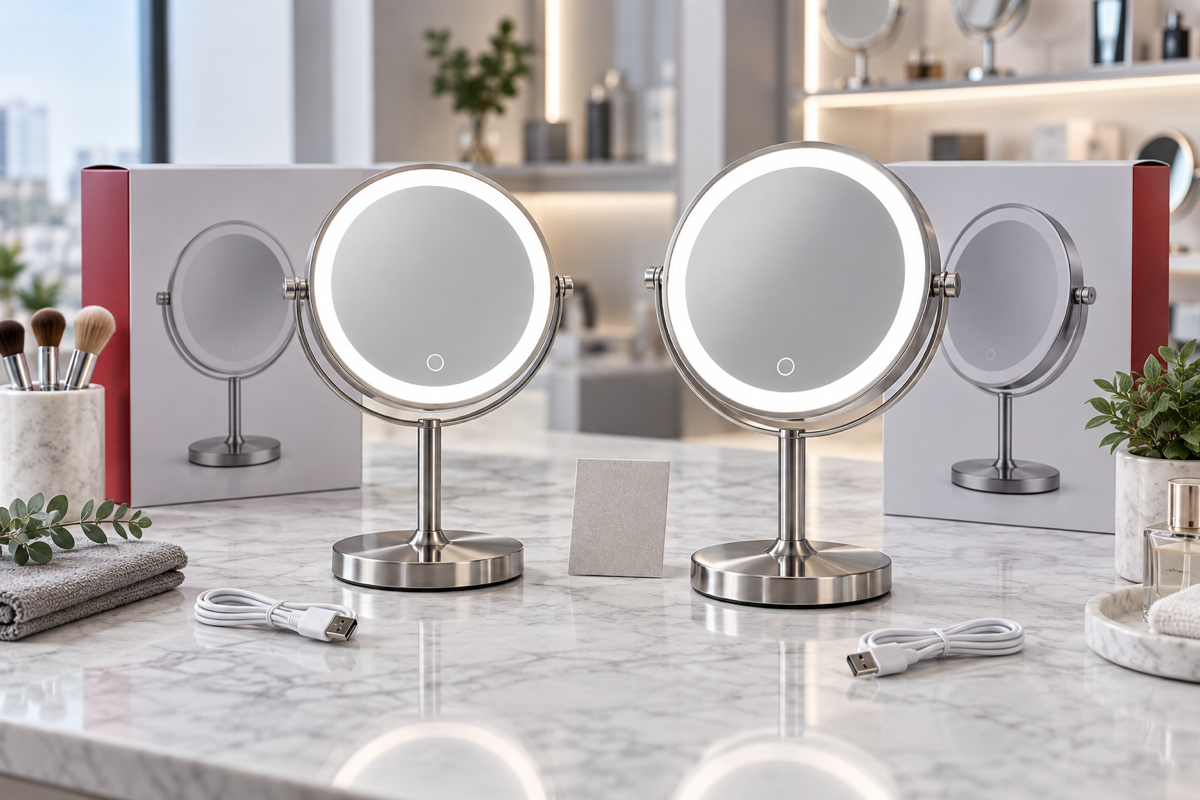
Buyer Context: Why Magnification Choice Affects Returns
Magnification changes how close the user must sit, how much facial area they can see, and how sensitive the mirror becomes to distortion. A beauty brand may see 10x as a premium specification, while a mass retailer may see it as a customer-service risk if end users expect a full-face view. Amazon sellers face an even sharper problem: a buyer may order a high-magnification mirror, use it at the wrong distance, then leave a review saying the image is distorted.
For B2B buyers, the sourcing question is not only “Can the factory make 10x?” It is “Which magnification level fits the channel, price point, packaging message, and after-sales tolerance?”
Mingda Mirror usually recommends confirming magnification together with LED brightness, mirror diameter, viewing distance, stand stability, charging design, and packaging instructions before sample approval.
Quick Comparison: 5x vs 10x LED Makeup Mirrors
| Decision point | 5x LED makeup mirror | 10x LED makeup mirror | Buyer recommendation |
|---|---|---|---|
| Main user need | Daily makeup, skincare, general detail work | Eyebrow, lash, pore-level precision, mature-skin support | Use 5x for broad assortments; add 10x for precision customers |
| Viewing distance | More forgiving | Shorter and less forgiving | Print clear usage guidance for 10x |
| Return risk | Validate with channel-specific pilot feedback | Expectation mismatch if users expect a full-face view | Test samples with non-technical users before bulk order |
| Mirror size | Works well across compact and tabletop formats | Benefits from clear optical quality and stable positioning | Avoid very small 10x mirrors unless the use case is specific |
| QC sensitivity | Moderate | High | Check distortion, focal distance, LED glare, and lens consistency |
| Channel fit | Retail chains, gift lines, Amazon entry SKUs, distributors | Premium beauty, professional detail use, mature customer segments | Match magnification to the listing promise and sales channel |
When 5x Is the Better Bulk-Order Choice
5x is usually the safer specification when the buyer needs a high-volume SKU with broad customer acceptance. It supports eye makeup, skincare checks, and detailed grooming while still allowing a comfortable viewing distance. Confirm customer comfort in a small pilot; magnification alone does not establish complaint or return rates.
5x also works better when the mirror will be sold as a gift item or bundled inside a beauty accessory program. The buyer does not need to educate the customer heavily, and the mirror can be positioned as useful without feeling too technical.
For an e-commerce seller, 5x is often a practical first SKU because product photos, listing copy, and customer expectations are easier to align. Buyers planning a wider line can pair it with a standard LED tabletop mirror, a rechargeable compact mirror, or a travel-size model. Related sourcing decisions are covered in Mingda’s guides to LED makeup mirror return risk and portable LED makeup mirror sourcing.
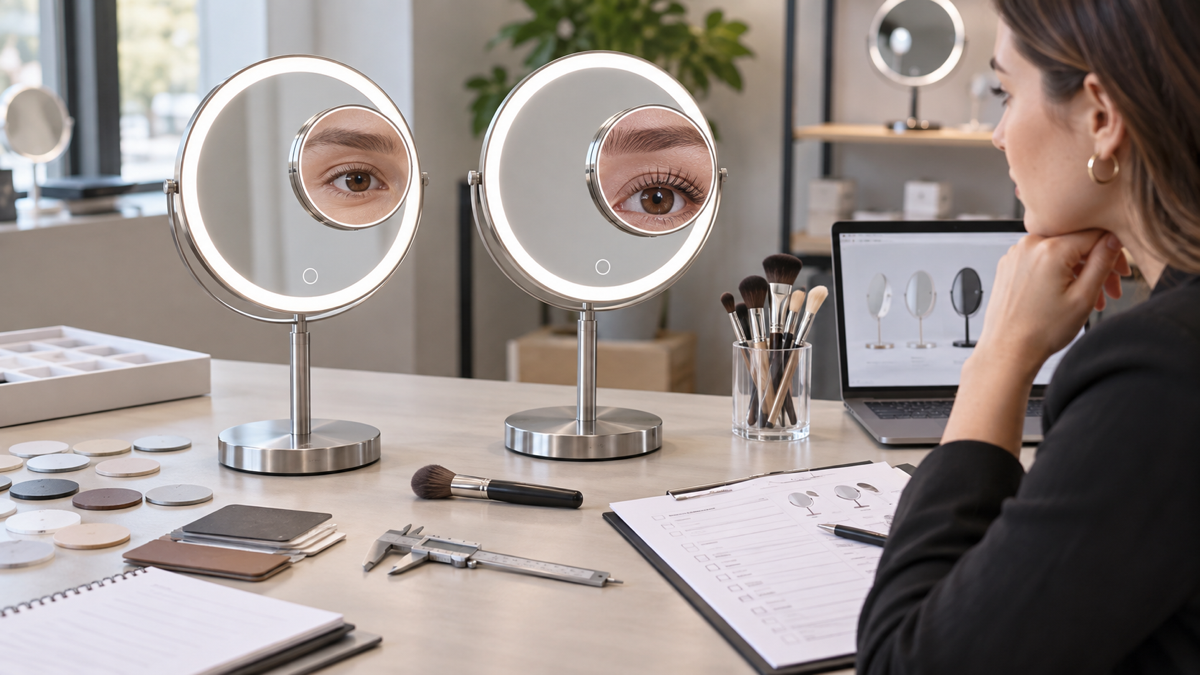
When 10x Magnification Makes Commercial Sense
10x is strongest when the buyer has a defined customer segment. It can work well for premium detail mirrors, brow and lash users, mature-skin customers, salon retail, and beauty brands that want a more specialized item. The benefit is precision; the risk is expectation mismatch.
Because 10x magnification narrows the usable viewing zone, the mirror needs stable positioning. A weak hinge, loose swivel, light base, or small mirror face can make the product feel frustrating. Buyers should also check whether the LED ring produces glare at the closer viewing distance required by 10x.
10x should be described honestly in packaging and listings. Good wording tells users that high magnification is for close-detail work, not for full-face makeup. Check whether the revised instructions resolve those misunderstandings in pilot feedback before claiming a reduction in returns.
Optical and Lighting Specifications Buyers Should Confirm
Magnification should be approved together with optical clarity and lighting. A mirror can be labeled 10x but still perform poorly if the lens has edge distortion, inconsistent focal distance, poor coating, or glare from the LED ring.
Buyers should ask the supplier to confirm:
- Actual magnification tolerance for the production batch.
- Recommended viewing distance for the sample.
- Distortion performance at the center and edge of the mirror.
- LED color temperature and CRI for makeup use.
- Dimming range and memory function if included.
- Battery capacity, USB-C charging, and charging protection for rechargeable models.
- Hinge torque, stand stability, and drop-test expectations.
- Packaging instructions that explain the correct magnification use.
For LED makeup mirrors, lighting and magnification must work as a system. A strong lens with harsh lighting can create a poor user experience. A comfortable 5x or 10x mirror should have soft diffusion, stable brightness, and a mirror size that fits the intended distance.
Common Mistakes Buyers Should Avoid
One common mistake is choosing 10x only because it sounds more premium. If the sales channel is broad retail or entry-level Amazon, a very strong magnification claim may increase confusion. Buyers may win a click but lose margin through returns.
Another mistake is approving only one sample. Magnifying lenses should be checked across several samples because small variations can affect clarity and edge distortion. If the project uses a color assortment, each finish should also be checked for hinge feel, base weight, and packaging fit.
A third mistake is separating the mirror specification from the listing or retail box. If the product is 10x, packaging and listing images should make the close-detail use case clear. If the product is 5x, the copy should emphasize daily makeup and comfortable detail work instead of overstating professional precision.
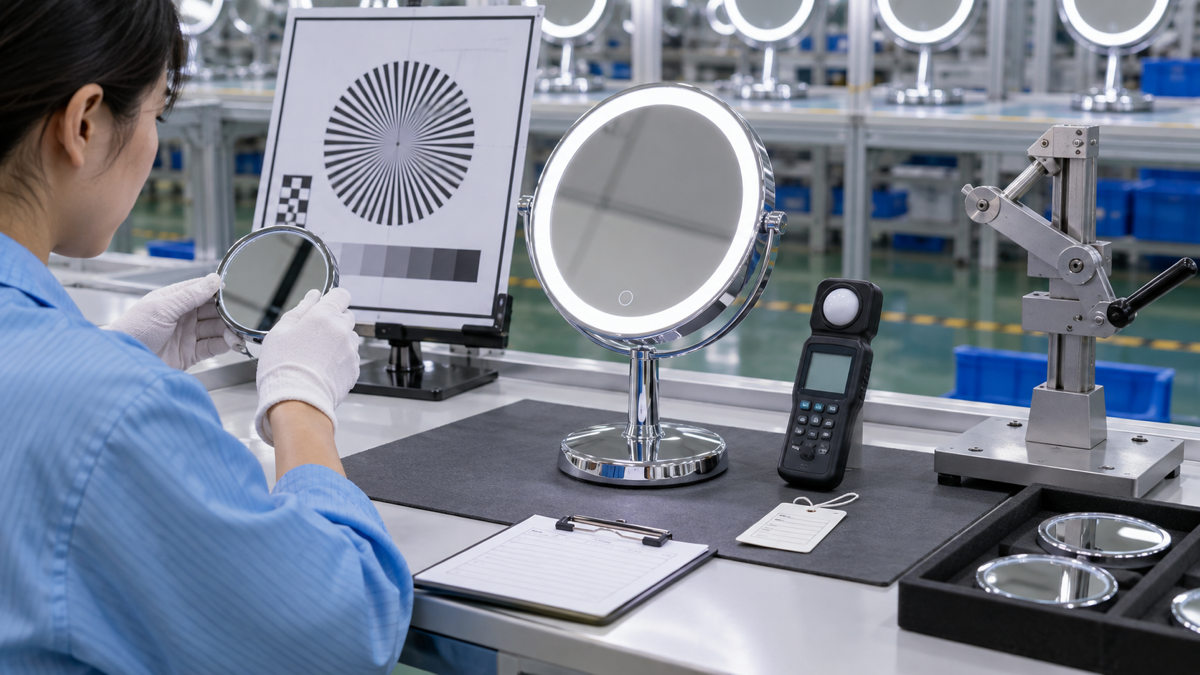
Pre-RFQ Checklist for 5x and 10x Mirror Orders
Before requesting a quotation, buyers should define the commercial target clearly. This helps the supplier recommend the right magnification, structure, and packaging instead of quoting a generic mirror.
| RFQ item | What to specify | Why it matters |
|---|---|---|
| Target channel | Retail, Amazon, gift, salon, distributor, or private label | Magnification and packaging education differ by channel |
| Magnification mix | 5x only, 10x only, or 5x plus 10x assortment | Controls SKU planning and MOQ |
| Mirror format | Tabletop, wall-mounted, compact, travel, or dual-sided | Affects viewing distance and user comfort |
| LED requirements | CCT, CRI, dimming, brightness, diffusion | Prevents glare and poor makeup color judgment |
| Power design | Rechargeable USB-C, battery, or plug-in | Affects compliance, logistics, and after-sales |
| Packaging | Retail box, molded insert, mailer protection, usage instruction | Reduces breakage, misunderstanding, and returns |
| QC standard | Magnification tolerance, distortion check, LED aging, hinge test | Protects repeat-order consistency |
Packaging and Listing Notes for E-Commerce Buyers
For Amazon and independent-store sellers, magnification education belongs in the product page and in the box. The customer should understand that 5x is for comfortable daily detail work and 10x is for close precision. This is especially important when the product image shows a beautiful LED mirror but the buyer does not understand that high magnification has a shorter focal distance.
Packaging should protect both the mirror face and the stand. For rechargeable models, buyers should confirm cable placement, accessory bag, manual position, barcode label area, and master-carton drop-test logic. These details may look small, but they influence review quality after the first shipment.
Buyers can also review Mingda’s guides to retail box and master carton packaging and molded insert packaging before finalizing a 5x or 10x mirror program.
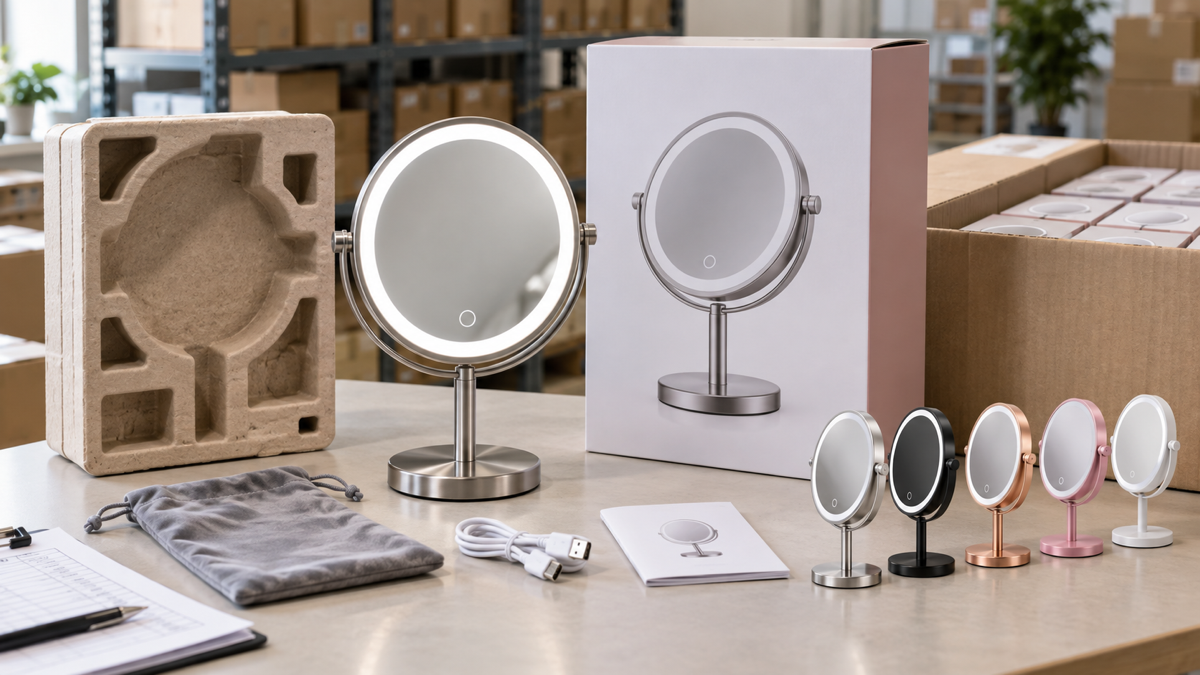
Approve a Measured Viewing Range for Each SKU
Do not approve optical performance from a printed 5x or 10x label or an illustrative photograph. Ask the supplier to state how magnification is defined and measured. On identified samples, record eye-to-mirror distance, usable field of view, center and edge clarity, light mode and brightness. Retain the agreed method, instrument details where applicable, sample IDs and buyer acceptance criteria; a magnification label alone cannot establish a universal comfortable distance.
Compare samples at the same task and lighting conditions, then record the viewing range that intended users can use comfortably. Put that sample-specific range in the instructions only after verification. For detachable magnifying inserts, also check attachment retention, removal and packed protection on the final assembly. Use the ABS versus metal frame comparison to evaluate stand and hinge behavior independently of the magnification label.
Review Delivered Magnification SKUs Before Reordering
At the 14-day review, separate the 5x and 10x delivery cohorts and retain the observation cutoff, units delivered, unique support cases and confirmed returns for each. Classify viewing-distance misunderstanding, glare, instability, transport damage and confirmed optical defects separately; do not infer an optical defect from a complaint alone or compare raw complaint counts across unequal cohorts.
Reproduce reported issues on the identified SKU at the documented viewing distance and light setting. Use the 3-color versus single-color lighting comparison to record the mode, dimming and control behavior. Assign each open issue an owner and retest date. Release a reorder only after the approved sample, instructions and live listing agree with the corrected configuration; record a hold or limited trial where evidence is incomplete.
Bottom-Line Recommendation
For most first-time or mainstream orders, choose 5x as the main LED makeup mirror magnification as an initial assortment hypothesis, then validate viewing comfort and customer instructions on samples. Choose 10x when the buyer has a defined precision-use customer, stronger packaging instructions, and a QC plan that checks distortion, focal distance, LED glare, and hinge stability.
If the assortment budget allows two SKUs, a 5x main model plus a targeted 10x detail model gives buyers a cleaner product ladder than forcing one magnification to serve every customer.
FAQ
Is 10x always better than 5x for LED makeup mirrors?
No. 10x gives stronger detail, but it also requires a shorter viewing distance and clearer customer education. 5x is often better for mainstream daily makeup and broad retail programs.
Which magnification is safer for Amazon sellers?
There is no universally safer magnification for Amazon sellers. Compare sample usability, listing clarity and pilot feedback for the intended customer group. If Amazon sellers choose 10x, the listing and packaging should explain that it is for close-detail work.
Can buyers order both 5x and 10x in one assortment?
Yes. Many brands use 5x as the broader daily-use SKU and 10x as a premium or precision option. Buyers should confirm MOQ, packaging artwork, barcode separation, and inventory planning for each SKU.
What QC checks matter most for 10x mirrors?
Check magnification tolerance, center and edge distortion, focal distance, LED glare, hinge torque, stand stability, and packaging instructions. 10x magnification is less forgiving than 5x, so QC discipline matters more.
Should the same packaging be used for 5x and 10x mirrors?
The structure can be similar, but the customer-facing explanation should differ. 10x packaging should clearly describe close-detail use so customers do not expect a normal full-face view.
Work With Mingda Mirror
Mingda Mirror supports B2B buyers with LED makeup mirror product planning, sample approval, magnification selection, lighting checks, private-label packaging, and shipment-ready QC. If you are comparing 5x vs 10x LED makeup mirrors for retail, Amazon, distributor, or brand programs, send your target market, channel, quantity, and packaging needs through the Contact page for a more precise RFQ.
Request an itemized magnification sample quotation with mirror diameter, magnification mix, target user, power design, packaging, order quantity and launch date. Ask for per-SKU MOQ, sample fees, optical acceptance method and production lead time after written sample approval.
Social Media Content Ideas
LinkedIn angle: Explain why “higher magnification” is not always the best procurement choice, and link to the full sourcing guide.
Facebook angle: Share a buyer-friendly tip: 5x is usually better for daily makeup, while 10x is for close-detail use.
Instagram angle: Use the comparison desk image to show how brands can plan 5x and 10x mirror assortments with packaging and QC in mind.
Short CTA: Read the full 5x vs 10x LED makeup mirror sourcing guide and contact Mingda Mirror for OEM/ODM sample planning.