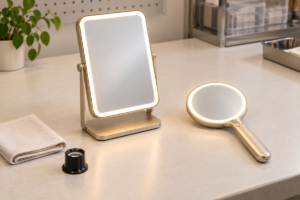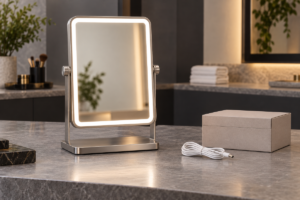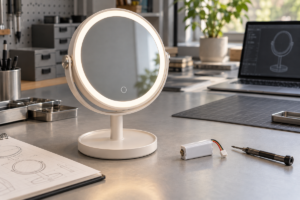

For LED makeup mirror orders, buyers should specify the retail box and the master carton separately. The retail box protects the selling unit, presents the brand, holds accessories, and supports barcode or channel labeling. The master carton protects multiple retail boxes during export, warehouse handling, pallet movement, and e-commerce fulfillment. If a buyer only approves the product sample but not both packaging levels, the order is more likely to face crushed boxes, mixed SKUs, relabeling, higher dimensional weight, or preventable returns.
This checklist is for beauty brands, retailers, distributors, Amazon sellers, wholesalers, and private-label buyers who source tabletop LED makeup mirrors and need packaging that works from factory packing table to final receiving.
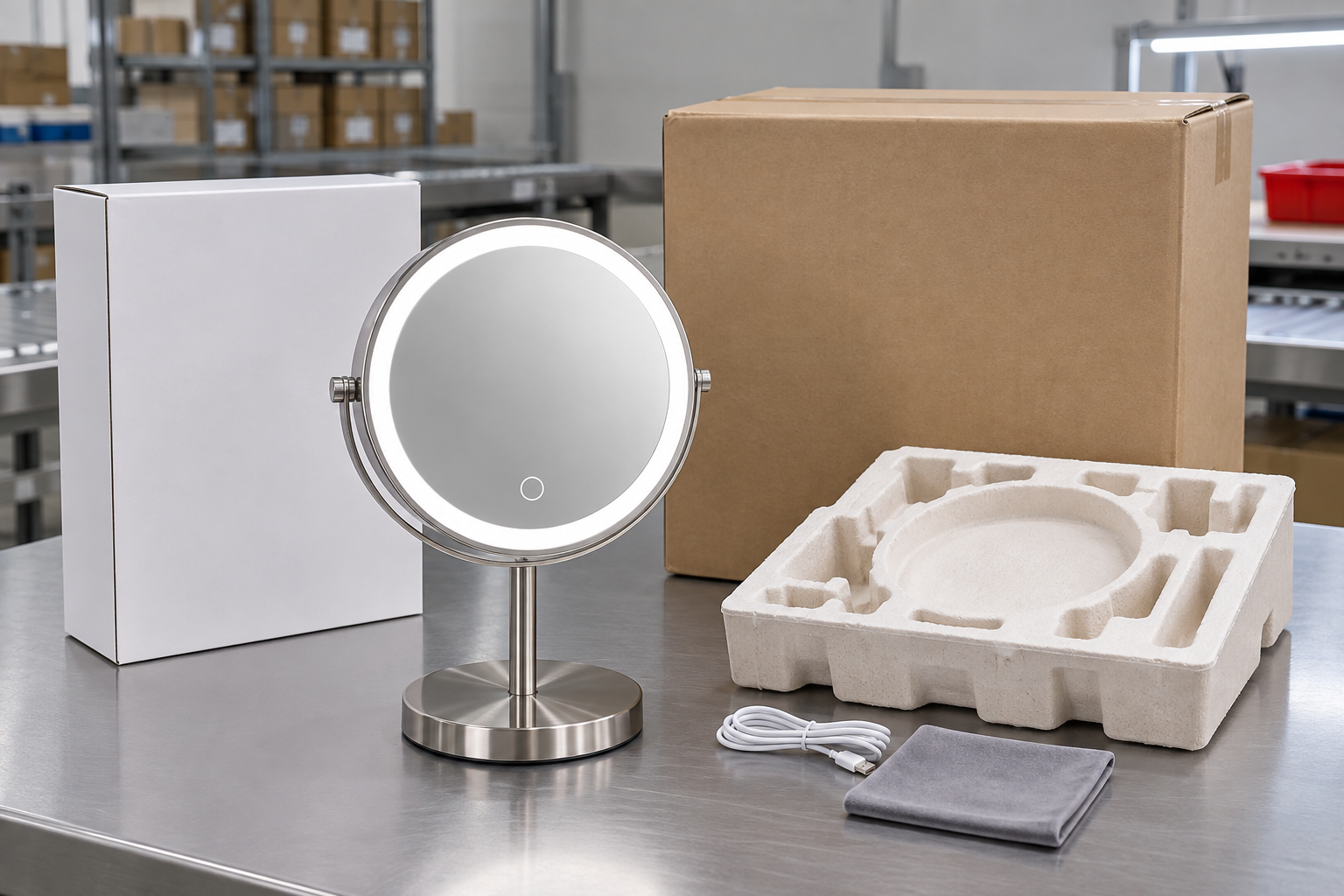
Why Retail Box and Master Carton Specs Must Be Separate
A retail box and a master carton have different jobs. The retail box is part of the customer-facing product. It needs the right size, insert fit, finish, barcode position, accessory layout, and shelf or parcel-readiness. The master carton is a logistics package. It needs the right carton strength, unit count, gross weight, sealing method, carton mark logic, and pallet or courier suitability.
For LED makeup mirrors, this difference matters because the product is both fragile and functional. The mirror surface, LED ring, stand, hinge, charging port, cable, pouch, and manual all need to arrive clean and matched. A strong outer carton cannot compensate for a loose retail insert. A beautiful color box cannot compensate for an export carton that collapses under stacking.
Buyers should therefore approve three samples before mass production: the bare product sample, the packed retail unit, and the packed master carton. This is especially important for rechargeable LED makeup mirrors sold through e-commerce channels, where barcode scannability, packaging durability, and channel-specific receiving rules can affect reviews and warehouse handling.
Retail Box vs Master Carton: What Each Level Controls
| Packaging level | Main purpose | Buyer should confirm | Risk if ignored |
|---|---|---|---|
| Retail box | Protect and present one selling unit | Exact mirror fit, insert material, accessory position, barcode area, box finish, manual placement | Scratched mirror, loose cable, damaged gift box, customer complaints |
| Inner protective insert | Lock product and accessories inside the retail box | Mirror face clearance, stand support, cable cavity, pouch position, movement after shake test | LED ring pressure, broken hinge, surface marks, mixed accessories |
| Master carton | Protect multiple retail boxes during export and receiving | Units per carton, carton grade, gross weight, carton size, carton mark, sealing method | Crushed boxes, high shipping cost, mixed SKU cartons, warehouse delays |
| Pallet or courier pack | Support delivery channel | Pallet pattern, carton orientation, corner protection, label side, drop and compression test scope | Transit damage, unreadable labels, rework before delivery |
The retail box should be designed from the buyer’s sales channel backward. A beauty retail chain may care about shelf presentation and giftability. An Amazon or e-commerce seller may care more about parcel survival, barcode placement, and reducing empty space. A distributor may need carton marks that separate color, plug type, magnification, and private-label SKU clearly.
Retail Box Specification for LED Makeup Mirrors
The retail box is not only artwork. It is a functional packed sample that should be checked against the final product specification.
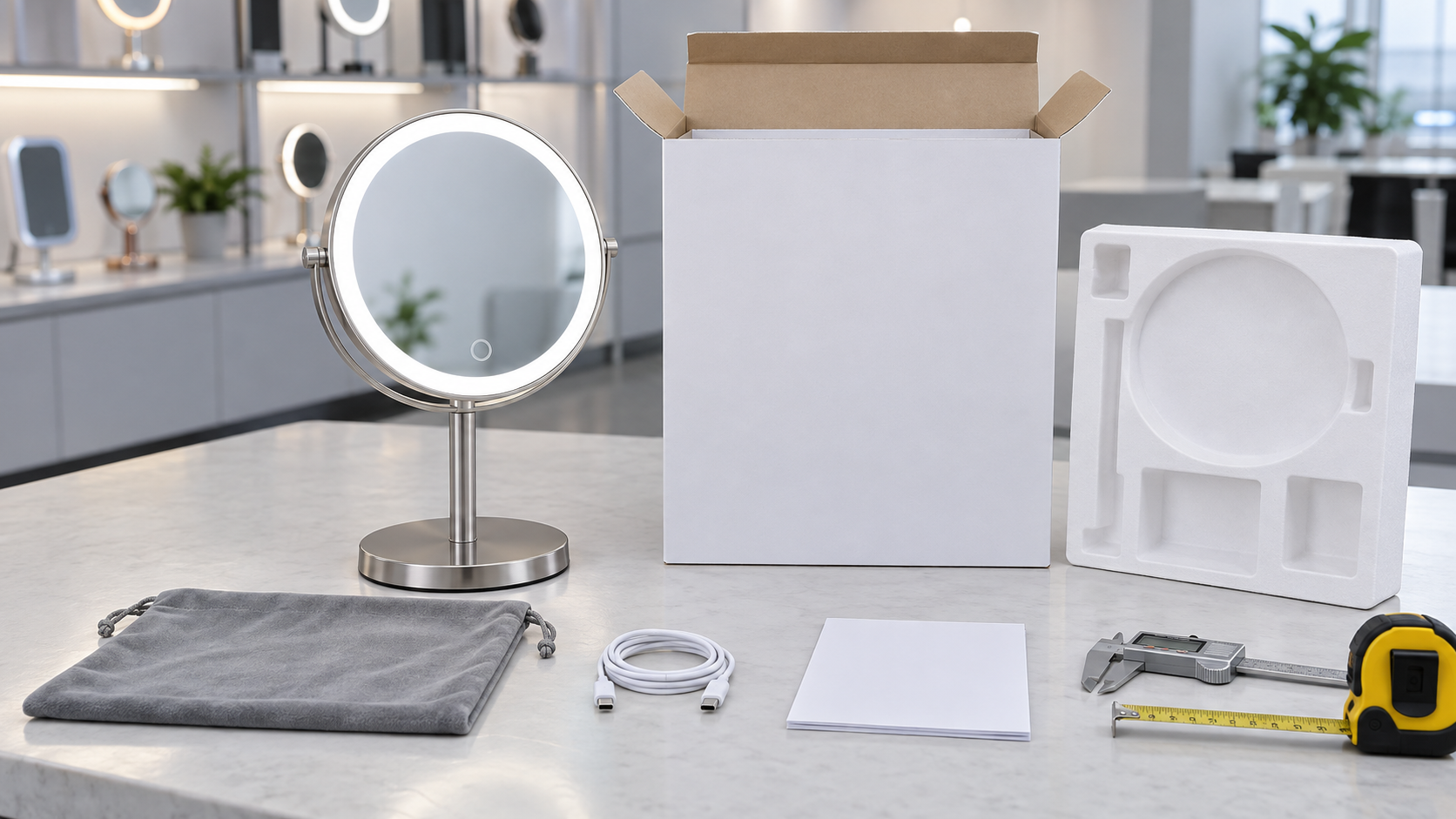
Buyers should confirm the retail box size after the mirror structure is final. A round tabletop LED makeup mirror with a metal stand may need different cavity support than a lightweight ABS frame mirror. A rechargeable model with USB-C cable, pouch, charging base, or magnifying side needs accessory positions that cannot slide during vibration or parcel handling.
Key retail box details include:
- Product fit: the mirror, stand, hinge, and LED ring should not touch the box wall under normal pressure.
- Insert type: molded pulp, EVA, EPE, paper card, or corrugated support should match the mirror weight, finish, and channel risk.
- Accessory layout: USB-C cable, adapter if supplied, pouch, manual, cleaning cloth, and warranty card should each have a fixed position.
- Barcode and label zone: the box should reserve a flat, scannable area for buyer SKU, FNSKU, EAN, UPC, or channel label.
- Artwork approval: color, logo, product photo, function claims, plug type, language version, and warning text should match the approved SKU.
- Opening experience: the customer should not scratch the mirror when pulling it out, and the mirror should not fall forward when the box opens.
For private-label buyers, the safest workflow is to approve a white dummy box for fit first, then approve printed artwork, and finally approve one complete packed sample before the bulk packaging run.
Master Carton Specification for Export and E-Commerce
The master carton should be treated as a shipping specification, not a minor packing detail. It affects breakage rate, warehouse receiving, shipping cost, and reorder consistency.
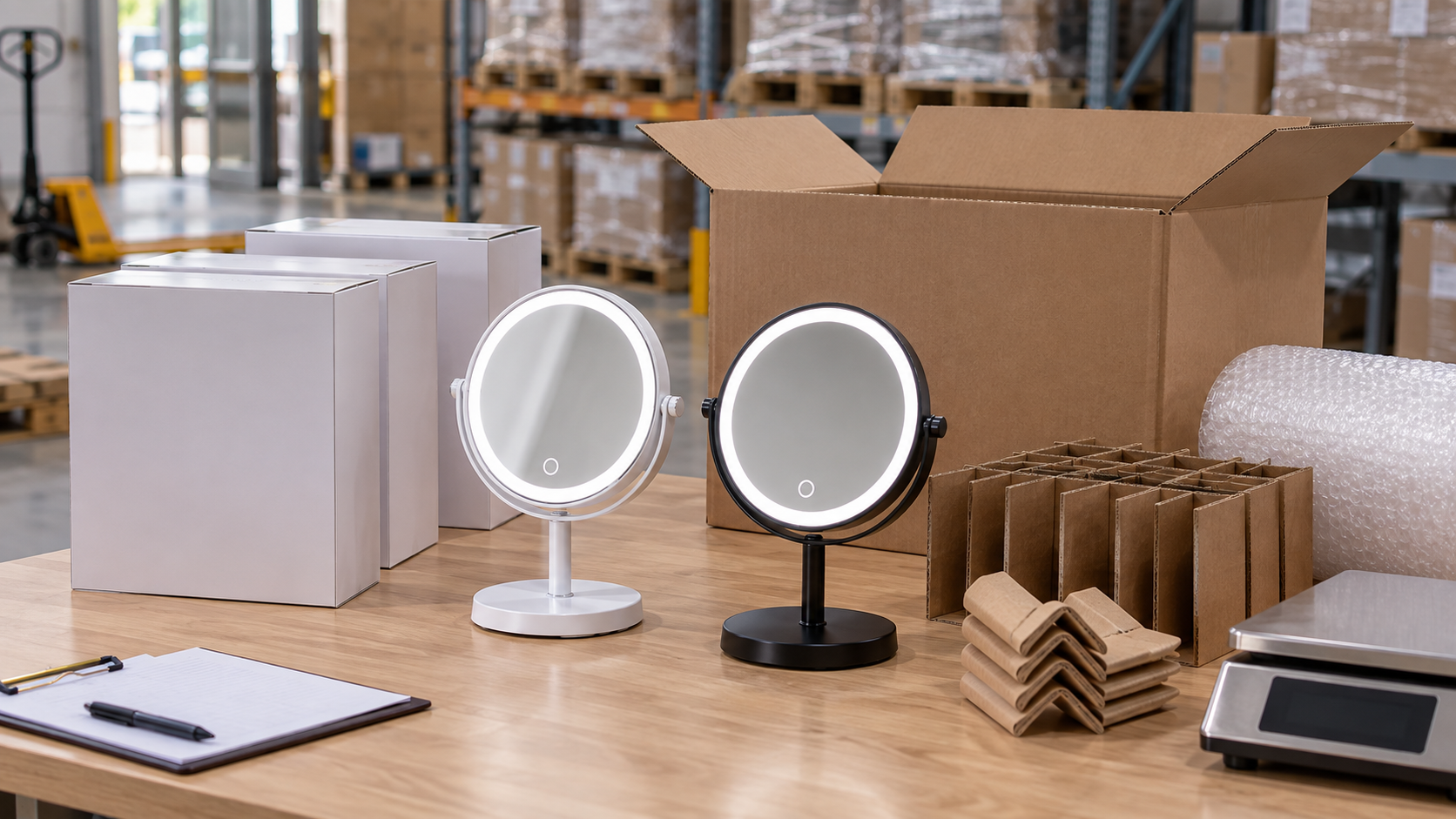
For LED makeup mirrors, the master carton should normally define:
- units per carton
- carton dimensions and tolerance
- gross weight and net weight
- carton material grade and flute type
- retail box orientation inside the carton
- divider, corner protector, or top/bottom pad requirements
- sealing tape method and strapping requirement if needed
- carton mark fields: buyer SKU, factory model number, color, plug type, quantity, carton number, and destination
The unit count should balance freight efficiency and handling risk. A carton that is too small may waste shipping cost because of too many cartons. A carton that is too large may exceed comfortable handling weight, increase compression risk, or make courier damage more likely. For tabletop LED makeup mirrors with glass, metal stand, or rechargeable components, buyers should avoid chasing the lowest carton count if it makes the carton heavy, loose, or hard to stack.
If the order includes mixed colors, plug versions, magnification options, or different retail labels, the master carton plan must prevent SKU mixing. A clear carton mark is useful, but physical separation in packing and final inspection is just as important.
Packaging Test Plan Buyers Should Request
Packaging tests do not need to become complicated, but the test scope should match the real route. A retail store order, an Amazon-ready e-commerce order, and a distributor container order may need different priorities.
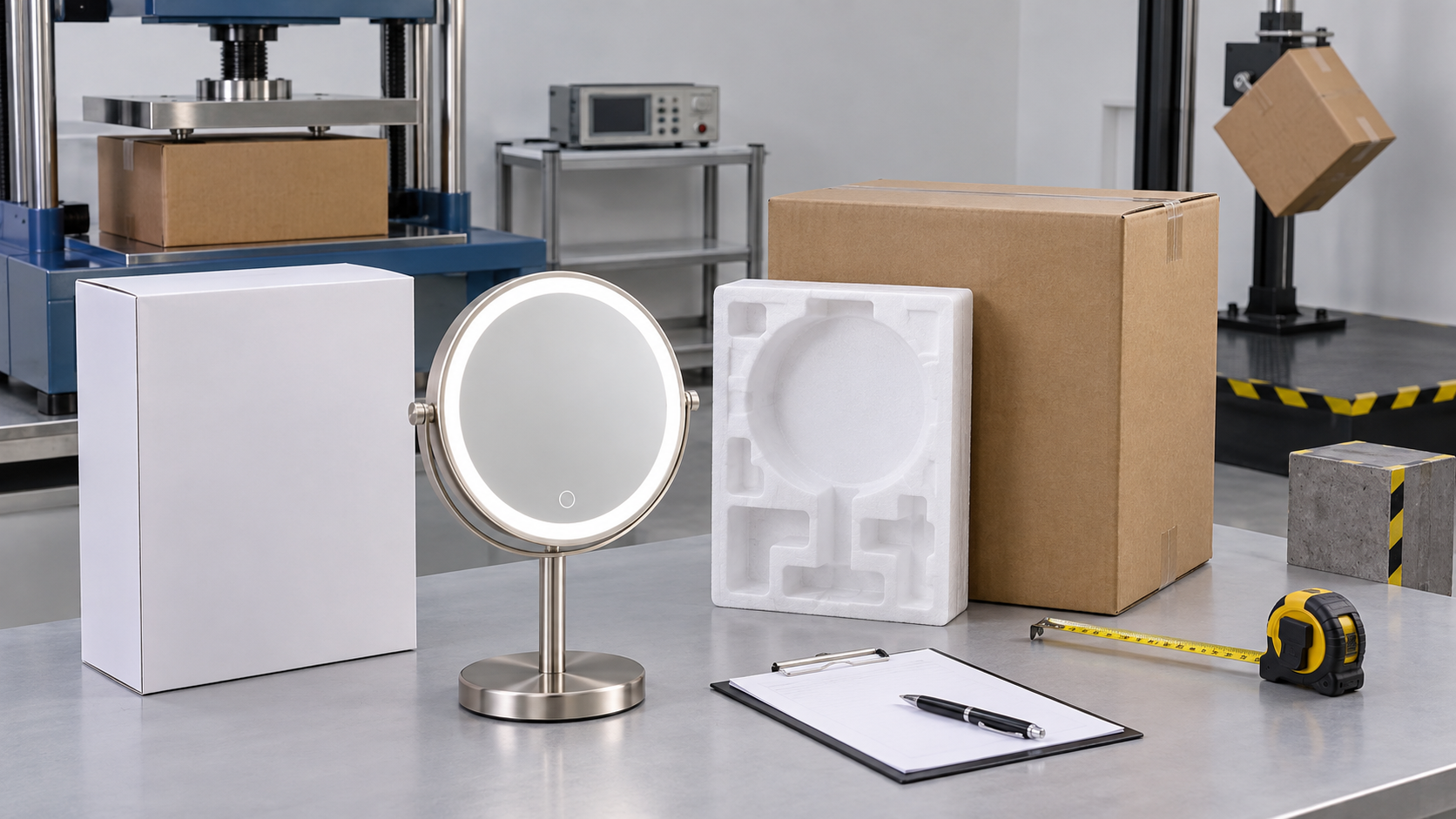
A practical pre-shipment packaging test plan can include:
- Fit test: packed mirror should not rattle heavily inside the retail box.
- Shake test: accessories should remain in position and not scratch the mirror.
- Drop test: test the packed retail unit or master carton from agreed heights and orientations based on channel risk.
- Compression test: check carton stacking strength for warehouse and container handling.
- Label scan test: confirm barcode and carton mark can be scanned or read after packing.
- Carton opening audit: open sampled cartons and verify SKU, color, plug, cable, manual, and quantity.
- Photo record: keep photos of packed unit, inner insert, carton orientation, carton mark, and sealed carton.
Buyers should ask the supplier to include packaging test photos in the inspection report, not only product function photos. For rechargeable LED mirrors, buyers should also confirm that shipping documents, battery information, product labels, and packed configuration stay consistent with the destination market and logistics channel.
Record the Packed Configuration and Acceptance Decision
Record the SKU, product revision, retail-box and insert revisions, carton drawing, units per carton, measured outer dimensions, gross weight, sample quantity, and delivery route. Agree the test procedure, conditions, acceptance criteria, and reviewer before testing. Keep product function, cosmetic condition, box damage, and label readability as separate results; a photograph or shake check alone does not establish transit performance.
When comparing freight quotations, supply measured packed dimensions and weight to the forwarder and request the applicable chargeable-weight calculation. Compare the complete route, including any parcel overpack, rather than assuming that fewer cartons always cost less. After a failure, record the packaging change, retest evidence, approver, and release date before using that configuration for bulk packing.
Use the molded insert packaging checklist to approve cavity fit and the model-number control guide to link the product and packaging revisions.
Common Packaging Mistakes That Create Returns
The most common packaging mistake is approving the mirror and box separately without testing the complete packed unit. A box may look good in artwork, but if the cavity is too loose, the mirror can move during courier delivery and scratch the reflective surface.
Another mistake is using one master carton plan for every sales channel. A wholesale carton going to a distributor warehouse may be acceptable for palletized handling, while the same packed unit may fail parcel delivery if the retail box has too much empty space or the mirror stand is not locked.
Buyers also need to control label logic. If the retail box, barcode, manual, and carton mark use different product names or model numbers, the warehouse may receive the order incorrectly. This is especially risky for private-label LED makeup mirrors with similar appearances but different magnification, finish, light color, plug, or charging port.
Finally, do not reduce packaging material only by cost. Lighter packaging can be useful when it reduces dimensional weight and waste, but it should not remove the insert or support needed to protect the LED ring, mirror face, hinge, and base.
Pre-RFQ Packaging Information to Send the Supplier
Before requesting a quotation, send enough packaging information so the supplier can quote the right structure from the start. Mingda Mirror buyers usually get better answers when they provide:
- target sales channel: retail shelf, Amazon/e-commerce, distributor, gift program, salon, or project use
- mirror type, size, frame material, stand type, magnification, and power source
- target retail box style: white box, color box, gift box, mailer-ready box, or private-label packaging
- barcode or label requirements: UPC, EAN, FNSKU, buyer SKU, carton number, or channel label
- accessory list: USB-C cable, adapter, pouch, manual, cleaning cloth, spare parts, warranty card
- expected units per carton or maximum carton weight
- destination market and shipping method
- packaging test standard or buyer-specific drop/compression requirement
- whether the order needs printed artwork, custom insert, or master carton mark approval
When this information is missing, the first quote may use a standard package that does not match the buyer’s channel. That can lead to re-quotation, sample delay, tooling changes, or packaging cost surprises before shipment.
Review Delivery Damage Before Reordering
At the first receiving review, record the shipment lot, packaging revision, route, cartons received, units received and units actually inspected. Record cosmetic box damage, product damage and missing accessories separately. For customer deliveries, use delivered units in the same cohort and observation window; warehouse inspection findings and customer damage reports have different denominators.
Photograph the outer parcel, retail box, insert and affected product before repacking. Record whether the failure occurred in a master carton or an individual parcel, then use the e-commerce packaging test evidence checklist to define the next test. Assign an owner, due date and disposition for affected stock. Keep the original failure and retest result, and obtain release approval before applying a new insert or carton revision to a reorder.
Bottom-Line Recommendation
For LED makeup mirror sourcing, approve the product, retail box, and master carton as one packaging system. The best packaging is not simply the strongest or the cheapest. It is the structure that keeps the mirror stable, protects the LED and glass components, supports the sales channel, keeps labels scannable, controls freight cost, and allows warehouse teams to identify the SKU quickly.
If you are planning a private-label or wholesale LED makeup mirror order, ask for a packed sample, carton layout, accessory list, label plan, and packaging test evidence before approving mass production. This small step can prevent much larger costs from breakage, relabeling, delayed receiving, and avoidable customer returns.
FAQ
Should the retail box be tested before artwork is finalized?
Yes. Approve the box structure and insert fit before final printed artwork whenever possible. If the box size changes after artwork approval, barcode position, product photo, claim layout, and shipping cost may all need revision.
What is the best insert material for LED makeup mirrors?
There is no single best insert for every order. Compare molded pulp, EPE, EVA, and corrugated supports on the same complete packed configuration. Material name alone does not prove cushioning performance or an environmental benefit; request the relevant material specification and test evidence. The right choice depends on mirror weight, finish, channel, and target cost.
How many units should be packed in one master carton?
The answer depends on mirror size, retail box size, gross weight, carton strength, and delivery route. Buyers should set a maximum carton weight and test the packed carton rather than choosing the highest unit count only to reduce carton quantity.
Do Amazon or e-commerce sellers need different packaging?
Usually yes. E-commerce packaging must handle parcel movement, label scanning, and individual-unit damage risk. Retail packaging may focus more on shelf appearance, while e-commerce packaging should also control empty space, product movement, and barcode readability.
What should be included in a packaging approval photo set?
A useful approval set should show the mirror inside the insert, accessory positions, closed retail box, barcode area, retail boxes inside the master carton, carton mark, sealed carton, and packaging test photos. These photos help both buyer and supplier confirm the same packed configuration.
Work With Mingda Mirror
Mingda Mirror manufactures LED makeup mirrors, compact mirrors, handheld mirrors, Hollywood mirrors, and LED bathroom mirror products for brands, retailers, distributors, and project buyers. If you are preparing a new order, share your target channel, product size, packaging style, barcode needs, carton weight limit, and destination market.
Our team can help review the mirror specification, retail box, master carton, sample approval process, and pre-shipment QC plan before bulk production. Visit Makeup Mirrors, review our QC process, explore OEM/ODM services, or contact Mingda Mirror to request a packaging-ready quotation.
Request an itemized packaging quotation with your SKU, order quantity, channel, accessory list, carton weight limit, destination, and delivery date. Ask for tooling, samples, testing, unit packaging, and any parcel overpack to be priced separately.
Social Media Content Ideas
LinkedIn angle: explain why LED makeup mirror buyers should approve the retail box and master carton as separate specifications before bulk production.
Facebook angle: show how better packaging planning reduces damaged gift boxes, missing accessories, barcode problems, and avoidable customer returns.
Instagram angle: use the packaging approval image to highlight the complete mirror, insert, retail box, USB-C cable, pouch, and carton as one retail-ready system.
CTA: Read the full packaging checklist and send your target channel, carton limits, and private-label needs to Mingda Mirror for an RFQ-ready review.