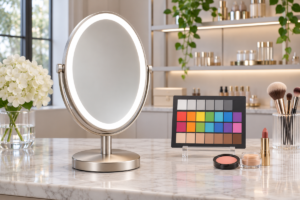

For a beauty brand or retailer, an LED makeup mirror’s CRI claim should be treated as an approval item, not a decorative line in a quotation. CRI (color rendering index) indicates how naturally colors appear under a light source compared with a reference. It matters because shoppers use makeup mirrors to judge foundation, blush, lipstick, and skin tone. The buyer decision is simple: specify the claim, ask how it is supported, then approve the actual light appearance on the production-intent sample—not only on a supplier presentation.
Why CRI affects a mirror program
High brightness and a selectable CCT do not automatically mean faithful color appearance. Two lighted mirrors can look similarly bright while rendering red, nude, or neutral makeup shades differently. A mismatch becomes a commercial problem when a premium retail box or marketplace listing promises a natural makeup-use experience but the delivered product makes colors look flat, cool, or distorted.
CRI is only one part of the decision. Buyers should judge it with CCT consistency, diffuser quality, brightness range, dimming and memory-function behavior, and the intended use distance. But it gives product teams a precise way to move beyond vague words such as “natural light.”
What to request in the RFQ
Use a claim that your team can verify. If a target CRI is important to the brand, place it in the product specification together with the light mode, measurement condition, and sample-approval requirement. Do not convert a marketing preference into an unconditional promise without confirming component availability, cost impact, and tolerances.
| RFQ item | Buyer question | Commercial reason |
|---|---|---|
| CRI target | What nominal CRI is proposed for each light mode? | Links the claim to the component specification |
| CCT modes | Which CCT values or ranges apply at warm, neutral, and cool settings? | A high CRI claim is not useful if modes visibly shift |
| Test evidence | What supplier or component documentation supports the claim? | Creates an auditable sample file |
| Visual approval | Can the buyer compare neutral and cosmetic swatches under the sample? | Confirms the user-facing appearance |
| Production control | Will the same approved LED and diffuser specification be used in mass production? | Reduces reorder drift |
| Listing language | Which words may appear on packaging and online listings? | Prevents unsupported marketplace claims |
A practical sample-approval method
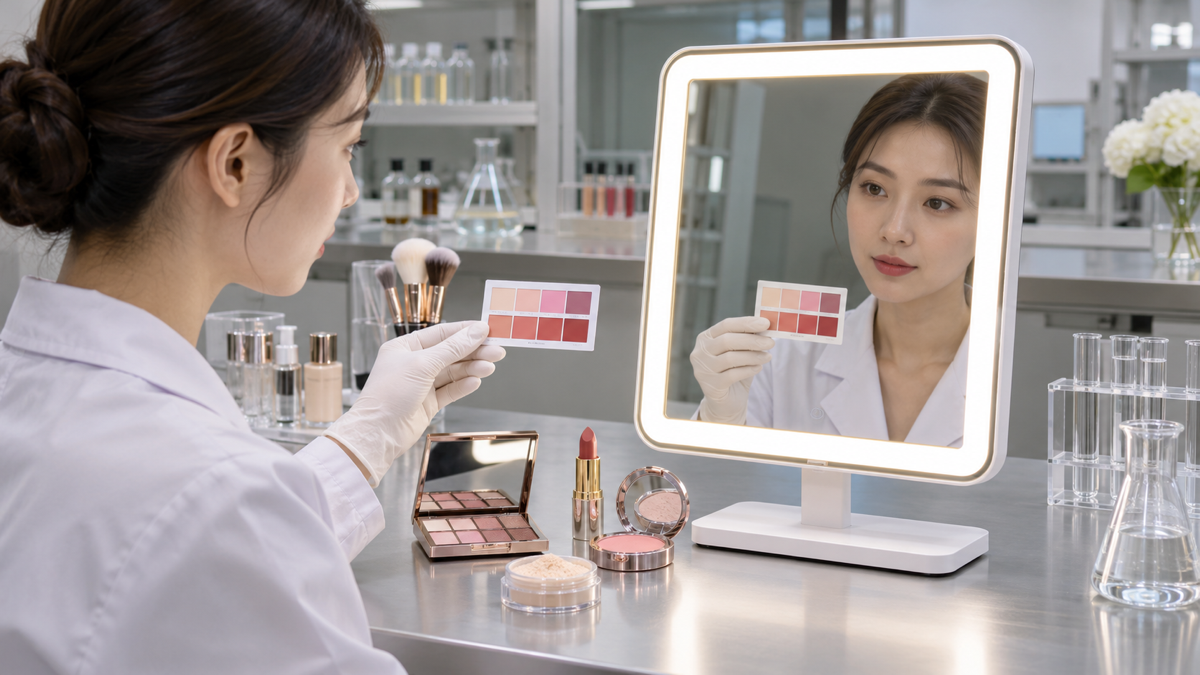
Ask to view the complete mirror after warm-up in the same power condition customers will use. Use a neutral white/gray reference and a small set of representative cosmetic shades. Compare the appearance at each requested CCT setting and at normal, mid, and low brightness. The objective is not to replace an accredited laboratory test; it is to confirm that the agreed claim corresponds to a repeatable product experience.
Check more than one lighting mode
Many retail mirrors offer three color temperatures. The approval record should identify which modes are claimed for makeup use and whether the chosen LED and diffuser combination maintains a consistent visual result. A sample that looks convincing at full brightness can be less satisfactory at the dimmer setting used near a bedside or during travel.
Tie visual approval to component control
Ask the factory to keep the approved LED, driver, diffuser, and light-frame construction in the sample record. If substitution is proposed, require buyer review before production. This is especially important for private-label programs where a product may be reordered months later.
Channel-by-channel decision matrix
| Sales channel | Priority | Recommended control |
|---|---|---|
| Prestige beauty retail | skin-tone and makeup-shade appearance | documented golden sample plus visual swatch approval |
| Amazon and e-commerce | listing accuracy and review-risk reduction | normal-exposure photo/video matched to the approved sample |
| Gift and travel compact | practical appearance at battery-powered brightness | check charged-battery and charging modes, not only bench power |
| Distributor program | repeatable reorders across markets | component lock and a clear substitution-approval route |
Common mistakes buyers should avoid
- Using “daylight” as the whole specification. Daylight is not a complete definition of CCT, CRI, brightness, or color consistency.
- Approving only a rendered image. A photo can be white-balanced or overexposed; review the physical sample or a controlled remote comparison.
- Ignoring low-dimming performance. The visual effect can change at reduced output, particularly on compact rechargeable mirrors.
- Making unverified product claims. Marketing teams should use only wording supported by the agreed product file and sample evidence.
- Treating CRI as separate from the mirror build. Diffusion, LED selection, driver stability, and light-frame geometry all influence what the buyer sees.
Pre-order checklist
- State the target market, mirror form, light modes, brightness controls, and power mode.
- Request the proposed CRI claim and related component evidence before the PP sample.
- Compare neutral and cosmetic color references under each intended CCT mode.
- Confirm the LED, diffuser, driver, and light-frame construction on the approval sheet.
- Agree how substitutions, pilot-run deviations, and reorder changes will be handled.
- Align packaging, manual, and online claims with the approved evidence.
Bottom line
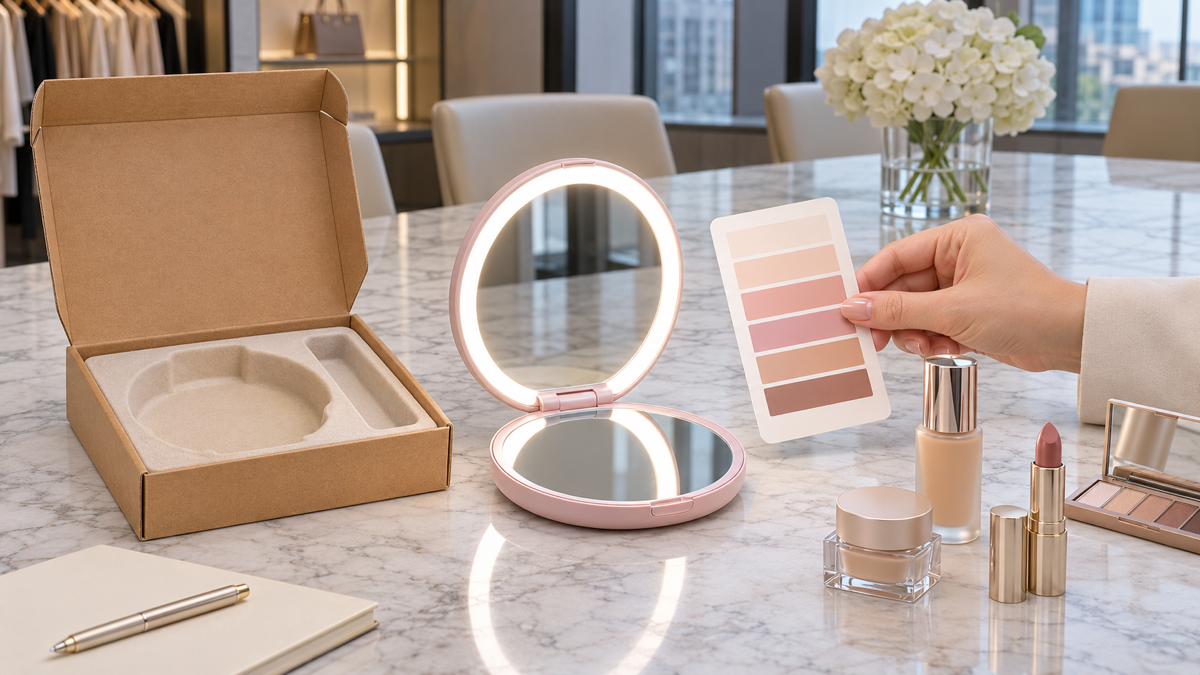
Specify CRI as part of a complete makeup-use lighting brief, then approve the result on a production-intent sample with realistic color references. For most buyers, the best control is a traceable sample file that combines the stated claim, the relevant CCT modes, visual approval, and a no-substitution rule without approval. That protects both the product experience and the accuracy of your retail claims.
Mingda Mirror can help translate a retail lighting brief into an RFQ-ready sample checklist for LED tabletop, compact, and Hollywood mirror programs. Explore our LED makeup mirror range or contact our manufacturing team with your target channel, size, light modes, and order plan.
FAQ
Is a high CRI number enough for a beauty mirror?
No. It should be assessed with CCT, brightness, dimming performance, diffusion, glare, and the actual cosmetic-use appearance of the approved sample.
Should retailers put a CRI claim on the product page?
Only when the claim is supported by the product specification and supplier evidence. Keep the wording aligned with the approved sample and avoid broader performance promises.
What should be retained for a reorder?
Retain the signed sample record, component specification, claim wording, images or controlled visual checks, and the agreed substitution-approval route.
Social Media Content Ideas
- LinkedIn: A CRI number is a starting point, not a buyer approval. Share the RFQ table and link to the full guide.
- Facebook: Explain why a natural-looking makeup result needs more than a “daylight” label.
- Instagram: Use the color-swatch sample image with the rule: approve color appearance at every intended light mode.