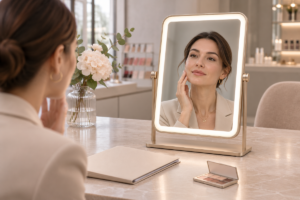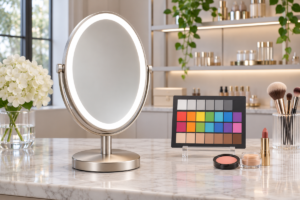

For beauty brands, retailers, and e-commerce sellers, glare control should be approved as a product-performance requirement—not left to a product photo. An LED makeup mirror can have attractive brightness and multiple color temperatures yet still create a harsh reflected LED line, an uneven halo, or uncomfortable eye glare at normal makeup distance. The practical buying rule is: approve the illuminated mirror at its intended viewing distance, at each selling brightness level, and in the final frame, diffuser, and power configuration. This turns “soft light” from a vague marketing phrase into a repeatable sample and production requirement.
Why glare is a commercial issue, not only a lighting detail
Makeup users look toward the light source while examining skin tone and fine detail. If the diffuser produces hotspots, visible LED points, or reflected streaks, the customer experience can feel lower-grade even when the mirror is mechanically sound. That can mean negative reviews, avoidable marketplace returns, or a retail presentation that does not match the premium positioning of the packaging.
For a buyer, the relevant question is not simply whether the lamp is bright. It is whether the complete mirror delivers comfortable, even, useful light for the intended use: close-up tabletop makeup, a travel compact, a salon counter, or a Hollywood-style vanity. The answer depends on the LED layout, diffuser material and thickness, light-chamber depth, frame finish, mirror angle, dimming curve, and ambient room lighting.
The specification points that should appear in an RFQ
Ask the supplier to identify the lighting construction early. A quotation that lists only “LED light” and a color-temperature range leaves too much room for a visually different mass-production result. The table below gives procurement teams a concise way to make the approval brief testable.
| Approval item | What to define | Why it matters |
|---|---|---|
| Viewing distance | Typical user distance and mirror angle | Glare can be acceptable at a bench test but distracting at close makeup distance |
| Diffuser appearance | No visible LED points, bright bands, or dark gaps at normal use | Sets a visible acceptance standard instead of a generic “soft light” claim |
| Brightness range | Low, normal, and maximum output to review | A diffuser can look even at full power and uneven after dimming |
| CCT modes | Which warm, neutral, and cool modes will be sold | Surface glare and cosmetic appearance change with CCT |
| Frame and light chamber | Approved frame finish, lens profile, and internal construction | Small substitutions can change reflection and light uniformity |
| Sample record | Golden sample, photos/video, and agreed rejection examples | Gives reorders and factory QC a common visual reference |
Diffuser choices: what buyers are really comparing
The diffuser is not a stand-alone part. It works with the distance from LED to lens, LED density, reflective cavity, and frame profile. Still, buyers should understand the broad tradeoff before approving a sample.
| Construction approach | Buyer advantage | Buyer risk to control | Best fit |
|---|---|---|---|
| Clear or lightly frosted lens | High apparent brightness | Individual LED points or hard reflections may remain visible | Utility-focused mirrors only when output is carefully controlled |
| Opal/frosted diffuser with adequate light chamber | Softer, more even appearance | Can reduce perceived output if LEDs and optics are not specified together | Premium tabletop, compact, and beauty-retail mirrors |
| Deep recessed light channel | Better shielding from direct view of LEDs | Deeper frame can affect product thickness, carton size, and cost | Tabletop and Hollywood formats where comfort is a priority |
| Edge-lit optical construction | Slim visual profile | Requires consistent materials and assembly to avoid edge brightening | Compact and thin-format programs after production-intent testing |
Do not select a lens just by looking at a component swatch. Ask to see the complete, powered mirror in its intended orientation. If the product will be photographed for an Amazon listing, also review how the illuminated ring appears in normal product photography so the listing does not over-promise a smooth glow that the delivered item cannot reproduce.
A buyer-friendly sample approval method
Test the mirror in a realistic use position
Place the sample where a customer would actually use it. For a tabletop model, test both upright and tilted positions. For a compact, test the viewing angle in the hand. Observe the light with the room lighting on and reduced, since a ring that appears smooth in a bright office can reveal hotspots in a bedroom, dressing area, or travel setting.
Review every sellable setting
Run warm, neutral, and cool modes if they are part of the offer. Then check maximum, normal, and low dimming levels. Confirm that the product switches cleanly and that the light remains comfortable after warm-up. If a memory function restores a previous setting, verify that the approved setting is not unexpectedly harsh on restart.
Define visible failure modes before production
Agree what triggers rework or rejection: visible individual LED dots, a dark section in the ring, a pronounced seam, flicker, glare that makes the user squint, or a lens seated unevenly in the frame. A short approval note with photos of the accepted sample is more actionable for incoming inspection than an email saying “please make the light soft.”
Common sourcing mistakes that create glare complaints
- Approving from renderings or one supplier photo. Exposure and retouching can hide hotspots and reflection lines.
- Testing only at full brightness. Unevenness may be more visible at low dimming levels or on battery power.
- Separating optics from the mechanical sample. A different bezel, diffuser fit, or internal reflective surface can alter the result.
- Treating “no glare” as an absolute claim. Specify the viewing condition and acceptable visual standard instead of making an untestable promise.
- Changing components after the golden sample without review. A diffuser, LED strip, or driver substitution can change appearance even when the stated wattage is unchanged.
- Ignoring packaging and handling. Lens pressure marks, a loose frame, or a shifted light ring after transport can create a complaint that was not present at sample approval.
QC, packaging, and reorder controls
For private-label programs, include the lighting approval in the product control plan. The factory can check a defined percentage of units at the agreed distance and output settings, while the buyer retains a signed sample file with the approved construction. This is especially useful when reorders are made months later or components face supply changes.
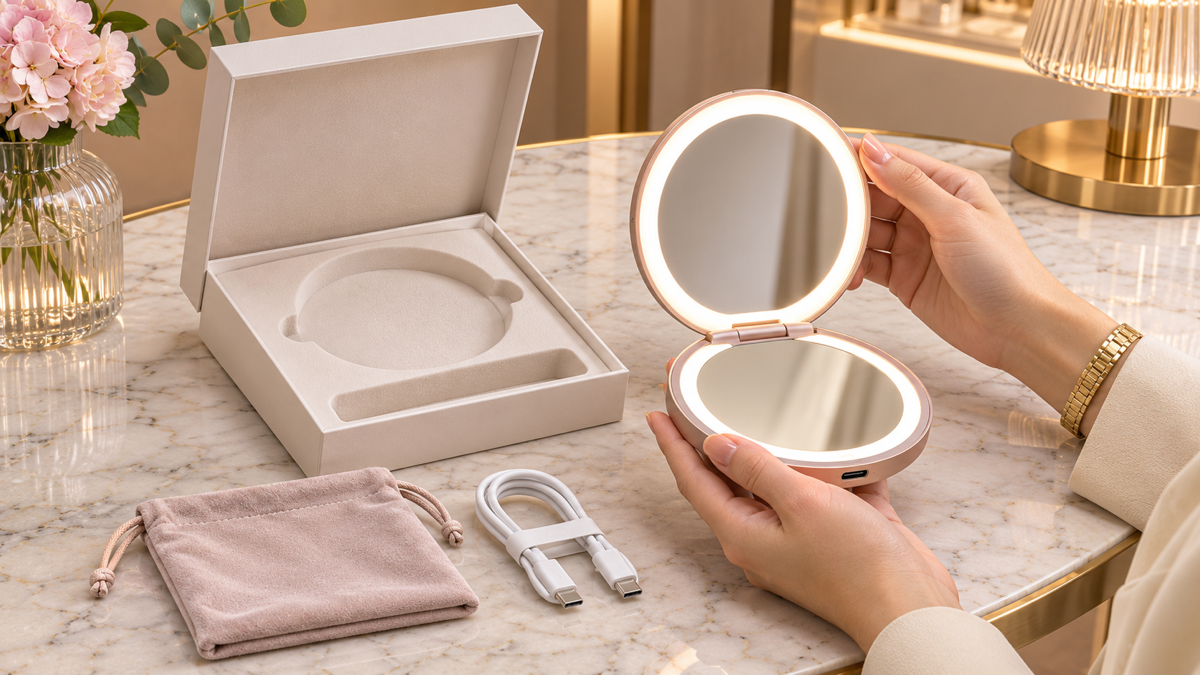
Packaging deserves a linked check. The inner tray should keep the mirror, hinge, and light frame from moving under normal transport. Confirm the illumination again after a packaging trial or transport simulation, especially for compact mirrors and slim tabletop models. For retail programs, request an unbranded final-packout sample before releasing printed artwork; it confirms the product presentation, USB cable placement where applicable, and product protection together.
MOQ, target price, and lead time can affect optical decisions. Instead of asking a supplier to make a blanket “best diffuser,” state the target sales channel and price position, then compare two production-intent options if needed. A slightly deeper light chamber or a more uniform diffuser may add material or assembly cost, but can be more economical than return handling and weak reviews for a premium line.
Pre-RFQ checklist for LED makeup mirror glare control
- Identify the mirror type, target customer, primary use distance, and intended sales channel.
- State which CCT modes, dimming levels, power condition, and memory behavior the buyer will review.
- Ask for the complete illuminated mirror sample, not a diffuser coupon or edited image alone.
- Record acceptable appearance at normal use: no visible LED points, obvious bright bands, dark gaps, or distracting reflected lines.
- Confirm the approved diffuser, light chamber, LED layout, frame, driver, and any no-substitution rule.
- Recheck the light after packaging validation and before bulk shipment.
- Retain photos/video of the golden sample and a clear route for handling production deviations.
Bottom line
The best LED makeup mirror diffuser is the one that delivers comfortable, even light in the buyer’s real use condition and can be repeated in production. Approve the whole illuminated assembly—not a marketing claim or isolated lens sample—across the settings customers can select. For beauty retail and e-commerce, that single discipline helps protect product positioning, listing accuracy, and return rates.
Mingda Mirror can turn your desired light appearance into an RFQ-ready sample and inspection brief for LED tabletop, compact, and Hollywood mirror programs. Browse our LED makeup mirror range, see our quality-control process, or contact our manufacturing team with your target channel, mirror size, light settings, and order plan.
FAQ
How can a buyer measure glare on a makeup mirror?
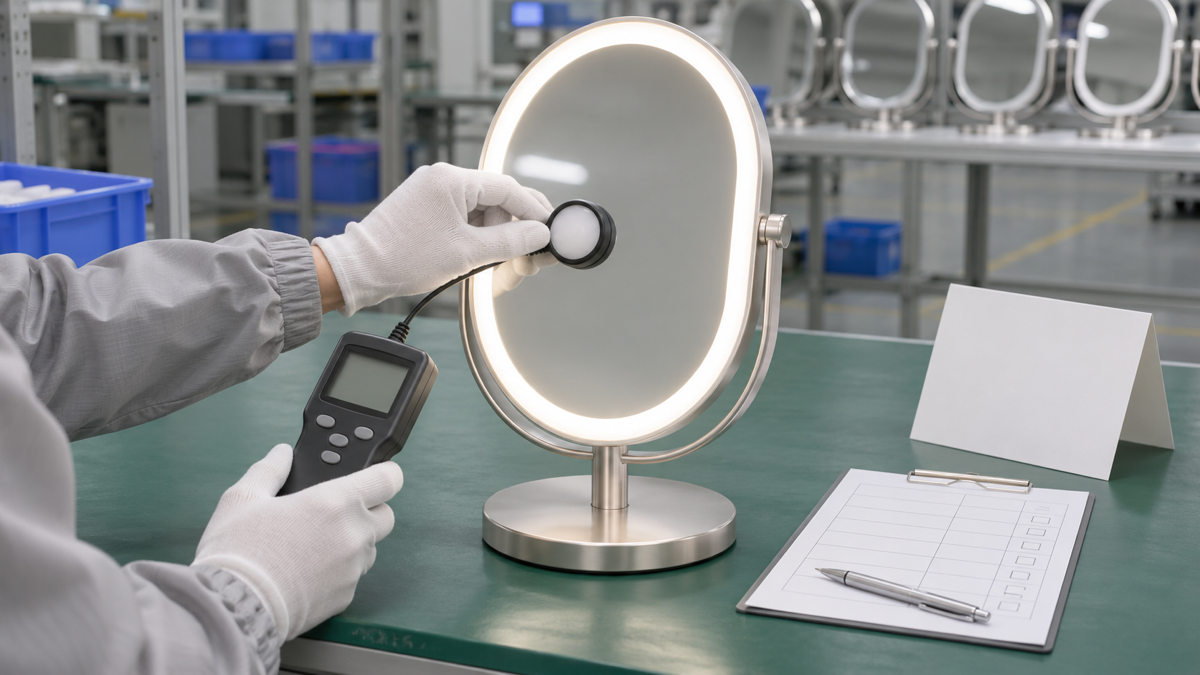
A light meter can support a factory check, but the commercial acceptance decision should also include a visual review at the normal user distance, mirror angle, and sellable brightness settings. The goal is an agreed, repeatable appearance—not an isolated number.
Does a thicker diffuser always make an LED makeup mirror better?
No. It may improve point-source masking but can reduce perceived output or change the product profile. Evaluate the diffuser with LED density, light-chamber depth, power target, and the intended retail position.
What should a private-label buyer retain after sample approval?
Retain the golden sample record, product photos or controlled video, component list, visual acceptance points, packaging approval, and any substitution-approval requirement. These controls make reorders more consistent.
Social Media Content Ideas
- LinkedIn: “Soft light” is not an RFQ specification. Share the six approval items and direct sourcing teams to the full guide.
- Facebook: Explain why shoppers can see glare problems that product photos hide, then link to the sample-approval method.
- Instagram: Use the full tabletop mirror cover with the caption: “Approve the complete illuminated mirror at real use distance—not only a diffuser swatch.”