
By the Mingda Mirror manufacturing team — makeup mirror manufacturers since 2006 · Last updated October 2026 · 8-minute read
The most useful way to control common quality problems in makeup and handheld mirrors is to agree on a model-specific defect guide before bulk production. Define what inspectors should see, how they should operate the product, which defects stop shipment, and how a failed lot will be handled. A signed sample alone cannot answer those questions.
For brand owners, importers and retailers, the immediate decision is not whether a sample looks attractive: it is whether the next production lot will be accepted consistently by both buyer and supplier. The checks below cover illuminated tabletop and handheld formats; apply electrical checks only to powered models.
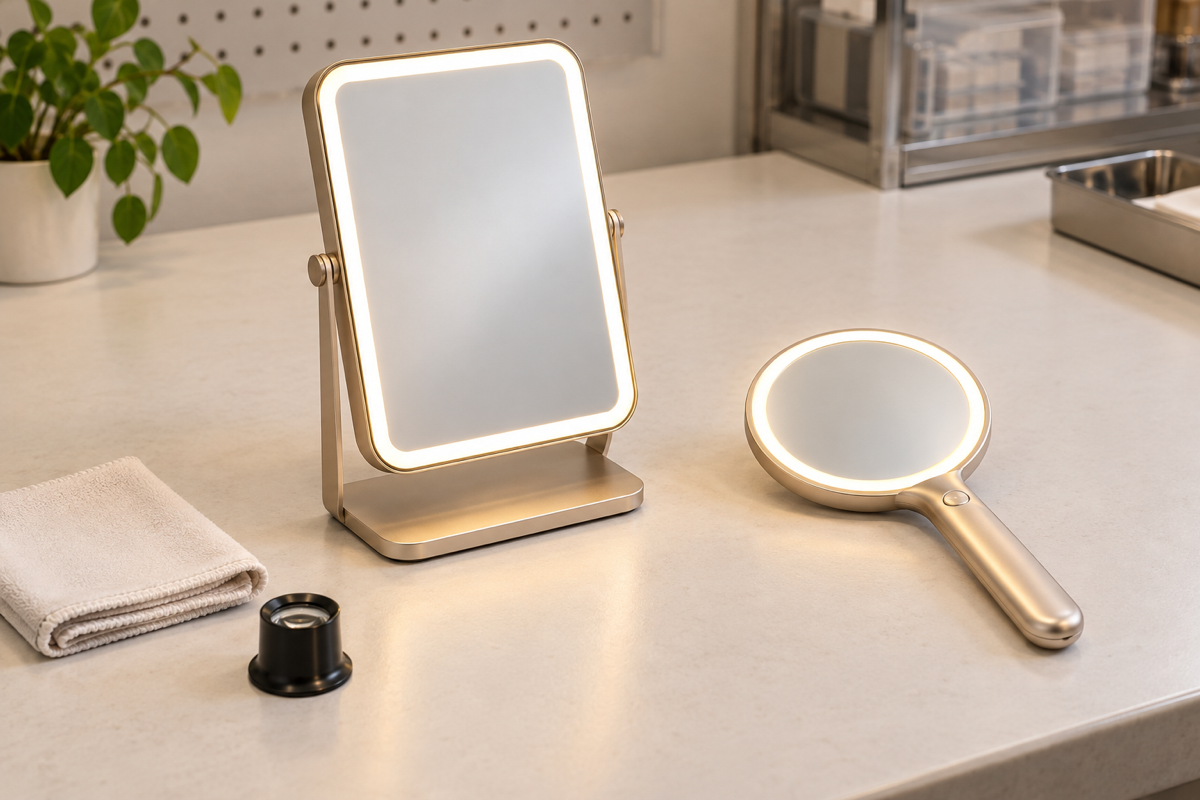
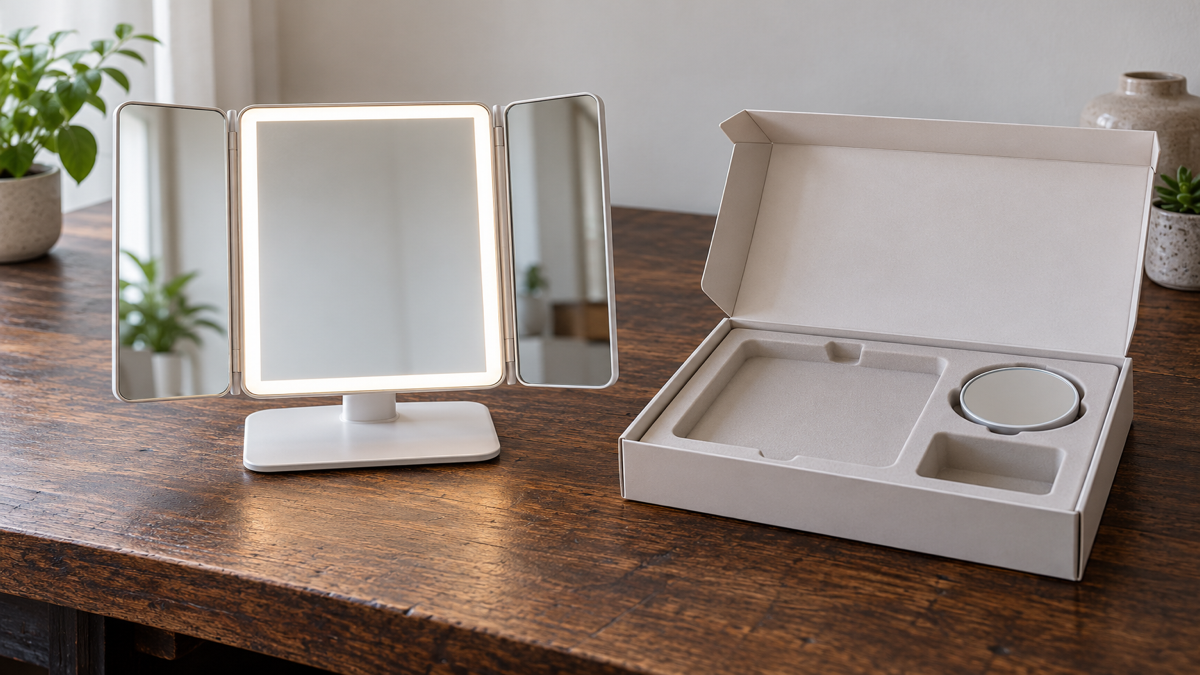
*Images are conceptual illustrations, not photographs of a specific Mingda product or inspection.*
Which mirror defects should buyers prioritize?
| Risk area | Example problem | Buyer check | Evidence to retain |
|---|---|---|---|
| Mirror and glass | Scratch, edge chip, spot or distorted reflection | Inspect the agreed viewing zone under specified light and distance; compare with signed boundary samples | Photos with position, size and inspection conditions |
| Handle, frame and stand | Loose handle, sharp edge, unstable base or assembly gap | Operate as intended and compare fit and finish against approved sample | Model revision, test method and observations |
| Hinge or pivot | Excessive play, slipping or stiffness | Move through the intended range and verify it holds its intended positions | Agreed cycle test and before/after results |
| Lighting and controls | Flicker, dead LEDs, uneven output or intermittent touch control | Run each mode, including dimming where fitted, against approved reference | Mode, power condition and repeatable failure |
| Power and accessories | Charging failure, wrong cable, missing manual or damaged connector | Verify the approved power configuration and pack-out; use only approved test equipment | Cable/model revision, function result and packing count |
| Packaging | Cracked glass, scuffed finish or loose contents after transport | Review the complete packed configuration and agreed distribution test | Test protocol, photos and post-test product condition |
This is a risk map, not a universal grading standard. A cosmetic mark may be minor or unacceptable depending on its location, size and the agreed specification; exposed hazardous edges or electrical safety concerns need immediate escalation, not a cosmetic allowance.
How to turn appearance complaints into measurable criteria
Separate the active reflection area from the rim, rear housing and hidden assembly surfaces. For each zone, agree the light source, viewing distance, viewing angle, inspection time and permitted defect size and number. Compare a production sample with an approved reference under the same conditions. Remove temporary protective film only according to the inspection procedure; do not mistake dust on film for a permanent defect.
Use a marked photograph or physical boundary sample for difficult cases such as pinpoints, scratches and finish variation. Record whether the defect is visible during normal use and whether it interferes with reflection. For more detail, see the glass inspection guide. Do not promise a distortion-free or scratch-proof product unless the model has an agreed, supportable specification.
Check construction and function as a complete product
Handheld mirrors
Check that the handle, frame and glass assembly are secure and that the edge feels safe in normal handling. If the design folds or rotates, examine both closed and open positions. A double-sided unit should be checked on both faces and at the joint. Agree a representative handling test with the supplier rather than applying an arbitrary force or cycle count across all models.
Tabletop and illuminated mirrors
Place the assembled mirror on the intended level surface, adjust it through the intended range and check stability and position retention. Test the LEDs and controls using the approved power setup; repeat intermittent faults rather than relying on a single press. Hinge wear and stand stability deserve separate methods: see the hinge cycle test guide and light uniformity guide.
For rechargeable models, agree the cable, input, charging indication and safety-document scope for the exact revision and destination. A functioning light alone does not establish electrical compliance or battery transport eligibility.
Agree defect grades and lot decisions before inspection
An effective defect list states the condition, test method, applicable model and the action required. A practical starting point is to discuss critical, major and minor categories, but the parties must approve the actual classification for their product and market. For example, a non-functioning switch may be major; a cosmetic scratch outside a specified visible zone may be minor; an unsafe exposed edge may require a stop and investigation. These examples are not a substitute for a safety assessment.
Define the lot, sampling method, inspection level, acceptance and rejection numbers, and who can approve exceptions. The American Society for Quality explains acceptance sampling and AQL: an AQL is not a promise that a particular shipment contains no defects. Sampling can miss defects, so agree any 100% checks or additional testing separately and document who performs them.
What happens when a lot fails?
1. Hold the affected lot and identify the model, color, batch and quantity; do not silently mix it with accepted stock. 2. Record representative photographs, measured results, test setup and the number found, including any uncertainty in diagnosis. 3. Ask the supplier for containment and root-cause evidence, then agree whether sorting, repair, replacement or rejection is permitted. 4. Define the reinspection scope, acceptance criteria, responsible party and costs before release. Verify the correction has not introduced a new defect. 5. Retain the approved reference, inspection report and change history for the reorder; changes to components, factory or packing configuration should trigger review.
Read the pre-production sample approval checklist alongside this guide: the signed sample and the written defect boundary should describe the same revision.
RFQ-ready quality checklist
Send the supplier the product type and model, target markets, forecast and lot size, intended use, required functions and approved product configuration. Attach expected appearance zones and boundary samples, critical safety concerns, desired inspection and sampling approach, packaging route, and the report format. Ask for the cost and lead-time impact of your proposed checks, who owns test equipment and whether independent inspection is allowed. Confirm the written remedies and reinspection process before paying for production.
FAQ for mirror buyers
Can one defect standard cover every mirror?
Use a shared framework, but specify separate requirements for handheld and tabletop structures, powered functions, finishes and packaging. A single generic checklist cannot describe all model-specific risks.
Is an approved sample enough to prevent defects?
No. Keep the sample as a reference and pair it with written tolerances, boundary examples, production checks and a documented lot-acceptance plan.
What should happen if an inspector finds a safety concern?
Hold affected product and promptly escalate to the buyer and responsible technical team. Determine the applicable legal and safety requirements for the exact product and market before deciding disposition.
Does AQL guarantee a defect-free shipment?
No. It is a parameter in an acceptance sampling scheme, not a guarantee of zero defects in an individual lot. The full plan and any additional testing must be agreed.
Will stricter inspection change MOQ or lead time?
It can change cost and timing, especially when special fixtures, destructive tests or independent inspectors are needed. Request a model-specific quotation; do not assume a standard MOQ, lead time or test capability.
Bottom line: make the acceptance boundary visible
Buyers should approve a complete mirror and packaging sample, then translate the highest-risk defects into an agreed inspection method, classification and lot decision. This gives the buyer and supplier a common basis for resolving a failure before goods leave the factory.
Planning a makeup or handheld mirror order? Explore Mingda’s mirror products and contact the team with your model, destination, quantity, target use, packaging route and draft defect criteria. Ask for a model-specific quotation and inspection proposal.