
For a retail, Amazon or wholesale mirror range, choose features by how the product will be discovered, shipped and supported—not by adding every available option. A store needs a stable display and a clear benefit at a glance; an e-commerce listing needs honest specifications and parcel-ready packaging; a distributor needs repeatable SKUs and dependable replenishment. Start with one core LED makeup mirror, then add magnification, portability or a larger Hollywood format only where the channel can explain and support the difference. Confirm actual demand with your own sell-through and return data before calling any feature a bestseller.
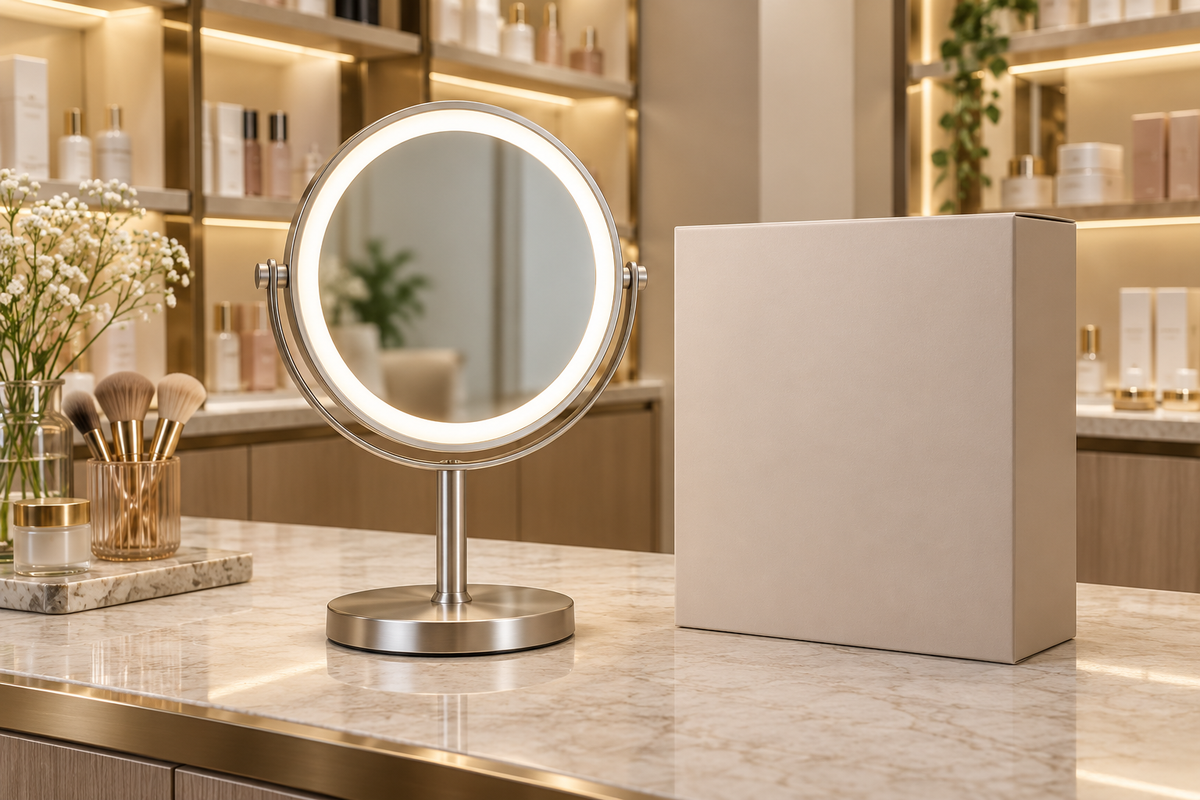
*Images in this article are conceptual illustrations, not photographs of a specific Mingda product.*
Which mirror features suit each sales channel?
| Buying decision | Retail store | Amazon and other e-commerce | Wholesale / distribution |
|---|---|---|---|
| Starting format | Stable tabletop LED mirror with an easy-to-understand light control | Compact rechargeable tabletop or folding design, if parcel dimensions and landed costs work | A core tabletop model plus a distinct handheld or Hollywood option for different accounts |
| Lighting | Comfortable, even illumination visible on display | Demonstrable brightness and color modes; accurately documented in the listing | Consistent specification across repeat lots and destination markets |
| Magnification | Normal view plus a clearly identified magnifying option | Show the magnification and intended viewing distance accurately | Standardize a small number of variants to reduce SKU complexity |
| Packaging | Shelf-ready, protected and easy to identify | Individually protected for the actual fulfillment route; verify platform requirements | Carton labels, case packs and mixed-order rules agreed before quotation |
| Main risk | A display that wobbles or is difficult to demonstrate | Damage, misleading images or charging-related returns | Substitution or specification drift between orders |
These are starting hypotheses, not sales rankings. Test a limited range with each channel’s customers and compare contribution margin, conversion, damage and returns before adding variants.
Retail: make the benefit visible in seconds
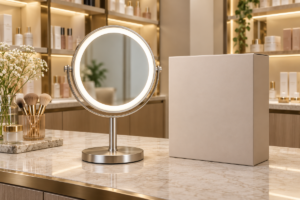
A beauty retailer has limited shelf space. Start with a tabletop LED makeup mirror that stands securely, offers a useful viewing area and has controls a shopper can understand without a demonstration. A retailer selling premium vanity furniture may instead need a complete Hollywood mirror with clear bulb layout and suitable tabletop or wall mounting.
Ask for an operating display sample and the actual retail box. Check whether the product remains stable when the touch control is pressed, whether the box communicates size and power source, and whether a shopper can distinguish standard and magnified views. Plan cable routing and access to a power outlet for a display; a rechargeable display also needs a charging routine. Agree whether display samples and replacement parts are included in the quote.
Lighting and magnification tradeoffs
Specify color temperature (CCT), color rendering index (CRI), brightness and dimming method for the actual model. Compare samples under the retailer’s ambient lighting, checking diffusion and glare as well as light output. A selectable color mode can be useful, but only if the control and packaging make its purpose clear. Avoid treating a high LED count as proof of comfortable or uniform light.
For magnification, a normal-view mirror serves broad everyday use. A separate magnified surface or attachment can help detailed work, but strong magnification reduces the usable viewing distance and field of view. Ask for the magnification, lens size, working-distance guidance and attachment method in writing; compare actual samples rather than relying on a number alone.
E-commerce: sell the product customers will actually receive
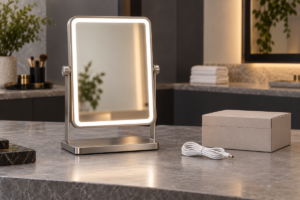
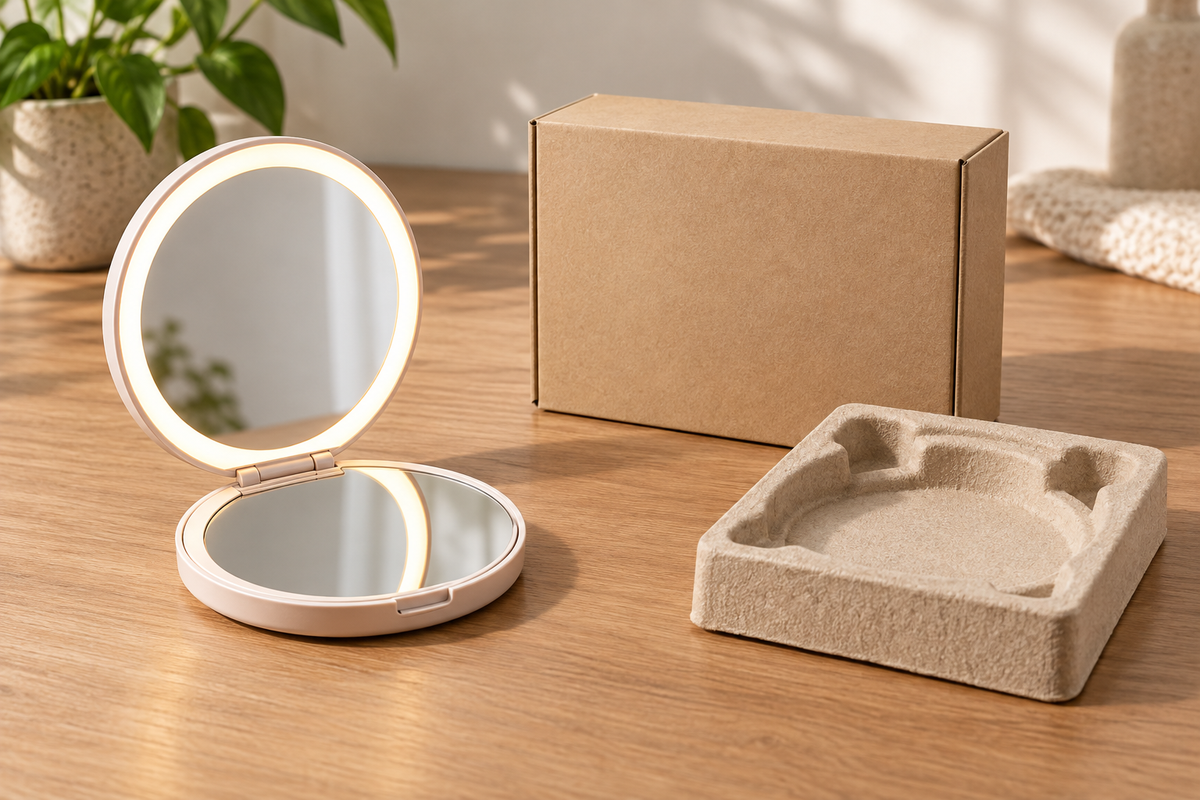
Online shoppers cannot test the mirror before buying. Show the complete product, base or hinge, charging connection, included accessories and dimensions. Describe whether it works while charging only after testing the specific model. Avoid implying that all USB cables, adapters or replaceable batteries are included. Check charging behavior, run time under a defined brightness setting, and travel-lock function if offered; document test conditions rather than promising a universal battery life.
An e-commerce buyer should request the individual retail pack, shipping configuration and sample images together. Test the complete packed unit on the intended route and inspect glass, frame, hinge and lighting after handling. Amazon’s fragile-product preparation guidance describes protective packaging, while the seller must confirm the current marketplace and product-specific instructions in its own shipment workflow. A retail box alone should not be assumed sufficient for every parcel route.
Map common return reasons to a corrective action: inaccurate size expectation calls for better dimensional images; a loose hinge calls for an agreed mechanical acceptance check; damaged glass calls for packaging validation. Track the rate by SKU and lot so that a packaging change is not confused with a product change.
Wholesale: reduce variation without making every SKU identical
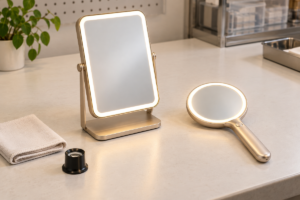
A distributor often serves different price points and replenishes over several orders. Build a small assortment with a clear role for each SKU: for example, one compact illuminated handheld or folding mirror for travel, one tabletop LED model for everyday beauty, and one larger Hollywood format for vanity projects. Confirm the actual models and capabilities with the supplier; these examples are not a claim that every configuration is available.
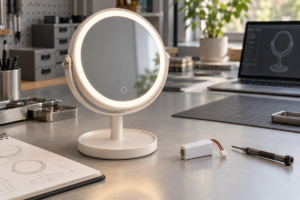
Specify finish, mirror size, magnification, light settings, power input, accessories and packaging revision by SKU. For plug-in products, confirm destination-market plug and electrical documentation with a qualified compliance adviser. For rechargeable models, check the battery and transport documentation required for the product and route. Keep a signed reference sample and written change-notification process for components, packaging and labeling.
Compare MOQ and price at the SKU and total-order levels. Ask whether color variants or mixed cartons change the MOQ, lead time or unit cost. Agree what happens when an approved component becomes unavailable: no substitution should be assumed acceptable without review and approval. For customization options, consult Mingda’s services.
A practical channel test before placing a bulk order
1. Define the customer and price position. Give the supplier the sales channel, destination, target retail price and projected first order; separate a forecast from a purchase commitment. 2. Select two differentiated samples. Compare a core model and one meaningful alternative, such as a folding rechargeable model versus a plug-in tabletop model. Record size, magnification and lighting settings. 3. Test the complete experience. Check stability, controls, reflection, lighting comfort, charging or plug compatibility, included accessories and instructions. Record conditions and acceptance limits before judging results. 4. Validate the pack and economics. Measure the packed dimensions and weight, test the actual shipping configuration and calculate landed cost, fulfillment fees, damage allowance and expected margin. 5. Approve a production reference. Sign off the product, packaging artwork, accessories, labeling and inspection criteria. Set the delivery schedule, replacement process and change-approval contact in the purchase agreement.
What should a buyer include in an RFQ?
Send the destination market, sales channel, model or reference photo, target quantity and timing. Include preferred mirror dimensions, tabletop or wall placement, lighting and magnification, power source, plug or charging accessories, finish, logo, retail box and shipping configuration. Ask for a quotation that separates tooling or artwork charges, sample cost, MOQ by variant, lead time, test documentation and available after-sales arrangements. Request written confirmation of which specifications and services apply to the quoted model.
Frequently asked questions
Are rechargeable mirrors always better for online sales?
No. Rechargeable models remove the need for an outlet during use, but add battery, charging, transport and support considerations. Compare a sample with a plug-in alternative against the customer’s use case, landed cost and applicable route requirements.
Should a retailer offer high magnification on every mirror?
Not necessarily. Normal view is useful for general application; higher magnification can serve detail work but has a narrower field and shorter working distance. Label the option clearly and validate the actual sample with target shoppers.
How many mirror SKUs should a distributor launch?
There is no universal number. Begin with distinct customer needs and the minimum assortment your accounts can support, then expand using sell-through, margin and returns. Confirm mixed-order and replenishment terms before committing to variants.
Does a protective retail box satisfy every marketplace requirement?
No. Requirements depend on the marketplace, product and fulfillment route. Review current platform instructions and validate the complete packed product for the planned shipment.
Bottom line
Choose features that solve a channel-specific buying problem: demonstrable stability and lighting for stores, accurate product information and parcel protection online, and controlled specifications and replenishment for distributors. Test real samples and packaging before predicting demand or placing a bulk order. To discuss a channel-ready assortment, contact Mingda Mirror with your market, target quantity, preferred formats and packaging requirements.