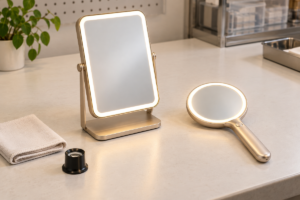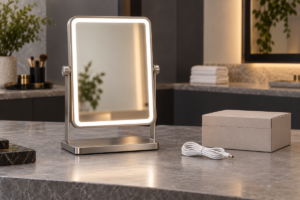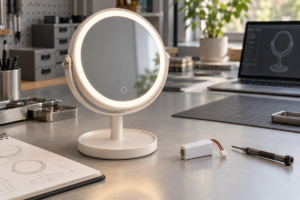

For folding LED makeup mirrors, the hinge is a return-risk component rather than a cosmetic detail. A brand, retailer, or e-commerce seller should require a written hinge specification and a sample-based cycle-test plan before releasing bulk production. The practical goal is not to insist on one universal cycle count: it is to agree on the opening range, torque feel, hold position, test method, sample size, and failure definition for the actual mirror design. That is especially important for rechargeable compact mirrors, where the lid carries glass, LEDs, wiring, and sometimes a magnifying panel.
Why hinge durability deserves its own approval gate
A mirror can look correct at final inspection yet create expensive returns after repeated opening in a handbag, bathroom, or retail display. The most common buyer complaints are a lid that will not stay open, a hinge that becomes loose, a sudden snap or bind, damaged LED wiring near the joint, and a gap that pinches the protective film or scratches the frame.
For a folding LED mirror, the moving joint connects several commercial risks at once:
- User experience: the mirror must hold a useful viewing angle without drifting or slamming shut.
- Product safety and function: the wire path, battery area, and switch operation must still work after cycling.
- E-commerce returns: a weak hinge can turn an otherwise good lighting review into a one-star durability complaint.
- Packaging and shipment: a hinge that is stable in use still needs protection from impact while closed in the retail box.
The same principle applies when selecting a body material. Our ABS vs metal frame LED makeup mirror comparison explains why housing weight and construction change the buyer’s durability trade-off; the approved hinge must be matched to that finished weight, not evaluated in isolation.
The buyer specification: what should be written before sampling
Ask the supplier to put the following items in the drawing, sample record, or inspection sheet. Avoid phrases such as “smooth hinge” or “good quality” because they are not measurable in production.
| Approval point | What to define | Why it changes the sourcing outcome |
|---|---|---|
| Opening range | Minimum and maximum usable angle, plus whether the lid must stand at intermediate angles | Prevents a sample that opens fully but cannot stay at the consumer’s viewing angle |
| Holding behavior | Allowed drift, rebound, wobble, and closing force after repeated use | Converts “feels stable” into an acceptance decision |
| Hinge construction | Pin, barrel, friction part, fastener/clip, lubricant policy, and wire routing where applicable | Lets the buyer compare the same component across sample and mass production |
| Test method | Open/close direction, cycle rate, dwell points, environmental condition, and sample quantity | Makes a supplier’s reported cycle figure meaningful |
| Failure definition | Crack, excessive play, loss of hold, noise, binding, damage to finish, LED/switch/charging failure | Stops disputes over whether a visibly degraded unit has technically “passed” |
| Post-test checks | Light modes, charging, mirror seating, housing gap, cosmetic finish, and closing fit | Catches cross-functional failures caused by hinge movement |
For a common retail compact mirror, a buyer may choose a commercial benchmark such as 5,000 or 10,000 open-close cycles. That number should be a negotiated product requirement, not a claim copied from another product. A heavier lid, wide opening angle, or high-frequency retail demonstrator may need a different test plan. The important part is that the approved sample, production sample, and inspection record all use the same stated method.
Compare the two practical test routes
Route A: sample approval cycle test
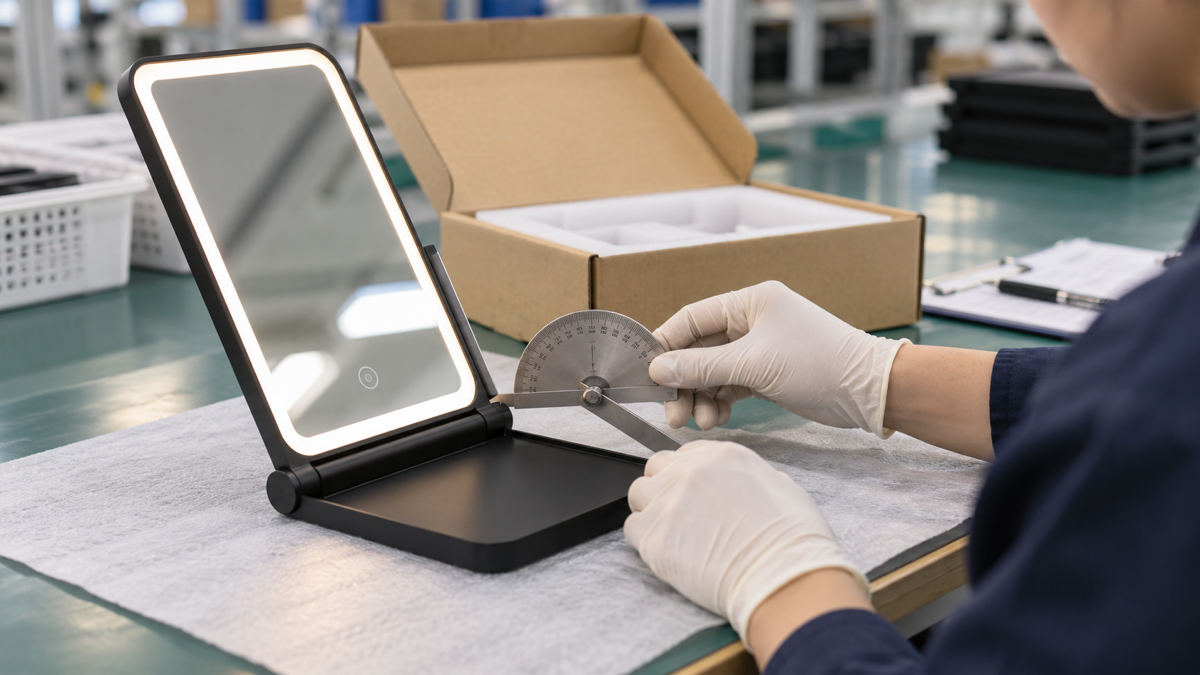
This route is used before a buyer signs off the PP sample or production release. It establishes whether the chosen hinge concept suits the lid weight, intended angle, and product channel. Request photos or a short continuous video of the test setup, then inspect the unit after the stated cycle count.
This is the right route when you are developing a private-label mirror, changing the housing, adding a magnifying panel, or moving from a basic to a rechargeable LED configuration. Pair it with the LED makeup mirror PP sample approval checklist so that hinge performance, lighting, packaging, artwork, and functional checks are released as one controlled record.
Route B: production verification test
This route confirms that the approved construction was maintained during mass production. It does not need to repeat every development experiment, but the buyer should request defined samples from the lot, an agreed test frequency, and recorded pass/fail results.
Production verification is particularly useful for Amazon and online retail orders where a small mechanical defect can create a concentrated wave of returns. If a factory changes a hinge vendor, pin material, lubrication, or housing mold condition, treat that as a change that requires renewed approval rather than a silent substitution.
A practical sample test sequence
1. Record the sample code, revision, finish, and the finished lid or mirror weight. 2. Photograph the hinge, wire path, fasteners, and normal open positions before testing. 3. Cycle the product through the agreed opening range using the stated method; do not force the product beyond its designed stop. 4. At agreed intervals, check holding angle, noise, side play, binding, housing gap, and cosmetic rub marks. 5. After the final cycle, verify every light mode, dimming control, charging function, and any magnification panel. 6. Close the unit and confirm that it still fits the approved protective insert and retail box without pressure on glass or switch areas. 7. Attach the photos/video, results, deviations, and corrective action to the sample approval file.
Do not treat a pass on an empty mechanical fixture as final proof. The buyer should see a complete, production-representative mirror tested with its actual lid, glass, LED assembly, and cable routing. That distinction matters because the load and center of gravity change once the mirror is fully assembled.

Common sourcing mistakes that create avoidable returns
Approving only the opening feel
A fresh hinge can feel firm by hand while losing holding force after repeated movement. Require before-and-after observations at the agreed angle, not only a technician’s first impression.
Testing one sample with no failure definition
One sample can be useful for development, but it is weak evidence for a retail launch. State how many units are tested, what counts as a failure, and whether one failure triggers investigation or retest. That is more useful in an RFQ than requesting a vague “durability certificate.”
Forgetting electrical checks after cycling
On an LED model, the hinge area can affect cable strain relief or solder joints. The post-cycle inspection must include illumination, CCT/mode switching, dimming, charging, and battery operation, not merely movement.
Separating the hinge from packaging approval
An approved hinge can still be damaged when the unit moves inside an under-sized insert. Confirm the closed position, protective film, foam or molded insert contact points, and master-carton handling together. For channel-specific risk control, use our e-commerce packaging guide alongside the product test plan.
RFQ-ready hinge durability checklist
Before asking for a quotation, send the supplier:
- Product format, dimensions, target lid weight, and intended opening range.
- Target channel: beauty retail, gift, travel, Amazon/e-commerce, salon, or promotional order.
- Whether the mirror is standard, rechargeable, magnified, or uses a heavier metal/glass assembly.
- Required sample-cycle method, proposed cycle target, sample quantity, and fail criteria.
- Required evidence: dated video/photos, angle/torque observations, pre- and post-test functional checks, and deviation report.
- Retail box and protective-insert drawing or a requirement to develop them with the closed product.
- Change-control requirement for any hinge, pin, lubricant, wire-routing, or housing-material change.
Bottom line
For B2B LED makeup mirror orders, the best hinge specification is not the highest unexplained cycle claim. It is a clear, product-specific agreement that links the complete mirror, expected opening behavior, repeat-use test method, failure criteria, and packaging condition. Buyers who establish that agreement at the sample stage have a far stronger basis for controlling reorders and preventing e-commerce returns.
Mingda can review your target mirror format, channel requirements, sample test points, and packaging brief before quotation. Contact our mirror team with your target market, projected quantity, product reference, and any required approval standard.
FAQ
What hinge cycle count should an LED makeup mirror buyer require?
There is no universal number that fits every product. Use a cycle target only when it is tied to the finished mirror, intended opening range, channel use, and an agreed test method. A supplier should document the method and post-test functional result, not simply quote a number.
Should the hinge be tested before or after packaging approval?
Both. First validate the complete mirror through the planned cycle test. Then check that the closed, approved product remains protected by its insert and retail box, because transit pressure can create different damage than normal opening and closing.
Can a supplier change the hinge after the PP sample is approved?
Only through written change control. Any change to the hinge, pin, friction component, lubrication, wire routing, or housing condition can change holding performance and should trigger a re-check against the approved sample criteria.