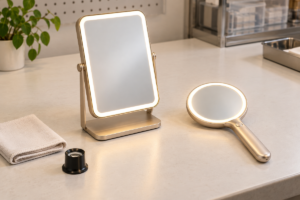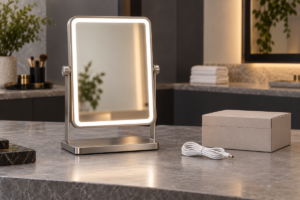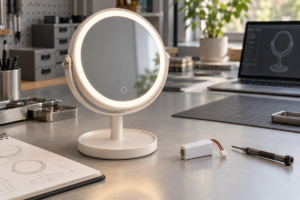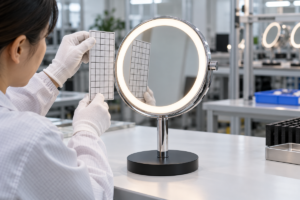

Direct answer: buyers should specify LED makeup mirror light uniformity as an assembled-product requirement—not as a claim about the LED strip alone. Before approving a sample, check the illuminated perimeter at the intended viewing distance, compare several points at the same dimming level, and confirm that the diffuser, frame, driver, and thermal design do not create visible dots, dark corners, glare, or colour shift. This is especially important for beauty brands, retailers, and e-commerce sellers: uneven light is immediately visible in customer photos and can turn an otherwise sound mirror into a return-risk SKU.
For a private-label line, the practical brief is simple: define the appearance customers must see, the measurement method the factory must use, and the pass/fail reference sample. That turns “even light” from an opinion into a repeatable approval point.
Why light uniformity is a procurement issue
Uniformity affects more than appearance. A hot spot next to a dim section can make skin tone look inconsistent, exaggerate glare in product photography, and make a premium package feel less premium at first switch-on. It also signals whether the LED density, diffuser distance, reflective cavity, and assembly tolerances have been engineered as a system.
For a beauty retailer, the risk is comparison shopping: customers can see a patchy light ring beside a cleaner competitor image. For an Amazon or DTC seller, it can become “uneven lighting” or “too much glare” in reviews. For a salon or hotel buyer, it can undermine grooming comfort even if the mirror meets the basic mechanical specification.
What buyers should ask the factory to evaluate
Do not accept a bare-strip demonstration as proof. The approved sample should be the same optical stack intended for mass production: LED board or strip, driver, diffuser or frosted area, mirror glass, frame, and final control setting. A diffuser can improve dot hiding but reduce output; a shallow cavity can create brightness bands; and heat can change output or colour consistency after extended use.
| Check point | What to look for | Why it matters commercially |
|---|---|---|
| Visible appearance | No visible LED dots, dark corners, zebra bands, or sharp glare at normal grooming distance. | Prevents first-impression complaints and listing-photo mismatch. |
| Brightness consistency | Compare centre, corners, and each side at the same dimming setting with an agreed meter method. | Creates a repeatable sample-to-bulk acceptance rule. |
| Colour consistency | Check whether the perimeter looks the same CCT throughout after the diffuser and glass. | Protects makeup colour judgement and premium positioning. |
| Glare control | Look for direct LED imaging or uncomfortable reflections from the user’s normal eye position. | Reduces “too bright” returns even when lumen output is acceptable. |
| Warm-up and thermal behaviour | Repeat the visual check after an agreed run time, not only at switch-on. | Flags drift that a short sample viewing can miss. |
Choose the optical approach for the sales channel
Value retail: protect the visible basics
For a price-sensitive retail SKU, the goal is a clean, continuous-looking perimeter at the claimed brightness. Buyers should avoid reducing LED density or cavity depth until individual points become visible through the diffuser. A fixed CCT can simplify control and inventory, but it should still be checked through the final assembly—not only from the LED supplier data sheet.
Beauty brands and content-led e-commerce: specify colour and glare
When the mirror is sold for makeup use, choose the intended CCT and colour-rendering target early. Current commercial mirror specifications commonly use 90+ CRI for colour-critical grooming, while 3000K–4000K is often selected according to the brand’s intended mood and market. More importantly, approve the actual emitted light after the diffuser. A sample can have a good LED bin on paper but a less convincing result after its optics are assembled.
Pair that target with a camera check. Photograph the approved sample at the planned listing angle and at a user’s eye height. If a bright perimeter blooms in images or produces a hard reflected line, adjust the optical stack before artwork, packaging, and launch assets are locked.
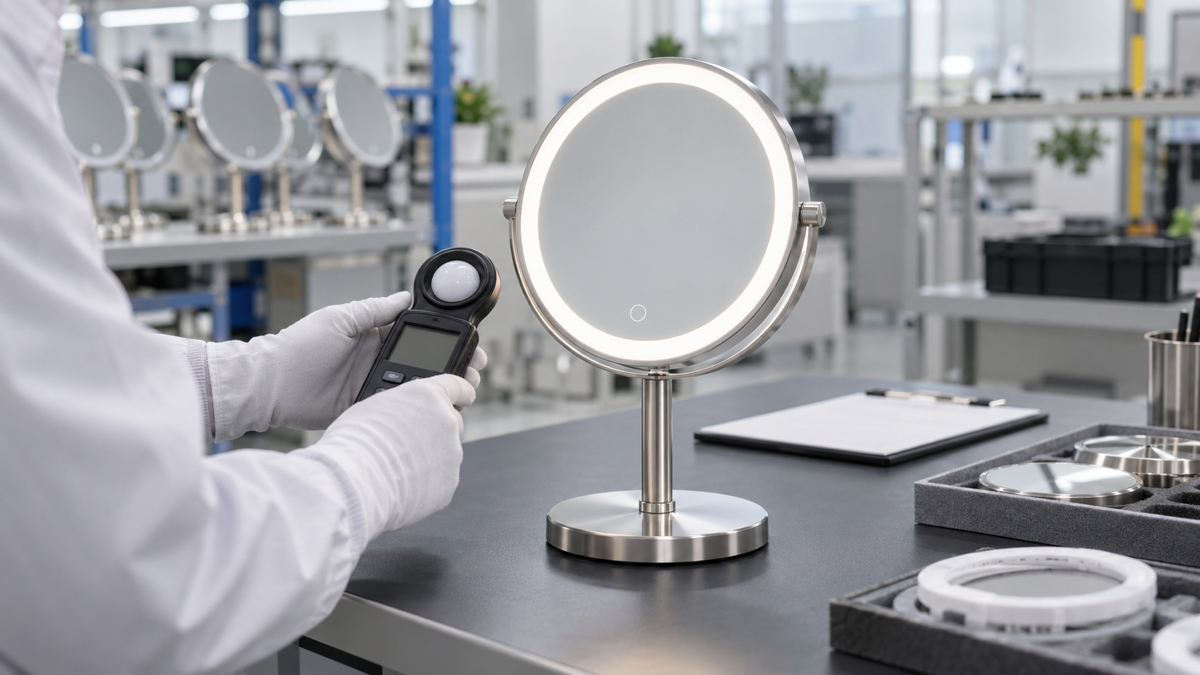
Hospitality, salon, and project orders: document the test
Projects benefit from an agreed sample record. Note the model, driver version, CCT, dimming position, ambient conditions, meter type, points checked, and visual reference photos. If a supplier substitutes a diffuser, LED batch, driver, or frame profile later, the team has a baseline for a re-approval decision. This also makes handover conversations clearer when one purchase order includes several mirror sizes.
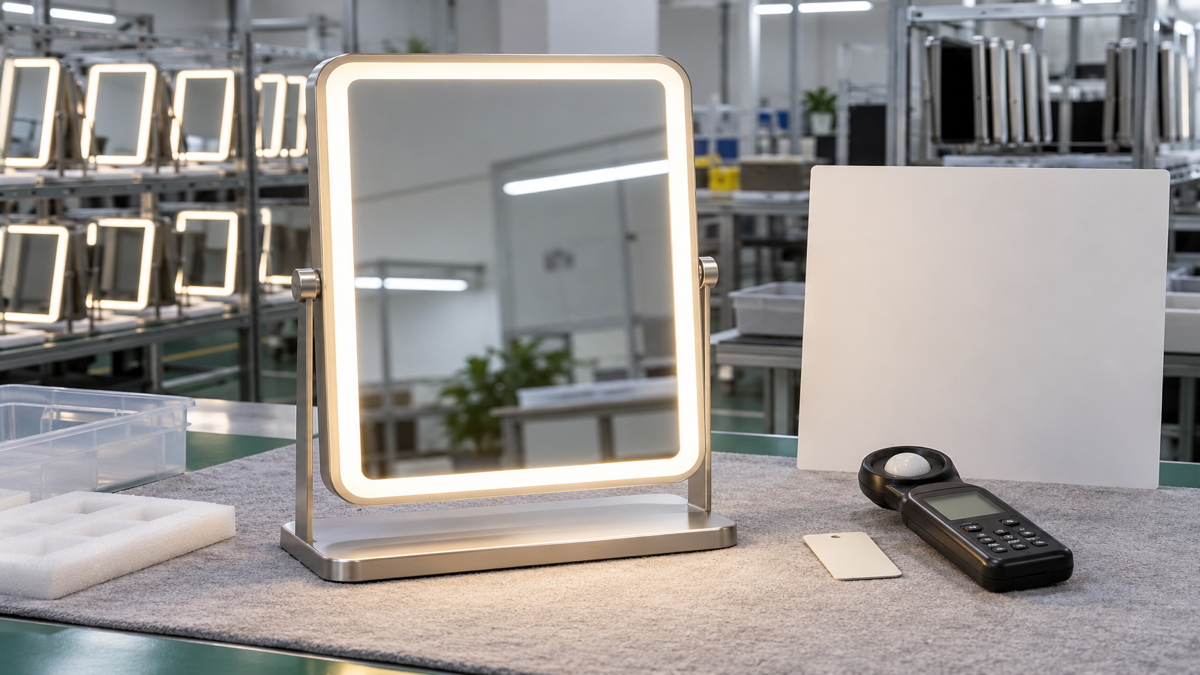
A practical sample-approval method
- Define the use case. State whether the mirror is for skincare, detailed makeup, travel retail, hotel vanity, or general décor. The acceptable brightness and glare tolerance differ.
- Lock the test condition. Agree voltage, CCT mode, dimming level, viewing distance, and warm-up time before the factory sends the sample.
- Inspect by eye first. View straight on and slightly off-axis. Look for dotting, dark sections, colour boundaries, and distracting reflections.
- Measure agreed points. Use a consistent point map around the lit area or at the intended task plane. Record results instead of relying on a single reading.
- Repeat after use. Recheck after the agreed burn-in or operating period. Confirm that the dimmer, touch control, and memory behaviour remain consistent.
- Keep the signed sample reference. Photograph the front, side profile, lighting modes, label, carton, and optical detail. Reference it in the purchase-order quality agreement.
Common buyer mistakes to avoid
- Buying on lumens alone. Higher output does not guarantee comfortable, even task light.
- Approving a white-background product photo only. Use a real grooming-distance inspection and a camera test.
- Testing one prototype but allowing uncontrolled substitutions. Require re-approval when the LED, diffuser, driver, or optical spacing changes.
- Leaving the dimming reference vague. A mirror can look acceptable at full output and uneven at lower settings; state which modes must pass.
- Separating optics from packaging decisions. If the diffuser or glass can shift during transit, include a post-packaging visual check in pre-shipment inspection.
RFQ-ready specification checklist
Include these points when you request a quotation for an LED makeup mirror:
- Mirror format, dimensions, frame finish, magnification, and intended channel.
- CCT option(s), target colour rendering, dimming range, control method, and memory requirement.
- Required optical appearance: no visible dots, no dark corners, controlled glare, and even perimeter colour.
- Agreed viewing distance, warm-up time, point map, meter method, and reference-sample sign-off process.
- LED, diffuser, driver, and frame-change notification requirement after sample approval.
- MOQ by finish, sample lead time, bulk lead time, retail box protection, master-carton configuration, and replacement-part policy.
For related sourcing decisions, see Mingda Mirror’s mirror product range, its OEM/ODM customization support, and the quality-control process. Buyers comparing power configurations can also review our guide to cordless versus plug-in LED makeup mirrors.
Bottom line
Specify uniform light as a complete-mirror, repeatable sample-approval requirement. The right question is not “Does this LED strip look bright?” It is “Does the assembled mirror deliver even, comfortable, colour-consistent light at the user’s viewing position after it has warmed up?” Buyers who document that answer before bulk production reduce avoidable returns and protect their product positioning.
FAQ
How should a buyer define “even light” for an LED makeup mirror?
Define it with both a visual reference and a repeatable test: the approved assembly should show no visible dotting, dark corners, harsh glare, or obvious colour boundary at the agreed viewing distance and dimming mode. Add a point-by-point meter record where the programme needs measurable acceptance.
Should I require 90+ CRI for a retail makeup mirror?
For makeup-led, premium, salon, and colour-critical positioning, 90+ CRI is a sensible target to discuss with the supplier. The final decision should match your price tier and market, but verify performance through the final diffuser and glass rather than relying only on component data.
What change requires another sample approval?
Re-approve changes to LED source or bin, diffuser material or thickness, driver, optical spacing, mirror glass treatment, frame profile, control logic, or anything that can change perceived output, CCT, glare, or dimming behaviour.
What should I ask about MOQ and lead time?
Ask for MOQ by model and finish, tooling or artwork dependencies, sample timing, mass-production lead time after deposit and artwork sign-off, and whether the chosen LED and diffuser are standard stocked components. Put those assumptions on the quotation before you compare suppliers.
Plan your next sample with Mingda Mirror
If you are building a retail, e-commerce, salon, or project programme, send your target channel, size, light preference, power option, finish, packaging requirement, and forecast quantity. The Mingda Mirror team can help turn those inputs into an RFQ-ready LED makeup mirror specification and a sample approval plan.
Social Media Content Ideas
- LinkedIn: “A bright LED strip is not the same as an even makeup mirror.” Share the six-point sample approval method for sourcing managers, then link to this guide.
- Facebook: Show how a diffuser, frame depth, and warm-up check influence the customer’s first impression of a vanity mirror.
- Instagram: Use the QC light-meter image with the caption: “Approve the complete optical stack—not just the LED strip.” Direct viewers to the full checklist.