
For an EU-bound rechargeable makeup mirror, buyers should assess battery removability and replacement before approving the product design—not after packaging is printed. Ask the supplier to demonstrate the proposed removal method, identify compatible replacement batteries, document safety and spare-parts arrangements, and have the responsible EU operator review the exact model against the applicable rules. A USB charging port alone does not make a battery replaceable.
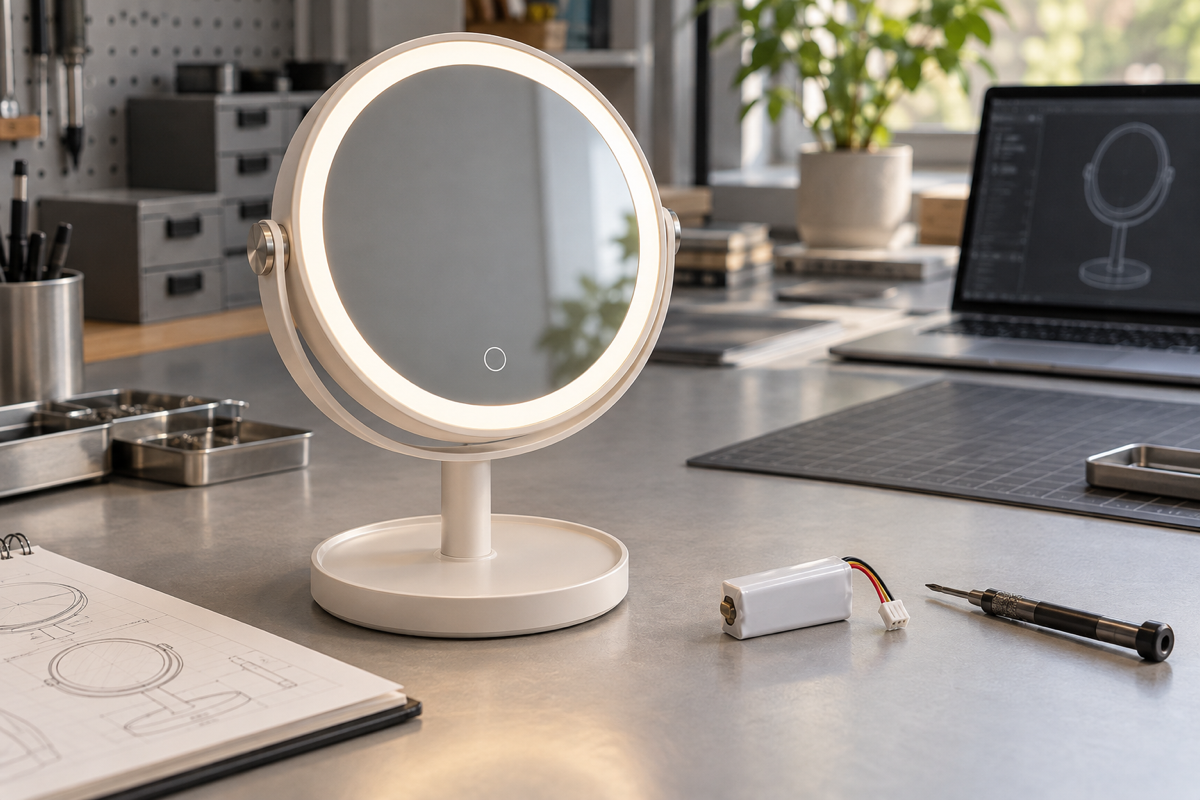
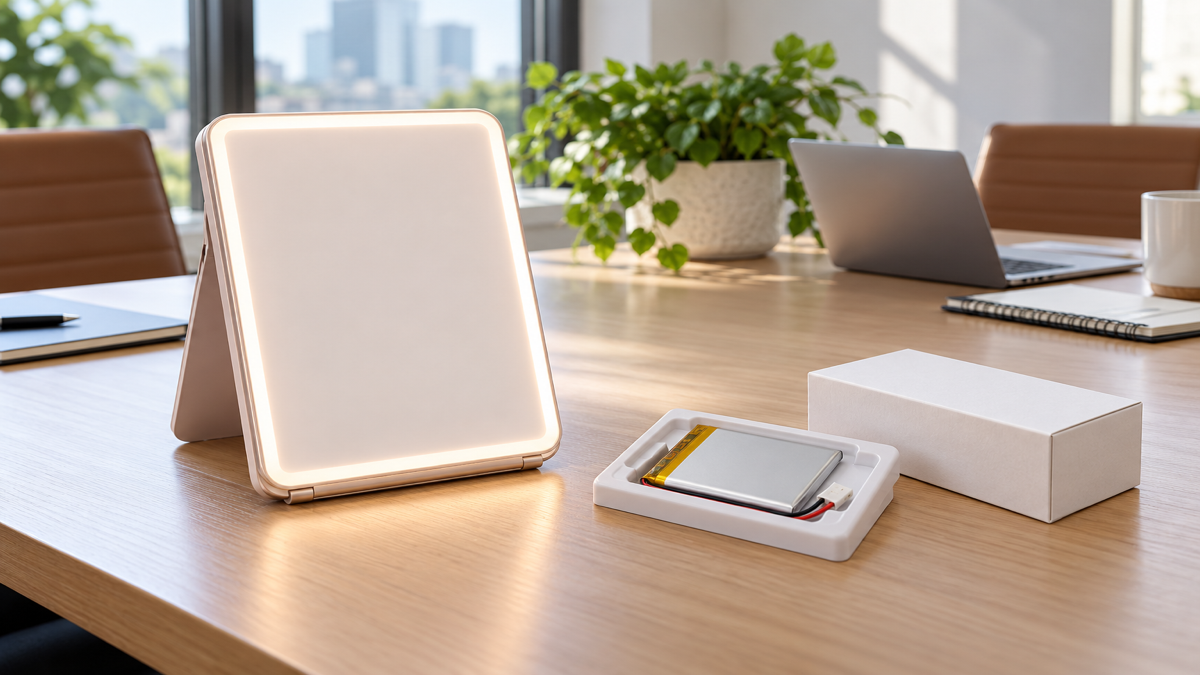
This guide is for brands, retailers and distributors choosing a rechargeable tabletop or travel mirror for the EU. The images are conceptual illustrations, not representations of a specific Mingda model or proof of compliance.
Why battery replacement is a sourcing decision now
Article 11 of the EU Batteries Regulation generally requires portable batteries incorporated into appliances to be readily removable and replaceable by the end user. The European Commission’s published guidance identifies 18 February 2027 as the date on which Article 11 applies. Exceptions and detailed conditions exist; they should not be assumed to apply to a mirror merely because it is rechargeable, sealed or used in a bathroom. The legal status and applicability of any subsequent measures must be checked for the specific product and time of placement on the market.
The practical issue is product architecture. A housing designed around a permanently bonded cell may require changes to the case, fastening, wiring, replacement parts and instructions. Those changes can affect tooling, sample timing, appearance and cost. Discuss them before an RFQ becomes a fixed purchase order.
Read the European Commission’s Article 11 guidance and the current consolidated regulation. This article is a procurement aid, not legal advice; the responsible EU operator should obtain model-specific compliance advice.
Compare battery access approaches before selecting a model
| Approach | Buyer advantage | Procurement question |
|---|---|---|
| User-accessible battery compartment | Replacement can be planned into the normal customer journey | Can a user safely remove and replace the correct battery using the permitted tools and instructions? |
| Service-accessible construction | May allow controlled repair on designs where applicable rules permit it | What specific legal basis supports professional-only access, and who provides service and parts? |
| Permanently bonded or sealed construction | Can simplify a compact initial design | Can it meet applicable removability requirements, or does it need redesign before EU placement? |
These are design approaches, not automatic compliance classifications. A removable cover is not enough if the battery cannot be disconnected and replaced safely, the correct replacement is unavailable, or the documented process fails the applicable requirements.
What to request from the supplier at RFQ stage
1. A model-specific access demonstration
Request a video and an inspectable sample showing the sequence from an intact mirror to removal and reinstallation. Identify every tool, fastener and connector, and check whether reassembly restores safe function without damaging the cell, wiring, glass or housing. Do not ask staff or consumers to pry open, puncture or short a lithium battery. A qualified person should assess safety and the procedure.
2. Replacement battery and spare-parts plan
Record the chemistry, nominal voltage, capacity, physical dimensions, connector and protection arrangement for the approved battery assembly. Ask who will supply compatible replacements, how long they will be available, how they will be identified, and who handles warranty claims. Confirm any legally required availability period with the responsible operator; do not rely on a supplier’s informal promise. Avoid presenting a generic battery as compatible without engineering approval.
3. Evidence tied to the finished SKU
Ask for the bill of materials revision, photographs, removal instructions, product and battery safety documentation, and any relevant test reports. Match model number, cell, battery pack, charging circuit and production revision to the quoted SKU. Review transport documentation separately: a design that allows replacement does not itself establish battery transport compliance.
4. Commercial implications
Request separate quotations for the existing construction and any proposed redesign, including tooling ownership, minimum order quantity, sample charges, replacement part pricing and lead time. Agree whether a battery change triggers a new sample approval, safety review or packaging revision. If a launch date is close to the applicable deadline, plan backwards from the date of EU placement on the market, not merely the factory dispatch date.
Sample approval checklist for retail and e-commerce buyers
- Identify destination countries, intended placement-on-market date, product model and the responsible importer or brand owner.
- Obtain a sample with the intended battery, enclosure, connector and charger interface—not a lookalike prototype with different internals.
- Review the supplier’s documented removal and reassembly demonstration and have the correct legal and technical specialists assess it.
- Specify the approved replacement battery, supply channel, user information and after-sales responsibilities.
- Test the reassembled mirror for lighting, switching, charging and mechanical fit under an agreed method; record any damage or performance change.
- Check packaging, instructions, claims and spare-part information against the approved design. Do not advertise replaceability without evidence.
- Freeze the approved sample and revision; agree how changes to a battery, connector, glue or enclosure are controlled during production.
Related work should also cover charging quality control and the battery compliance file. Those checks complement rather than replace a removability review.
Common mistakes that create avoidable risk
Confusing rechargeable with replaceable. Charging through USB says nothing about how the cell is removed or replaced. Ask for the full procedure and compatible part.
Assuming a water-resistance claim grants an exception. The regulation and guidance describe specific conditions and exceptions; a marketing label alone is not a legal determination. Verify the actual intended use and applicable legal text with counsel or a qualified compliance adviser.
Approving a render instead of a production-representative sample. An attractive compartment shown in a drawing is not evidence that the approved battery and connector can be safely serviced after assembly.
Leaving ownership unclear. Identify who prepares technical documentation, sources replacement batteries, maintains instructions, responds to complaints and authorizes design changes. Put the responsibilities in the purchase agreement.
FAQ
Does every rechargeable makeup mirror automatically qualify for an exception?
No. Applicability depends on the precise product, legal conditions and current rules. Ask the responsible EU operator for a documented assessment rather than assuming an exception.
Can the supplier simply add a battery door?
Not necessarily. Safe access, disconnection, compatible replacement, instructions and the applicable legal conditions all need review. A changed enclosure may also require new tooling and sample verification.
Will a replaceable battery increase MOQ or lead time?
It can, especially if an existing enclosure or tooling needs modification. Ask for separate stock-design and custom-design quotations, sample timing, tooling charges and spare-part pricing; actual terms depend on the model and order.
What should an online seller put in the listing?
Only claims supported by the approved model and instructions. Confirm who can perform replacement, what part is compatible and how customers obtain it; keep the listing aligned with the package and after-sales plan.
Bottom line and RFQ next step
For an EU-bound rechargeable mirror, choose the battery access strategy before locking the SKU. Request a production-representative demonstration, a compatible-spares plan, documented responsibility and a model-specific legal review. This gives the buyer a concrete basis for comparing cost and launch risk—not just a claim that the mirror is rechargeable.
Explore makeup mirrors and OEM/ODM services, or contact Mingda Mirror with your target market, planned launch date, annual quantity, desired mirror format, battery-access requirement and packaging needs. Ask the team to confirm available designs and provide an appropriate quotation; no particular model’s compliance is implied by this article.