
For brands, retailers, Amazon sellers, and distributors, rechargeable LED makeup mirror charging QC should confirm the full charging system, not only whether the light turns on. Before bulk production, buyers should verify the USB-C or DC port, battery capacity claim, adapter compatibility, cable quality, charging behavior, runtime, heat, labeling, packaging, and inspection records. These records help buyers identify configuration mismatches and support shipment decisions; they do not establish certification or guarantee a return-free batch.
This guide gives sourcing teams a practical approval framework before placing or releasing a bulk order for rechargeable LED makeup mirrors.
Why Charging QC Is a Buyer-Level Decision
Rechargeable LED makeup mirrors are sold as convenient, portable, and retail-ready products. That convenience depends on parts buyers may not see in a catalog photo: the charging port, cable, battery, PCB, touch control, adapter match, warning label, and packed accessory set. If any of these are inconsistent, the buyer may face weak reviews, customer service claims, retailer chargebacks, or shipment delays.
Charging QC is especially important for private-label and e-commerce orders because the product page, retail box, and manual often make specific claims. A listing may mention USB-C charging, cordless use, three light modes, dimming memory, or long runtime. Those claims should be supported by sample tests and inspection records before mass production begins.
Charging QC Decision Matrix for Buyers
| QC Area | What to Verify | Buyer Risk if Missed |
|---|---|---|
| Charging port | USB-C or DC position, insertion feel, durability, alignment | Loose port, charging failure, poor user experience |
| Cable and adapter | Connector type, cable length, plug market, adapter output | Accessory mismatch, slow charging, support complaints |
| Battery claim | Rated capacity, real runtime, charge cycle expectation | Overstated listing claims and negative reviews |
| Charging behavior | Indicator light, full-charge signal, dimming while charging | Confusing user operation and return requests |
| Heat and stability | Surface temperature during charging and use | Safety concern, retailer rejection, warranty exposure |
| Labels and manual | Battery warning, charging instructions, market language | Compliance file gaps and customer misuse |
| Packaging | Cable pouch, adapter compartment, battery notice, carton protection | Missing accessories, pressure damage, FBA or retail issues |
| Inspection file | Golden sample, test method, sampling plan, defect limits | No shared standard for factory and buyer acceptance |
Confirm the Charging Interface Before Approving Appearance
The charging interface should be reviewed on the real sample, not only in a rendering. Buyers should check whether the port is easy to access after the mirror is placed on a dressing table, whether the cable can connect without tilting the base, and whether the connector feels stable after repeated insertion.
For USB-C models, confirm whether the product supports USB-C input only or whether it also accepts common fast-charging adapters. A mirror does not need high-wattage charging, but it should behave predictably with the adapter and cable included in the order. For DC-port models, confirm the exact adapter output and plug market before approving packaging artwork.
Test Runtime Against the Sales Channel Promise
Runtime should be measured in a repeatable way. A buyer should ask the supplier to test the mirror after a full charge at the brightness level and CCT mode closest to real use. If the product has warm, neutral, and cool light settings, record which mode was tested. If the product has stepless dimming, define the brightness level used for the runtime claim.
For Amazon and social-commerce sellers, conservative claims are safer than aggressive claims. A mirror that performs well in a controlled test may have shorter runtime when customers use high brightness, frequent mode switching, or an older charging adapter. The supplier and buyer should agree on wording that the factory can support with sample records.
Review Cable, Adapter, and Accessory Consistency
Many after-sales problems come from accessories rather than the mirror body. Before bulk production, buyers should confirm the cable connector, cable length, adapter type, plug market, accessory bag, manual language, warning card, and replacement policy. The packed sample should include the exact accessory set intended for shipment.
Accessory decisions also affect quotation and lead time. Adding an adapter, changing plug type, upgrading cable length, or adding multilingual manuals may change MOQ, unit cost, packaging size, and sample timing. For RFQ accuracy, send the supplier your target market, expected quantity, distribution channel, and whether the order needs retail packaging, FBA-style preparation, or distributor carton labeling.
Build a Simple Charging Test Plan
A practical charging QC plan does not need to be complicated, but it should be written before production. The plan should define the approved sample, testing conditions, acceptable limits, and who keeps the record. For higher-volume orders, confirm whether the supplier will test every unit for basic charging function or use a sampling plan for runtime and heat checks.
Recommended test points include:
- Port alignment and connector insertion feel on the approved sample.
- Charging indicator behavior from low battery to full charge.
- Runtime at the agreed brightness and CCT setting.
- Light operation while plugged in, if this is allowed by the design.
- Surface temperature after continuous operation and charging.
- Cable, adapter, manual, label, and accessory count in the packed unit.
- Drop or vibration check for packed samples when the order is e-commerce heavy.
Record Charging Results and Release Exceptions
Record the buyer SKU, sample ID, battery and board revision, cable, adapter model and test date together. A USB-C connector shape alone does not establish compatibility with every cable or power supply. List each supported combination and test the actual supplied set; ask the supplier to confirm any charging protocol claim before it appears on the box.
| Check | Repeatable record | Release decision |
|---|---|---|
| Charge and runtime | Initial charge state, charge-complete criterion, ambient conditions, brightness, CCT, elapsed time and agreed endpoint | Compare each result with the agreed limit; record not-tested conditions separately |
| Accessory compatibility | Adapter rating and model, cable type, supported combinations, indicator behavior and observed interruptions | Hold unsupported charging claims; recheck substitutions before approving a changed set |
| Observed heating | Operating mode, duration, measurement location, instrument and observed value against the approved test plan | Refer safety acceptance to the applicable qualified assessment; a photograph or touch check is not safety evidence |
| Failure and retest | Original sample result, affected lot, corrective action, owner and separate retest result | Keep initial failures visible and obtain named release authorization for unresolved exceptions |
Connect the test record to the inspection report checklist and the versioned sample approval file. Reopen approval after a battery, charging board, cable or adapter change; an earlier passing configuration does not automatically cover the replacement.
Compliance and Documentation Buyers Should Request
Charging-related documentation depends on the market, product configuration, and importer role. Buyers should not rely on a generic statement that the mirror is “safe” or “certified.” Instead, request the test reports, battery information, adapter information, label files, manual files, and production inspection records that match the actual ordered configuration.
In the U.S. market, importers increasingly need better certificate and product data discipline for regulated consumer products. Even when a specific mirror order does not require the same documents as a high-risk electrical product category, maintaining clear charging, battery, label, and inspection files helps buyers respond faster to retailer, customs, or marketplace questions.
For the EU, UK, Middle East, or other destination markets, buyers should confirm which electrical, battery, labeling, and packaging requirements apply to the exact product. The right question is not only “Do you have certificates?” It is “Do these certificates and labels match this battery, adapter, charging port, artwork, and destination market?”
Common Mistakes Buyers Should Avoid
- Approving the mirror design before confirming the final cable and adapter.
- Using the supplier’s maximum runtime claim without asking for test conditions.
- Listing “USB-C fast charging” when the product only supports ordinary USB-C input.
- Changing the adapter or plug market after packaging artwork has been approved.
- Forgetting battery warnings, manual language, or carton labels for the destination market.
- Checking one loose sample but not approving a complete packed sample.
- Treating charging QC as a factory-only issue instead of an RFQ and listing-risk issue.
Pre-RFQ Checklist for Rechargeable LED Makeup Mirrors
Before requesting a quotation, send the supplier your target market, sales channel, mirror size, magnification, lighting modes, expected runtime claim, charging interface, adapter needs, cable length, plug market, packaging style, certification needs, order quantity, and launch timeline.
If the product is for Amazon, retail chains, or private label, include the expected listing claims, manual language, barcode rules, battery warning format, accessory set, and replacement policy. This helps the supplier quote realistic cost, sample time, certification support, and production lead time.
Bottom-Line Recommendation
For rechargeable LED makeup mirror orders, buyers should approve the complete charging system before bulk production: port, cable, adapter, battery claim, runtime, labels, manual, packed accessories, and QC records. A practical sourcing approach is to link the sample test results directly to the product listing, retail box, and inspection file so the buyer, factory, and final customer all work from the same standard.
Mingda Mirror supports rechargeable LED makeup mirror OEM/ODM development for beauty brands, retailers, distributors, and e-commerce sellers. You can review our makeup mirror options, compare custom OEM/ODM support, and send the RFQ team your destination, sales channel, quantity, charging set, runtime claim, packaging and launch date. Request MOQ by configuration, sample and testing charges, approval milestones, substitution controls and lead time after final sign-off.
FAQ
What should buyers test first in rechargeable LED makeup mirror charging QC?
Start with the approved sample’s charging port, included cable, adapter compatibility, charging indicator, runtime, and heat behavior. These points affect both user experience and after-sales risk.
Is USB-C always better than a DC charging port for makeup mirrors?
USB-C is familiar to consumers and easier for retail messaging, but buyers still need to confirm charging behavior, adapter compatibility, cable quality, and port durability. A well-controlled DC system may be acceptable for some project or distributor channels.
How should buyers verify battery runtime claims?
Ask the supplier to record the test mode, brightness level, CCT setting, full-charge condition, and cutoff point. Use a conservative claim that matches normal customer use rather than only the best lab result.
Should the adapter be included in every rechargeable LED makeup mirror order?
It depends on market expectations, cost target, safety documentation, and packaging size. If an adapter is included, confirm plug type, output, labeling, manual wording, and whether it changes certification needs.
What documents should importers request for rechargeable makeup mirrors?
Request product specifications, battery information, adapter details, label and manual files, test reports where applicable, packed sample photos, QC checklist, and inspection records tied to the approved configuration.
Social Media Content Ideas
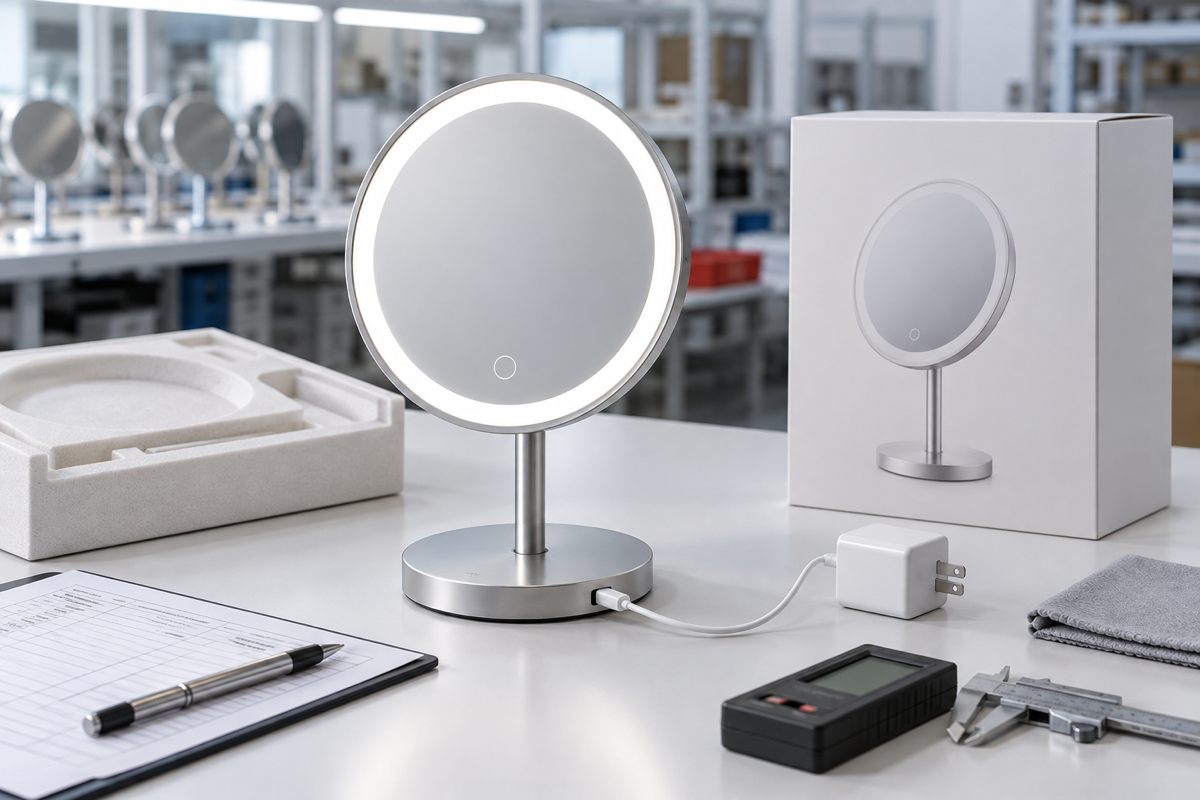
LinkedIn can highlight how charging QC protects importer compliance files and reduces private-label disputes. Facebook can explain why cable, adapter, and runtime claims should be approved before packaging artwork. Instagram can show the QC bench image with a short reminder: test the complete charging set, not only the mirror light.