
A rechargeable LED makeup mirror can arrive with a flat battery even when the cell, LED board and charger are technically sound. The avoidable cause is accidental activation: a touch key or exposed button is pressed during packing, container movement, warehouse handling, or last-mile delivery. For Amazon, travel retail and gift programs, buyers should specify a rechargeable LED makeup mirror travel lock or an equally validated anti-activation method, then test it in production packaging. The requirement is not merely “add a lock.” It is a clear lock state, a defined release action, a packed-product test, and a check that the mirror remains off until the customer intentionally uses it.
Why accidental activation is a procurement problem
An illuminated mirror can be switched on by pressure from an insert, a cable, a manual, or another unit. A simple touch sensor can be particularly vulnerable when a protective film, packing material, or moisture reaches the active area. The resulting battery drain becomes a customer-experience issue: a buyer may see a “dead on arrival” review, a retailer may receive a chargeback, and a brand may need to replace a product that passed its normal factory functional test.
The shipping context also matters. For lithium-ion products, air-transport and marketplace documentation can require a defined state of charge and accurate battery information. That makes unplanned discharge a supply-chain control issue, not just a usability detail. A factory should not assume that an individual product passed a final light-on test means its delivered battery condition is acceptable.
Choose the anti-activation method before artwork approval
There are several workable approaches. The best option depends on the mirror structure and the intended channel.
| Method | Best fit | Buyer benefit | Control to specify |
|---|---|---|---|
| Long-press software lock | Touch-control tabletop and compact mirrors | No added mechanical part; clean exterior | Press duration, lock indicator, and unlock sequence |
| Recessed mechanical slider | Travel mirrors and high-handling gift items | Clear physical state; less sensitive to packing pressure | Slider travel, tactile feel, lock mark, and cycle test |
| Protective isolator tab | Entry-price or replaceable-battery products | Prevents electrical use during storage | Tab position, removal force, customer instruction, and retention |
| Auto-off plus locked wake-up | Premium rechargeable SKUs | Limits loss when the product is left on | Timer behavior and proof that ordinary contact cannot wake it |
A long-press lock is usually a strong choice for a sleek rechargeable mirror when it needs no extra opening in the housing. However, it must not conflict with the normal dimming command. A mechanical slider is easier for retailers and shoppers to understand, but it adds a component, an assembly step, and a potential ingress or feel issue. An isolator tab can work well in a simple product, but the buyer should confirm that removing it does not create a confusing first-use experience.
The specification should define behavior, not marketing language
Do not put “travel lock included” on an RFQ without defining what it does. A practical specification states:
- the lock action, such as holding the touch key for three seconds or moving a side slider fully to LOCK;
- what happens while locked: no LED activation from short touch, pressure, cable insertion, or ordinary handling;
- how the user unlocks it and whether a visible indicator is required;
- whether charging remains available while locked;
- the expected state at packing and the allowed battery state of charge at dispatch;
- the sample test method, production-line check, and evidence to retain.
For brand buyers, this definition must also flow into the manual, quick-start card, listing copy, and retail-box artwork. The product photo, accessory list, and first-use instructions should all describe the same behavior. If the feature is a long-press lock, do not show it as a separate hard switch in the artwork.
Test the lock in the real packaging configuration

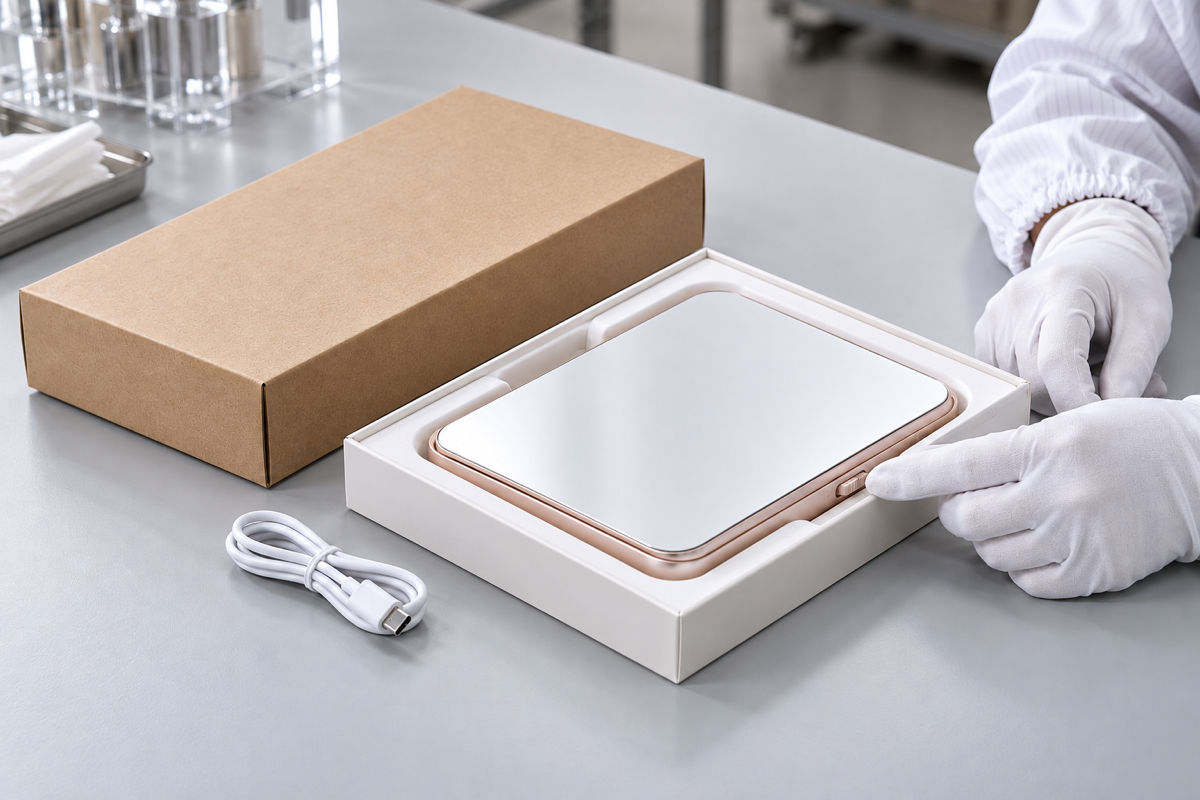
The useful test is not a technician locking an unpacked mirror for a few seconds. Test a production-representative unit after the cable, instruction sheet, bag, insert and retail box are assembled. Then simulate the handling pressure the product may see in a master carton.
A practical sample and production test sequence
1. Fully function-check the mirror, charging input, indicator, dimming and auto-off behavior. 2. Set the agreed dispatch charge condition and record the starting battery indicator or measurement method. 3. Engage the lock using the approved customer action. 4. Pack the unit with the final insert, cable, manual and retail box; confirm no item rests directly on an active touch zone. 5. Apply repeated normal handling pressure to relevant carton faces and move the packed unit through the agreed vibration or handling simulation. 6. Open the pack and verify that the mirror is still locked, the LEDs did not activate, and the customer can unlock it with the documented action. 7. Retain the result in the golden-sample record and include the lock state in final inspection instructions.
For a high-return e-commerce SKU, add a short post-packaging hold test. This can expose a unit that wakes intermittently from pressure, a sensitive touch board, or a packing component that shifts onto the key. It is also sensible to compare battery status before and after the hold period rather than relying only on a visual light check.
Common mistakes that create avoidable returns
Treating auto-off as a travel lock
Auto-off limits the time that a light stays on, but it does not prevent repeated activation. If a carton presses a sensor again and again, the product can still lose meaningful charge. Use auto-off as a back-up control, not the sole transport solution.
Testing only the bare mirror
A bare mirror may pass while a cable, instruction booklet or insert presses its control after the box is closed. Require the finished retail pack in both sample approval and pre-shipment inspection.
Leaving the lock out of the customer journey
An effective lock can still generate support tickets if the shopper cannot identify it. Include a concise English first-use instruction and make sure the customer can tell whether the product is locked without guessing.
Assuming one battery condition fits every route
The agreed dispatch state must be reviewed with the importer, freight forwarder and marketplace workflow. Battery transport rules, destination requirements and product configuration can differ. Ask for route-specific confirmation rather than copying a generic percentage into every PO.
Pre-RFQ checklist for buyers
Before placing a rechargeable LED makeup mirror order, ask the supplier to confirm:
- lock type, user action, and unlock action;
- resistance to short touch, carton pressure and cable contact while locked;
- whether the lock is evaluated with the final retail pack and master-carton arrangement;
- battery type, rated capacity, charging input, cable inclusion and allowed dispatch condition;
- sample evidence, functional-inspection point, and defect disposition if the lock fails;
- manual and packaging wording for first use;
- MOQ, sample lead time, and any tooling or PCB revision needed for the selected lock;
- warranty policy for an out-of-box low-battery or no-light claim.
Buyers developing a private-label mirror should align these points with the broader OEM/ODM service process, the quality control process, and the planned makeup mirror product range. A lock should be approved alongside lighting, magnification, finish, packaging and accessories—not as a late artwork detail.
Bottom line
For rechargeable LED makeup mirrors, a travel lock is worthwhile when the product will experience e-commerce fulfillment, travel retail handling, long storage, or any packed configuration that could contact the control area. Specify the exact behavior, test it in the final pack, and keep the result in the production approval file. The lowest-risk solution is the one that prevents activation in transit while remaining obvious and simple for the customer to unlock.
Mingda Mirror can help brands, retailers and importers turn this into an RFQ-ready sample requirement, covering the lock behavior, battery and charging specification, packaging layout, inspection points and buyer documentation. Contact our team with your target channel, product format and launch quantity for a practical review.
FAQ
It can be, provided the required press time is clear and the packed-product test demonstrates that ordinary pressure, short touches and accessory contact do not wake the LEDs. Confirm the behavior on the approved production sample.
Should the travel lock remain active while charging?
That is a product decision. Allowing charging while locked can be convenient, but the desired behavior must be written into the specification and user instructions. Test both cable insertion and charging-indicator behavior.
Does a travel lock replace battery transport documentation?
No. A lock reduces accidental product activation; it does not replace the applicable battery, transport, marketplace, destination or labeling documentation. Confirm the complete compliance path for the actual battery and shipping route.
What evidence should a supplier provide before bulk production?
Ask for the approved sample behavior, packaging test result, final inspection instruction, battery and charging specification, and the retail-pack/manual wording. For a customized design, include these in the PP sample or golden-sample sign-off.