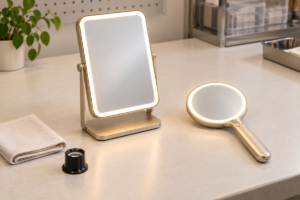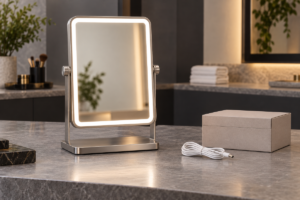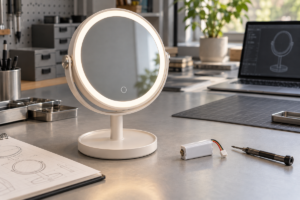

Amazon sellers, beauty brands, retailers, and private-label buyers often face the same sourcing question when selecting LED makeup mirrors: should the product use a rechargeable battery or a replaceable dry battery? The right answer depends on your target customer, price band, after-sales expectations, and shipping model.
This guide compares rechargeable and battery-powered makeup mirrors from a B2B sourcing perspective so buyers can choose a configuration that fits their market more accurately.
Buyers planning a broader assortment should also compare rechargeable vs. plug-in makeup mirrors, review the private label makeup mirror FAQ, and use the sample approval checklist before locking power configuration for a branded or retail program.
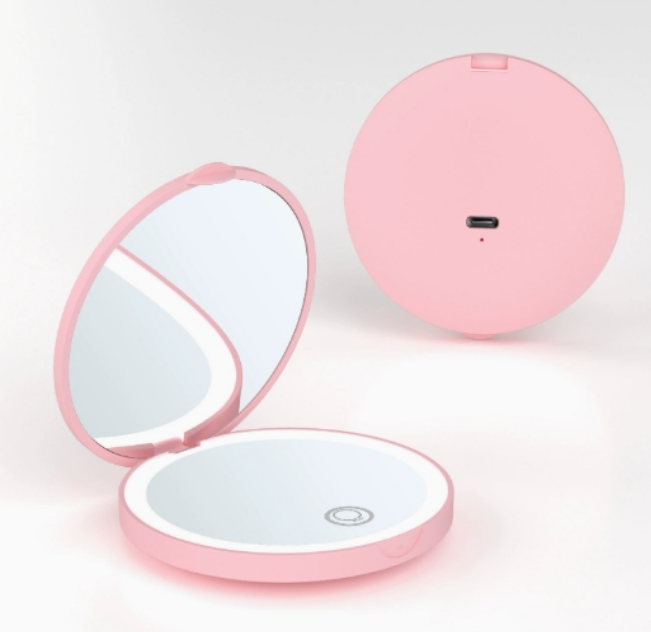
1. Rechargeable Makeup Mirrors: Better for Premium Retail and Brand Positioning
Rechargeable LED makeup mirrors usually use built-in lithium batteries and USB charging. For beauty brands, e-commerce sellers, and gift-focused retail buyers, this setup often creates a better end-user experience because customers do not need to replace batteries frequently.
Main sourcing advantages include:
- More premium product positioning
- Better convenience for end users
- Lower risk of negative reviews caused by frequent battery replacement
- More flexibility for branded charging cables and gift-box packaging
The tradeoff is that rechargeable models usually have a higher production cost and may require closer attention to battery specification, charging safety, and transport planning.
2. Battery-Powered Makeup Mirrors: Better for Budget Programs and Entry-Level Channels
Battery-powered mirrors using AA, AAA, or coin-cell batteries are often easier to position in lower price ranges. This makes them useful for supermarket programs, discount retail, promotional gifting, and budget market testing.
Common advantages include:
- Lower unit cost
- Simpler opening price strategy for retail buyers
- Suitable for low-risk testing in new channels
- No built-in battery logistics concerns for some projects
The main downside is user inconvenience. If customers need to replace batteries often, review quality and long-term satisfaction may drop, especially in e-commerce channels.

3. Which Power Type Fits Which Buyer?
- Amazon and e-commerce sellers: rechargeable models are usually the stronger long-term option
- Beauty brands and boutique retailers: rechargeable models support better brand perception
- Promotional and discount channels: battery-powered models may fit cost-sensitive programs better
- Small trial orders: battery-powered models can reduce initial product risk
4. Questions Buyers Should Confirm Before Ordering
Before finalizing a makeup mirror program, buyers should confirm:
- Target retail price and buyer segment
- Expected battery life and charging behavior
- Packaging requirements for the sales channel
- Whether private-label branding is needed
- Whether the product should prioritize convenience or lowest possible cost
If your broader product line includes bathroom mirrors or private-label mirror development, it is also useful to review How to Choose a Reliable LED Mirror Manufacturer for Your Business, browse Makeup Mirrors, and compare with Custom LED Bathroom Mirrors: OEM and ODM Options for Business Buyers.
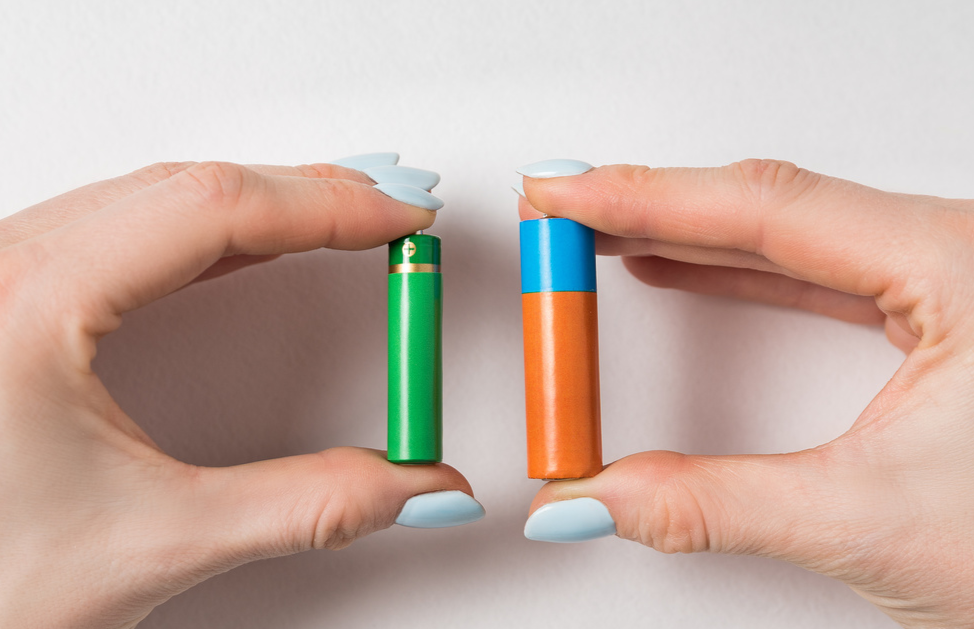
Rechargeable vs Battery-Powered Makeup Mirror Comparison Table
| Buyer Factor | Rechargeable Makeup Mirror | Battery-Powered Makeup Mirror |
|---|---|---|
| Market positioning | Better for premium retail, beauty brands, and e-commerce value packs. | Better for entry-level price points and simple retail programs. |
| User convenience | No frequent battery replacement; charging cable and battery quality matter. | Easy to use but battery replacement may reduce user satisfaction. |
| Cost structure | Higher component cost and more safety/charging checks. | Lower unit cost but weaker premium positioning. |
| Buyer checks | Battery capacity, charging port, cable, charging time, and safety. | Battery type, compartment design, runtime, and replacement convenience. |
Common Power-Type Selection Mistakes
Buyers often compare rechargeable and battery-powered mirrors only by unit price. This misses the real question: what does the target customer expect? Premium beauty buyers may value rechargeable convenience, while budget channels may prefer simple battery-powered products. The power choice should match retail price, user habit, packaging, and after-sales risk.
Bottom Line for Buyers
Choose rechargeable makeup mirrors for premium positioning, better user convenience, and stronger e-commerce storytelling. Choose battery-powered mirrors for simpler, lower-cost retail programs. Before ordering, confirm battery quality, charging or battery structure, runtime, packaging, and market expectations.
Social Media Content Ideas
- LinkedIn: Share the comparison table for beauty brand product planning.
- Facebook: Explain the everyday difference between rechargeable and battery-powered mirrors.
- Instagram: Create a carousel comparing charging, portability, cost, and retail positioning.
Battery Choice Procurement Matrix for Business Buyers
| Procurement factor | Rechargeable makeup mirror | Battery-powered makeup mirror |
|---|---|---|
| Best-fit channel | Beauty brands, Amazon sellers, gift sets, premium retail, and private-label programs | Budget retail, promotional orders, price-sensitive wholesale, and simple travel assortments |
| Sample approval focus | Charging port, cable, battery capacity, switch response, charging time, lighting stability, and safety labeling | Battery compartment, spring contact, battery cover strength, user instructions, and replacement convenience |
| Commercial risk | Higher component cost, battery transport requirements, and stricter after-sales questions if charging fails | Lower perceived value, more customer battery replacement friction, and possible contact corrosion risk |
| RFQ details to confirm | MOQ, battery specification, USB cable, certification expectations, packaging layout, and bulk lead time | MOQ, battery type, whether batteries are included, carton wording, display packaging, and target retail price |
For sourcing managers, the decision should not be based only on unit price. A rechargeable mirror may protect brand value when the buyer sells through reviews, gifting, or premium beauty channels. A replaceable-battery mirror may be more practical when the buyer needs a lower opening price, simpler compliance route, or a fast promotional order.
Pre-RFQ Checks Before Choosing the Power System
- Confirm the destination market, target retail price, and whether the buyer wants a premium or entry-level SKU.
- Ask whether the order needs private-label packaging, barcode placement, instruction language, and battery or charging safety notes.
- Review sample performance after repeated switching, dimming, charging, transport simulation, and normal vanity use.
- Clarify MOQ, sample lead time, bulk lead time, inspection points, spare-part policy, and replacement responsibility before purchase order confirmation.
- For rechargeable models, confirm battery transport documents and charging component consistency. For replaceable-battery models, confirm whether batteries are included or excluded from the retail package.
The safest sourcing route is to match the power system to the sales channel first, then compare quotations with the same lighting, magnification, packaging, testing, and after-sales assumptions. Buyers who are building a broader makeup mirror assortment can contact Mingda Mirror to compare rechargeable, plug-in, and battery-powered options before sample approval.
FAQ
Are rechargeable makeup mirrors better for Amazon sellers?
Usually yes. Rechargeable models often create better customer experience and reduce complaints about frequent battery replacement.
When should buyers choose battery-powered makeup mirrors?
Battery-powered models are more suitable for low-cost retail, promotional programs, and budget testing where opening price matters more than premium user experience.
Can Mingda Mirror support private-label power configuration?
Yes. Buyers can discuss battery type, packaging, branding, and appearance details based on their channel and target market.
CTA
If you are selecting makeup mirrors for retail, e-commerce, or private-label orders, contact Mingda Mirror to discuss your target price range, battery preference, packaging needs, and sample plan.
Home | Makeup Mirrors | Brand & Private Label Solution | E-Commerce & Amazon Seller Solution | Contact