
For brands, retailers, and e-commerce sellers, the short answer is yes: custom LED makeup mirrors can be adjusted across product design, lighting, magnification, power, branding, and packaging. The right OEM/ODM plan starts with the buyer’s sales channel and target user, then narrows into the mirror type, feature set, and packaging method that fit the market.
This guide explains what can realistically be customized, what information suppliers need before quotation, and which buyer mistakes usually slow down sampling or mass production.
1. Start with the Buyer Need and Sales Channel
Before discussing colors or logos, buyers should define where the mirror will be sold and how it will be used. A tabletop vanity mirror for beauty retail has different priorities from a foldable travel mirror for e-commerce bundles or a wall-mounted makeup mirror for hotel projects.
- Beauty brands: usually care about brand fit, color consistency, giftability, and private-label packaging.
- Retail chains: usually care about product display value, barcode readiness, and stable repeat orders.
- E-commerce sellers: usually care about drop resistance, packaging protection, review risk, and charging convenience.
- Professional channels: usually care about lighting accuracy, magnification, durability, and certification support.
If the buyer requirement is still broad, it helps to first review the broader Makeup Mirrors category and compare it with the intended end user.
2. Which Mirror Types Can Be Customized?
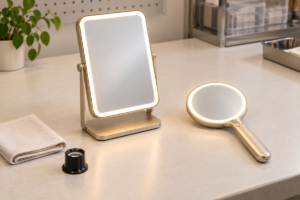
Most custom LED makeup mirror projects start from an existing product platform, then adjust the structure and finish. For larger OEM or ODM programs, buyers can also request new mold development.
| Buyer Need | Mirror Type | Common Customization Direction | Best Fit |
|---|---|---|---|
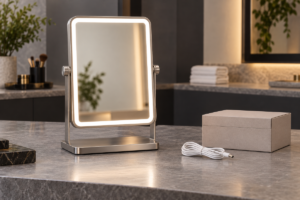
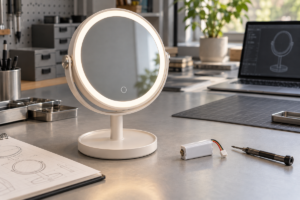
| Countertop daily use | Tabletop LED makeup mirror | Frame color, base shape, dimming mode, logo, packaging | Beauty retail, chain stores, private-label home products |
| Travel and gifting | Foldable or compact LED mirror | Battery type, charging port, pouch, box size, logo placement | E-commerce, promotional kits, subscription boxes |
| Precision makeup or skincare | Double-sided magnifying mirror | 1X/5X pairing, hinge strength, light intensity, finish | Professional beauty users, premium retail |
| Vanity or project use | Wall-mounted or larger vanity mirror | Arm structure, installation method, lighting mode, finish | Hotels, salons, premium room sets |
Buyers comparing portable and charging options can also review rechargeable vs. battery-powered makeup mirrors before finalizing the product route.
3. Core Feature Requirements Buyers Usually Customize
Lighting
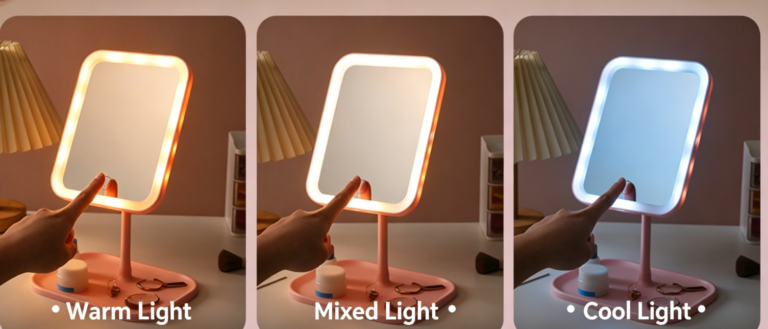
Lighting is often the most commercially sensitive part of the specification. Buyers may request warm, natural, or cool color temperature, three-color switching, dimming, high CRI output, memory function, or different LED layouts. For makeup use, CRI and brightness consistency matter more than generic “LED” claims.
Magnification
Common options include 1X, 3X, 5X, 7X, and 10X. In most retail programs, 1X plus 5X is the safest combination because it balances daily use and close-up detail work without becoming too niche.
Power Source
Common choices include replaceable batteries, USB rechargeable designs, USB-C charging, built-in lithium batteries, or dual-power structures. Power selection should consider freight rules, after-sales risk, and the user’s charging habits.
Touch and Smart Functions
Depending on price level, buyers may request touch sensors, anti-fingerprint finishes, auto-off timers, memory settings, or detachable bases. These features should be evaluated against retail price targets and packaging size.
4. Branding and Packaging Are Part of the Product
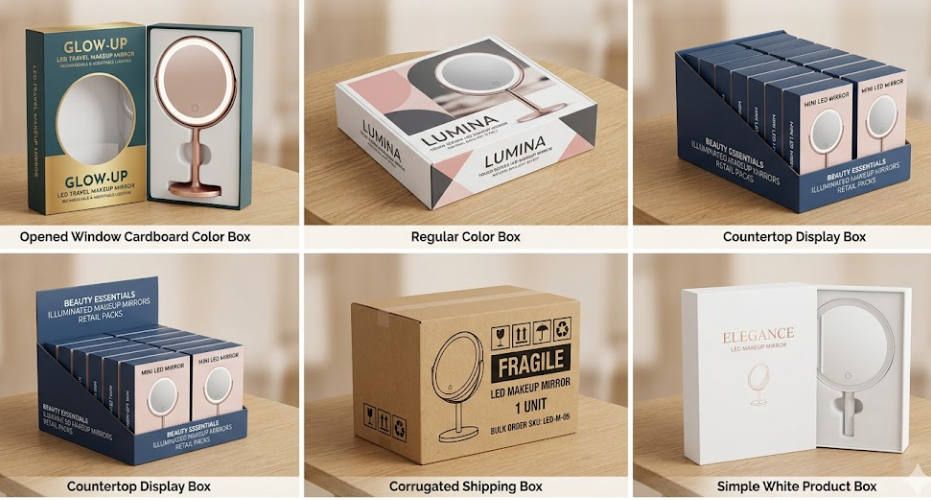
In private-label mirror programs, branding is not limited to printing a logo on the frame. Buyers often customize product color, finish, gift box artwork, barcode labels, instruction manuals, and carton marks so the mirror is ready for retail shelves or online fulfillment.
- Logo methods: silk screen, UV print, engraving, hot stamping, stickers, or packaging print.
- Color and finish: white, black, beige, pink, rose gold, matte black, chrome, or Pantone-matched finishes.
- Packaging layers: color box, gift box, e-commerce mailer, foam tray, pouch, manual, barcode label, FBA label, and export carton marks.
For buyers shipping internationally, packaging should be confirmed together with drop protection and labeling requirements. The related shipping guide is here: how to pack LED mirrors for international shipping and e-commerce delivery.
5. What Buyers Should Send Before Asking for a Quote
Quotations become more accurate when the buyer gives the supplier commercial context rather than only saying “I need customization.” The minimum useful input usually includes:
- target market and sales channel
- reference product photos or sketch
- preferred size, shape, and magnification
- lighting requirement: CCT, dimming, CRI, brightness, touch control
- power source and charging preference
- logo file and packaging concept
- target order quantity and target price range
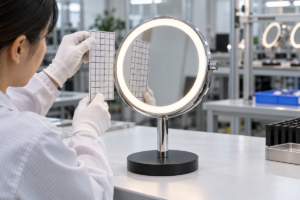
- compliance or testing requirement
If the market has compliance requirements, buyers should also cross-check which certifications matter for LED makeup mirrors before sample approval.
Custom LED Makeup Mirror Buyer Checklist
| Checkpoint | Why It Matters | Buyer Action |
|---|---|---|
| Target user | Defines size, style, and feature priority | State whether the mirror is for retail, e-commerce, gifting, or professional use |
| Lighting spec | Affects user experience and returns risk | Confirm color temperature, dimming, and CRI expectations |
| Power design | Affects freight, safety, and convenience | Choose battery, rechargeable, USB-C, or dual-power early |
| Branding | Impacts perceived value and MOQ planning | Send vector logo files and finish references |
| Packaging | Impacts damage rate and retail readiness | Confirm inner protection, box type, barcode, and carton marks |
| Sample approval | Prevents rework before mass production | Lock final spec before artwork and bulk scheduling |
Common Mistakes Buyers Should Avoid
- Requesting customization before defining the end market, which leads to vague sampling and repeated revisions.
- Focusing only on appearance while ignoring packaging protection, certification, or charging safety.
- Changing lighting, structure, or logo position after sample approval, which can reset cost and lead time.
- Choosing magnification or power options without considering how consumers actually use the mirror.
Customization Decision Matrix for Business Buyers
| Customization area | Best-fit buyer scenario | What to confirm before RFQ |
|---|---|---|
| Logo and brand marking | Beauty brands, retailers, distributors | Logo position, printing method, minimum order quantity, artwork file, and sample approval standard. |
| Lighting and magnification | Makeup mirror lines for retail or e-commerce | CCT, brightness, dimming, magnification level, battery or plug-in design, and user safety expectations. |
| Frame color and finish | Private-label assortments and gift channels | Target price band, finish durability, color tolerance, scratch risk, and repeat-order consistency. |
| Packaging and manuals | Amazon sellers, retailers, importers | Color box design, barcode, instruction language, carton protection, drop-test needs, and shipping method. |
| Product structure | ODM buyers building a differentiated line | Tooling need, development time, sample cost, testing plan, replacement policy, and production lead time. |
For sourcing teams, the safest customization path is to separate low-risk branding changes from structure-level ODM changes. Logo, color, and packaging updates are usually easier to sample and repeat. New structures, new lighting systems, or battery changes require stricter testing, clearer MOQ discussion, and more time before mass production.
FAQ
Can buyers customize both the mirror and the packaging?
Yes. In most private-label programs, buyers can customize the mirror finish, logo, power design, packaging artwork, manual, and carton marks together.
Do custom LED makeup mirrors always require a new mold?
No. Many projects start from an existing product platform, then adjust branding, color, lighting, or accessories. New molds are usually only needed for exclusive structure or shape changes.
What is the most important information to confirm before sampling?
The buyer should confirm target user, sales channel, size, lighting mode, magnification, power source, packaging need, and compliance requirement before sample production starts.
Bottom Line for Buyers
The best custom LED makeup mirror projects do not start with decoration alone. They start with the buyer’s market, then connect mirror type, feature requirement, packaging method, and compliance expectations into one clear OEM/ODM brief.
Talk to Mingda Mirror
If you are planning a private-label or OEM/ODM mirror program, contact Mingda Mirror with your target market, preferred style, feature list, and quantity plan. You can also review the home page and related mirror categories to narrow the right product direction before quotation.
CTA
If you are preparing a private-label makeup mirror order, contact Mingda Mirror with your target market, quantity, logo files, packaging needs, sample expectations, and required lead time.
CTA
If you are preparing a private-label makeup mirror order, contact Mingda Mirror with your target market, quantity, logo files, packaging needs, sample expectations, and required lead time.