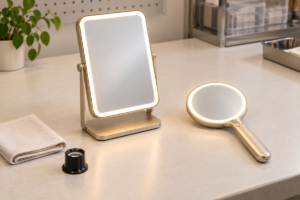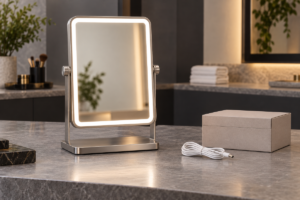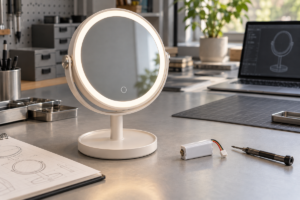

For beauty retailers and distributors, LED makeup mirror retail display planning should connect the mirror assortment, shelf space, lighting demo, packaging, barcode labels, tester control, and replenishment plan before the order is placed. A mirror that looks good in a product photo can still underperform in stores if buyers choose too many similar SKUs, weak demo lighting, oversized packaging, or unclear shelf tags. The best display plan helps shoppers compare mirror size, lighting, magnification, finish, and price tier quickly while helping stores manage inventory and returns.
This checklist is written for beauty stores, retail chains, distributors, wholesalers, private-label brands, and Amazon-to-retail sellers sourcing LED tabletop makeup mirrors, rechargeable mirrors, compact mirrors, and gift-ready mirror programs.
Why Retail Display Planning Matters
LED makeup mirrors are decision products. Shoppers usually want to see the light, mirror size, stand stability, magnification, charging method, and finish before they buy. If the display does not make these differences clear, buyers may get slow sell-through even when the product quality is acceptable.
Retail display planning also affects the supplier quotation. Packaging size, retail box structure, tester units, shelf tags, barcode labels, gift-box sleeves, and carton packing all influence cost, MOQ, lead time, and warehouse handling. For distributors, a stronger display plan makes it easier to sell the same mirror line to multiple stores without redesigning the assortment for every customer.
The practical sourcing rule is simple: do not buy a retail LED makeup mirror line as isolated products. Buy it as a store-ready selling system.
Build the Assortment Around Clear Shopper Choices
A strong retail assortment should give shoppers a reason to compare, not just a row of similar round mirrors. Buyers should normally define three levels: entry, core, and premium. Each level should have a different job in the store.
| Retail Role | Recommended Mirror Type | Buyer Decision Point | Risk If Ignored |
|---|---|---|---|
| Entry SKU | Compact or smaller LED tabletop mirror | Accessible price, simple lighting, giftable box | Low price but weak margin or poor repeat value |
| Core SKU | Rechargeable tabletop LED makeup mirror | Best balance of size, brightness, finish, and packaging | Too many similar core models confuse shoppers |
| Premium SKU | Larger dimmable or metal-frame LED mirror | Higher perceived value, better demo effect | Expensive SKU may sit if display does not show value |
| Gift SKU | Portable LED mirror with pouch or sleeve | Seasonal gifting, travel, beauty bundles | Packaging may look too plain for gift channels |
| Tester Unit | Working display sample | Lighting demo, touch switch, magnification trial | Broken tester damages trust in the whole line |
For a first retail order, fewer well-separated SKUs are usually better than a wide catalog. A buyer can start with one compact or travel mirror, one core rechargeable tabletop mirror, and one premium larger or metal-finish mirror. After sell-through data arrives, the distributor can adjust color, magnification, packaging, and reorder quantity.
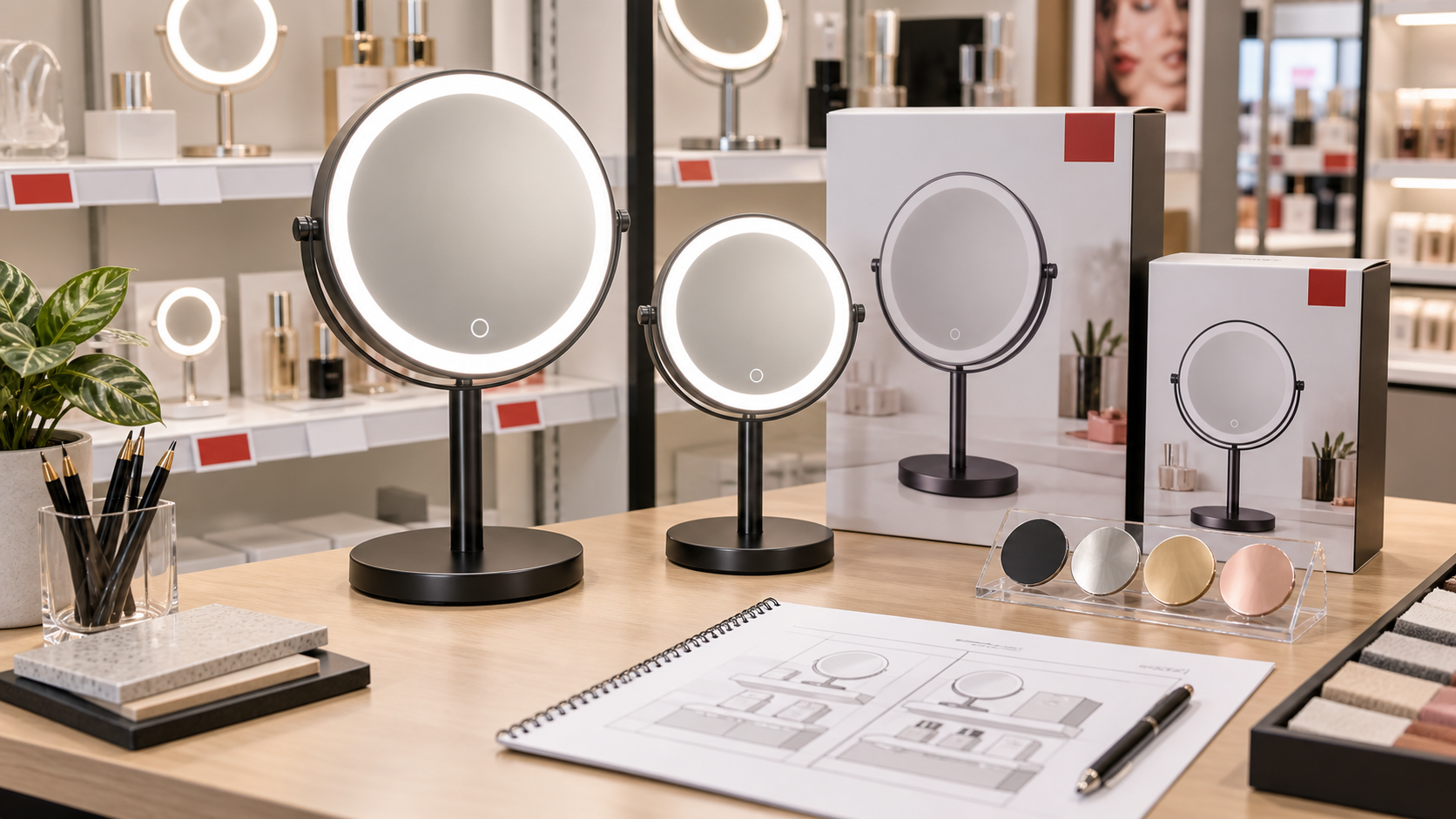
Match Display Space to Mirror Size and Packaging
Shelf space is a real cost. Before confirming an order, buyers should check the mirror dimensions, retail box dimensions, display footprint, and master carton quantity. A mirror that looks premium may be difficult to place if the box is too deep for a standard beauty shelf or if the tester base uses too much counter space.
For LED tabletop makeup mirrors, confirm the mirror head diameter, stand height, base diameter, viewing angle, and cable position. For rechargeable models, the store display should show whether the mirror uses USB-C, charging dock, dry battery, or plug-in power. If the mirror has magnification, the package and shelf tag should make the magnification level easy to understand without overclaiming performance.
Retail buyers should also consider how the product looks from three distances: the aisle view, the shelf view, and the close-up trial view. The LED ring should be visible enough to attract attention, but not so bright that it creates glare for shoppers or store staff.
Packaging and Barcode Details for Retail Orders
Retail packaging has two jobs: sell the product and keep store operations clean. The box should show the mirror type, finish, power source, key feature, and product image clearly. At the same time, barcode placement, carton marks, model number, and buyer SKU should support receiving, scanning, replenishment, and return handling.
For distributors serving several retailers, packaging may need neutral branding, private-label artwork, removable stickers, or market-specific barcode labels. These details should be discussed before the supplier quotes, because artwork approval, barcode setup, color-box printing, inserts, and sample packaging can affect MOQ and lead time.
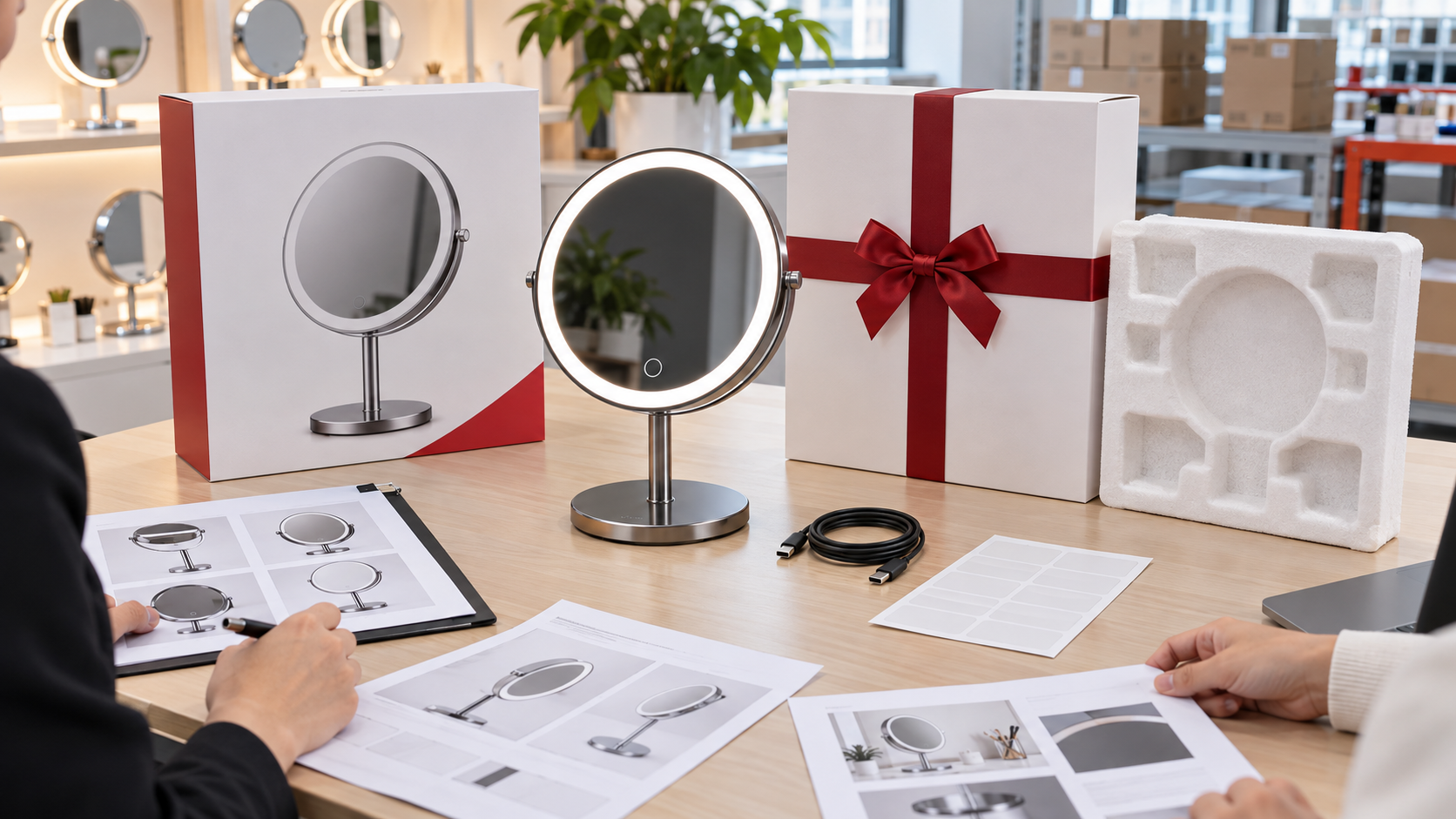
Buyers should request a packed sample that includes the mirror, retail box, insert, cable, manual, barcode labels, carton marks, and any display accessories. The product should be reviewed as the store will actually receive it, not only as a loose factory sample.
Tester Units Need Their Own Control Plan
Many retail problems start with the tester unit. A tester may be handled hundreds of times, left powered on for long periods, moved by staff, or used under store lighting that differs from home use. If the tester becomes loose, scratched, dim, or hard to charge, shoppers may assume the boxed products have the same problem.
Buyers should ask the supplier whether the display sample needs stronger hinge control, spare cable support, charging instructions, anti-theft setup, or replacement parts. The tester should match the selling SKU in lighting color, touch-control logic, magnification, and finish. If the tester uses different components, store feedback will not represent the real product.
For retail chains, define how many tester units are needed per store and whether they are included in the MOQ, invoiced separately, or supplied as a display allowance. This prevents last-minute cost disputes when the buyer places the first bulk order.
Pre-Shipment Display and Label QC
Before shipment, retail-display readiness should be checked alongside normal product QC. The supplier should not only test whether the mirror turns on. They should confirm that the boxed product, tester, labels, cartons, and display accessories match the approved retail plan.
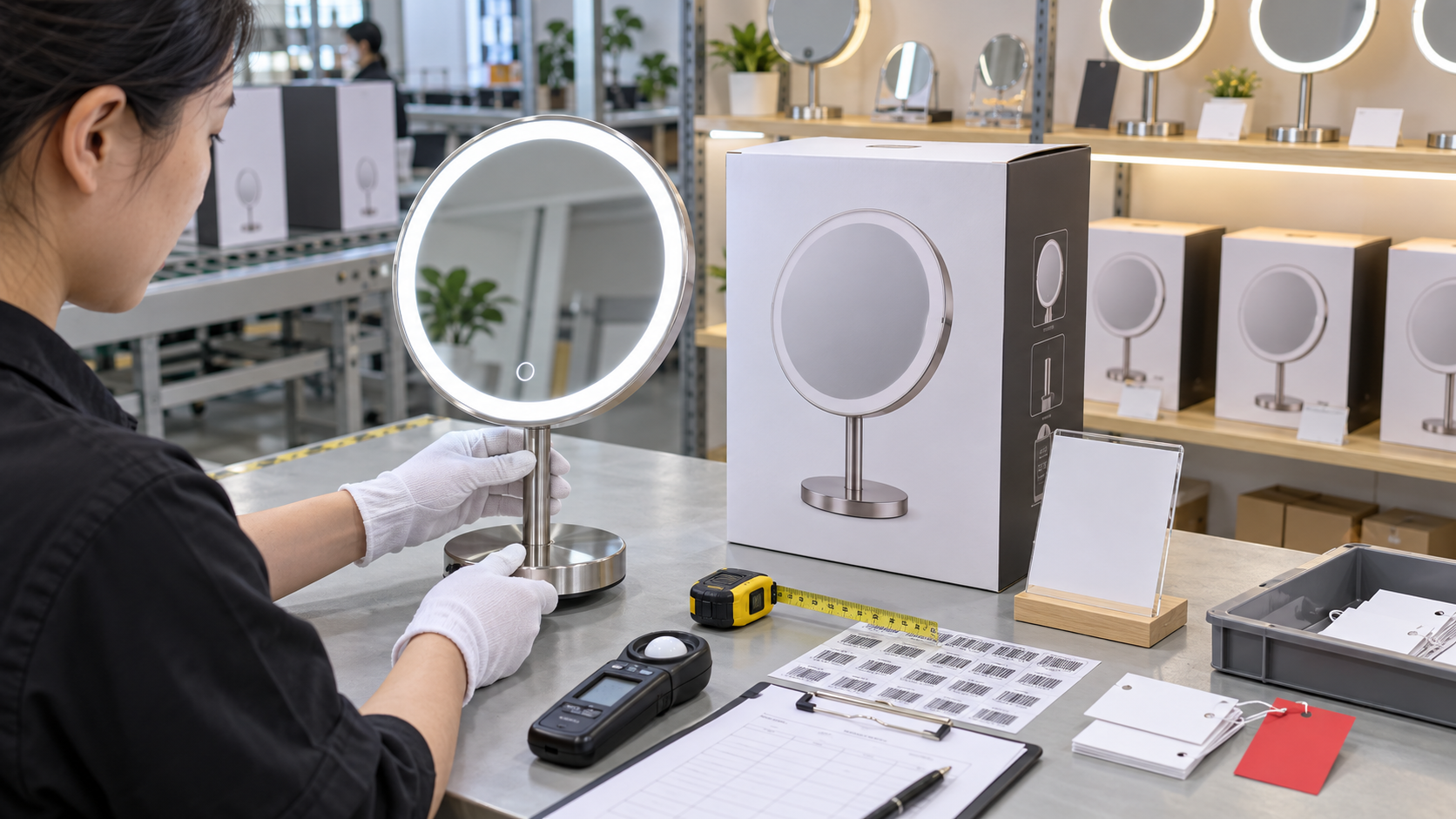
A practical pre-shipment check includes:
- Mirror lighting, dimming, CCT mode, magnification, and touch-control function.
- Stand, hinge, base, and viewing-angle stability for display use.
- Retail box artwork, product image, finish name, barcode, and SKU code.
- Tester unit condition, cable, charging status, and display support parts.
- Carton quantity, carton mark, gross weight, and mixed-SKU separation.
- Packed-sample photos for every SKU before container or parcel release.
- Packaging and label language agreed for the destination market and retailer; approve each required language version.
- Reorder reference photos linked to the factory model number and buyer SKU.
This check is especially important when a distributor orders several similar mirrors with different finishes, magnification levels, or packaging versions. Small label mistakes can create store receiving problems and customer returns even when the product itself is good.
Commercial Implications: MOQ, Lead Time, and Reorders
Retail display planning changes the quotation conversation. A simple standard box may have a lower MOQ, but a private-label box, gift sleeve, display tray, or retailer-specific barcode may need artwork approval and printing minimums. Tester units, replacement cables, and spare display stands also affect the total program cost.
Lead time should include sample approval, packaging proofing, color confirmation, display sample preparation, mass production, aging or function testing, packing, and final inspection. If the buyer needs a seasonal launch, promotional window, or new-store opening date, these dates should be shared before the supplier confirms the production schedule.
For reorders, the most important control is consistency. Keep the same model number, finish name, packaging file, barcode, carton mark, and tester specification unless a change is approved. This helps stores replenish without confusing shoppers or mixing old and new packaging on the same shelf.
How Should Buyers Evaluate a Store Pilot Before Reordering?
Agree the trial stores, review period, opening sellable stock, receipts, returns, and launch promotion before the pilot begins. Track net units sold per in-stock store-week, return reasons, tester downtime, and remaining sellable units by SKU. Count tester and damaged stock separately. Record stockout days so a poorly supplied store is not mistaken for weak demand, and compare stores with similar display space and promotions.
Set the reorder decision before reviewing results: expand a SKU only when the buyer’s agreed sell-through, margin, return, and service thresholds are met. If testers fail or labels do not scan, fix the issue and repeat the affected store trial before scaling. Use the mirror assortment planning guide to decide which product role deserves more inventory and the spare-parts kit checklist to plan tester support.
RFQ Checklist for Retail and Distributor Buyers
Before requesting a quotation, buyers should prepare:
- Target channel: beauty store, department store, distributor showroom, gift shop, Amazon-to-retail, or mixed channel.
- SKU role: entry, core, premium, gift, tester, or seasonal set.
- Mirror details: size, magnification, lighting modes, dimming, power source, finish, base shape, and charging method.
- Display requirement: shelf depth, counter display, tester quantity, anti-theft need, shelf tags, and sample replacement plan.
- Packaging: color box, gift box, sleeve, molded insert, barcode location, carton mark, and private-label artwork.
- MOQ and forecast: first order quantity, store count, replenishment cycle, and expected reorder timing.
- QC request: lighting test, charging check, hinge stability, packaging inspection, label scan, and packed-sample photos.
- Documentation: product images, specification sheet, barcode file, artwork file, carton list, and after-sales policy.
The more clearly buyers define the retail job of each SKU, the more accurately the supplier can recommend mirror structure, packaging, and order plan.
Close Pilot Exceptions Before the Next Store Rollout
At the two-week review, reconcile each store’s received units, sellable stock, tester units, damaged units and returns by buyer SKU and packaging revision. Record tester downtime and out-of-stock days separately so unavailable stock is not counted as evidence of weak demand. Keep the review cutoff and promotional conditions attached to the result.
For an unreadable barcode, failed tester or incorrect shelf label, record the affected store and lot, corrective owner, replacement date and successful recheck before adding stores. Confirm whether the correction also changes the manual, accessory kit or packed sample. Use the channel-fit pilot matrix when the same model moves into a new channel; store approval alone does not establish parcel-delivery readiness.
Bottom-Line Recommendation
For retail LED makeup mirror programs, buyers should source the product, packaging, tester, labels, and shelf plan together. Choose fewer SKUs with clearer roles, make the lighting demo easy to understand, control barcode and packaging details, and verify the store-ready version before shipment.
Mingda Mirror supports beauty retailers, distributors, and private-label buyers with LED makeup mirror selection, packaging development, retail display planning, sample approval, and pre-shipment QC. Buyers can review Makeup Mirrors, explore OEM/ODM customization, check Mingda’s QC process, or contact Mingda Mirror with target channel, store count, shelf dimensions, SKU forecast, tester quantity, packaging version, destination, and launch date. Request separate product, tester, display, packaging, and spare-part costs, with sample approval dates and written replacement terms.
FAQ
How many LED makeup mirror SKUs should a retailer start with?
As a starting scenario, evaluate three to five distinct selling SKUs: one compact or entry option, one core rechargeable tabletop mirror, one premium model, and optional gift or tester units. The exact number depends on shelf space, price range, and reorder plan.
Should retail buyers order tester units?
Yes, if the store allows product trial. A working tester lets shoppers compare brightness, touch control, size, and magnification; verify any sales benefit through a store pilot. Tester units should match the selling SKU and include a plan for charging, cleaning, and replacement.
What packaging details matter most for retail LED makeup mirrors?
Retail buyers should confirm box size, product image, finish name, barcode position, insert protection, accessory list, carton marks, and private-label artwork. These details affect both shelf conversion and store receiving.
Can one display plan work for multiple retailers?
Sometimes. Distributors can use a core display plan, but barcode labels, language, artwork, shelf depth, and tester policy may change by retailer. Confirm these details before mass production.
What should buyers send Mingda Mirror before an RFQ?
Send target market, store type, expected quantity, mirror size, lighting requirement, power source, packaging style, barcode needs, tester-unit plan, and any retailer compliance or display rules.
Social Media Content Ideas
LinkedIn angle: retail LED makeup mirror sourcing works best when product, tester, packaging, barcode, and shelf plan are approved as one selling system.
Facebook angle: before putting LED makeup mirrors into beauty stores, check whether shoppers can easily compare size, light, finish, and price tier.
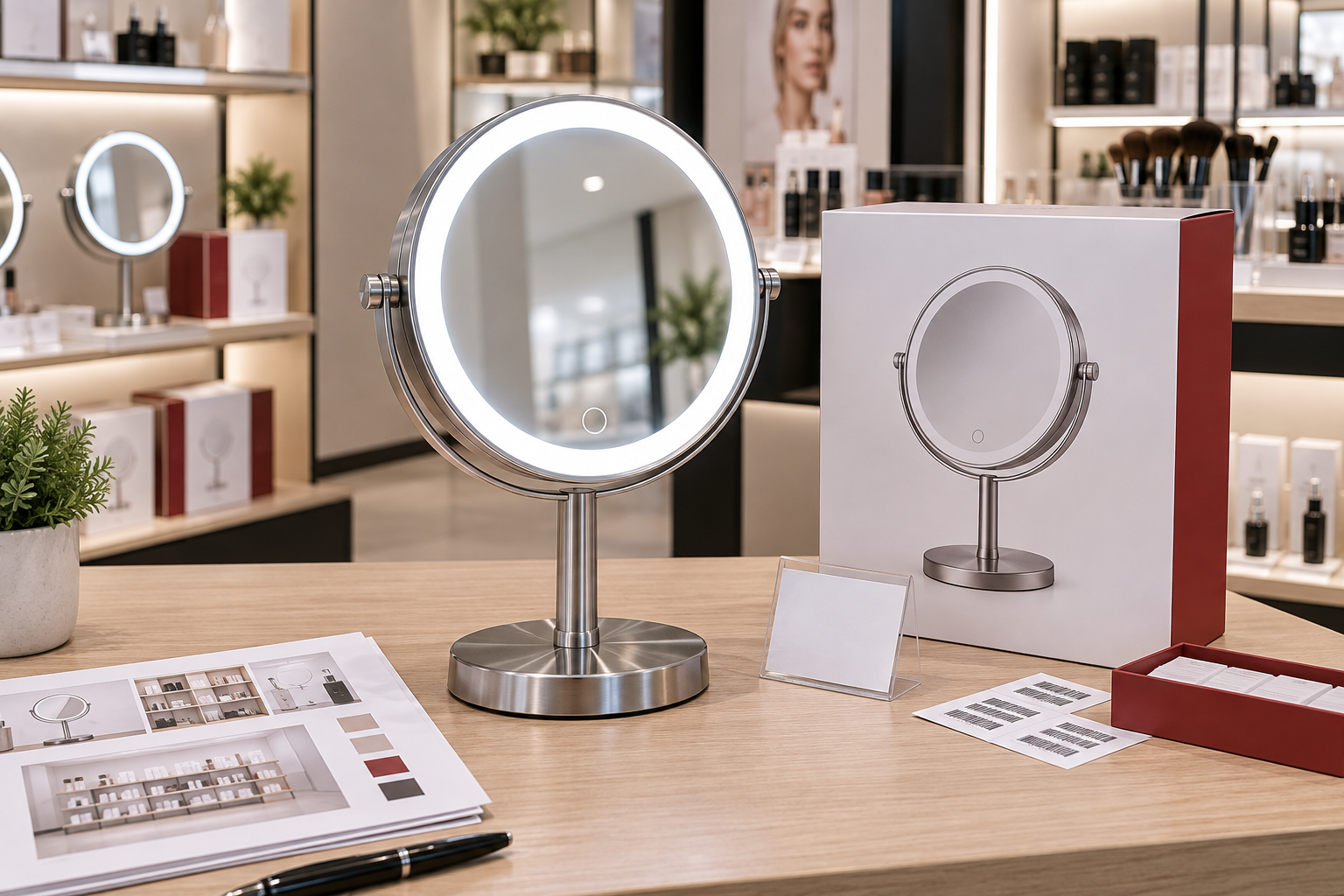
Instagram angle: use the retail display planning cover to show a complete LED makeup mirror, box, shelf tags, and buying props in one store-ready scene.
CTA: read the full checklist and send Mingda Mirror your target channel, store count, mirror style, packaging requirement, and first-order plan for an RFQ-ready display review.