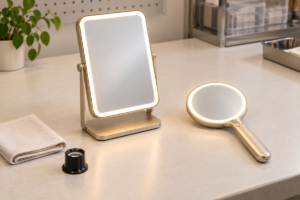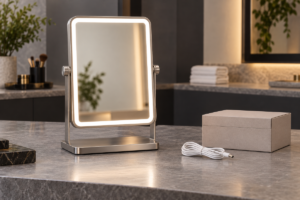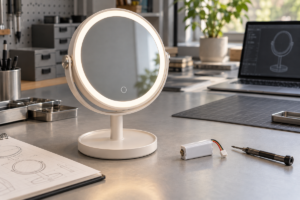

LED makeup mirror channel fit means choosing mirror models, packaging, power design, and replenishment logic based on where the product will be sold. A retail chain may need strong shelf presentation and easy comparison. An e-commerce seller needs damage control, clear claims, and review stability. Gift channels need compact value and packaging appeal. Salon or professional buyers need durability and predictable lighting. The safest sourcing decision is not to buy one “best” mirror for every channel, but to build a controlled model map before quotation.
Start with the fewest models that serve distinct channel needs within your trial budget, shelf capacity and MOQ by finish. Two to four roles can be a planning example; use approved samples and a channel pilot to decide which models justify stock before expanding the range.
Why Channel Fit Matters Before RFQ
Many LED makeup mirror projects fail commercially because the product is technically acceptable but poorly matched to the selling channel. A rechargeable tabletop mirror with premium packaging may work well for a beauty brand, but the same specification can be too expensive for a promotion channel. A compact mirror may be perfect for travel retail, yet too small to carry a high Amazon price point unless the lighting, battery, finish, and content assets are strong enough.
Before asking for a quotation, buyers should define the sales channel first, then confirm the product specification. This order matters because channel determines:
- target retail price and acceptable landed cost
- product size and packaging volume
- lighting brightness, CCT, dimming, and magnification needs
- rechargeable, plug-in, or battery operation
- retail box, mailer, insert, and master carton design
- sample approval points and after-sales spare parts
- whether the model should be exclusive, private-label, or open-line
This is especially important for LED mirror products because lighting, charging design, packaging protection, and claim wording all affect returns. A channel-fit review should happen before finalizing mold, finish, packaging artwork, or bulk order quantity.
Channel Model Comparison
| Sales channel | Best-fit mirror type | Main buyer priority | Procurement risk to control | RFQ point to confirm |
|---|---|---|---|---|
| Beauty retail chain | Tabletop LED makeup mirror or premium compact LED mirror | Shelf appeal, finish consistency, clear feature ladder | Too many similar SKUs competing on the same shelf | Display box size, color options, MOQ by finish, barcode placement |
| E-commerce / marketplace | Rechargeable LED makeup mirror with tested packaging | Low damage rate, accurate claims, review stability | Breakage, battery complaints, overstated brightness or magnification | Drop test, battery data, image assets, replacement policy |
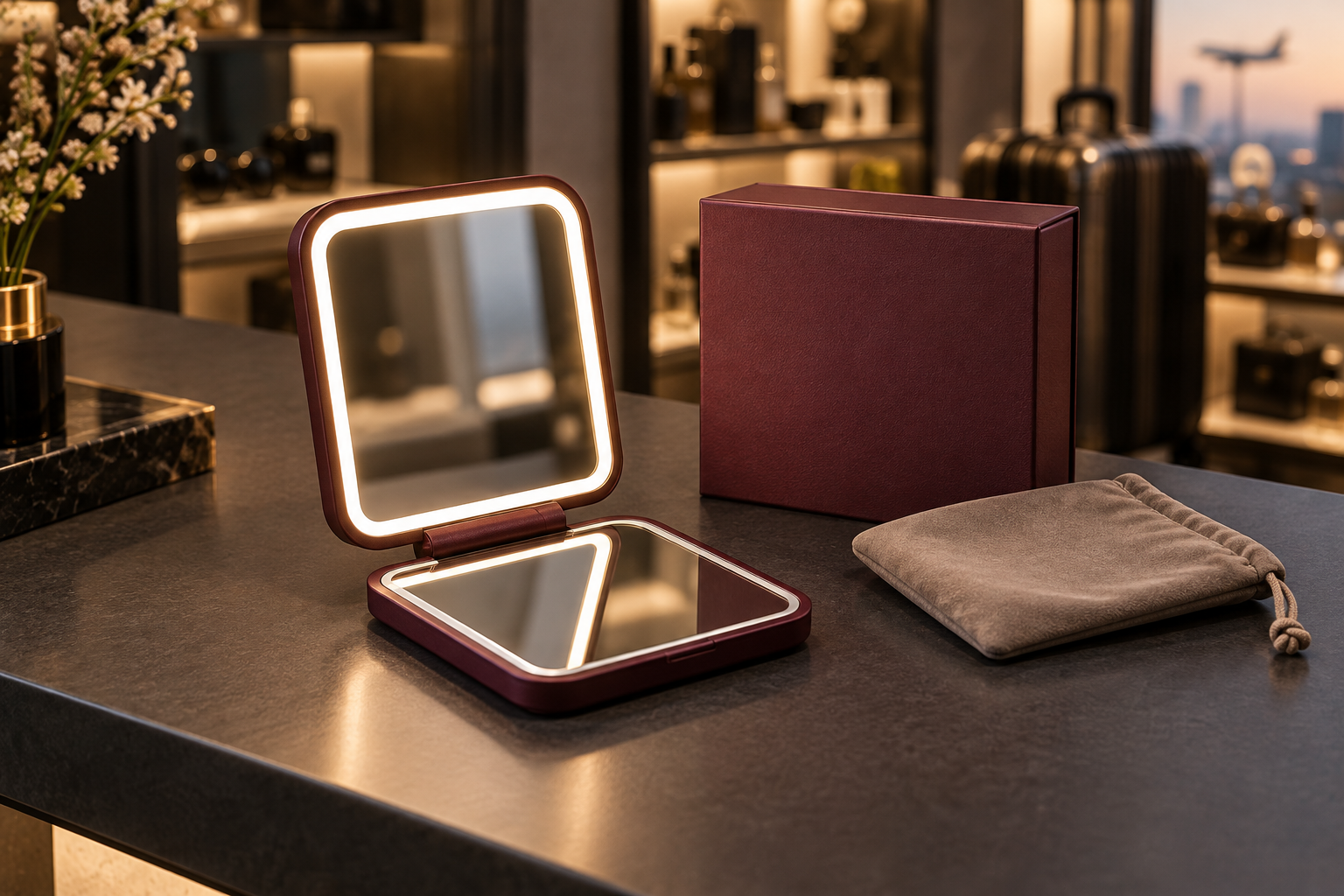
| Gift and travel retail | Compact LED mirror or foldable portable mirror | Attractive packaging, light weight, easy price point | Weak hinge, short battery life, packaging that feels low value | Hinge cycle test, USB cable spec, gift box finish, inner carton quantity |
| Salon and professional use | Larger tabletop or wall-mounted LED mirror | Durable structure, comfortable lighting, stable base or arm | Loose joints, glare, unstable stand, difficult cleaning | frame material, joint torque, CRI/CCT range, spare parts availability |
This table should not be treated as a fixed catalog. It is a starting decision matrix. A distributor may decide to carry one premium tabletop mirror for beauty retail, one compact LED mirror for gift stores, and one damage-tested rechargeable model for e-commerce. The important point is that each model has a clear job.
Retail Chain Buyers: Build a Clear Feature Ladder
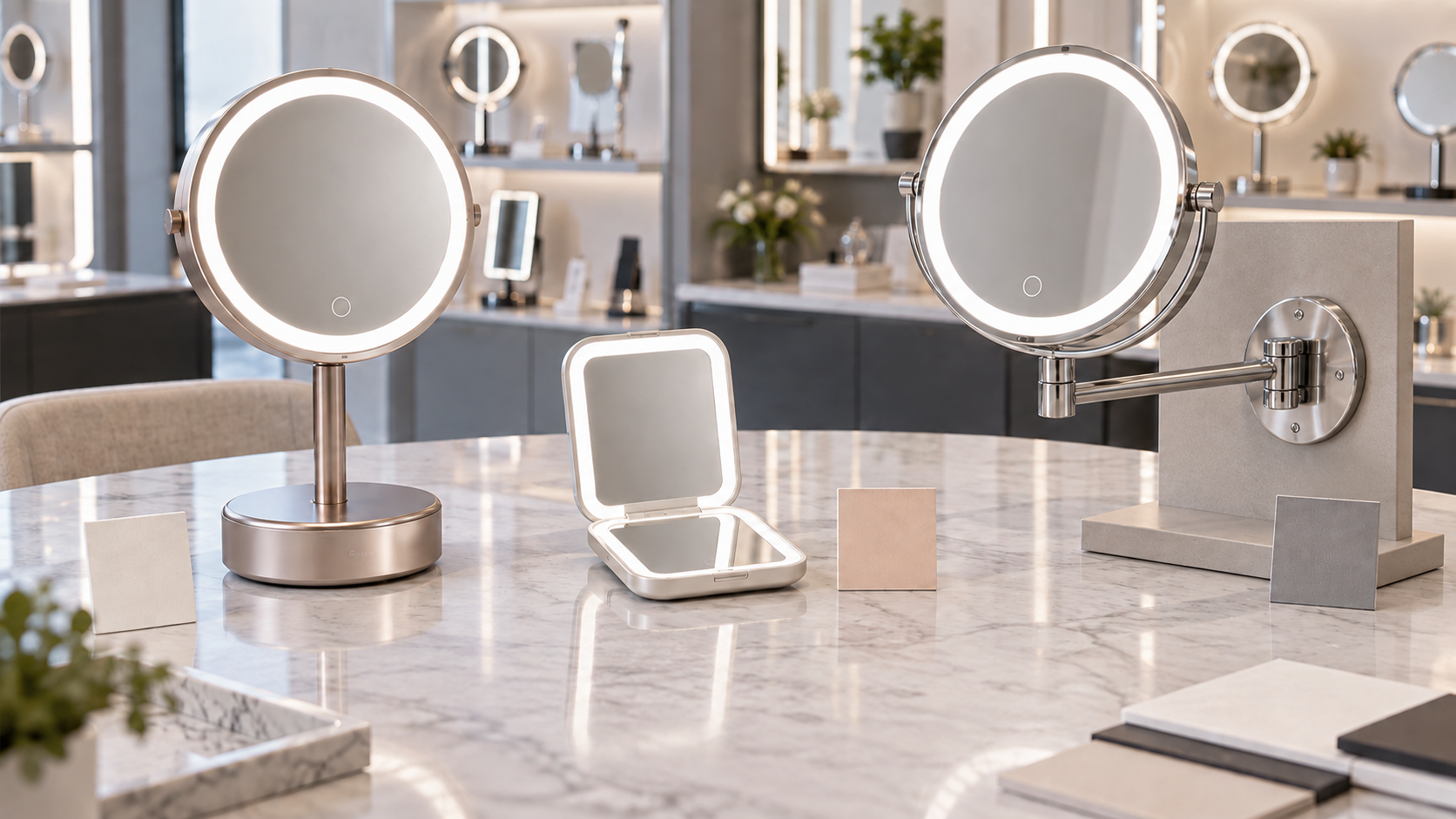
Retail stores need fast visual comparison. Buyers should avoid selecting several LED makeup mirrors that look almost identical but differ only in small technical details. On a shelf, that creates confusion rather than choice.
A stronger retail assortment usually has a clear feature ladder:
- an entry model with basic LED lighting and stable tabletop use
- a mid-range model with dimming, rechargeable power, or magnification
- a premium model with better finish, larger mirror size, stronger packaging, or private-label positioning
For retail buyers, the manufacturer should confirm finish consistency, switch feel, mirror clarity, packaging size, barcode area, carton quantity, and showroom display options. If the product will be displayed out of box, hinge tightness, stand stability, and surface scratch resistance become more important than they may appear in a sample photo.
Retail orders also need disciplined MOQ planning. If each finish or color requires a separate MOQ, a buyer should not approve too many finishes too early. It is better to launch with the strongest color or finish combination, review sales data, and then extend the line.
E-Commerce Buyers: Control Claims, Damage, and Reviews
E-commerce LED makeup mirror sourcing should begin with return-risk control. Online shoppers depend on photos, claims, and reviews, so any gap between listing promise and delivered product can become expensive.
Important checks include:
- whether the LED brightness and dimming range match the product page claim
- whether CCT language such as warm, neutral, and daylight is supported by the actual LED design
- whether the rechargeable battery capacity, charging port, and cable type are documented
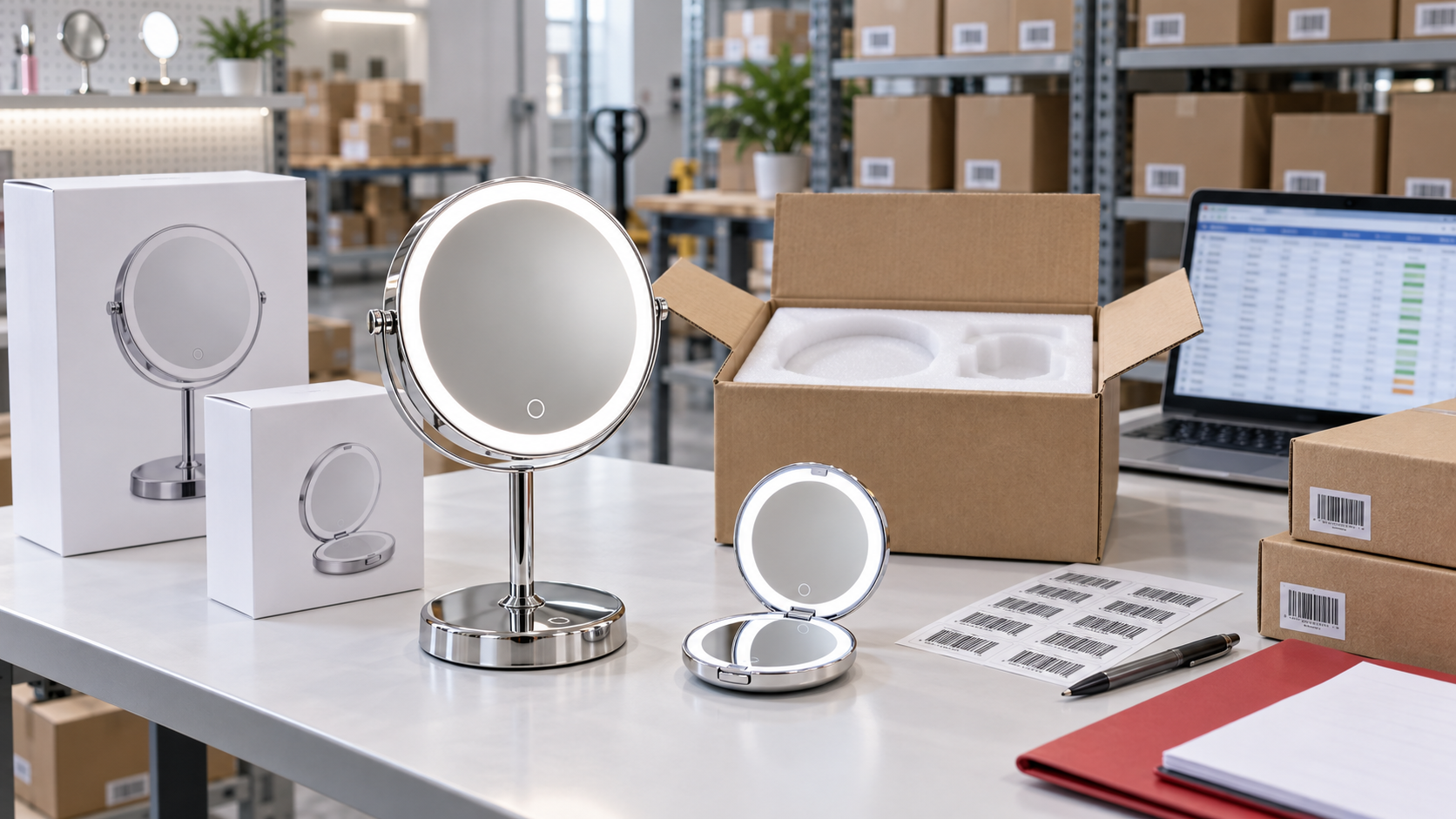
- whether the product can survive parcel handling with the selected retail box and mailer
- whether magnification level is clearly marked and consistent across sample and bulk goods
- whether instruction manuals, safety labels, and after-sales parts are ready before launch
For Amazon, Shopify, TikTok Shop, and other online channels, packaging should be evaluated as part of the product, not as a late cost-cutting item. A mirror that looks strong in a factory sample room can still create bad reviews if the box crushes, the hinge loosens in transit, or the lighting claim is unclear.
Gift and Travel Channels: Keep the Product Compact but Not Cheap
Gift and travel buyers often want a smaller LED compact mirror, but smaller does not mean lower quality. In this channel, the product must feel easy to buy, easy to carry, and good enough to give as a gift.
The strongest gift-channel compact mirrors usually combine:
- a refined shell finish or soft-touch texture
- reliable hinge movement
- bright but comfortable LED lighting
- simple USB charging or battery operation
- compact packaging with good shelf presence
- optional logo, color, and insert-card customization
Buyers should be careful with very low-cost compact mirrors if the hinge, LED diffusion, or battery performance is weak. Gift products are often judged quickly by hand feel and presentation. If the opening feel is loose, the LED ring is uneven, or the packaging looks too basic, the product may struggle even when the price is attractive.
Salon and Professional Channels: Prioritize Durability and Lighting Comfort
Salon and professional users care less about novelty and more about repeat use. A salon LED makeup mirror should be easy to clean, stable during daily handling, and comfortable under longer viewing time.
For this channel, buyers should confirm frame strength, base weight, arm or hinge torque, anti-slip pads, LED diffusion, CRI, CCT, and after-sales spare parts. If the mirror is wall-mounted, installation method and screw pack accuracy must be checked during sample approval. If it is tabletop, the base should not wobble when the mirror angle is adjusted.
Lighting comfort matters because salon users may work under the mirror for longer periods than home users. Excessive glare, visible LED dots, or weak color rendering can make the product feel unprofessional even if the appearance is attractive.
Packaging and Replenishment Planning
Channel fit also affects replenishment. Retail chains may prefer stable carton quantity and predictable shelf-ready boxes. E-commerce sellers may prioritize protective inserts, mailer compatibility, and replacement stock. Gift buyers may ask for seasonal packaging deadlines. Distributors may need a balanced mix that can be reordered without holding too much slow inventory.
Before bulk production, buyers should confirm:
- MOQ by model, color, finish, and packaging version
- sample approval timeline and whether packaging samples are included
- retail box dimensions, gross weight, and master carton quantity
- inner protection method for mirror glass, LED ring, stand, hinge, and cable
- spare parts policy for cables, adapters, screws, stands, and mirrors
- lead time for repeat orders and whether materials are stocked
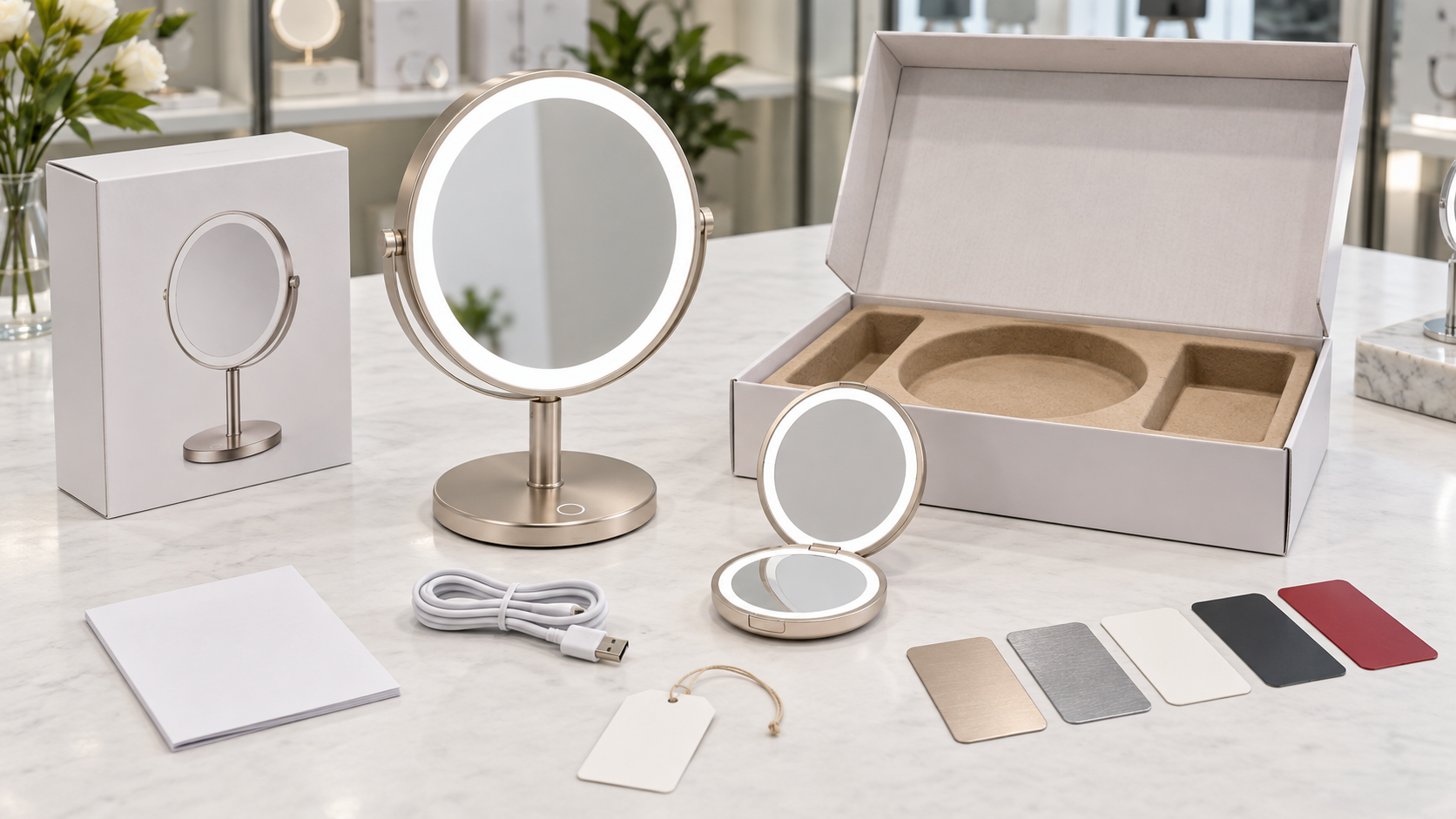
For private-label orders, the buyer should also align logo position, instruction language, warning labels, barcode area, and outer carton marks before mass production. Changing these details after production starts can delay shipment and increase rework cost.
Pre-RFQ Channel-Fit Checklist
Use this checklist before requesting a quotation from a LED makeup mirror supplier:
- Define the primary channel: retail, e-commerce, gift, salon, distributor, or mixed.
- Set the target price band and expected margin before selecting features.
- Decide the hero product type: tabletop, compact, wall-mounted, travel, or professional.
- Confirm lighting requirements: CCT, CRI, brightness, dimming, and glare control.
- Choose the power design: rechargeable, plug-in, replaceable battery, or mixed.
- Confirm magnification level and whether it matches buyer expectations in that channel.
- Select packaging based on channel handling: shelf display, parcel shipping, gift, or wholesale carton.
- Ask for sample testing: hinge movement, charging, aging, drop test, surface finish, and packaging fit.
- Confirm MOQ by each variant before approving too many colors or finishes.
- Prepare product images, manuals, labels, and after-sales policy before launch.
This checklist gives the supplier enough information to quote the correct model rather than guessing from a general product photo.
Approve a Channel Pilot Before Expanding the Range
Give each proposed model a buyer SKU, sample revision, channel owner and trial quantity. Agree the review period and acceptance criteria before ordering; channel labels alone do not prove demand or product suitability. A shared mirror can serve several channels only when the actual accessories, claims and packed configuration pass each channel’s approval.
| Channel pilot | Evidence to retain | Release or hold decision |
|---|---|---|
| Retail store | Shelf dimensions, label scan, tester uptime, stockout days and net units sold per in-stock store-week | Resolve display or tester failures before comparing demand across similar stores |
| Parcel e-commerce | Approved listing revision, packed-sample test conditions, delivered units and reported versus verified damage | Close packaging and claim discrepancies before increasing shipment volume |
| Gift or salon | Delivery deadline, approved branding or cleaning instructions, observed hinge and lighting issues | Confirm the signed sample and replacement arrangements meet the intended use |
Record the observation cutoff, corrective-action owner and recheck date. Keep promotion effects and stockouts visible; neither an attractive sample nor a short trial guarantees future sales. Use the retail display pilot checklist for store execution and the return-risk buying guide to connect customer reports with the actual SKU and lot.
Two-Week Review: Keep Channel Configurations Traceable
At the first pilot review, link each channel result to the buyer SKU, lot, packaging revision and live listing or shelf-label revision. Separate units received, units inspected, saleable stock and reported returns. Keep damaged stock out of reorder availability and do not extrapolate a two-week return count to a full product lifetime.
If the same mirror performs differently across channels, first check promotion exposure, in-stock days, accessory differences and delivery handling before changing the mirror specification. Record the issue owner, correction and verification date. For online variants, apply the assortment reorder, hold or exit matrix and check remaining packaging commitments before retiring a SKU.
Bottom-Line Recommendation
For B2B LED makeup mirror buyers, the best channel strategy is to assign each model a commercial role before RFQ. Do not choose a mirror only because it looks attractive in a sample image. Match the model to channel price, packaging journey, product claims, after-sales risk, and replenishment plan.
A strong starting mix may include one retail-ready tabletop LED makeup mirror, one e-commerce-ready rechargeable model with tested packaging, and one compact LED mirror for gift or travel channels. Once sales data is available, buyers can expand colors, finishes, magnification levels, or private-label packaging with less inventory risk.
Mingda Mirror supports brands, distributors, retailers, and e-commerce sellers with LED makeup mirror development, packaging review, sample approval, and OEM/ODM customization. Buyers can review Mingda’s makeup mirror products, OEM/ODM services, quality control process, and contact the team with the target channel and destination, quantity per SKU, price band, sample requirements, packaging version and launch date. Request itemized sample, tooling, packaging and spare-part costs, MOQ by finish and repeat-order lead time for a channel-fit quotation.
FAQ
How many LED makeup mirror models should a distributor launch first?
There is no universal starting quantity of models. Choose distinct channel roles that fit your trial budget, MOQ and replenishment capacity, then expand only after reviewing comparable sales, service and return evidence. Two to four roles are an example, not a minimum assortment requirement.
Should e-commerce buyers choose rechargeable LED makeup mirrors?
Rechargeable LED makeup mirrors can work very well online, but buyers must confirm battery specification, charging port, cable quality, safety labels, packaging protection, and claim accuracy. The product page should match the tested product, not just the ideal sample.
What is the biggest retail-channel mistake when buying LED makeup mirrors?
The biggest mistake is building an assortment where every mirror looks similar on the shelf. Retail customers need a clear feature ladder, such as basic, rechargeable, magnifying, compact, and premium finish options.
What should private-label buyers confirm before packaging approval?
Private-label buyers should confirm logo position, box structure, manual language, warning labels, barcode area, carton marks, insert fit, and product image accuracy. Packaging approval should happen with the actual mirror sample, not separately.
Can one LED makeup mirror model serve retail and e-commerce channels?
Yes, but only if packaging and claims are adjusted for both channels. Retail needs shelf appeal and comparison clarity. E-commerce needs stronger parcel protection, accurate online content, and return-risk control.
Social Media Content Ideas
LinkedIn angle: Explain why channel fit should come before RFQ when sourcing LED makeup mirrors for retail, e-commerce, gift, or salon programs.
Facebook angle: Share a buyer-friendly comparison of which LED makeup mirror type works best for each sales channel.
Instagram angle: Use the private-label approval image to show packaging, finish swatches, and mirror samples before bulk production.
CTA: Read the full channel-fit checklist and request a Mingda Mirror quotation for your target market.