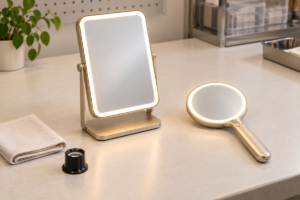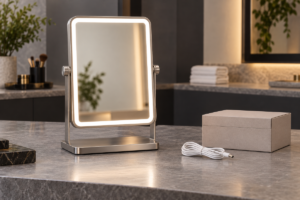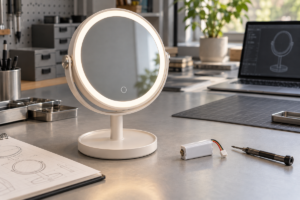

Mirror assortment planning should give every SKU a clear channel role: traffic item, core volume item, premium margin item, seasonal gift item, or project/order-specific item. Retail chains and distributors should not simply buy many similar mirrors. A balanced assortment combines LED makeup mirrors, handheld or compact mirrors, Hollywood mirrors, and selected bathroom or project mirrors with controlled packaging, MOQ, lead time, and replenishment logic.
This article is for retail chain buyers, distributors, wholesalers, category managers, and sourcing teams building a mirror program across several sales channels.
Useful starting points: Product | Handheld Mirror Sourcing Guide | Hollywood Mirrors.
Assign a role to every SKU
A mirror assortment becomes hard to manage when several items compete for the same buyer need. One product should win on price, one should win on everyday value, one should represent premium function, and one may support gift, travel, salon, or project demand. This role-based method helps buyers avoid duplicated inventory and makes supplier quotations easier to compare.
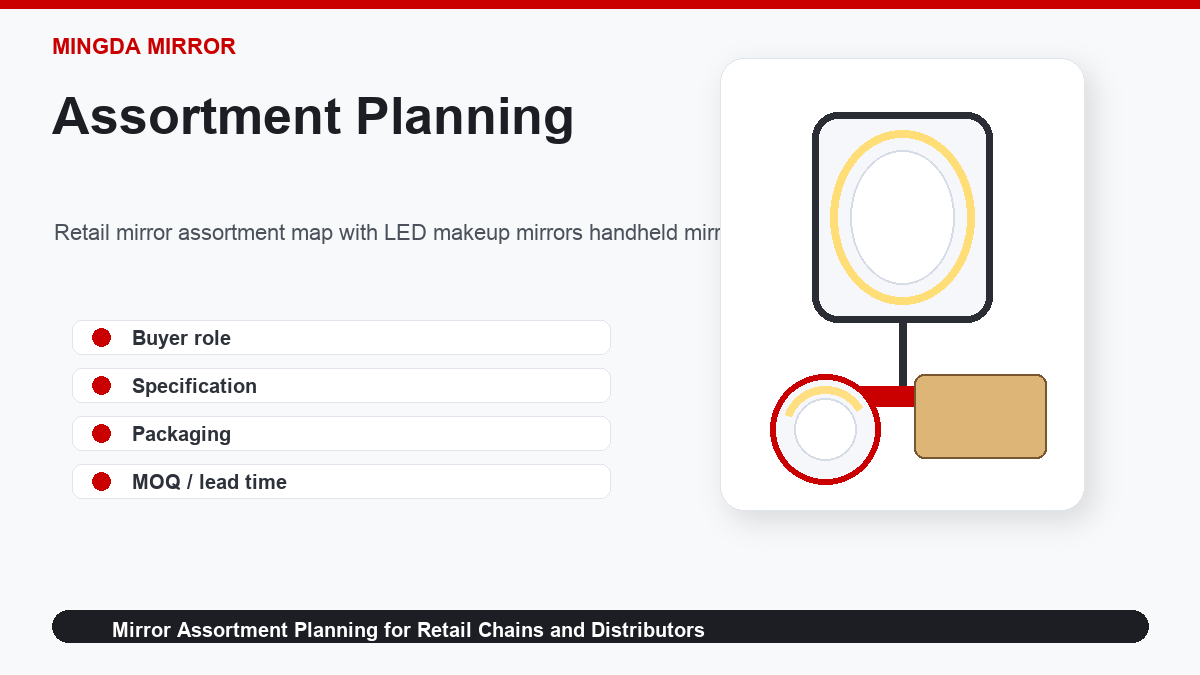
Balance product types across the range
A practical program may include LED tabletop makeup mirrors for daily beauty use, handheld or compact mirrors for travel and gift channels, Hollywood mirrors for vanity and salon presentation, and bathroom LED mirrors for project or higher-ticket demand. The exact mix depends on store size, distributor customer base, target margin, and shipping model. The key is to avoid a catalog filled with small visual differences but no clear commercial difference.
Separate retail, e-commerce, and distributor needs
Retail chains care about shelf impact, barcode accuracy, packaging consistency, and stable reorder SKUs. E-commerce sellers care about parcel protection, listing images, user instructions, and review risk. Distributors care about carton efficiency, replacement policy, and the ability to serve several downstream buyers from the same inventory. The same mirror may need different packaging or accessory rules for each channel.
Use MOQ and lead time to control assortment width
A wide assortment can look attractive in a presentation but become expensive when each SKU has separate MOQ, custom packaging, manuals, labels, and replacement parts. Buyers should check product MOQ, packaging MOQ, sample lead time, artwork lead time, production lead time, and expected reorder cycle before confirming too many models. A focused launch is often better than a large line with slow-moving inventory.
Plan packaging before final SKU selection
Packaging should match the product role. Traffic items need cost-efficient but protective cartons. Premium items need stronger brand presentation and clearer feature explanation. E-commerce items need drop-resistant packing and simple user instructions. Distributor cartons need clear marks, loading efficiency, and easy warehouse identification. These packaging choices should be included in the quotation, not negotiated after price approval.
Review assortment performance after samples and first order
The first order should create learning for the next cycle. Buyers should track sample approval issues, carton damage, customer questions, slow-moving SKUs, high-return features, and reorder timing. A supplier can help adjust finish colors, packaging, magnification, power source, or accessory bundle when the data is reviewed before the next purchase order.
Separate Display Problems from Assortment Problems
Before dropping a slow SKU, check whether stores had sellable stock, a working tester, a readable shelf label, and the agreed display space. Compare net unit sales per in-stock store-week and record promotions, returns, tester downtime, and stockout days. An unavailable item or broken tester cannot provide a fair demand signal. Agree the margin, return, and replenishment thresholds with the buyer before expanding the range.
Use the LED makeup mirror retail display planning checklist to approve the store-ready sample and pilot record. Separate display and spare units from sellable stock when calculating the next purchase order.
Buyer Decision Matrix
| Option | Best use | Best channel | Buyer risk to control |
|---|---|---|---|
| Traffic SKU | Accessible price and simple feature story | Retail chains and distributors | Do not over-customize or weaken carton protection |
| Core SKU | Best balance of function, margin, and reorder stability | Main volume channel | Lock specifications and packaging before scaling |
| Premium SKU | Higher lighting, finish, size, or presentation value | Brand image, gifting, salon, hero display | Confirm demand before accepting high MOQ |
| Channel SKU | Special size, packaging, or accessory bundle | E-commerce, project, seasonal, or regional buyer | Keep separate quote and reorder plan |
Pre-RFQ Checklist
- Map each SKU to a buyer role before selecting models.
- Balance LED makeup, handheld, Hollywood, and project mirror opportunities by channel.
- Check MOQ, packaging MOQ, sample lead time, production lead time, and reorder cycle.
- Confirm barcode, carton marks, manual language, color box, and accessory packing.
- Approve packed samples and inspection criteria before mass production.
- Review first-order returns, damage, slow sellers, and reorder data before expanding the range.
Commercial Notes for Sourcing Managers
Sourcing managers should ask for separate lines for product cost, packaging cost, customization cost, sample cost, tooling or setup fees, and replacement terms. This prevents a low unit price from hiding missing cartons, labels, manuals, accessories, or after-sales responsibility. For private-label orders, confirm artwork approval timing and whether packaging MOQ is different from product MOQ.
Bottom Line
Good mirror assortment planning is disciplined. Retail chains and distributors should launch with clear SKU roles, controlled packaging, realistic MOQ, and a supplier workflow that supports replenishment instead of creating a wide but fragile catalog.
FAQ
What should buyers confirm before asking for a quotation?
Buyers should confirm target channel, expected price range, product role, key specifications, packaging style, logo requirements, order quantity, and sample approval steps.
How does MOQ affect product planning?
MOQ affects how many models, colors, packaging versions, and replacement parts can be managed safely. A focused launch usually reduces inventory and rework risk.
Should packaging be approved before bulk production?
Yes. Buyers should approve a packed sample because packaging affects breakage risk, retail presentation, barcode accuracy, carton size, and customer experience.
Can Mingda support private-label mirror orders?
Yes. Mingda can support logo, packaging, product selection, sample review, QC, and shipment planning for makeup mirrors, handheld mirrors, Hollywood mirrors, and related LED mirror products.
Social Media Content Ideas
LinkedIn: share one sourcing decision rule from this article for purchasing teams. Facebook: explain the buyer mistake this checklist prevents. Instagram: use the main comparison image as a short visual guide. CTA: read the full blog post and contact Mingda Mirror with target market, quantity, packaging, and customization details.
CTA
If you are planning a mirror order for retail, e-commerce, wholesale, beauty brand, distributor, or project channels, contact Mingda Mirror with your store count, SKU roles, shelf limits, sell-through forecast, target market, packaging versions, and launch date. Request MOQ by model and packaging version, separate tester and spare-unit costs, and a replenishment schedule tied to the approved sample.
Home | Product | Makeup Mirrors | Hollywood Mirrors | QC Process | Contact