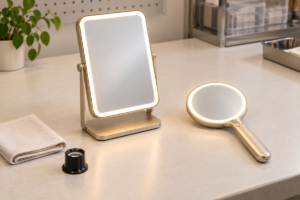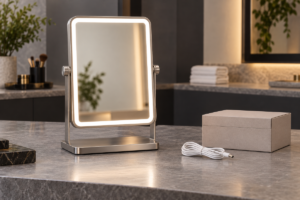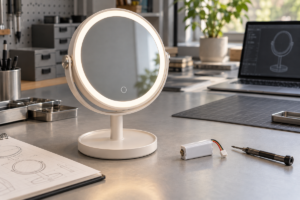

Most makeup mirror buyers should offer 1x for daily makeup, 5x or 7x for detail work, and 10x only when the target customer understands close working distance. Magnification is not automatically better when the number is higher. It changes user comfort, distortion risk, return rate, packaging claims, and product positioning, so buyers should choose magnification levels by channel and user expectation.
This guide helps beauty brands, Amazon sellers, retail buyers, and private-label importers choose magnification levels before confirming a makeup mirror order.
Useful starting points: Makeup Mirrors | Rechargeable vs Plug-In Makeup Mirrors | Contact.
Understand what each magnification level does
A 1x mirror shows the full face and is easiest for daily makeup, skincare, and hair touch-up. A 3x mirror can support light detail work without feeling too close. A 5x or 7x mirror is useful for eyeliner, brow shaping, shaving, and skincare checks. A 10x mirror shows very small details but requires the face to be close to the mirror, so it can create distortion complaints if the packaging does not explain use distance.
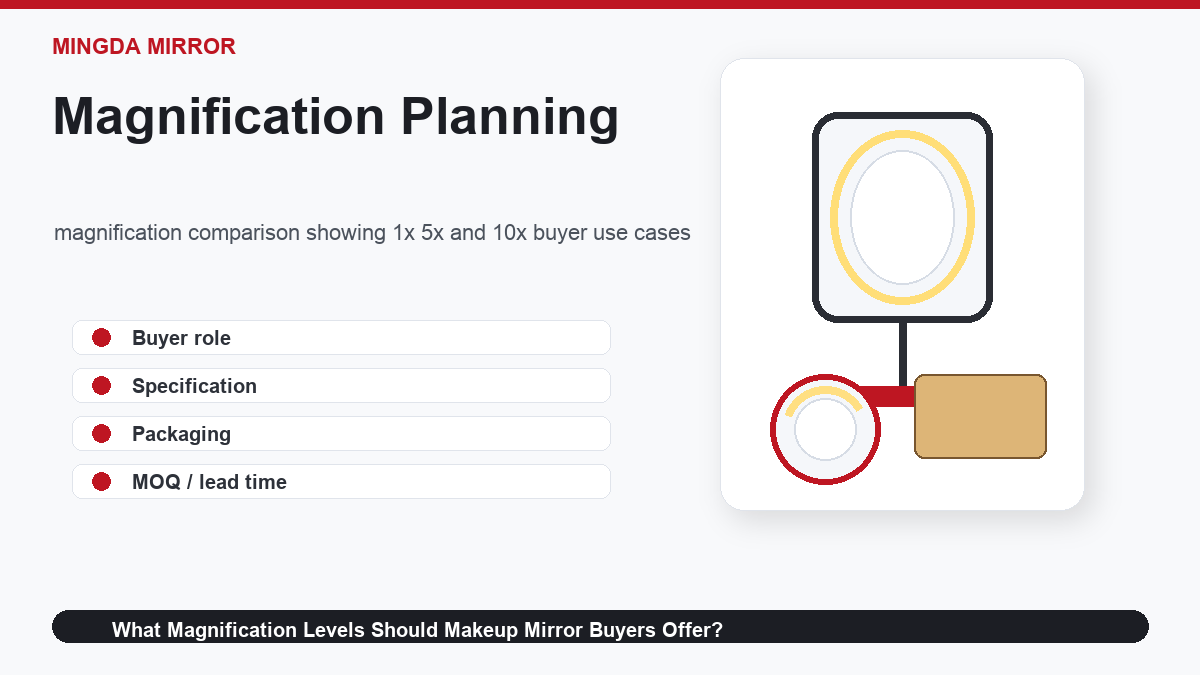
Match magnification to the sales channel
Retail chains often prefer simple claims that are easy for shoppers to understand, such as 1x plus 5x. Amazon sellers may use 1x and 10x, but they need accurate listing copy and images that explain working distance. Beauty brands may choose 1x and 7x to look more professional while avoiding the highest complaint risk. Wholesale buyers should avoid ordering many magnification versions before they know which market segment will reorder.
Decide single-sided or double-sided structure
Single-sided mirrors are simpler and can be lighter, but they usually need a separate small magnifying attachment if detail work is required. Double-sided mirrors provide a clearer product story because one side handles normal viewing and the other side handles detail work. The tradeoff is higher structure cost, more hinge or rotation testing, and a stronger need for packaging protection.
Check optical quality, not only the number
Magnification claims must be supported by optical clarity. Buyers should check distortion near the edge, coating quality, image sharpness, glass bonding, frame stability, and whether the magnified side is labeled clearly. A cheap high-magnification mirror can look attractive in a quotation but create returns if the reflection feels warped or the user cannot find the right distance.
Use instructions to reduce return risk
Many negative reviews come from misunderstanding rather than product failure. High magnification works only at a shorter distance. Buyers should include clear packaging icons, manual notes, and listing copy that explain the correct distance and use case. This is especially important for e-commerce channels where shoppers cannot test the mirror before purchase.
Confirm packaging and sample approval details
Magnifying mirrors can be more sensitive to scratches, pressure marks, and claims about distortion. The purchasing team should approve samples from normal production tooling, then approve packed samples after drop or transport checks. For private label orders, the magnification claim on box, manual, barcode label, and online listing should match the approved product exactly.
Buyer Decision Matrix
| Option | Best use | Best channel | Buyer risk to control |
|---|---|---|---|
| 1x | Full-face daily makeup and skincare | All channels, entry and core items | Low complaint risk but less detail value |
| 5x or 7x | Brow, eyeliner, shaving, close detail | Beauty brands, retail, salon, e-commerce | Best balance when optical quality is stable |
| 10x | Very close detail work | Niche users and strong listing education | Higher distortion and distance misunderstanding risk |
Pre-RFQ Checklist
- Define whether the item is daily-use, travel, salon, beauty brand, or e-commerce focused.
- Choose 1x plus one detail level instead of offering too many versions at launch.
- Check distortion, edge clarity, coating, hinge strength, and reflected image comfort.
- Confirm packaging and listing text explain working distance for higher magnification.
- Approve the exact magnification label on product, color box, manual, and barcode file.
- Ask for replacement rules if optical defects or mirror scratches appear after shipment.
Commercial Notes for Sourcing Managers
Sourcing managers should ask for separate lines for product cost, packaging cost, customization cost, sample cost, tooling or setup fees, and replacement terms. This prevents a low unit price from hiding missing cartons, labels, manuals, accessories, or after-sales responsibility. For private-label orders, confirm artwork approval timing and whether packaging MOQ is different from product MOQ.
Bottom Line
For most commercial makeup mirror lines, 1x plus 5x or 7x is the safest starting point. Use 10x only when the buyer can educate the channel clearly and accept stricter sample approval for optical quality and packaging claims.
FAQ
What should buyers confirm before asking for a quotation?
Buyers should confirm target channel, expected price range, product role, key specifications, packaging style, logo requirements, order quantity, and sample approval steps.
How does MOQ affect product planning?
MOQ affects how many models, colors, packaging versions, and replacement parts can be managed safely. A focused launch usually reduces inventory and rework risk.
Should packaging be approved before bulk production?
Yes. Buyers should approve a packed sample because packaging affects breakage risk, retail presentation, barcode accuracy, carton size, and customer experience.
Can Mingda support private-label mirror orders?
Yes. Mingda can support logo, packaging, product selection, sample review, QC, and shipment planning for makeup mirrors, handheld mirrors, Hollywood mirrors, and related LED mirror products.
Social Media Content Ideas
LinkedIn: share one sourcing decision rule from this article for purchasing teams. Facebook: explain the buyer mistake this checklist prevents. Instagram: use the main comparison image as a short visual guide. CTA: read the full blog post and contact Mingda Mirror with target market, quantity, packaging, and customization details.
CTA
If you are planning a mirror order for retail, e-commerce, wholesale, beauty brand, distributor, or project channels, contact Mingda Mirror with your target market, quantity, specifications, packaging needs, and private-label requirements.
Home | Product | Makeup Mirrors | Hollywood Mirrors | QC Process | Contact