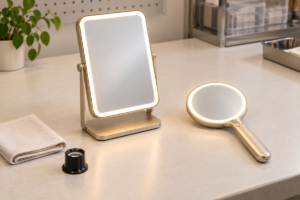

For LED makeup mirror orders, a spare parts kit should be planned before bulk production, not after customer complaints begin. The right kit connects each mirror model to replaceable parts such as USB-C cables, charging bases, hinges, screws, pads, light modules, adapters, manuals, and retail packaging components. For retailers, e-commerce sellers, wholesalers, and distributors, this reduces return cost, speeds up after-sales service, and keeps repeat orders matched to the approved sample.

Why Spare Parts Planning Matters for Mirror Buyers
LED makeup mirrors combine glass, lighting, electronics, plastic or metal structures, packaging, and accessories. A return is not always caused by a failed mirror. Sometimes the issue is a missing USB cable, loose hinge screw, scratched stand pad, damaged retail box, unclear manual, or incompatible charging accessory.
For Amazon and DTC sellers, a small accessory problem can become a full product return, a negative review, or a replacement shipment. For distributors, poor spare parts control can slow down dealer support and make warehouses hold unsellable units. For retail chains, stores may need replacement packaging, testers, or accessory sets without opening a new master carton.
The practical rule is clear: approve the spare parts plan together with the product sample, packaging sample, carton mark, and warranty policy. A low unit price is less useful if the supplier cannot identify, pack, and replenish service parts for the exact model sold.
What Should an LED Makeup Mirror Spare Parts Kit Include?
The spare parts list depends on the mirror structure and sales channel. A rechargeable tabletop mirror needs different parts from a wall-mounted mirror, tri-fold mirror, or compact travel mirror. Buyers should start with the parts most likely to be lost, damaged, replaced, or requested by customer service.
| Spare part or service item | Buyer decision | Why it affects after-sales cost |
|---|---|---|
| USB-C cable or charging cable | Match port type, cable length, color, and plug policy | Prevents charging complaints caused by mismatched accessories |
| Charging base or detachable stand | Confirm compatibility by model number and finish | Reduces full-unit replacement when only the base is damaged |
| Hinge screws and small hardware | Define screw type, finish, and packing method | Helps repair loose stands, arms, or foldable structures |
| Rubber pads and anti-slip parts | Confirm shape, adhesive, color, and spare quantity | Prevents wobble complaints and surface-scratch claims |
| Light module or PCB service part | Decide whether replacement is factory-only or buyer-serviceable | Controls repair feasibility and warranty handling |
| Manual and accessory pouch | Keep version, language, barcode, and packing position controlled | Reduces missing-accessory and wrong-instruction disputes |
| Retail box or insert replacement | Decide whether packaging spares are needed for resellable returns | Helps recover units damaged only by packaging issues |
A spare parts kit does not mean every buyer should repair every product locally. It means the buyer and supplier agree which problems can be solved by sending a part, which require factory diagnosis, and which require full-unit replacement.

Match Spare Parts to Sales Channel
Different channels need different service logic. A distributor with local repair capability may want more hardware and charging accessories. An Amazon seller may want customer-service-ready accessory packs. A retail buyer may care more about tester units, packaging replacement, and store-level replenishment.
Amazon and E-Commerce Sellers
E-commerce buyers should focus on parts that prevent avoidable returns: cables, manuals, accessory pouches, pads, charging bases, and replacement packaging. The kit should be easy to identify by SKU and model number so customer service can ship the right part quickly.
For rechargeable LED makeup mirrors, accessory consistency is especially important. Product pages, manuals, cable type, charging port, battery/runtime claim, and actual accessory pack must match. If the listing says USB-C but the packed cable or port differs, the seller may face return claims even when the mirror lights correctly.
Retail Chains and Beauty Stores
Retail buyers often need tester control. A display mirror may require replacement cables, adapters, pads, stands, or a backup sample more often than a sealed consumer unit. If testers are part of the launch, confirm whether they use the same parts as sellable stock and whether the supplier can pack tester accessories separately.
Wholesalers and Distributors
Distributors should plan service kits by product family. If three mirror models use the same USB-C cable, pad, screw, or charging base, the distributor can stock fewer part types. If every model uses different parts, the supplier should provide a model-to-part mapping sheet before shipment.

Common Spare Parts Mistakes Buyers Should Avoid
The first mistake is treating spare parts as a warranty topic only. Spare parts are also a specification, packaging, warehouse, and customer-service topic. A buyer should know which parts are replaceable before confirming the golden sample.
The second mistake is allowing accessories to change between sample approval and mass production. Cable length, connector type, hinge screw, pad material, manual version, or charging base shape may seem minor, but they can create real after-sales issues when customer photos do not match the approved sample.
The third mistake is stocking generic parts without model control. A white cable may fit physically but fail the buyer’s length, packaging, or safety documentation requirement. A hinge screw may look similar but change mirror stability. A charging base may connect but not match the approved finish or retail-box insert.
Buyers should also avoid unclear service-pack packaging. Spare parts need their own small bag, label, or carton logic so warehouse teams can identify them without opening sellable units. For multi-market orders, manuals, adapter policies, and service labels should match the destination market.
Pre-RFQ Spare Parts Checklist
Before requesting a quotation, buyers should send more than the product photo. A supplier can price and plan after-sales support more accurately when the RFQ includes the service scenario.
- Target sales channel: Amazon, DTC, retail chain, distributor, wholesaler, salon, hotel/project, or mixed channel.
- Mirror structure: tabletop, wall-mounted, tri-fold, compact, magnification, finish, lighting mode, and power source.
- Accessory pack: cable type, charging base, adapter policy, pouch, manual, pads, screws, and cleaning cloth.
- Service policy: parts-only replacement, full-unit replacement, local repair, factory repair, or distributor repair.
- Spare parts ratio: percentage of cables, bases, hinges, pads, manuals, and retail boxes requested against bulk order quantity.
- Model control: buyer SKU, factory model number, color, magnification, power version, and packaging version.
- Packing method: separate spare-parts carton, included service kit, distributor warehouse pack, or customer-service envelope.
- Documentation: part photos, part numbers, packing list, service instruction, warranty terms, and reorder file.
For first orders, buyers can start with a small but practical spare parts set: extra cables, pads, screws, manuals, accessory pouches, and a few charging bases or stands if the structure allows replacement. For repeat orders, use real return data to adjust the spare ratio.
MOQ, Lead Time, and Cost Implications
Spare parts may affect MOQ because some components are purchased or molded separately. Cables, screws, pads, labels, manuals, and pouches are usually easier to prepare than custom charging bases, color-matched stands, or retail packaging. If the buyer requires a private-label service kit, the supplier may need extra time for printed bags, part labels, or small cartons.
Lead time can also change when replacement parts require the same finish as the main product. A rose-gold stand, chrome hinge, or special-color base may need to be produced together with the mirror order. Buyers should ask whether spare parts are pulled from mass production, produced separately, or stocked by the factory.
The cheapest approach is not always the best. Sending full replacement units for every minor issue can cost more than holding a controlled spare kit. But overstocking too many rare parts also creates dead inventory. The best plan uses product structure, sales channel, expected claim type, and reorder timing to set a realistic spare ratio.

How to Verify Spare Parts Before Shipment
Spare parts should be checked during pre-shipment inspection, not only counted in the office. Ask the supplier to show real parts beside the approved mirror sample and retail box. The inspection should confirm fit, finish, function, packing, and model number control.
For rechargeable LED makeup mirrors, test the charging cable and charging base with the actual production unit. For hinged or foldable mirrors, check whether screws, washers, pads, and stands match the bulk product. For manuals and packaging components, confirm language version, barcode, accessory list, and carton marking.
If the buyer plans local service, request simple replacement guidance from the supplier. If a part is not intended for buyer-side replacement, it should be marked as factory-service-only so the customer-service team does not promise a repair that cannot be performed safely.
Review Service Demand Before Replenishing Parts
At the two-week review, record service requests by buyer SKU, production lot, part number, confirmed cause, and resolution. Separate missing accessories, user-instruction issues, shipping damage, and confirmed component defects. Keep units delivered and the observation period beside any complaint rate; early request counts alone do not justify a fixed spare-parts percentage.
For each part, compare on-hand usable stock, open service cases, observed consumption, replenishment lead time, and the next order date. Agree a reorder trigger with the buyer and review it as demand develops. Confirm substitutions against the approved model-to-part mapping before dispatch; visually similar components are not automatically interchangeable.
Carry corrected accessory descriptions and support instructions into the e-commerce listing kit. Ask for separate part prices, minimum order quantities, dispatch costs, and availability periods so a service promise has a practical replenishment plan.
Bottom-Line Recommendation
For LED makeup mirror buyers, a spare parts kit is a practical way to reduce avoidable returns, improve service speed, and protect repeat-order consistency. Do not ask only whether the supplier offers a warranty. Ask which parts are replaceable, how they are packed, how they are matched to each model, and how they will be replenished after the first shipment.
The best supplier is not only the one that ships the mirror. It is the one that can connect the approved sample, product label, packaging, carton mark, QC record, and service-parts file into one controlled order system.
FAQ
Should every LED makeup mirror order include spare parts?
Most B2B orders should include at least a small spare parts plan, especially for e-commerce, retail display, distributor, and private-label programs. The exact quantity depends on order size, product structure, and service policy.
Which spare parts are most useful for rechargeable LED makeup mirrors?
Common useful items include USB-C cables, charging bases, pads, screws, manuals, accessory pouches, and selected packaging components. More technical parts should be confirmed with the supplier before promising local repair.
How many spare parts should buyers request?
There is no single ratio for every order. First-time buyers can request a small percentage of high-use accessories, then adjust after reviewing return reasons, customer-service tickets, and distributor feedback.
Can spare parts use a different model number from the mirror?
They can have internal part numbers, but they must be clearly linked to the buyer SKU and factory mirror model number. Without mapping, warehouses may send the wrong cable, base, hinge, or packaging component.
When should spare parts be approved?
Approve them with the golden sample and packed sample, before mass production and final packing. This keeps the accessory pack, manual, carton mark, and service kit aligned.
Request a Spare Parts and After-Sales Review
Mingda Mirror supports LED makeup mirror buyers with model selection, OEM/ODM customization, packaging approval, QC inspection, spare parts planning, and after-sales order control. If you are preparing a retail, Amazon, wholesale, distributor, or private-label mirror order, share your SKU list, target channel, service policy, and estimated quantity with our team.
Useful next pages:
Social Media Content Ideas
LinkedIn angle: spare parts planning is an after-sales cost control point, not a small accessory detail. Use it to connect sample approval, QC records, and service policy.
Facebook angle: for LED makeup mirror orders, a simple cable, pad, or charging-base service kit can prevent avoidable full-unit returns.
Instagram angle: use the spare parts approval image to show the mirror, cable, charging base, hinge hardware, insert, and service kit arranged before shipment.
CTA: read the full buyer checklist and send your SKU, sales channel, and after-sales policy to Mingda Mirror for an RFQ-ready review.