

For a rechargeable LED makeup mirror, specifying “USB-C charging” is not enough. A buyer should define the charging input, cable and adapter scope, charge-time target, charging-state indication, protection behavior, and sample test before approving a retail or e-commerce order. USB-C can make a mirror easier to sell and support because customers may already own compatible cables, but an unclear power specification can still create complaints about slow charging, missing adapters, or a mirror that works differently from the listing. This guide turns USB-C charging into RFQ-ready requirements for brands, retailers, and Amazon sellers.
Start with the customer’s charging situation
The right charging package depends on the sales channel and what the customer will receive. A premium tabletop mirror sold with a dedicated adapter has a different support burden from a compact mirror sold cable-only. Begin with the customer journey: what is included, what may be reused, and what happens when the battery is low. Then write a measurable requirement instead of adding “Type-C” to a feature list.
| Sales channel | Practical USB-C package | Risk to control |
|---|---|---|
| Amazon or DTC compact mirror | USB-C cable, clear input rating, accurate “adapter not included” wording when applicable | Listing photos or copy imply an adapter that is not in the box |
| Beauty retail tabletop mirror | Cable plus approved adapter or a clear compatible-adapter instruction | Store staff cannot explain which power source is acceptable |
| Gift or travel range | Short durable cable, protected port, simple charge indication | Cable loss, port damage, or confusing low-battery behavior |
| Private-label premium range | Final branded cable/adapter decision locked during sample approval | A late accessory substitution changes charge time or customer experience |
For product-platform options, see Mingda Mirror’s makeup mirror range and private-label support. The buyer does not need to require every charging protocol. The buyer needs a safe, repeatable package that the product page, instruction card, and after-sales team can describe honestly.
The five USB-C requirements to put in the product brief
1. State the input rating and the approved power source
Specify the intended input in the approved product specification—for example, the voltage and current range accepted by the finished mirror—and state whether the test uses a supplied adapter, a standard USB source, or a named class of adapter. Do not assume that a USB-C connector alone tells a customer or inspector what the product accepts. The input claim, cable, adapter scope, and instruction wording must agree.
For a rechargeable beauty device, confirm the complete charging path on the production-intent sample: power source, cable, connector, port fit, charging indicator, and mirror operation. If a retail buyer plans to supply an adapter, approve that adapter together with the mirror. If the buyer plans cable-only retail packaging, verify the actual customer instruction and listing language before artwork is released.
2. Define charge time as a controlled test, not a promise
“Fast charging” is often too vague for this product category. Ask the supplier to record the battery state at the start, the power source used, the ambient condition, the time to full indication, and the final function check. Charge time changes with battery capacity, charge-control settings, cable condition, and the adapter used; it should not be copied from an early engineering sample into an e-commerce listing.
Set an acceptance rule such as: charge the approved production-intent unit with the approved accessory set from the defined low-battery state, then confirm the agreed full-charge indicator and normal illumination operation. If the mirror is expected to operate while charging, test that behavior separately. If it is not, say so clearly in the user guidance rather than allowing customers to discover the limitation.
3. Approve the cable and port fit together
The cable is part of the customer experience, not a free accessory to decide after the mirror is approved. Confirm connector insertion feel, cable length, strain relief, cosmetic color, packing position, and whether the plug can be inserted without interfering with the stand, hinge, or tabletop placement. For a compact mirror, test the cable with the product open and closed. For a tabletop mirror, test it at the normal angle of use.
Ask the supplier to keep the approved cable sample or a controlled cable specification with the project file. A visually similar replacement cable can create a poor fit, inconsistent charge time, or an unplanned color mismatch in a private-label box. The same control applies to any bundled wall adapter.
4. Make charging-state communication obvious
Define what the customer sees during charging, at full charge, and at low battery. The indicator should not make a discharged mirror look ready, and the manual should explain the meaning without technical jargon. A buyer should also ask what happens if the cable is connected to an unsuitable source, if the port is obstructed, or if the battery protection has stopped the mirror.
Avoid unsupported safety or performance claims. The practical sourcing goal is not to advertise a generic “smart charging” feature; it is to verify that the approved charging control, indicator, and instructions behave consistently across the bulk order.
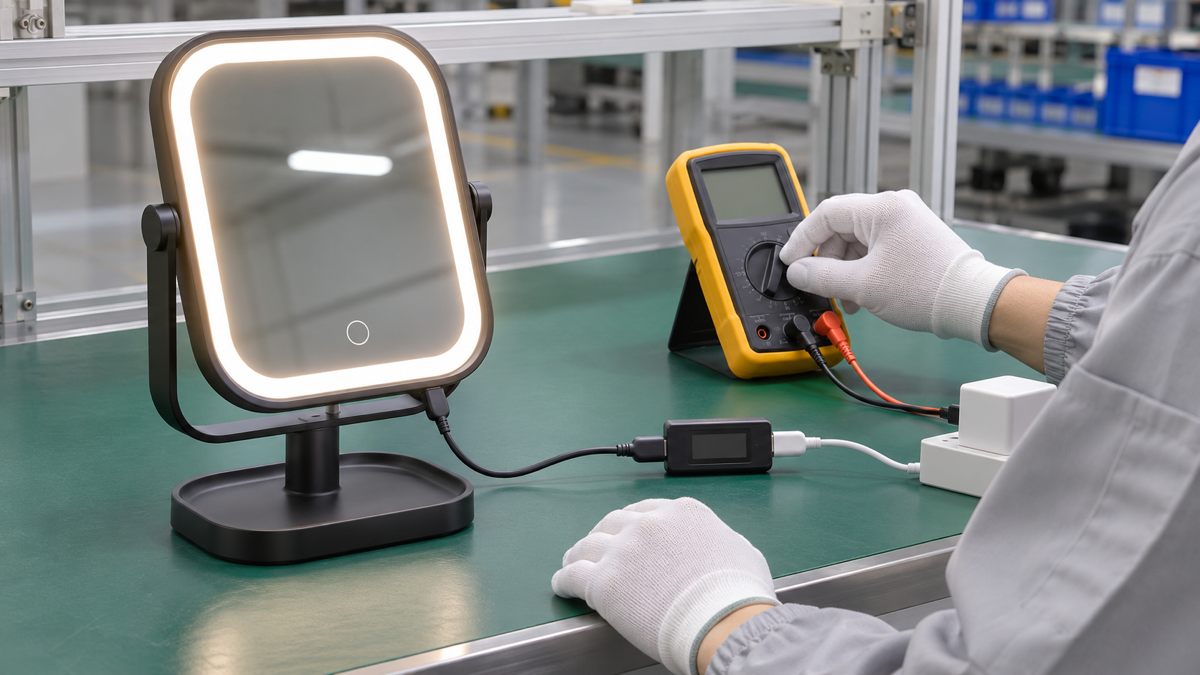
5. Test the exception cases before bulk release
The sample approval should include more than a successful first charge. Check cable insertion and removal, charge indication, full-charge state, low-battery recovery, repeated charge cycles, and normal mirror lighting after charging. If the model uses dimming or memory functions, recheck them after the agreed charge and protection events. A control feature that passed before charging but resets unpredictably afterward is an avoidable return risk.
USB-C charging approval matrix
Use this table in the sample confirmation, pre-production meeting, and pre-shipment inspection plan. It gives the brand team, supplier, and inspector the same decision standard.
| Checkpoint | What to record | Pass decision |
|---|---|---|
| Input configuration | Approved voltage/current range and exact test source | Matches the product brief and instruction artwork |
| Cable fit | Connector insertion, retention, clearance, color, and length | Secure fit; no interference with stand, hinge, or normal use |
| Charge indication | Appearance at charging, full charge, and low battery | Customer can distinguish states without guesswork |
| Charge-time test | Starting state, accessory set, elapsed time, and final function | Meets the agreed sample-approval target |
| Post-charge function | LED brightness, CCT, touch control, and memory behavior | Matches approved functional specification |
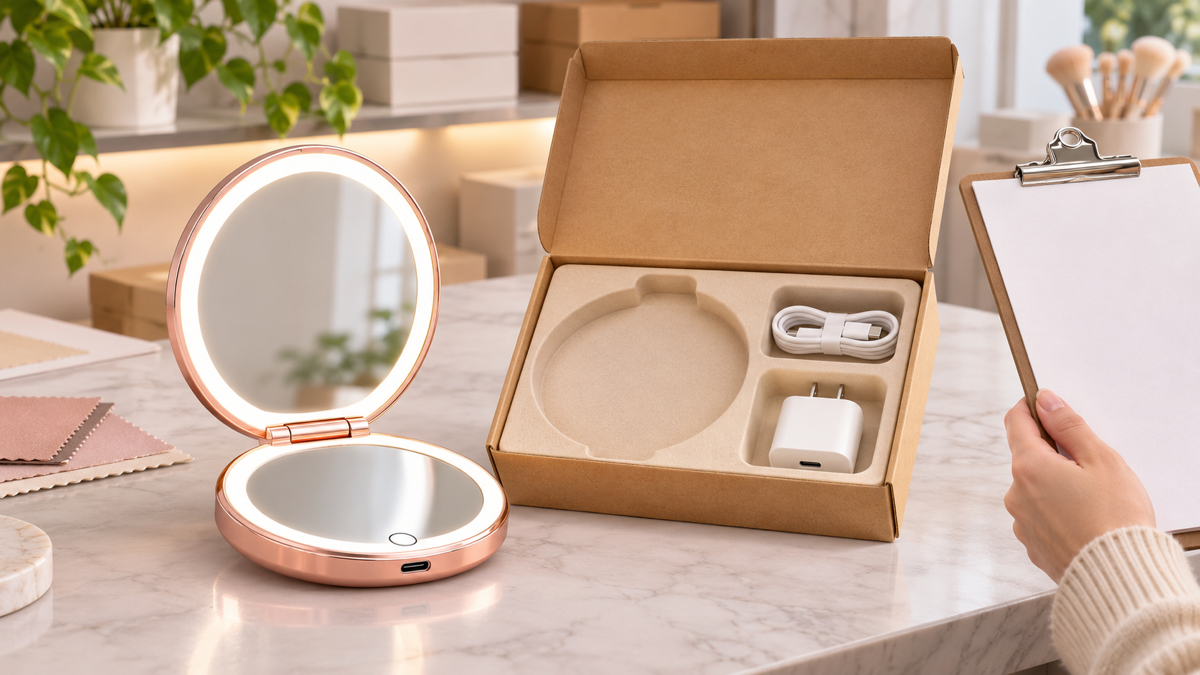
| Packaging scope | Cable, adapter decision, tray position, and printed contents | Box, listing, and actual contents agree |
| Repeatability | Repeat an agreed charge/discharge sequence on sampled units | No loose port, unstable indication, or inconsistent recovery |
This record should travel with the approved sample rather than live only in an email thread. It also helps an Amazon or retail team write an accurate listing and prevents a purchasing team from comparing quotations that include different accessory scopes.
Common buying mistakes that create return risk
The first mistake is treating USB-C as a complete specification. A connector is not a documented input limit, a charge-time agreement, or an accessory decision. The second is approving a mirror with one engineering cable and later sourcing a cheaper cable or adapter without rechecking the finished unit. That substitution can affect fit, charging behavior, retail presentation, and customer support.
The third is letting the product box, online listing, and physical contents drift apart. If an adapter is not included, show and state that consistently; if an adapter is included, identify its approved market version and packaging position. The fourth is ignoring port protection during transit. A compact mirror’s port, cable cavity, and inner tray should be reviewed as part of the packaging drop-test and unpacking experience—not as separate tasks.
For additional development support, Mingda’s product design service can help turn the chosen charging path into a controlled product brief. Request MOQ, sample lead time, production lead time, accessory scope, packaging method, and the charge-test evidence together with the quotation. A lower unit price is not comparable if it excludes the cable, uses a different adapter assumption, or has not been verified on the final configuration.
RFQ-ready questions for rechargeable mirror suppliers
- What input range is approved for this exact model, and which power source will be used for sample acceptance?
- Is the USB-C cable included? If yes, what length, connector construction, color, and packing position are included in the quoted price?
- Is a wall adapter included, optional, or excluded—and how will that be stated in the box and listing?
- What is the agreed charge-time test method and expected indicator behavior?
- Can the mirror operate while charging, and if not, what will the user instruction say?
- What happens after low-battery protection, full recharge, cable reconnection, and repeated charge cycles?
- Which charging parts are controlled components that require renewed approval before substitution?
Bottom line: approve the whole charging experience
For most retail and e-commerce rechargeable LED makeup mirrors, the strongest USB-C specification is not the highest claimed charging speed. It is a clearly defined input range, an approved cable and adapter scope, understandable charge indication, a documented charge-time test, and packaging/listing language that matches the box. Approve that complete experience on the production-intent sample before artwork and bulk production. It will reduce avoidable buyer disputes and help customers use the mirror as expected.
FAQ
Should a rechargeable makeup mirror include a wall adapter?
It depends on the target market and channel. An included adapter can simplify the user experience, while cable-only packaging can suit some online or travel-oriented ranges. The key is to make the quoted accessory scope, box contents, and listing wording match exactly.
Does a USB-C port mean every USB-C charger is appropriate?
No. Buyers should define the approved input specification and validate the finished mirror with the planned cable and power source. Do not turn compatibility assumptions into marketing promises without testing the final configuration.
What should a pre-shipment inspector check?
Inspectors should confirm the agreed cable/accessory scope, port fit, charge indicator, normal post-charge lighting, and packaging position on the defined sample size. They should compare against the signed sample-approval record, not an informal feature list.
Ready to develop a rechargeable LED makeup mirror for your market? Contact Mingda Mirror with your target country, sales channel, expected order volume, preferred accessory scope, and packaging plan for an RFQ-ready discussion.