
A lighted makeup mirror buying guide should help B2B buyers choose the right lighting, magnification, size, power setup, and packaging standard before sample approval. That matters because a mirror that looks attractive in a catalog can still fail in retail, e-commerce, or private-label programs if the specification does not match the real customer and channel.
This guide explains how retail buyers, beauty brands, Amazon sellers, and sourcing teams should compare lighted makeup mirrors from a commercial point of view. The goal is to reduce returns, protect margins, and make supplier discussions more precise before bulk production.
1. Start With the Buyer Scenario
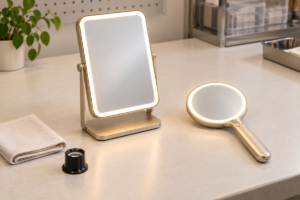
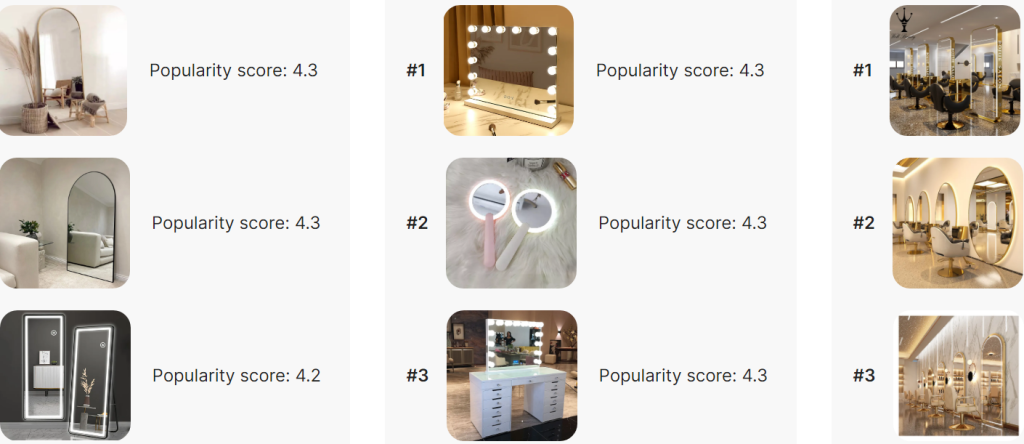
The best lighted makeup mirror depends on who will buy it and where it will be sold. A compact folding mirror may fit travel retail, checkout gifting, and e-commerce bundles, while a tabletop mirror with stronger lighting may be better for beauty stores, salon supply, and premium brand programs.
Before requesting quotations, confirm the target user, expected retail price band, selling channel, and whether the program needs standard products or OEM support. Buyers planning a broader assortment can also review this makeup mirror sourcing guide and browse Makeup Mirrors.
2. Compare Lighting Quality, Not Only Brightness
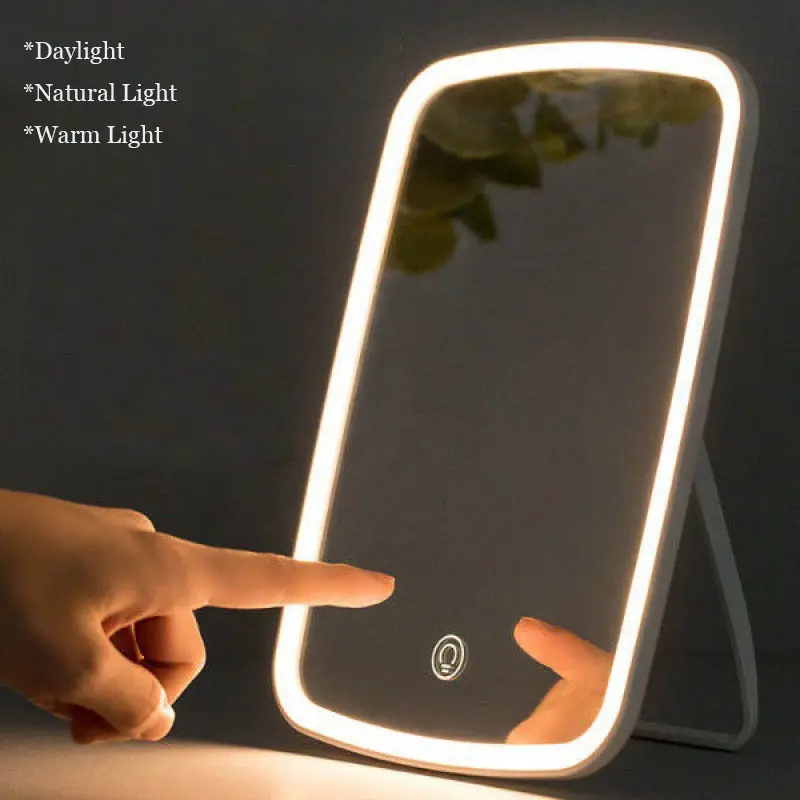
Lighting is usually the main reason customers choose a lighted makeup mirror, but buyers should compare more than brightness alone. Check color temperature options, color consistency, glare control, dimming behavior, and whether the light is comfortable at close distance. These details affect product reviews and return risk.
For private-label programs, it is useful to confirm whether the factory can keep lighting consistency across batches and whether the light output matches the intended use case such as vanity use, travel use, or gifting.
3. Choose Magnification and Mirror Structure by Channel
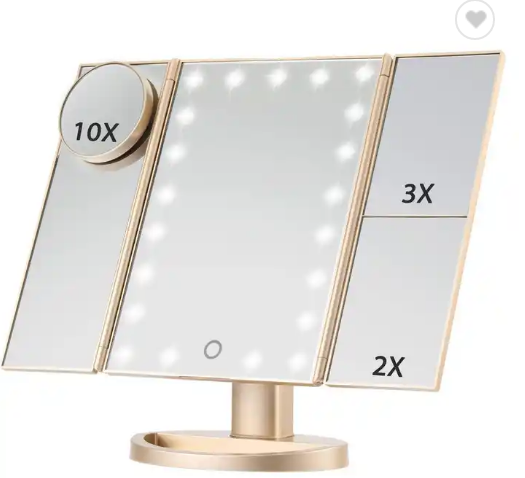
Magnification should match the customer expectation instead of chasing the highest number. Many retail programs work better with practical daily-use magnification, while high-magnification options are more suitable when the buyer clearly targets precision makeup or grooming scenarios.
Mirror structure also matters. Tabletop, wall-mounted, handheld, and foldable mirrors serve different channels. If portability and battery planning are part of the line, compare rechargeable vs battery-powered makeup mirrors before finalizing the assortment.
4. Check Power Source, Safety, and After-Sales Risk
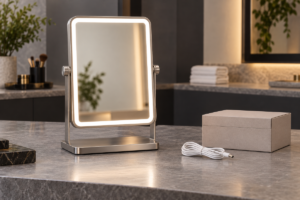
Power choice affects cost, user experience, and compliance. Rechargeable models can feel more premium, but they require battery planning, shipping checks, and charging-component stability. Replaceable-battery models may simplify entry-level retail, yet they can weaken long-term user experience if brightness drops quickly or battery replacement is inconvenient.
Buyers should also confirm switch durability, charging-port strength, adapter requirements, and any market-specific compliance expectations. For export programs, it helps to review LED makeup mirror certifications before approving final specifications.
5. Treat Packaging as Part of the Product Spec
Packaging is not only a logistics detail. It affects transit damage, shelf presentation, unboxing experience, and replenishment efficiency. Buyers should confirm inner protection, carton strength, accessory layout, manual language, barcode position, and whether the product needs a gift-box or retail-display presentation.
For e-commerce and export orders, packaging quality can directly affect claim rate and reorder confidence. Ask the supplier about master-carton planning, drop-risk prevention, and sample packaging review before bulk production.
6. Evaluate Supplier Capability Before Bulk Orders
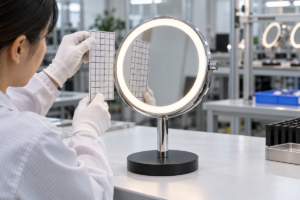
A strong mirror supplier should help buyers refine specifications, not just quote a photo. Review sampling speed, OEM/ODM support, quality-control checkpoints, lead time stability, and communication clarity. This is especially important for beauty brands and private-label buyers that need repeatable quality across multiple POs.
Buyers comparing factory support can also review how to choose a reliable LED mirror manufacturer and keep a direct inquiry path through the Contact page.
B2B Buyer Checklist
| Buyer question | What to confirm | Why it matters |
|---|---|---|
| Which channel is this for? | Retail, e-commerce, gifting, salon supply, or private-label distribution | Channel fit decides size, feature set, packaging, and acceptable cost. |
| What lighting level is required? | Brightness, dimming, color temperature, and close-distance comfort | Lighting quality is a major driver of satisfaction and returns. |
| What power setup is best? | Rechargeable, replaceable battery, or plug-in structure | Power affects safety checks, user experience, and shipping complexity. |
| How will the product ship? | Protective inserts, gift box, master carton, labels, and accessory packing | Packaging quality reduces damage claims and improves retail readiness. |
| Can the supplier support repeat orders? | Sampling speed, QC process, OEM details, lead time, and communication | Supply reliability protects launch timing and reorder confidence. |
Compare Quotations Against One Released Sample
Give each candidate a buyer SKU and a revision-controlled specification. Compare the complete selling unit, including mirror, stand, cable or adaptor where supplied, manual, retail box and protective inserts. A lower unit price is not comparable if the quotation omits accessories, testing or packaging that another supplier includes. Record the currency, trade terms, destination and quote validity before comparing delivered-cost estimates.
| Decision | Evidence to request | Reason to pause the order |
|---|---|---|
| Lighting and controls | Agreed viewing distance, dimming settings, power condition and recorded sample results | Unexplained brightness differences or unsupported listing claims |
| Structure and magnification | Complete sample trial for viewing distance, hinge movement, base stability and storage | Unusable viewing range or unstable placement in the target scenario |
| Packaging and replenishment | Approved packed sample, accessory list, carton dimensions and revision identifier | Loose accessories, changed inserts or unclear replacement compatibility |
| Commercial release | MOQ by finish, sample fees, artwork approval date, production schedule and defect-handling terms | Unassigned corrections or a delivery commitment that excludes approval time |
For the lighting record, use the LED makeup mirror brightness range guide. It explains why readings need consistent distance, ambient light and power conditions. Keep this measurement record with the signed sample; photos alone cannot establish brightness or color performance.
Release production only after the buyer and supplier identify the approved sample, accepted deviations and responsible approver. If an LED board, diffuser, battery, hinge or insert changes, assess which checks must be repeated. At the first reorder, compare delivered condition and reported issues by SKU and shipment rather than treating all returns as one undifferentiated rate.
Common Buyer Mistakes
The most common mistake is choosing the product only by appearance or headline price. B2B buyers should compare lighting performance, magnification, power setup, packaging, compliance, and supplier execution together. Another mistake is ignoring the sales channel, which often leads to mismatched features and weaker sell-through.
Bottom Line Recommendation
The best lighted makeup mirror is the one that fits the buyer scenario, not the one with the longest feature list. Business buyers should lock the target channel, user expectation, lighting specification, power setup, packaging method, and supplier support standard before approving samples or placing a bulk order.
FAQ
What type of lighted makeup mirror is best for retail stores?
Tabletop and compact folding models are usually easier for retail because they balance display value, everyday usability, and manageable packaging. The best choice still depends on the price band and target customer.
Should buyers choose rechargeable or battery-powered lighted mirrors?
Rechargeable models are usually stronger for premium user experience, while replaceable-battery models can fit entry-level retail. The right choice depends on channel expectations, compliance planning, and after-sales tolerance.
What should private-label buyers confirm before bulk production?
Confirm logo placement, packaging artwork, barcode layout, manual language, lighting specification, power setup, and sample approval criteria before mass production starts.
Why is packaging so important for lighted makeup mirrors?
Because transit damage, accessory loss, and weak presentation can quickly create returns or negative reviews. Packaging quality directly supports delivered product quality and channel performance.
CTA
If you are sourcing lighted makeup mirrors for retail, brand, or private-label programs, contact Mingda Mirror with your target market, sales channel, order quantity, mirror format, lighting and power preference, packaging route and launch date. Request MOQ by finish, sample cost, itemized accessories, carton dimensions, production lead time and written defect-handling terms so quotations can be compared on the same basis.