
For most retail and private-label programs, the right LED makeup mirror brightness range is not simply the highest output a supplier can provide. Buyers should specify a comfortable close-use brightness level, stable dimming, practical color temperature options, good diffusion, and repeatable batch testing. A mirror that looks dramatic in photos can still create glare, battery complaints, poor reviews, or inconsistent shelf experience if the brightness target is not defined before sampling.
This guide helps beauty brands, retailers, Amazon sellers, and distributors turn “bright enough” into an RFQ-ready specification for LED tabletop, compact, and rechargeable makeup mirrors.
Why Brightness Range Is a Procurement Decision
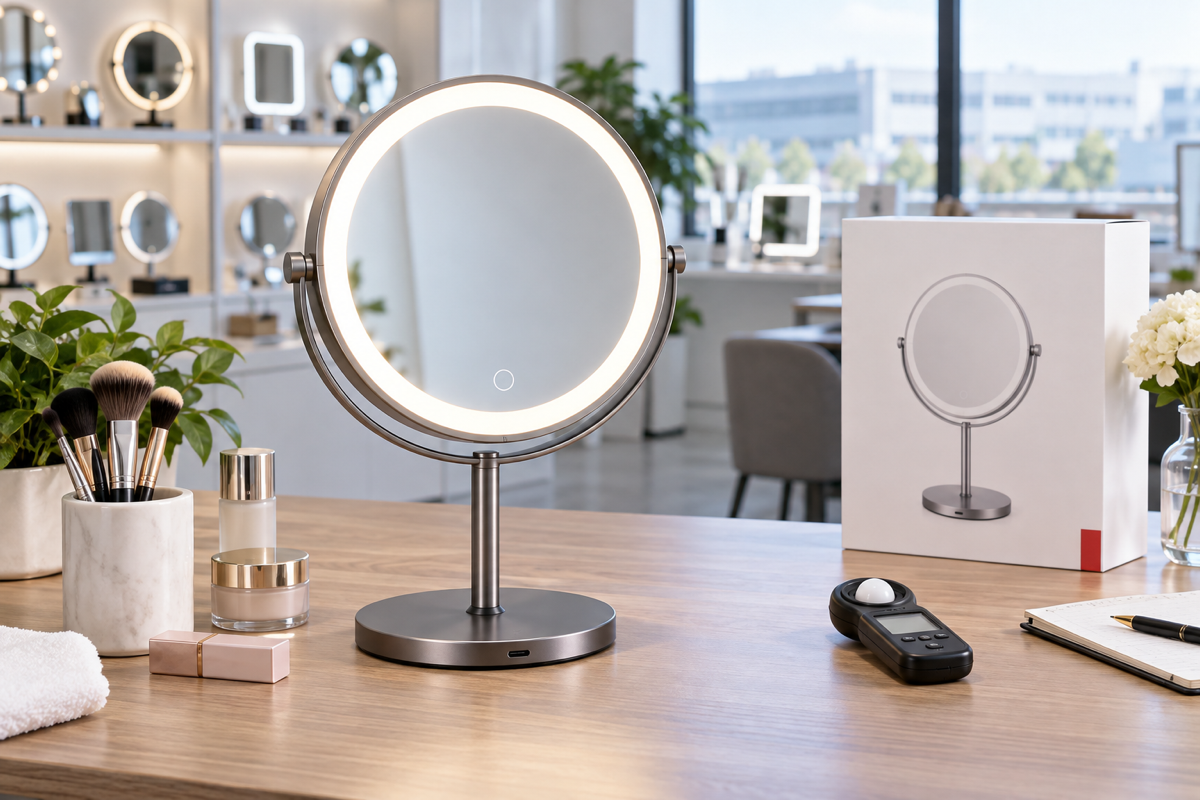
LED makeup mirror lighting affects product reviews, perceived value, return risk, packaging claims, and power-system cost. Buyers often ask for a “brighter mirror” because it sounds premium, but close-use facial lighting is different from room lighting. Agree a representative viewing distance for the intended format and magnification; excessive output, visible hotspots or harsh glare can make close use uncomfortable even when the LED count looks impressive.
For a B2B buyer, the more useful question is: what brightness range fits the target channel, product size, power method, and claim on the retail box or listing page? A rechargeable travel mirror, a tabletop vanity mirror, and a salon-oriented plug-in mirror should not be approved with the same brightness expectation.
Buyers can review Mingda’s broader makeup mirror sourcing guide when planning the whole product line, then use this article to define the lighting section of the RFQ.
A Practical Brightness Framework for Buyers
Instead of requesting a vague “high brightness” LED mirror, buyers should define lighting in four layers: usable brightness range, dimming behavior, light quality, and production control.
| Buyer scenario | Better brightness direction | What to confirm before sampling | Main sourcing risk |
|---|---|---|---|
| Beauty-brand gift set | Soft to medium brightness with smooth dimming | Comfortable close-use light, premium finish, gift packaging | Product feels harsh or low-end despite nice packaging |
| Retail tabletop SKU | Medium adjustable range | CCT options, diffusion, stand stability, retail-box claim | Shelf sample looks good but home use creates glare complaints |
| Amazon rechargeable mirror | Practical medium range with honest runtime | Battery capacity, charging port, dimming memory, parcel-safe packaging | Listing overpromises brightness or runtime |
| Salon or fixed vanity use | Higher stable output may be acceptable | Plug/adaptor, heat control, long-use stability, replacement policy | Brightness drops or color shifts during repeated use |
| Travel compact mirror | Lower to medium range | Battery safety, compact diffusion, hinge durability | Short runtime, uneven light, or fragile hinge returns |
The safest RFQ language is usually: “Please recommend a comfortable close-use LED brightness range for this channel, with smooth dimming, agreed CCT options, diffusion method, power configuration, and batch inspection standard.” That gives the supplier room to recommend a realistic structure instead of quoting a cheaper component that only looks good in a photo.
Do Not Separate Brightness From CCT and CRI
Brightness alone does not define lighting quality. A mirror can be bright but still make skin tone look flat, yellow, blue, or uneven. Buyers should confirm three related items:
- CCT range: Warm, neutral, and cool modes are common for retail LED makeup mirrors, but the buyer should define which tones are actually needed for the channel.
- CRI target: Better color rendering supports makeup accuracy and premium positioning. Buyers should ask whether the supplier can keep color rendering consistent across production.
- Diffusion quality: A frosted ring, diffuser strip, or LED layout should reduce hotspots and direct glare.
Compare the proposed CCT modes in a target-user trial. Extra modes add value only when customers can distinguish and use them; select the final mode count from sample feedback, control simplicity and cost rather than assuming more modes improve satisfaction.
How to Test Brightness During Sample Approval
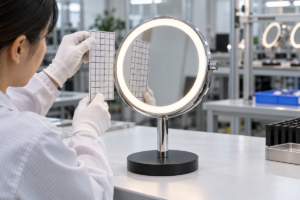
Brightness should be tested in a repeatable way, not judged only by phone photos. Buyers do not need an advanced laboratory for every project, but they should ask the supplier to control distance, ambient light, power status, and test points.
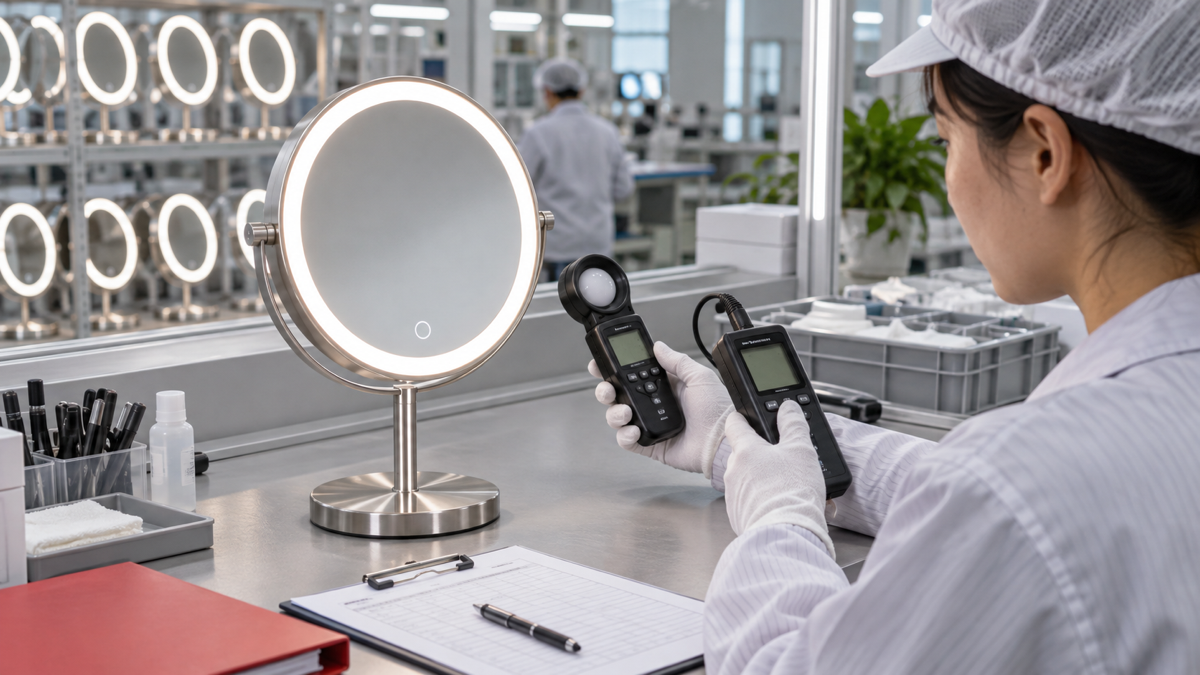
Useful sample checks include:
- Test the mirror in normal indoor light and in a dimmer room.
- Check minimum, middle, and maximum brightness levels.
- Confirm whether dimming is smooth or jumps in obvious steps.
- Compare warm, neutral, and cool modes side by side.
- Look for visible LED dots, dark zones, flicker, or glare.
- Run the mirror long enough to see whether brightness drops quickly.
- For rechargeable models, test brightness after partial battery discharge, not only when fully charged.
- Photograph the sample from normal user distance, not only from a dramatic marketing angle.
For production control, the buyer should ask Mingda Mirror or any supplier to define the inspection standard for LED uniformity, switch response, charging performance, and appearance. This connects the approved sample to bulk-goods consistency.
Record the Lighting Acceptance Method
Define brightness with a measurement method as well as a user trial. If comparing illuminance readings in lux, agree the sensor position, distance from the mirror, orientation and ambient-light condition. Lux at a stated position is different from total light output in lumens; do not substitute one claim for the other. A lux meter alone does not establish CCT, CRI or flicker performance. Request suitable instrument records for those claims, with the test method and sample configuration identified.
| Approval record | What to fix before comparing samples | Evidence needed for release |
|---|---|---|
| Sample identity | Buyer SKU, LED board, diffuser, power system and firmware or switch revision | Traceable sample ID and agreed component list |
| Lighting setup | Sensor geometry, ambient light, warm-up period and instrument reference | Recorded readings at the agreed minimum, middle and maximum settings for each CCT mode |
| Power and duration | Supply rating or battery charge condition, runtime setting and observation interval | Initial and later readings with the actual elapsed time; no comparison between different test conditions |
| Decision and claims | Buyer-agreed limits, user-trial feedback and the exact retail claim | Pass or hold decision, exception owner and retest date before production release |
Agree numerical acceptance limits with the supplier after evaluating representative samples; this guide does not prescribe one universal lux threshold. Keep measurement results separate from subjective comfort feedback, and use the sample approval checklist to record both. For format, magnification and packaging decisions, return to the lighted makeup mirror buying guide.
Match Brightness to Channel, Not Just Price
The same LED mirror can feel right or wrong depending on where it will be sold. Retail buyers need a product that looks attractive on shelf and remains comfortable at home. Amazon sellers need claims that reduce review risk. Beauty brands need a mirror that supports their brand story without creating after-sales pressure. Distributors need a specification that can be reordered consistently.
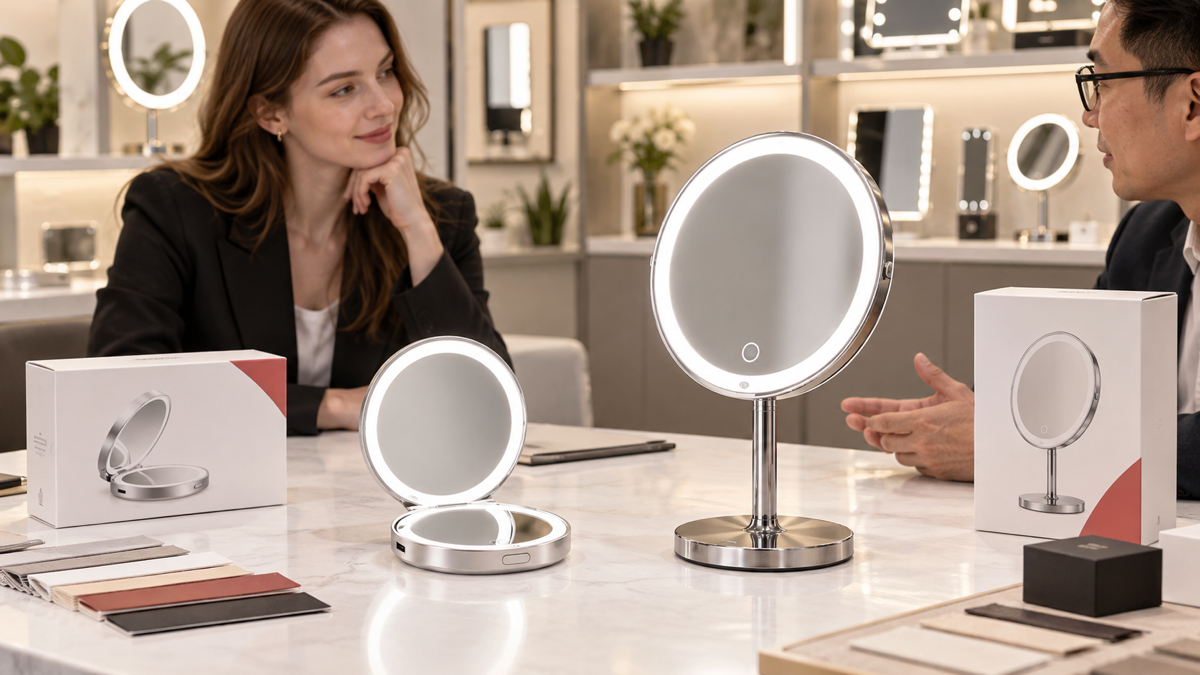
For rechargeable mirrors, buyers should be careful with extreme brightness claims because they may shorten runtime or require a larger battery, higher-cost charging components, or a bigger body. For plug-in tabletop mirrors, higher output can be more realistic, but cable length, adaptor standard, heat control, and packaging size become more important.
If the buyer is still choosing the power direction, Mingda’s rechargeable vs plug-in makeup mirror comparison can help clarify channel fit before the lighting target is locked.
Common Mistakes Buyers Should Avoid
The first mistake is approving the brightest sample without considering glare. For close-use products, comfort matters as much as output.
The second mistake is using only product photos for lighting approval. Camera exposure can make weak lighting look strong or harsh lighting look soft.
The third mistake is asking for multiple CCT modes without checking whether the tones are useful. Three unstable modes are worse than two consistent modes.
The fourth mistake is separating lighting from battery, USB-C, adaptor, and packaging decisions. Brightness changes power demand, charging expectations, heat behavior, and carton claims.
The fifth mistake is failing to convert the sample into a production checklist. If the supplier does not know which brightness level, diffuser, LED board, battery, and switch logic were approved, bulk production can drift from the sample.
RFQ Checklist for LED Makeup Mirror Brightness
Before asking for a quotation or approving a sample, buyers should prepare these details:
- Target buyer: beauty brand, retailer, Amazon seller, distributor, gift buyer, salon buyer, or hotel/project buyer.
- Mirror format: tabletop, compact, travel, wall-mounted, or Hollywood-style vanity mirror.
- Power method: rechargeable battery, plug-in adaptor, USB-powered, or replaceable battery.
- Preferred CCT modes and whether memory function is needed.
- Required dimming style: touch control, step dimming, long-press dimming, or sensor control.
- Expected brightness use case: daily makeup, travel touch-up, retail gift, salon station, or premium vanity use.
- Product claim language for packaging and listing pages.
- Sample test requirement for brightness, color temperature, glare, runtime, charging, and switch response.
- Packaging route: retail shelf, e-commerce parcel, wholesale carton, or project delivery.
- Logo, manual, warning label, and instruction-card requirements.
For private-label orders, these details help the supplier quote a real product structure instead of a generic LED mirror that later needs costly revision.
Packaging and Production Control Matter Too
Lighting approval should be linked to packaging and mass-production control. If the mirror is rechargeable, the package should protect the charging port, cable, mirror surface, stand, and LED ring. If the mirror is positioned as a premium tabletop product, the retail box should not promise a lighting performance that the approved sample cannot repeat.
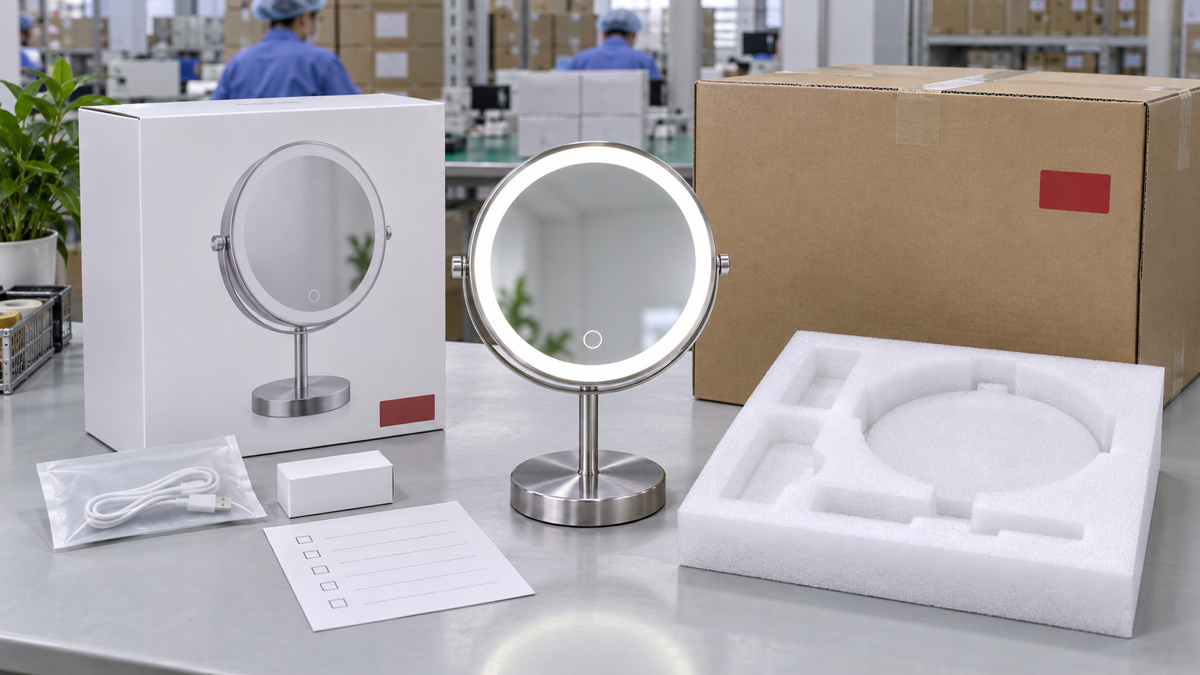
For bulk orders, buyers should confirm MOQ, sample approval timing, expected lead time, packaging proofing, and inspection points before the PO is released. A practical first order often works better when the buyer locks one dependable brightness specification and packaging method, then expands colors, finishes, or SKUs after market feedback.
Bottom-Line Recommendation
Retail and brand buyers should specify LED makeup mirror brightness as a complete lighting system: brightness range, CCT, CRI, diffusion, dimming, power method, packaging claim, and QC standard. The best sample is not the brightest mirror on the table. It is the mirror whose lighting feels comfortable, matches the sales channel, can be produced consistently, and gives the buyer a claim they can safely repeat on packaging and online listings.
Mingda Mirror supports OEM and ODM buyers with LED makeup mirror product selection, lighting configuration, sample review, private-label packaging, and bulk-order inspection. To discuss your target channel and brightness requirements, visit the Makeup Mirrors page or contact Mingda Mirror with your target market, order quantity, mirror format, power preference, lighting test conditions, packaging claim and launch date. Request itemized sample cost, MOQ by configuration, production lead time and the proposed lighting acceptance record.
FAQ
What is the best brightness for an LED makeup mirror?
There is no single best brightness for every LED makeup mirror. Buyers should define the brightness range by channel, mirror size, power method, user distance, dimming behavior, and packaging claim.
Should retail buyers choose the brightest makeup mirror sample?
Not always. A very bright sample can create glare, short runtime, heat concerns, or unrealistic listing claims. Comfortable, adjustable, repeatable light is usually better for retail and e-commerce programs.
What should buyers test before approving LED makeup mirror lighting?
Buyers should test brightness levels, CCT modes, dimming smoothness, glare, diffusion, switch response, runtime, charging stability, and whether the sample matches the planned retail-box or listing claims.
Does rechargeable power limit LED makeup mirror brightness?
Rechargeable mirrors can provide strong practical lighting, but buyers must balance brightness with battery capacity, runtime, charging safety, body size, and price position.
Can Mingda Mirror customize LED makeup mirror brightness and CCT?
Yes. Mingda Mirror can discuss LED makeup mirror lighting configuration, CCT options, dimming controls, rechargeable or plug-in structures, packaging, logo, MOQ, and sample approval for OEM and ODM buyers.
Social Media Content Ideas
LinkedIn angle: Explain why sourcing managers should define brightness range, CCT, dimming, and QC standard together before approving LED makeup mirror samples.
Facebook angle: Educate retailers on why “brighter” is not always better for close-use makeup mirrors, especially for private-label and gift programs.
Instagram angle: Use the sample-review image to show how a complete LED makeup mirror should be checked for light comfort, packaging claim, and channel fit.
CTA: Read the full guide and send Mingda Mirror your target channel, power preference, and brightness requirements for a practical RFQ discussion.