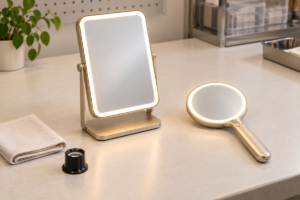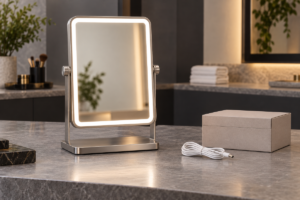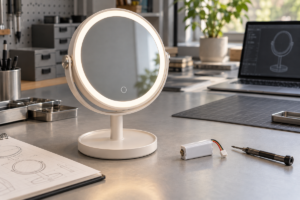

Private-label LED makeup mirror buyers should approve the user manual, labels, barcode files, carton marks, and packed sample before bulk production starts. The goal is not only good-looking artwork. The manual and label system must match the real mirror function, charging method, lighting modes, accessories, destination market, retail channel, and warehouse receiving rules. When these files are controlled early, buyers reduce relabeling, customer confusion, platform receiving issues, and avoidable returns.
This checklist is written for beauty brands, Amazon and e-commerce sellers, retail buyers, wholesalers, distributors, and OEM/ODM teams sourcing rechargeable LED makeup mirrors, tabletop makeup mirrors, compact mirrors, and private-label vanity mirror programs.
Why Manual and Label Approval Belongs in the RFQ
Many buyers treat the user manual and labels as a late packaging step. That creates risk. A rechargeable LED makeup mirror may have touch dimming, color temperature modes, USB-C charging, battery storage instructions, magnification notes, cleaning guidance, accessory lists, and model identification. If the manual is drafted after production starts, the buyer may discover that the artwork, product claim, barcode, and packed product do not match.
For e-commerce and fulfillment programs, confirm the receiving instructions for the specific marketplace, destination, and shipment before approving artwork. Keep the buyer-provided instructions and their revision with the label files; requirements may differ between programs. For retail chains, the same discipline supports shelf tags, replenishment, returns, and customer service.
The practical rule is simple: approve the documentation system together with the product sample, not after the purchase order is already moving.
What Buyers Should Approve
| Approval Item | What to Check | Why It Matters |
|---|---|---|
| User manual | Operating steps, charging guidance, light modes, cleaning, warnings, language version | Reduces customer confusion and support tickets |
| Product label | Model number, input/output rating, battery or power details, supplier or brand data where required | Keeps the product traceable and consistent with reports |
| Barcode label | UPC/EAN/FNSKU or buyer SKU, scannability, placement, human-readable number | Helps warehouse receiving and SKU separation |
| Retail box artwork | Product name, feature claims, accessories, color, size, power type, warning icons | Prevents overpromising and artwork mismatch |
| Carton mark | Buyer SKU, factory model, quantity, carton number, gross/net weight, destination notes | Reduces mixed cartons and receiving errors |
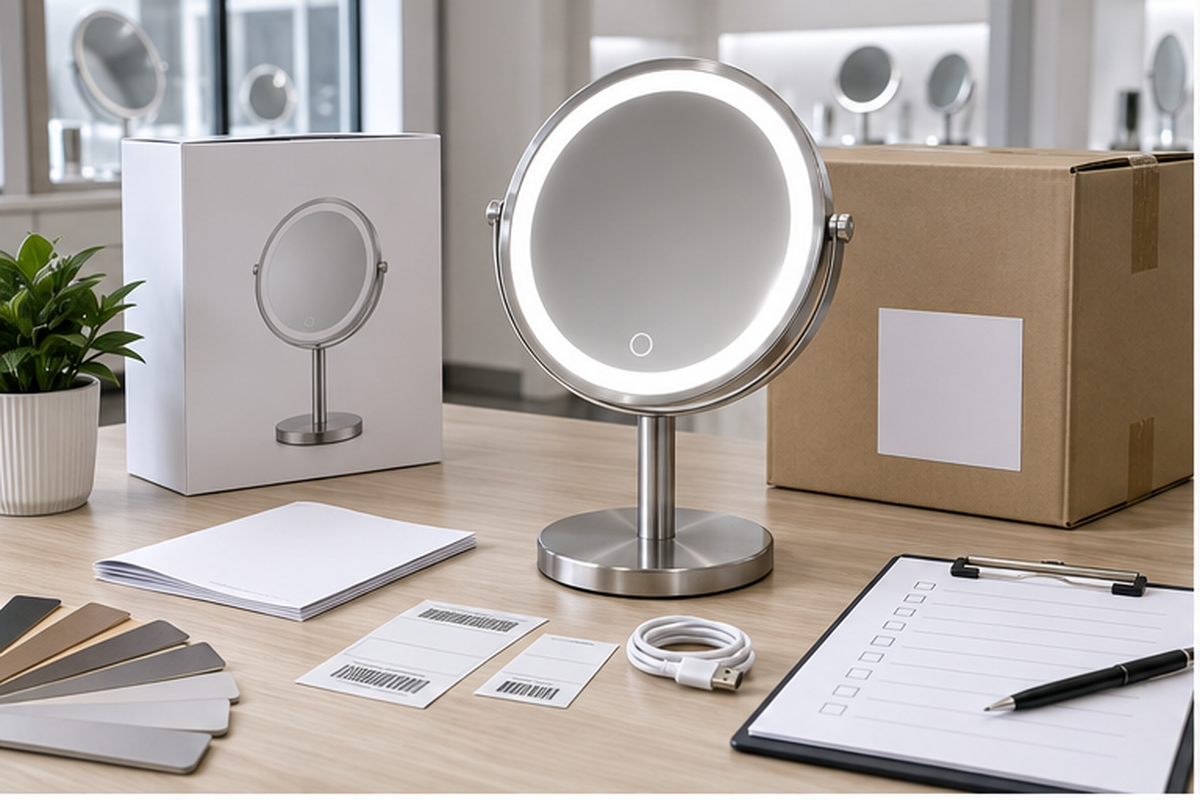
| Packed sample | Real mirror, manual, labels, insert, cable, accessories, retail box, export carton | Confirms the full selling unit before mass packing |
This table should be part of the RFQ and sample-approval record. If the supplier quotes only the mirror body without documentation and packaging review, the buyer is not comparing the true launch-ready cost.
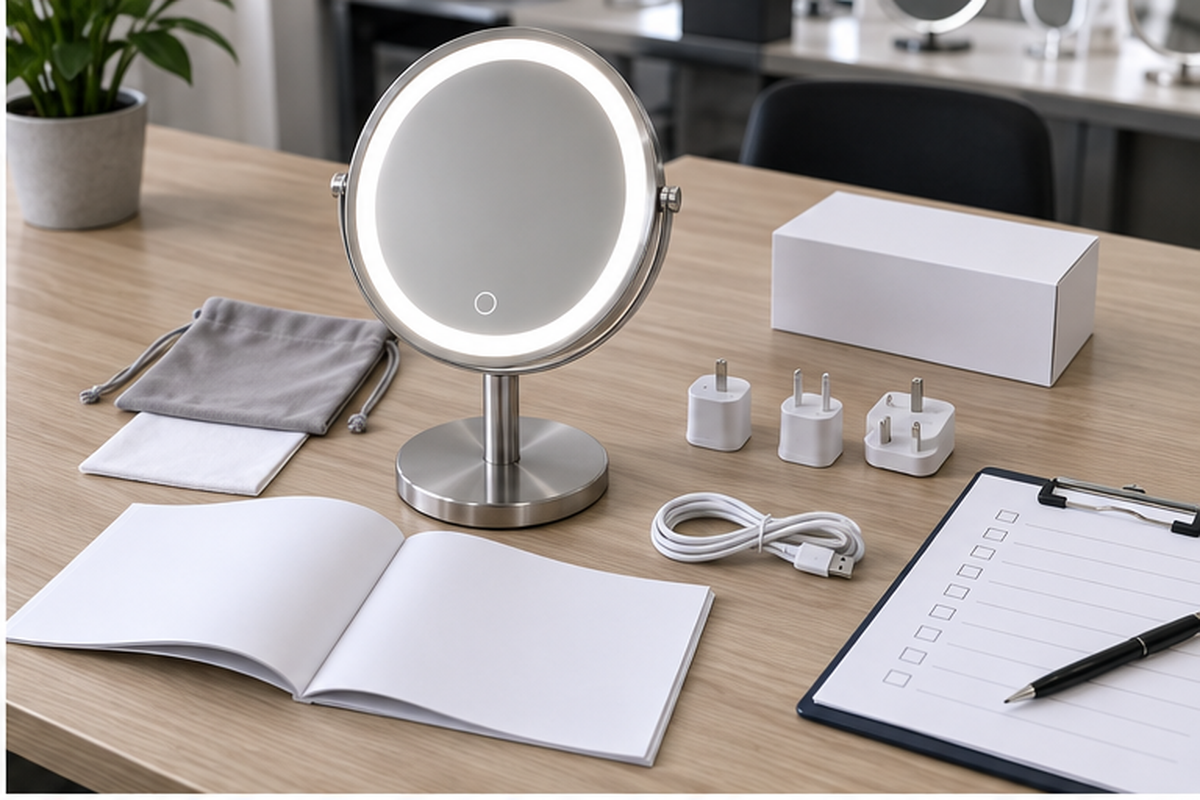
Match the Manual to the Real Mirror Function
The manual must describe the exact approved version. Small differences matter. A mirror with touch switch operation should not use wording written for a sensor switch model. A three-color LED version should not be packed with a manual that explains only one brightness mode. A rechargeable mirror should not leave charging time, indicator behavior, or storage guidance unclear.
Buyers should compare the manual against the working sample and confirm:
- on/off method, dimming method, and light color switching
- USB-C, Micro-USB, plug-in, battery, or dual-power configuration
- charging time, estimated runtime, and indicator-light behavior
- accessory list, including cable, adapter, pouch, stand, screws, or magnifying attachment
- magnification distance and safe use guidance if the product includes magnification
- cleaning instructions for mirror glass, LED ring, switch area, and frame finish
- destination language version and customer-service contact or brand information
For private-label orders, the manual should also match the brand’s tone. A premium beauty brand may need clearer care language and simpler diagrams. A distributor may need multi-language inserts. An Amazon seller may need short troubleshooting steps that reduce return requests.
Label and Barcode Checks for E-Commerce and Retail
Labels are not decoration. They connect the approved sample, the selling SKU, warehouse receiving, and after-sales support. If one LED makeup mirror line includes different finishes, magnification levels, switch types, charging ports, or packaging versions, the label system must separate them clearly.
For marketplace and e-commerce programs, buyers should confirm:
- whether the unit needs UPC, EAN, FNSKU, buyer SKU, or another channel-specific barcode
- whether old or extra scannable barcodes must be covered or removed from the outside packaging
- label size, quiet zone, print contrast, and scan test result
- position on the retail box, polybag, inner carton, and master carton
- model number consistency across product label, manual, carton mark, invoice, and test report
- barcode ownership and file control, especially for private-label listings
For retail chains and distributors, the same check prevents mixed replenishment. A white finish and a rose-gold finish may look similar in a carton photo, but they should not share a vague label. A standard touch-control version and a premium sensor-control version need separate SKU and carton identification.
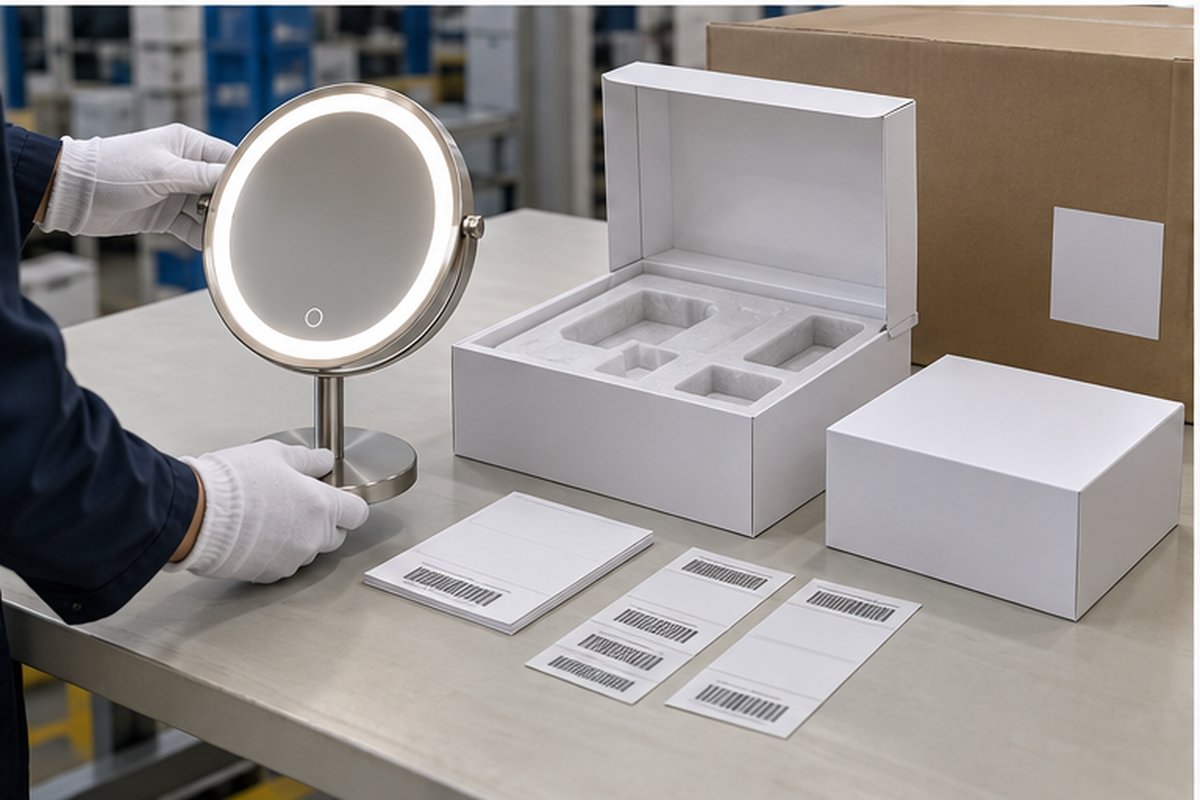
Common Mistakes That Delay Production
The first mistake is approving a loose sample but not a packed sample. The mirror may work, but the manual may list the wrong cable, the insert may hide the barcode area, or the carton mark may use the factory model instead of the buyer SKU.
The second mistake is copying a manual from a similar product. LED mirrors often share the same shape while using different boards, batteries, switches, stands, or light modes. A reused manual can create wrong claims and customer complaints.
The third mistake is leaving barcode files to the final packing week. If the buyer sends SKU labels late, the supplier may need to pause packing, relabel cartons, or reprint retail boxes. This can affect launch timing, shipping booking, and warehouse appointment schedules.
The fourth mistake is not locking the document version. If the sample manual says Version A, the retail box says Version B, and the packed carton uses a changed SKU name, later inspection becomes difficult. The buyer should keep one approved file set tied to the final golden sample.
MOQ, Lead Time, and Cost Implications
Manuals and labels can affect MOQ and lead time because they involve printing, translation, barcode files, color box approval, and sometimes destination-market review. A neutral manual sticker may be faster for a pilot order. A fully printed private-label manual and retail box may need more preparation but create a stronger retail experience.
Buyers should ask suppliers to quote documentation and packaging work separately where possible:
- manual design, translation, and printing cost
- barcode label printing and application cost
- product label or rating label cost
- retail box artwork proof and color proof timing
- packed sample fee and shipping time
- custom packaging MOQ versus product MOQ
- reprint cost if artwork changes after approval
This makes quotation comparison cleaner. A lower unit price may be incomplete if it excludes manual setup, barcode work, packed-sample approval, or carton-label application.
Pre-Production Approval Workflow
Use a controlled approval workflow before bulk production:
1. Confirm the target sales channel, destination market, and buyer SKU structure. 2. Approve the working product sample, including lighting, magnification, charging, switch, finish, stand, and accessories. 3. Draft the manual, product label, barcode label, retail box, carton mark, and accessory list from the approved sample. 4. Check all files against the same model number and buyer SKU. 5. Print a packed sample with the real manual, labels, insert, box, cable, accessories, and carton. 6. Scan the barcode on the actual package surface. 7. Run a packaging and function inspection using the packed sample. 8. Lock the final document version before mass production and packing.
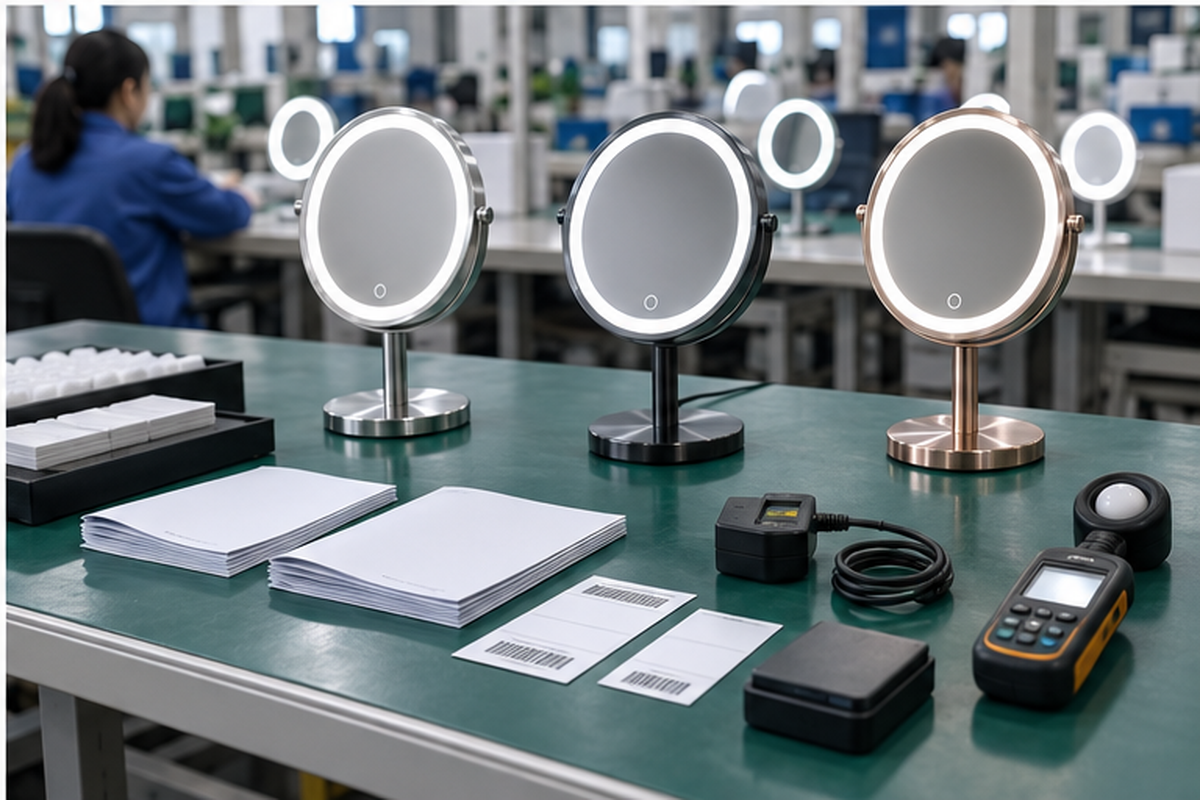
For larger retail or distributor orders, keep photos of each approved side of the packaging. For e-commerce orders, also keep the barcode placement image and accessory checklist. These records help the supplier, buyer, inspection team, and warehouse work from the same reference.
Keep One Release Record for Every Selling SKU
Create an approval record with the buyer SKU, factory model, control-board revision, artwork file name and revision, language, approver, approval date, and packed-sample reference. Identify who prepares each file and who signs it off. A revised manual or label must trigger a check of the affected packaging, accessories, and operating instructions before packing resumes.
Test the printed barcode on the finished package, not only on a screen. Record the scanner used, the decoded identifier, the intended SKU, package surface, and result. Agree sample quantities and acceptance criteria with the buyer. A successful scan checks readability in those conditions; it does not prove identifier ownership or acceptance by a marketplace.
Use model-number and revision control to keep the selling unit traceable. Compare setup, translation, proofing, and reprint charges with the LED makeup mirror total-cost checklist before selecting a quotation.
Review Documentation Issues After the First Delivery
At the first delivery review, collect receiving rejections, unreadable labels, wrong-language manuals and instruction-related support cases separately. For each issue, record the buyer SKU, shipment, printed-file revision, affected count, units received or sold and observation cutoff. A case count without its denominator cannot show whether a document change improved the result.
Compare the delivered unit with the retained packed sample and reproduce the reported operating or scanning problem before assigning a cause. Separate confirmed print or content errors from product faults and receiving-system mismatches. Record who owns the correction, which stock or future order it affects and when the revised printed sample will be checked. Reopen the custom LED makeup mirror sample approval record when the manual, label, accessory set or operating sequence changes; do not carry an old sign-off into a changed configuration without review.
What to Send Mingda Before RFQ
Before requesting a custom LED makeup mirror quotation, prepare:
- target channel: Amazon, retail, beauty brand, gift, wholesale, distributor, or salon
- destination market and required language versions
- mirror type: tabletop, compact, travel, wall-mounted, or vanity mirror
- lighting modes, magnification, power source, and charging details
- logo position, finish color, and packaging style
- barcode type and buyer SKU list
- manual requirements, warranty wording, and troubleshooting expectations
- carton mark format and warehouse receiving rules
- target MOQ, launch date, and sample approval deadline
If buyers do not have final artwork yet, they can still ask for a quotation based on a clear approval path. The important point is to identify which files are buyer-supplied, which are supplier-prepared, and which must be approved physically before production.
Bottom-Line Recommendation
For private-label LED makeup mirror orders, the safest sourcing path is to approve the manual and labels as part of the product, not as separate paperwork. The product sample, manual, barcode, retail box, carton mark, and packed sample should all describe the same approved SKU. This protects marketplace receiving, retail replenishment, customer understanding, after-sales support, and repeat-order consistency.
If the order will sell through more than one channel, keep channel labels separated. A retail barcode, Amazon label, distributor SKU, and export carton mark may each have a different job. Mixing them late in production is much more expensive than planning them during RFQ.
FAQ
When should buyers approve the manual for a custom LED makeup mirror?
Approve the manual after the working sample is confirmed and before bulk production begins. The manual should match the final light modes, switch type, charging method, accessories, labels, and package contents.
Does a barcode label need to be tested before production?
Yes. Buyers should scan the actual printed label on the real package surface. Confirm barcode type, placement, print contrast, quiet zone, and whether any older exterior barcode must be covered or removed.
Can Mingda help prepare private-label manual and label files?
Yes. Mingda can help buyers organize manual content, label placement, barcode application, packaging artwork checks, and packed-sample approval based on the selected LED makeup mirror model and sales channel.
Does custom documentation affect MOQ?
It can. Product MOQ, color box MOQ, manual printing MOQ, label setup, and packaging material MOQ may be different. Buyers should ask which MOQ applies to the actual order structure.
What is the most important packed-sample check?
Confirm that the real mirror, accessories, manual, labels, box, insert, barcode, and carton mark all match the same model number and buyer SKU. This prevents mixed products and late relabeling.
Work With Mingda Mirror
Mingda Mirror manufactures LED makeup mirrors, compact mirrors, handheld mirrors, Hollywood mirrors, and LED bathroom mirrors for B2B buyers. If you are preparing a private-label LED makeup mirror order, send your product type, target market, channel, barcode needs, manual language, packaging goal, MOQ, and launch schedule. Request separate prices and approval dates for artwork preparation, translation, print proofs, packed samples, and bulk production. Name the buyer and supplier approval owners so the quotation includes the full documentation scope.
Related sourcing pages:
Social Media Content Ideas
LinkedIn angle: Manual and label approval is not paperwork. For private-label LED makeup mirror orders, it controls SKU separation, warehouse receiving, customer understanding, and repeat-order consistency.
Facebook angle: Before bulk production, check whether the mirror, manual, barcode, accessories, box, and carton all describe the same product. That one step can prevent returns and relabeling.
Instagram angle: Use the packed-sample approval image to show how a complete LED makeup mirror order is checked before mass packing.
CTA: Read the full checklist and send Mingda Mirror your target channel, barcode needs, manual language, MOQ, and packaging plan for a practical RFQ.