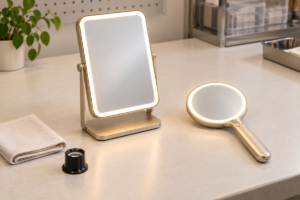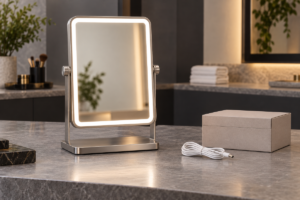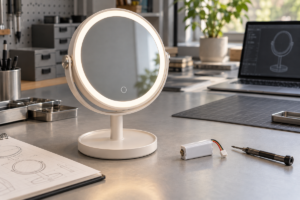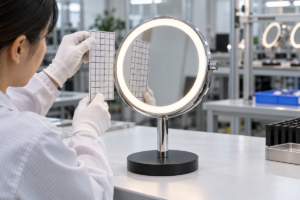

For OEM and private-label buyers, custom LED makeup mirror sample approval should confirm more than appearance. Before mass production, buyers should sign off the final product structure, lighting performance, magnification, finish, logo position, accessories, labels, packaging, and QC limits. A versioned approval file helps resolve discrepancies and gives purchasing, assembly, packing and inspection teams a shared reference; it does not replace agreed production checks.
This guide explains what brand buyers, retailers, distributors, and e-commerce sellers should check before approving a custom LED makeup mirror sample for production.
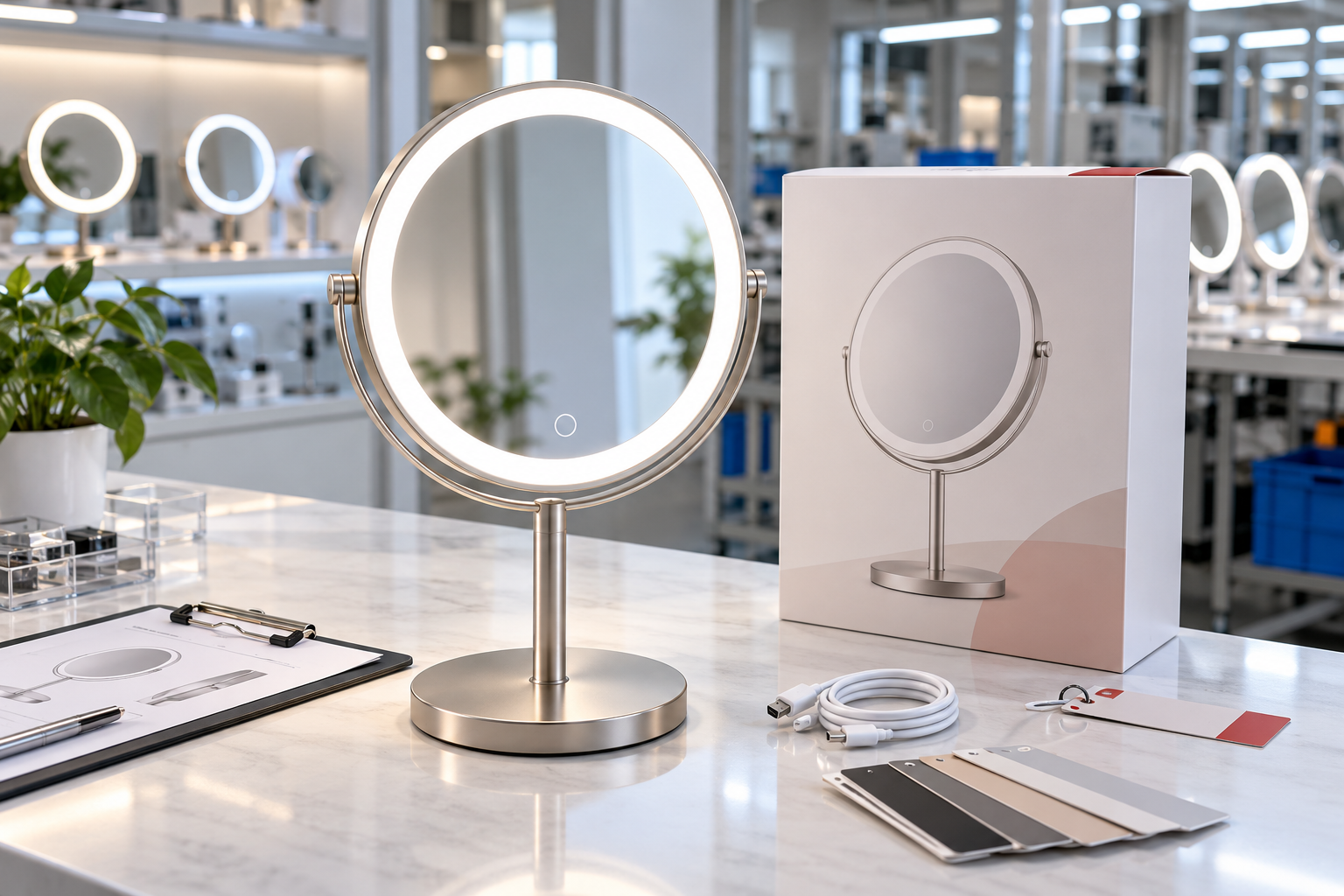
Why Sample Approval Matters for OEM Mirror Orders
A custom LED makeup mirror may look simple in catalog photos, but the approved sample controls many production details. The mirror size, LED diffuser, dimming range, color temperature, frame finish, hinge tension, charging port, cable, adapter, logo, retail box, and inner protection all affect the buyer’s final product experience.
If the buyer approves only a loose appearance sample, the bulk order can drift. The finish may look slightly different, the retail box may not protect the base well enough, the cable may not fit the tray, the logo may sit too close to the touch button, or the lighting may feel different from the sample used for listing photos. For private-label programs, these small changes can create return risk, marketplace complaints, and costly rework.
Sample Approval Matrix for Custom LED Makeup Mirrors
| Approval Area | What Buyers Should Confirm | Why It Matters in Bulk Production |
|---|---|---|
| Product structure | Mirror diameter, base size, stand angle, hinge tension, rotation range | Prevents unstable placement, poor user feel, or carton-fit issues |
| Lighting | CCT, brightness range, CRI target, dimming method, glare control | Keeps listing claims and user experience consistent |
| Magnification | Normal mirror, 3x, 5x, 7x, 10x, or detachable lens design | Controls working distance, distortion, and market positioning |
| Power system | USB-C or DC port, battery capacity, adapter, cable length, charging behavior | Reduces accessory mismatch and after-sales risk |
| Surface finish | Color standard, plating or coating, texture, scratch tolerance | Protects brand consistency across production batches |
| Logo and labels | Logo size, placement, print method, warning labels, barcode position | Avoids branding errors and retail compliance problems |
| Packaging | Retail box, molded insert, manual, accessory bag, master carton | Reduces breakage, missing parts, and e-commerce return risk |
| QC file | Golden sample, inspection points, acceptable limits, packed sample photos | Gives factory and buyer the same production reference |
Step 1: Approve the Product, Not Just the Photo
The first approval layer is the physical mirror. Buyers should check the mirror from the same distance and angle that end users will use. For tabletop LED makeup mirrors, this means checking the base stability, mirror tilt, rotation feel, hinge tightness, touch control position, and whether the mirror stays steady when adjusted.
For rechargeable models, test the mirror after a full charge and again after partial use. For plug-in models, test with the exact adapter and cable intended for the order. The sample should include the same power accessories, not temporary lab accessories.
Step 2: Lock the Lighting Standard
Lighting is one of the most common areas where buyer expectations and factory production can separate. The approved sample should define the CCT settings, brightness range, dimming behavior, LED diffusion, glare control, and whether the light remains comfortable during close-up makeup use.
For buyer-facing claims, avoid vague descriptions such as “bright LED light.” A stronger approval file states the lighting mode, expected use scenario, and accepted variation. If your listing or retail package claims warm, neutral, and cool lighting, the sample approval should confirm all three modes and the touch-control sequence.
Step 3: Confirm Finish, Color, and Logo Together
Color approval should happen on the real product surface, not only on a digital rendering. Brushed nickel, chrome, rose gold, matte black, white, and champagne finishes can look different under showroom light, daylight, and LED reflection. Buyers should approve finish swatches and the actual sample side by side.
Logo approval should also be reviewed on the real mirror. A logo that looks acceptable on a PDF may interfere with a touch button, sit too close to the mirror edge, or look too large once printed on a curved base or retail box. For private-label orders, the buyer should keep a clear photo record of the approved logo position, logo color, and print method.
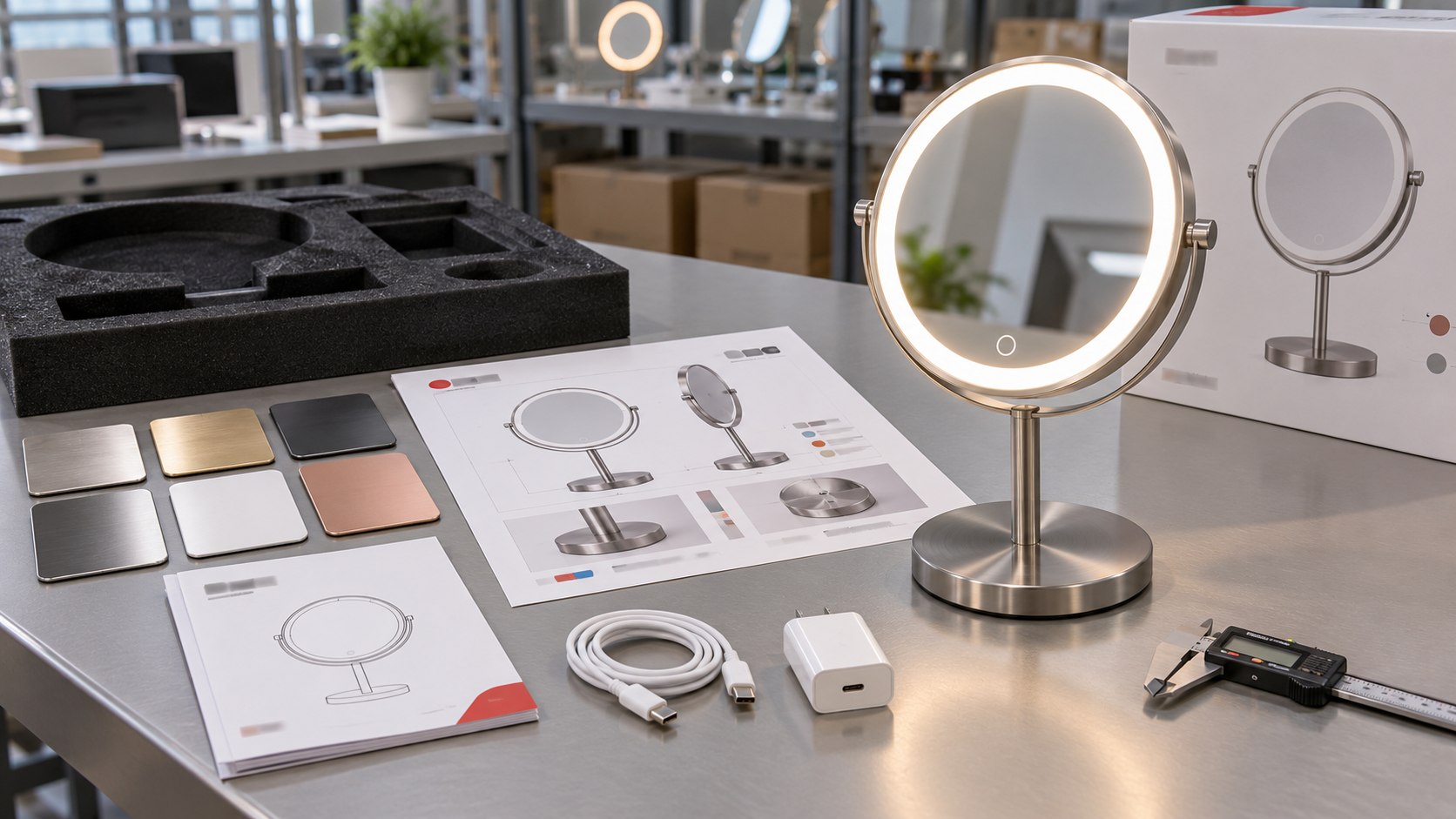
Step 4: Review Accessories as Part of the Product
Accessories are a frequent source of after-sales issues. A buyer may approve the mirror body but forget to lock the cable, adapter, plug type, manual, cleaning cloth, battery warning insert, or accessory bag. When bulk production starts, these items may be sourced separately unless they are clearly included in the approval file.
For e-commerce and retail buyers, accessory details affect both user satisfaction and listing accuracy. Confirm cable length, connector type, adapter output, plug market, manual language, warning label, barcode position, and replacement policy. If accessories are customized, ask the supplier whether they affect MOQ, lead time, or packaging structure.
Step 5: Approve the Packed Sample Before Production
The packed sample should be treated as the final buying unit. It should include the mirror, accessories, manual, inner tray, retail box, labels, barcode, master carton mark, and any marketplace or retailer-specific packaging requirement.
For LED makeup mirrors, the inner protection should hold the base, stand, mirror head, and accessories without pressure marks or movement. The retail box should protect the mirror during domestic handling, international shipping, warehouse storage, and last-mile delivery. If the product is for Amazon, retail chains, gift channels, or distributor replenishment, packaging approval should happen before mass production, not after goods are finished.
Step 6: Define the Golden Sample and Inspection Limits
The final approved sample should become the golden sample. It gives the factory, inspection team, and buyer a shared reference. A good golden sample record includes photos from multiple angles, product dimensions, finish notes, lighting notes, accessory list, packing method, carton details, and acceptable tolerance limits.
Without a golden sample record, the inspection team may only check whether the product works. That is not enough for custom orders. The buyer should define which points are critical, such as lighting mode, logo placement, mirror stability, charging function, surface scratches, carton strength, and accessory completeness.
Control Sample Revisions and Release Exceptions
Identify each approval by buyer SKU, factory model, sample number, hardware revision, accessory set and packaging revision. Keep the retained sample and dated photographs with the signed specification. An approval applies to that configuration; a similar-looking replacement board, cable, finish or insert needs an impact review before it can inherit the approval.
| Release record | Evidence to retain | When to hold or recheck |
|---|---|---|
| Lighting and power | Sample revision, supplied accessories, CCT and brightness settings, measurement geometry, elapsed time and agreed limits | Recheck changed drivers, batteries or adapters; a showroom photo does not establish measured performance |
| Product and packed unit | Dimensions, finish reference, accessory count, insert revision, packed weight and agreed inspection results | Review fit, protection and claims again when the configuration changes |
| Open exceptions | Observed deviation, affected quantity or sample IDs, owner, due date and retest result | Separate approval from conditional approval; name the buyer-authorized scope of any exception |
| Production release | Buyer and supplier sign-off, approved file versions and first-batch verification record | Hold release while agreed critical checks remain open; sampling does not guarantee every unit is defect-free |
Use the brightness range guide to specify repeatable lighting checks, and the manual and label approval checklist to connect printed claims to the released configuration. Keep the final approval record accessible to purchasing, inspection and packing teams.
Common Mistakes Buyers Should Avoid
- Approving product appearance before confirming the final power accessories.
- Using a photo approval instead of a physical packed sample approval.
- Checking logo artwork without reviewing its position on the actual mirror.
- Confirming retail box design before testing inner tray fit and drop protection.
- Forgetting to define acceptable variation for finish, brightness, and hinge tension.
- Treating the pre-production sample and mass-production sample as the same stage.
- Starting bulk production before the buyer and factory share the same golden sample file.
Pre-RFQ Information to Send the Supplier
Before asking for a custom LED makeup mirror quotation, send the supplier your target market, sales channel, mirror size, tabletop or wall-mounted format, magnification requirement, lighting modes, power preference, finish, logo needs, packaging style, expected quantity, certification needs, and launch timeline.
If the project needs private-label packaging, include the retail box structure, barcode rules, manual language, accessory requirements, and any marketplace or retailer packaging standards. This helps the supplier quote realistic cost, MOQ, sample time, and lead time.
Bottom-Line Recommendation
For custom LED makeup mirror projects, approve one complete packed sample before mass production. The approval should cover product structure, lighting, finish, logo, accessories, labels, packaging, and QC limits. A clear sample approval file is one of the simplest ways to reduce production disputes, late changes, and return risk.
Mingda Mirror supports OEM/ODM LED makeup mirror development for beauty brands, retailers, distributors, and project buyers. You can review our makeup mirror options, explore custom OEM/ODM support, and send the RFQ team your market, channel, quantity, mirror configuration, artwork readiness and launch date. Request separate sample and tooling charges, MOQ by configuration, approval milestones, retest responsibility and lead time measured from final sign-off.
FAQ
What is the most important item in custom LED makeup mirror sample approval?
The most important item is the complete packed sample. It confirms not only the mirror body, but also lighting, accessories, logo, labels, manual, retail box, inner protection, and master carton details.
Should buyers approve lighting before or after packaging?
Lighting should be approved before packaging artwork is finalized, because the product claims on the box and listing should match the real CCT, brightness, dimming, and power performance.
Can logo placement be changed after sample approval?
It can be changed, but it may require a new sample or at least a written revision file. For private-label orders, logo position, size, color, and print method should be locked before bulk production.
How many samples should buyers request before mass production?
Most buyers should approve an appearance sample, then a pre-production packed sample. For large retail or e-commerce orders, it is also useful to approve a mass-production sample from the first production batch.
What should be included in an OEM mirror approval file?
Include product photos, dimensions, lighting settings, finish standard, logo position, accessory list, packaging photos, label files, carton details, QC checklist, acceptable tolerances, and signed approval date.
Social Media Content Ideas
LinkedIn can focus on how a golden sample file reduces OEM production disputes. Facebook can educate retailers on why accessories and packaging must be approved with the mirror. Instagram can use the sample approval workspace image to show finish swatches, cable, packaging, and the complete LED mirror in one sourcing scene.