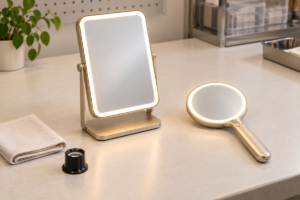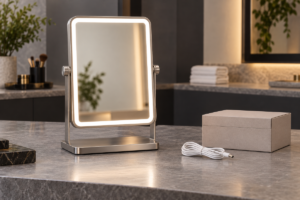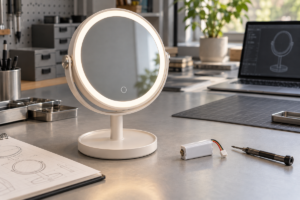

For B2B buyers, the lowest LED makeup mirror price is only useful when the specification, lighting performance, charging reliability, packaging, and after-sales risk are also comparable. A cheaper quotation can become more expensive after weak LEDs, unstable hinges, short battery runtime, poor inserts, unclear product claims, or replacement requests are counted. The better sourcing decision is to compare total landed value: unit price, defect risk, channel readiness, packaging protection, and supplier support before bulk production starts.

This guide is written for brands, Amazon and e-commerce sellers, distributors, retailers, and private-label buyers who need to compare LED makeup mirror quotations without choosing a risky low-cost SKU by mistake.
Why Low Unit Price Can Hide Higher Commercial Risk
LED makeup mirrors look easy to compare because many quotations use similar words: LED light, touch switch, rechargeable battery, magnification, USB cable, gift box, and export carton. The problem is that those words do not define the real product.
Two mirrors can both be described as rechargeable tabletop LED makeup mirrors, while one uses better LED diffusion, stronger hinge hardware, a more stable base, safer battery protection, cleaner mirror glass, and a stronger molded insert. If the buyer only compares unit price, the weaker version may win the RFQ even though it creates more complaints after launch.
For e-commerce sellers, this is especially important because AI-assisted listing tools and marketplace catalog systems can help create product content quickly, but buyers still need accurate product attributes, real photos, and claims that match the final goods. A low quotation that cannot support brightness, battery, material, or packaging claims can damage listing quality and customer trust.
What Actually Changes the Price of an LED Makeup Mirror?
The first step is to ask what is included in the quotation. A serious supplier should be able to explain why one model costs more than another in practical sourcing terms.
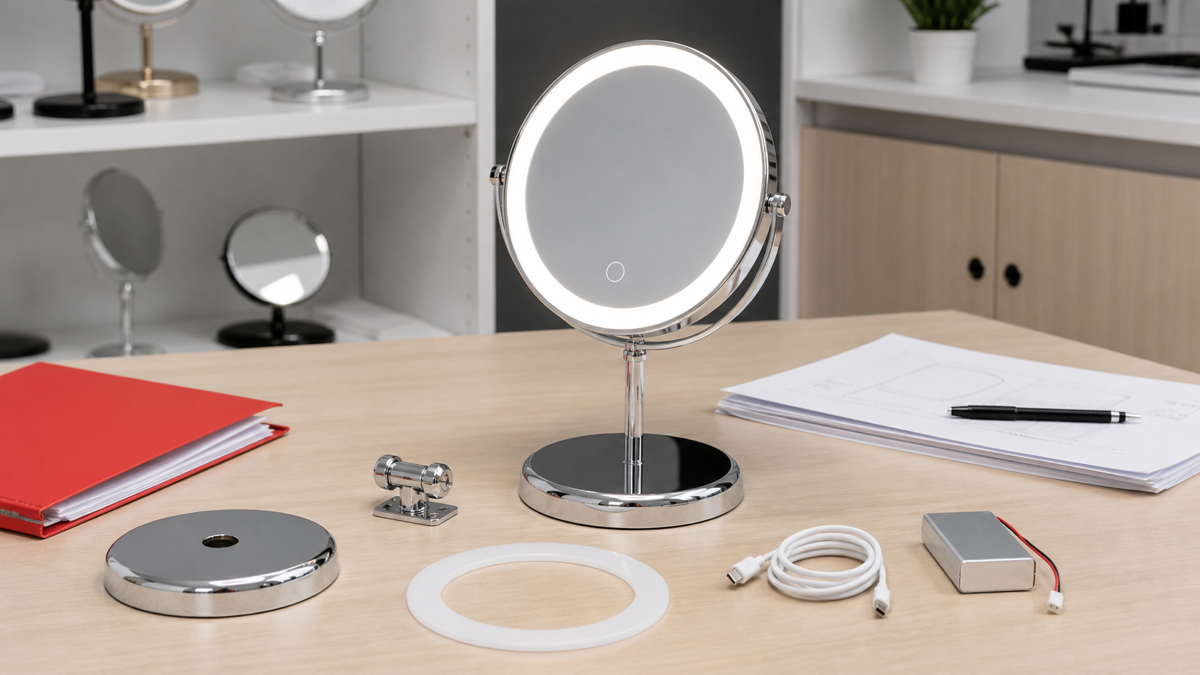
| Cost Driver | Lower-Price Shortcut | Buyer Risk | What to Confirm Before RFQ |
|---|---|---|---|
| LED light source | Fewer LEDs or uneven diffusion | Dull lighting, glare, poor reviews | CCT, brightness range, CRI target, diffusion sample |
| Mirror structure | Lighter base, weaker hinge, thinner frame | Shaking, loose angle, breakage | Base weight, hinge cycle test, sample stability |
| Power system | Lower-grade battery or charging board | Short runtime, charging complaints | Charging time, runtime, USB-C fit, protection design |
| Magnification | Unclear or inconsistent magnifying glass | Distortion, user dissatisfaction | Magnification level, usable viewing distance |
| Finish and plating | Thin coating or poor surface control | Scratches, color variation, low perceived value | Finish sample, scratch protection, color tolerance |
| Packaging | Thin insert or generic carton | Damage, returns, warehouse issues | Packed sample, carton strength, accessory placement |
When buyers ask only for “your best price,” the supplier may remove cost from exactly the areas that protect the order: lighting, structure, packaging, and inspection. A better RFQ asks for a target price band plus a required quality and packaging level.
Compare Total Cost, Not Only Unit Price
The most useful comparison is not the cheapest ex-factory number. It is the total cost of receiving, selling, and supporting the product.
For a retail chain, the hidden cost may be poor shelf presentation, unstable testers, or inconsistent color across replenishment orders. For an Amazon seller, the hidden cost may be damaged cartons, inaccurate product-page claims, weak battery performance, or returns that reduce account health. For a distributor, the hidden cost may be a product that is difficult to reorder because the original low-price supplier changed components after the first shipment.
Use this practical comparison:
| Decision Point | Lowest-Price Quote | Better-Value Quote |
|---|---|---|
| Sample matches mass production | Not clearly guaranteed | Final components confirmed before approval |
| Lighting claim | General LED description | CCT, brightness, dimming, and diffusion defined |
| Packaging | Basic box and carton | Channel-specific insert, retail box, and export carton |
| QC evidence | Visual check only | Function, charging, hinge, appearance, and packaging checks |
| Reorder stability | Price may change with components | Component and finish standard locked |
| After-sales support | Unclear replacement logic | Spare parts, defect response, and photo evidence process |
The lower unit price is acceptable only if it still passes the same buyer-useful checks. If it cannot, the buyer is not saving cost. The buyer is moving cost into returns, relabeling, replacement parts, and customer complaints.
Quality Checks That Protect the Real Margin
LED makeup mirror quality is not just about whether the light turns on during sample review. Buyers should confirm the product can still perform after charging, handling, packing, shipping, and daily use.
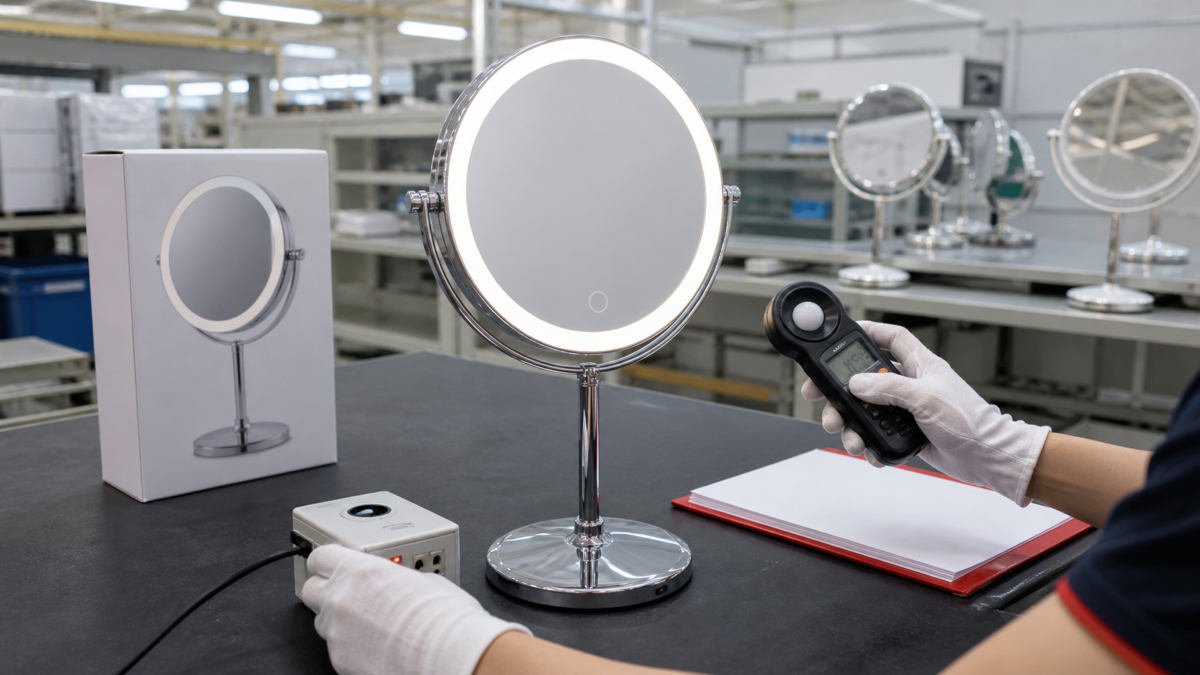
Key checks include:
- Lighting consistency across several samples, not only one hero sample.
- Touch switch response, dimming smoothness, and no obvious flicker.
- USB-C cable fit, charging indicator behavior, runtime, and charging time.
- Hinge holding force after repeated angle adjustment.
- Base stability on a real vanity surface.
- Mirror glass clarity, magnification accuracy, and edge finishing.
- Surface finish, plating, color consistency, and scratch protection.
- Accessory count, instruction sheet, barcode area, and carton mark readiness.
For rechargeable mirrors, buyers should also treat battery-related packing and transport documents as part of the quotation. International battery guidance continues to emphasize correct handling, packaging, marking, and documentation for battery-powered goods. That does not mean every mirror order is complicated, but it does mean the supplier should understand the export route and prepare the right information before shipment.
Packaging Is Part of the Price Decision
Many low-price quotations become expensive because packaging was treated as a finishing detail. For mirrors, packaging is a product-protection system. It affects breakage, review quality, warehouse receiving, and replacement cost.
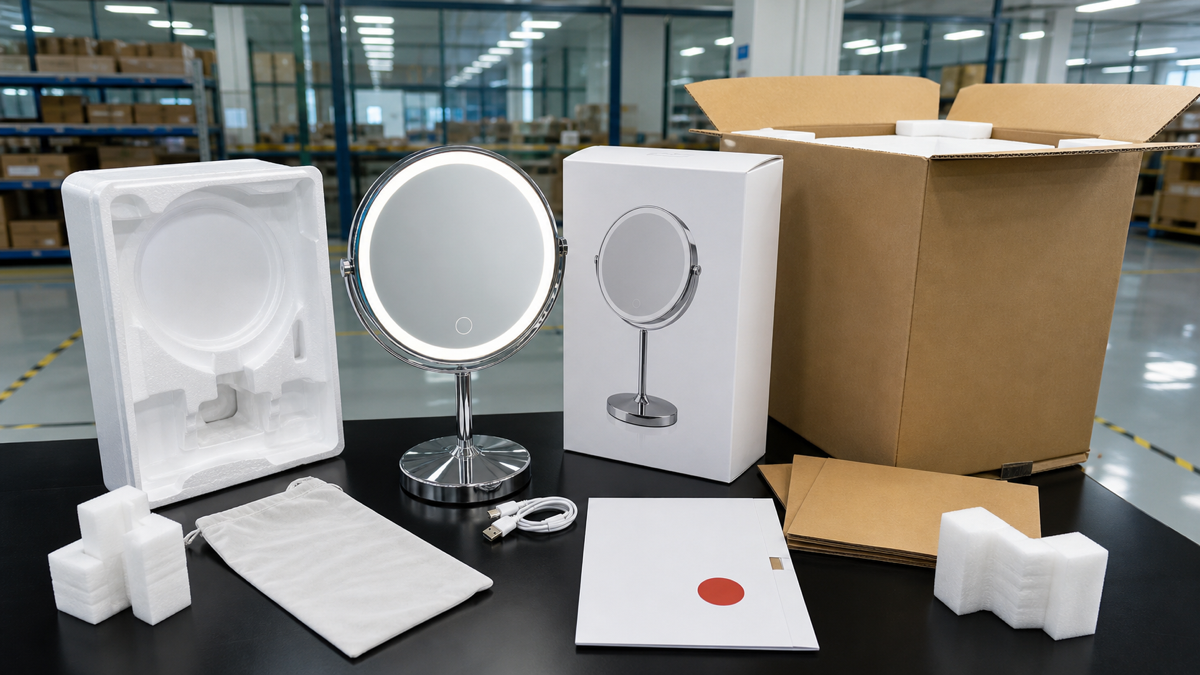
For e-commerce, the buyer should approve a packed sample, not only the product sample. The mirror, stand, USB-C cable, manual, insert, and retail box should stay fixed inside the package after normal handling. The carton should support the selected shipping route and the label area should be clean enough for warehouse scanning.
For retail, the packaging must also present the product clearly. A cheaper box may reduce unit cost, but if it weakens gift value or looks inconsistent on the shelf, the SKU may lose sales even before quality complaints appear.
RFQ Checklist for Comparing LED Makeup Mirror Prices
Before choosing a supplier, send the same RFQ structure to every shortlisted factory. This makes price comparison fair and reduces the chance of comparing different products under the same name.
- Target buyer channel: Amazon, DTC, retail chain, distributor, salon, gift, or private label.
- Mirror type: tabletop, wall-mounted, compact, travel, tri-fold, or Hollywood-style.
- Size, magnification, base material, finish, and color requirement.
- LED details: CCT, CRI expectation, brightness range, dimming method, diffusion requirement.
- Power details: rechargeable or plug-in, USB-C requirement, battery capacity target, runtime expectation.
- Packaging route: retail box, gift box, mailer-ready box, molded insert, export carton, pallet requirement.
- Logo and private-label scope: mirror logo, box artwork, manual, insert card, barcode, carton mark.
- Compliance and documents: target market, plug or battery documents, test reports needed for the buyer channel.
- QC scope: appearance, lighting, charging, hinge, stability, packaging, accessory count, and AQL expectation.
- Commercial terms: MOQ, sample lead time, bulk lead time, payment term, spare parts, and replacement process.
If a supplier cannot quote against this structure, the low price may not be reliable enough for a commercial launch.
Common Mistakes Buyers Should Avoid
The first mistake is comparing samples that are not built to the same specification. A heavier base, better hinge, brighter light, stronger insert, or cleaner finish can change cost in a justified way.
The second mistake is approving a low price before packaging is confirmed. Mirror packaging changes carton size, damage risk, accessory placement, and sometimes MOQ or lead time.
The third mistake is asking for premium listing claims without paying for the product evidence behind those claims. If the product page says strong brightness, long runtime, premium finish, or travel-ready protection, the final goods must support that statement.
The fourth mistake is ignoring reorder stability. A supplier can quote aggressively once, then change components later to protect margin. Buyers should ask which parts are locked after sample approval and how changes will be communicated.
Recheck the Quote After Documentation and Packing Approval
At the two-week quotation review, confirm that competing offers cover the same product revision, quantity, currency, delivery basis, accessories, inspection scope, and packed dimensions. Separate one-time setup costs from recurring unit charges, and record exclusions instead of treating missing figures as zero. Compare expected costs as scenarios when shipment damage or returns have not yet been measured.
Use the manual and label approval checklist to capture translation, print proof, barcode application, and reprint charges. Ask each supplier to identify the event that starts its lead time and the owner of each approval. Keep the final quotation and signed packed sample on the same revision before releasing the purchase order.
Bottom-Line Recommendation
Choose the LED makeup mirror supplier that can explain the price, protect the channel, and prove the specification. A low unit price is attractive only when lighting, charging, structure, packaging, QC, and after-sales support are still controlled. For most B2B buyers, the best value is not the cheapest mirror. It is the mirror that reaches the target price band while reducing returns, claims, launch delays, and repeat-order uncertainty.
Buyers planning a private-label or wholesale program can also review Mingda Mirror’s Makeup Mirrors, Product Design Support, Packaging & Logistics, QC Process, and Contact pages before sending an RFQ.
FAQ
Is the lowest LED makeup mirror price always risky?
No. A low price can be workable when the specification is simple, the channel is price-sensitive, and the supplier still controls lighting, charging, packaging, and QC. The risk appears when the low price is not tied to a clear product standard.
What should buyers compare besides unit price?
Compare lighting performance, mirror stability, battery and charging reliability, packaging strength, sample-to-mass-production consistency, MOQ, lead time, QC scope, and after-sales support.
Why does packaging change the real cost?
Packaging affects damage rate, carton size, dimensional weight, warehouse receiving, retail presentation, and replacement claims. For mirrors, weak packaging can erase the savings from a cheaper unit price.
How can Amazon or e-commerce sellers reduce low-price return risk?
They should confirm product claims against the final sample, approve the packed sample, check charging and lighting performance, prepare accurate listing attributes, and request clear defect-response terms before bulk shipment.
What should a buyer send Mingda Mirror for a comparable quotation?
Send the target sales channel, expected price band, mirror size and style, lighting and power requirements, packaging route, logo scope, target market, estimated quantity, and any inspection or document requirements.
Request a Value-Based Quotation
If you are comparing LED makeup mirror suppliers, send Mingda Mirror your target channel, price band, specification, packaging route, and expected order quantity. The Mingda team can help you compare the real tradeoffs behind the quotation and prepare a sample plan that supports both cost control and launch reliability.