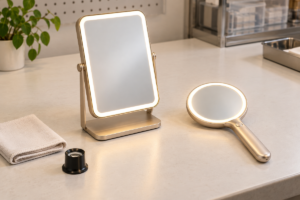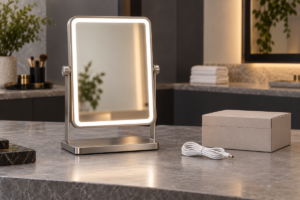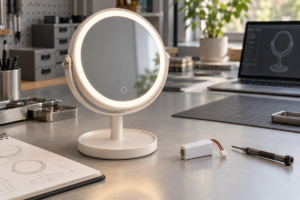

For a retail-ready LED makeup mirror, a bright light ring cannot compensate for poor reflection quality. Buyers should approve an LED makeup mirror glass inspection standard before bulk production: define the viewing distance, lighting, inspection zones, sample size, and rejectable defects. This converts vague comments such as “the mirror looks wavy” into a repeatable release decision for brands, retailers, Amazon sellers, distributors, and private-label programs.
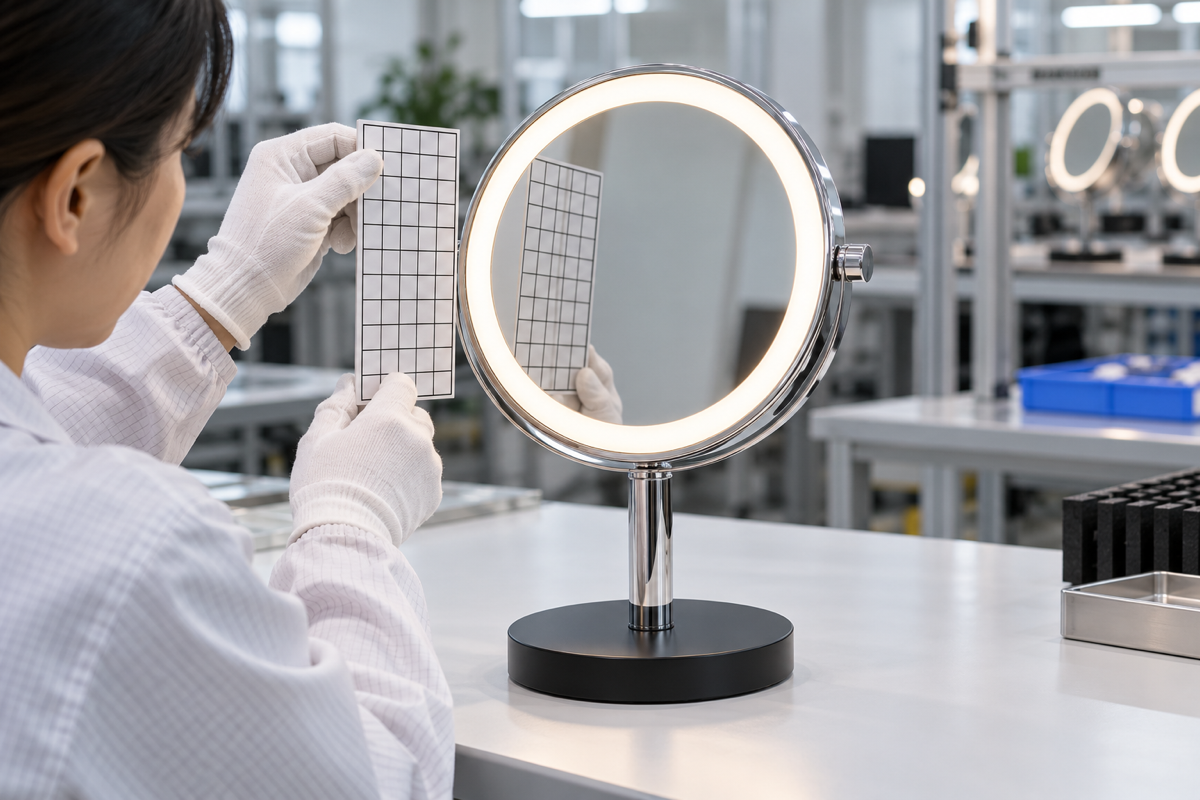
The direct answer: inspect the glass as a finished, lit product
The most useful acceptance method is not an isolated glass check. Inspect the assembled mirror at the intended user distance, with its production lighting on and the protective film removed. Check center and edge reflection, visible marks, optical waves, backing defects, and the way the LED ring makes defects more noticeable. Record the pass/fail sample with photos and keep it as the golden reference for production inspection.
A mirror can look acceptable on a supplier bench yet create complaints in a customer bathroom or vanity. Bright, even LED lighting makes smudges, scratches, coating marks, and distortion easier to see. That is why optical quality belongs in the same approval file as lighting uniformity, frame finish, magnification, and packaging protection.
What an optical acceptance standard should define
“No defect” is not an inspection instruction. A workable standard tells the factory and third-party inspector exactly how to look, what to compare, and what requires a hold.
| Control point | What the buyer should define | Why it matters |
|---|---|---|
| Product state | Final glass, final bezel, LED on, protective film removed | Prevents a pre-assembly check from hiding finished-product defects |
| Viewing method | Normal use distance and a fixed close-check distance | Separates a real user-visible defect from an irrelevant micro-mark |
| Light condition | Agreed CCT/brightness plus neutral ambient light | Makes each batch comparable |
| Inspection zones | Center viewing area, edge area, bezel boundary, magnifying zone if fitted | Stops inspectors from checking only the easy center area |
| Reference | Signed golden sample and defect photo sheet | Avoids subjective “looks fine” decisions |
| Disposition | Rework, replace, hold, or accept rule for each defect class | Keeps shipment decisions fast and traceable |
For magnifying models, write the magnification and working-distance expectation into the same sheet. A 5x or 10x surface will make edge behavior more visible, and a consumer using it too far away may mistake normal optical behavior for a defect. See Mingda’s 5x vs 10x LED makeup mirror comparison when deciding whether high magnification fits the target channel.
A practical LED makeup mirror glass inspection sequence
1. Confirm the correct sample and configuration
Before checking the surface, verify model number, mirror size, normal or magnifying side, frame/bezel, LED mode, and approved color. An inspector cannot make a reliable visual decision if the sample uses a different glass specification or lighting configuration from the purchase order.
2. Check reflection at normal use distance
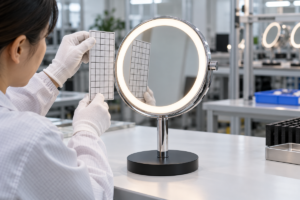
Look straight at the mirror and then move the reflection-grid card through the center and edge zones. Lines should remain stable enough for the approved product type; sudden waves, double images, or local bending that a user can see during ordinary makeup use should be documented. Do not confuse normal reflection perspective with a true glass or backing defect—use the agreed reference sample beside the unit when a decision is close.
3. Check the lit face and the perimeter
Turn on the LED and inspect the glass face, edge, and bezel boundary. Record scratches, black spots, stains, coating marks, trapped dust, glue marks, chips, and edge damage. Also check whether the LED ring creates a bright reflection that exposes a defect not visible when the product is off. This is especially important for premium tabletop mirrors sold as gift or beauty-brand products.
4. Separate optical, cosmetic, and handling defects
Not every visual defect has the same cause or remedy. The table below helps buyers request the right corrective action rather than a generic “improve QC” response.
| Defect type | Typical symptom | Likely production or handling path | RFQ / inspection response |
|---|---|---|---|
| Optical distortion | Wavy grid or shifted reflection | Glass flatness, lamination/backing, magnifying lens variation | Compare with golden sample; hold affected units for technical review |
| Surface contamination | Spot, haze, fingerprint, dust, glue mark | Cleaning, assembly environment, protective-film handling | Define cleanability and reject criteria before packing |
| Scratch or abrasion | Visible line under task lighting | Fixture contact, loose accessory, insert movement | Improve handling protection and packed-product test |
| Edge or coating defect | Chip, dark edge, backing mark, perimeter blemish | Cutting/edging, mounting, bezel fit, moisture exposure | Define acceptable edge zone and replacement rule |
| Magnification mismatch | Customer reports blur or discomfort | Wrong lens, focal-distance expectation, copy mismatch | Confirm lens specification and user instruction before release |
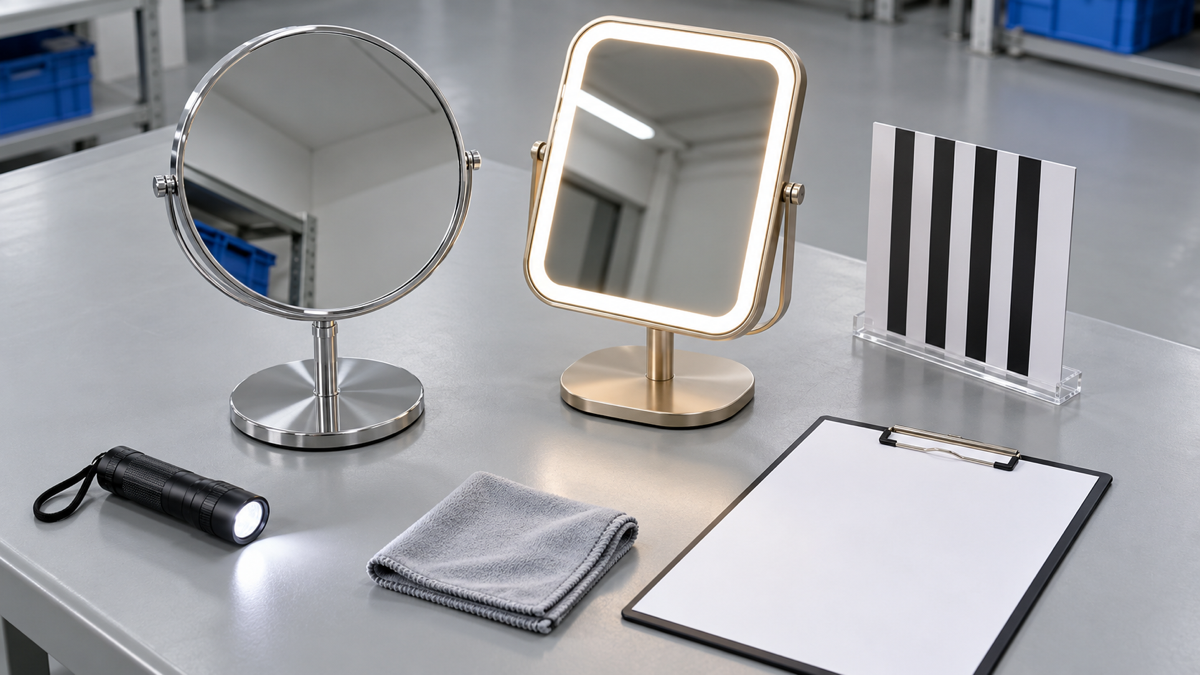
Buyer checklist before approving mass production
- Approve a finished, illuminated golden sample—not loose mirror glass alone.
- Specify normal-use and close-check viewing distances for the product format.
- Photograph acceptable center and edge reflection from the approved sample.
- Set a defect map for the primary viewing area, perimeter, and any magnifying zone.
- Check the glass with the planned LED mode, bezel, and frame color.
- Include scratch, dust, glue, edge, coating, and distortion checks in the pre-shipment report.
- Confirm that protective film, microfiber cloth, cable, and accessories cannot rub the glass inside the retail pack.
- Retain one sealed packed sample for comparison if a later claim occurs.
Common buyer mistakes
Approving from product photos only
Photos can hide subtle waves, edge issues, or reflection artifacts. Request a short controlled inspection video and still photos using the same grid or line reference that will be used in production.
Treating a magnifying zone like a normal 1x mirror
Magnification changes working distance and perceived distortion. The correct standard is usability at the stated magnification and distance, not a promise that every angle looks identical to a flat 1x mirror.
Leaving packing out of the glass decision
A clean approved unit can arrive scratched if the insert permits movement or a loose accessory contacts the surface. Approve the mirror and the pack together, then use the LED makeup mirror pre-shipment inspection checklist to connect visual inspection with final packing evidence.
Accepting a verbal quality promise instead of a reference sample
“High-quality mirror glass” is not measurable. Ask for an inspection instruction, defect photos, a retained reference sample, and a clear disposition path for borderline units.
RFQ-ready decision points
Send these inputs with a new RFQ or purchase-order revision:
1. Mirror model, diameter or viewing area, and normal/magnifying configuration. 2. Target market and channel: retail, marketplace, distributor, salon, or hotel/project. 3. Approved lighting mode and the visual inspection condition. 4. Reference sample photos showing acceptable center and edge reflection. 5. Rejectable visual defects, including scratches, spots, waves, chips, and glue marks. 6. Sampling level, evidence format, rework authority, and claim-response process. 7. Packed-product protection requirement for the mirror face and loose accessories.
Bottom line
Buyers should specify LED makeup mirror glass inspection as a finished-product acceptance step: evaluate the assembled mirror under its real lighting, compare reflection against a signed reference, define visible defect zones, and protect the approved surface through packing. This is a practical way to reduce subjective disputes, avoidable returns, and late-stage rework without over-specifying insignificant marks.
Mingda Mirror can help align a mirror sample, optical acceptance sheet, LED function check, packing plan, and production QC evidence before a bulk order. Review our makeup mirror product options, OEM/ODM services, and quality control process, then contact Mingda Mirror with your target market, model, quantity, and desired inspection standard.
FAQ
How should buyers check LED makeup mirror distortion?
Check the finished, illuminated product at the agreed user distance and move a straight-line or grid reference through the center and edge zones. Compare uncertain units directly with the signed golden sample rather than relying on a verbal judgement.
Does a magnifying makeup mirror need a different inspection standard?
Yes. Include magnification, useful viewing distance, center/edge behavior, lighting glare, and user-facing instructions. Higher magnification can make optical variation more visible and needs clearer acceptance criteria.
Can packaging create mirror-glass defects after final QC?
Yes. Loose cables, accessories, insufficient film protection, and inserts that allow movement can scratch or mark the glass after it passes line inspection. Approve a packed sample and include a post-pack visual check.
What evidence should a supplier provide before shipment?
Ask for inspection photos or video of the approved test method, a pre-shipment report covering optical and cosmetic defects, packed-sample photos, and traceable model/batch information. The exact evidence should match the order value and channel risk.
Social Media Content Ideas
- LinkedIn: “A bright LED ring makes mirror defects easier—not harder—to see. Here is the three-step optical acceptance method procurement teams can add to an RFQ.”
- Facebook: “Before approving a lighted makeup mirror, check the reflection with the LEDs on. Our new buyer checklist explains why.”
- Instagram: Use the grid-card inspection cover with the caption: “Approve the reflection, not just the product photo.”
- CTA: Read the full guide and send your model, market, and quantity through the Mingda Mirror Contact page for an RFQ-ready inspection plan.