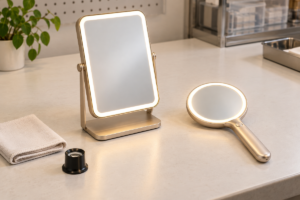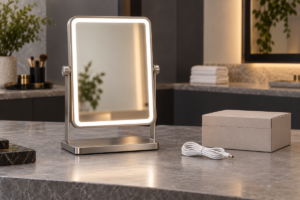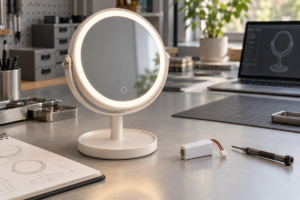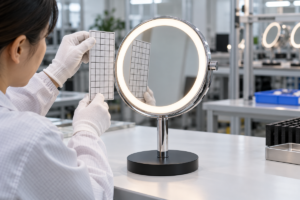

For hotel LED makeup mirror placement, buyers should approve the mirror in a real room or mockup before bulk production. The approval should confirm guest viewing distance, mounting height, arm clearance, power method, lighting comfort, finish, cleaning access, hardware pack, spare parts, and room-type labeling. A beautiful sample can still fail in a hotel bathroom if it hits a faucet, sits too far from the guest, creates glare, or cannot be serviced after installation.
This guide is written for hotel owners, FF&E buyers, project distributors, developers, and contractors who need a repeatable approval standard before ordering wall-mounted LED makeup mirrors for many rooms.
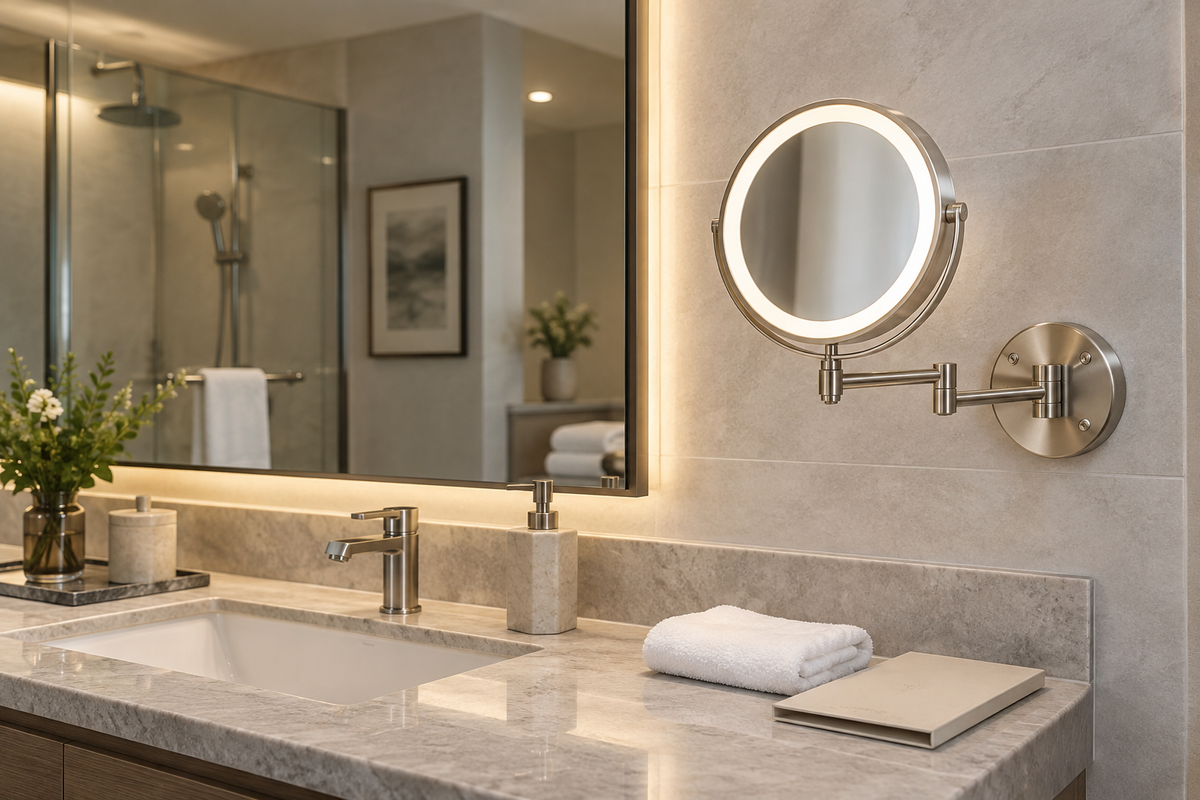
Why Placement Approval Matters for Hotel LED Makeup Mirrors
A hotel LED makeup mirror is a small product, but it is used at close distance and touched by many guests. Placement affects whether the mirror feels premium, whether the light is comfortable, and whether housekeeping or maintenance teams can clean and service the product without extra work.
Project buyers should not approve placement only from a catalog photo. The same wall-mounted mirror can work well in one room type and perform poorly in another because vanity depth, faucet position, wall tile, mirror size, room lighting, door swing, and electrical outlet position all change the user experience.
For Mingda Mirror buyers, the safest workflow is to connect the placement decision with the approved sample, installation hardware, power option, packaging, and spare parts record. Buyers can start from the Makeup Mirrors range, then confirm project details through OEM/ODM services and the QC process.
Placement Decisions Buyers Should Confirm
Hotel project approval should convert a sample into a room-ready specification. The table below helps buyers separate visual preference from installation risk.
| Placement factor | What to approve | Why it matters |
|---|---|---|
| Mounting height | Center height, guest standing or seated use, wall plate position | Prevents uncomfortable viewing distance and inconsistent room installation |
| Arm clearance | Full extension, folding path, faucet and main mirror clearance | Avoids collisions, scratched finishes, and guest complaints |
| Power method | Plug-in, hardwired, adapter location, cable exit, voltage | Reduces installation rework and safety uncertainty |
| Lighting comfort | CCT, brightness, dimming, glare, reflection from tiles | Protects guest experience during makeup, shaving, and skincare |
| Magnification | 3X, 5X, or other option plus viewing distance | Prevents distortion complaints and wrong product selection |
| Finish and hardware | Metal finish, wall screws, anchors, gasket, wall plate | Keeps the room design consistent and installation kit complete |
| Cleaning access | Space behind mirror, hinge access, water splash exposure | Helps housekeeping clean without loosening the arm |
| Service record | Spare adapter, wall plate, switch, mirror head, room label | Makes later replacement faster and traceable |
Wall-Mounted vs Tabletop for Hotel Projects
Wall-mounted LED makeup mirrors usually suit hotels when the room layout allows consistent installation. They reduce counter clutter, stay in the room, and create a more permanent amenity. They also need stricter approval because wall position, wiring, and replacement access become part of the project.
Tabletop LED makeup mirrors can be useful for serviced apartments, suites, or flexible hospitality programs where fixed wall installation is difficult. They are easier to replace, but they require counter space, theft-loss control, charging or cable management, and packaging for room-by-room distribution.
A wall-mounted mirror can suit a hotel project when room layout, mounting support, service access and installation responsibilities are confirmed. For mixed room types, buyers should approve one configuration per room family instead of forcing every bathroom to use the same arm length, power plan, or magnification.
Power Method: Plug-In or Hardwired
Power method should be decided before mass production, not during installation. A plug-in LED makeup mirror can simplify replacement and testing if the room has a suitable outlet near the mirror location. It may be practical for serviced apartments, renovation projects, or markets where plug-in bathroom accessories are accepted.
A hardwired solution can look cleaner and reduce exposed cable concerns, but it requires coordination with the contractor, wall opening, driver location, voltage, installation instructions, and service access. If the project uses hardwiring, buyers should request a clear wiring drawing and confirm who is responsible for final electrical connection at the site.
The RFQ should state destination voltage, plug or wiring requirement, adapter expectation, switch type, cable length, packing method, and whether each room type needs the same setup. Without these details, two supplier quotations may look similar while carrying very different installation cost and risk.
Lighting and Magnification Checks in the Mockup Room
Lighting approval should happen at real guest distance, not only on a factory table. Ask the supplier to identify CCT options, brightness range, dimming method, and diffusion structure. In the mockup room, check glare from the LED ring, reflections from glossy tile, shadows from the main bathroom mirror, and comfort after several minutes of use.
Record CRI alongside CCT, and agree how brightness and flicker will be checked at the same working distance, dimming level and room-light setting. Retain the approved sample and test record: a brighter LED ring alone is not evidence of better guest comfort.
Magnification should match guest use rather than the strongest headline claim. A higher magnification level can be useful for detailed grooming, but it requires closer working distance and can feel distorted if the mirror is mounted too far away. Buyers should record the approved magnification, viewing distance, arm extension, and room type together.
Use the existing hotel LED makeup mirror specification as the parent specification, then add placement results from the actual room. If the main bathroom mirror also needs approval, coordinate with the hotel LED bathroom mirror mockup room approval workflow.
Common Placement Mistakes
The most common mistake is approving the mirror as a product but not as an installed room detail. A buyer may approve the finish and lighting in the sample room, then discover that the arm hits the faucet, the mirror blocks the main mirror, or the cable path looks unfinished after installation.
Another risk is treating all room types as identical. Standard rooms, suites, accessible rooms, and apartment-style bathrooms can have different vanity widths, wall materials, and guest positions. If the project uses one SKU across all rooms, the approval record should explain why it works across those layouts.
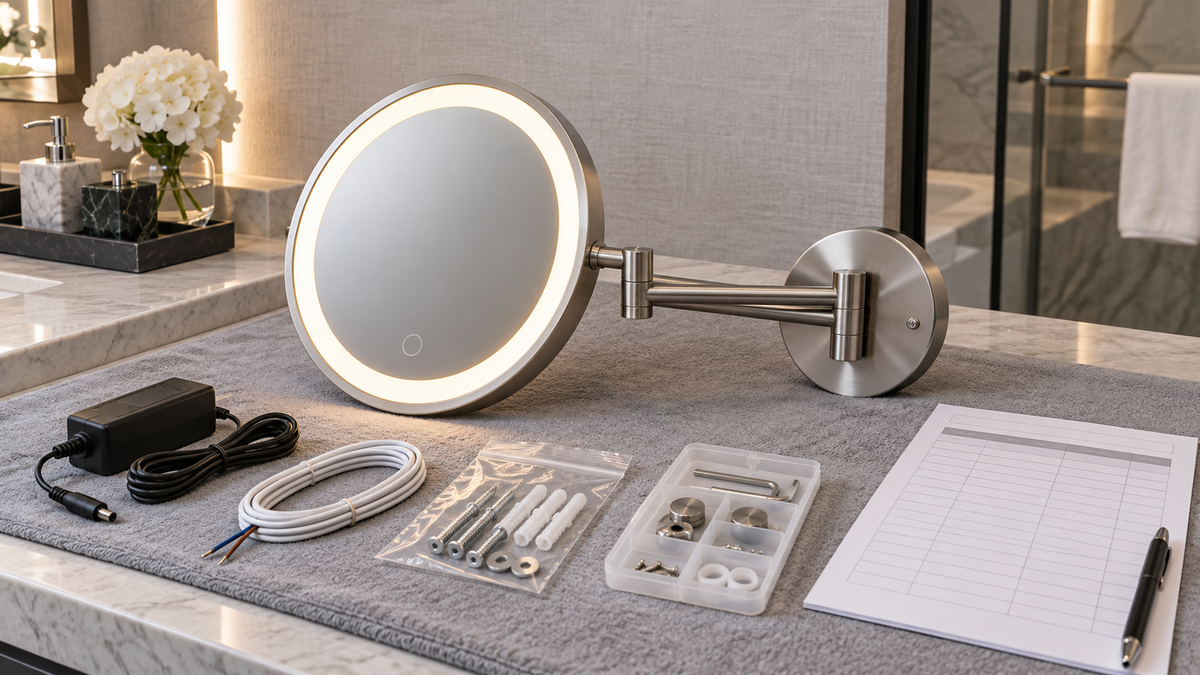
Buyers should also avoid separating placement from packaging. A project-ready order needs room labels, accessory packs, screws, installation instructions, spare parts, and carton marks that match the approved mirror revision. A correct product can still slow the site if installers cannot identify the right pack for the right room.
Pre-RFQ Checklist for Hotel LED Makeup Mirror Placement
Before requesting a formal quotation, send the supplier a room-ready brief:
Ask the supplier to quote MOQ by finish, power configuration and packaging version, with sample and production lead times shown separately. Agree that production release follows signed room-mockup approval. Record the spare-part quantities, replacement responsibilities and revision identifiers in the purchase order so later room batches match the approved installation.
- Room type and quantity for each mirror configuration.
- Wall surface, vanity depth, faucet position, and main mirror size.
- Preferred wall-mounted or tabletop format.
- Mirror diameter, magnification, arm length, and finish.
- Plug-in or hardwired power requirement, voltage, cable, and adapter details.
- Lighting requirement: CCT, dimming, glare comfort, and switch method.
- Hardware pack, manual, carton label, and spare parts expectation.
- Sample approval process, mockup room timing, and mass-production release date.
- Packaging requirement for project delivery, storage, and room-by-room distribution.
- Contact person for installation questions, replacement terms, and final sign-off.
Turn Placement Observations into a Room-Type Release Record
A room mockup approves only the configuration actually reviewed. Record the room-family ID, drawing revision, sample ID, mounting position and power option before checking the installed mirror. Agree acceptance criteria with the project team rather than copying a universal mounting height from another project.
| Check | Evidence to retain | Decision before ordering |
|---|---|---|
| Reach and moving clearance | Measured position, full arm movement, nearby fixtures and photographs of the reviewed room | Installer and buyer approve the room configuration or assign a revised layout for recheck |
| Viewing and lighting comfort | Working distance, magnification, room-light setting, dimming level and recorded observations | Resolve viewing-distance or glare concerns on the actual sample |
| Hardware and service access | Approved hardware list, mounting surface, model-specific instructions and replaceable part numbers | Confirm installation and replacement responsibilities for the chosen configuration |
| Open issue or changed component | Affected rooms, issue owner, revised sample or drawing, retest result and approval date | Hold the affected configuration until its responsible approver closes the issue |
Keep passed and failed observations together. If an arm, power component, mounting surface or room layout changes, record the impact and agree the required recheck before extending approval to other rooms. Carry the signed revision into the purchase order, room labels and installation handover.
Bottom-Line Recommendation
For hotel LED makeup mirror placement, approve the complete installed experience before bulk production. The best specification is not only the mirror size or lighting mode. It is the combination of guest distance, arm movement, power method, lighting comfort, magnification, cleaning access, hardware pack, and service record.
If a project has several room types, approve the mirror by room family and keep one signed record for each configuration. This helps the buyer compare quotations fairly, reduce installation rework, and make future replacement easier.
FAQ
What is the best height for a hotel LED makeup mirror?
There is no universal height because vanity height, guest position, arm length, and room design vary. Buyers should approve the mounted sample in the mockup room and record the final center height for each room type.
Should hotel projects choose plug-in or hardwired LED makeup mirrors?
Plug-in mirrors can be easier to replace when an approved outlet is available. Hardwired mirrors can look cleaner but require stronger coordination with the contractor and electrical plan. The buyer should confirm this before quotation.
Is 5X magnification suitable for hotels?
5X can work well when the viewing distance and arm reach are comfortable. If the mirror is mounted too far from the guest, higher magnification can feel distorted. Test magnification in the actual room position.
What should be included in the installation hardware pack?
The pack should normally include the approved wall plate, screws, anchors, any gasket or spacer, adapter or wiring accessories where applicable, manual, and room-specific labeling. Buyers should confirm this during sample approval.
Can Mingda Mirror support hotel project approval?
Yes. Mingda Mirror can support wall-mounted LED makeup mirror selection, sample development, lighting review, installation accessory planning, project packaging, and QC before bulk shipment. Contact Mingda Mirror with quantities by room type, drawing revision, power method, finish, mockup deadline and delivery schedule. Request itemized sample, hardware, packaging and spare-part costs plus MOQ by configuration and lead time after approval.
Social Media Content Ideas
LinkedIn angle: explain why hotel buyers should approve LED makeup mirror placement in a real room before releasing bulk production.
Facebook angle: show how arm clearance, power method, and lighting comfort reduce hotel bathroom complaints.
Instagram angle: use the complete wall-mounted LED makeup mirror bathroom scene to highlight a premium guest-room detail.
Short CTA: Read the full placement approval guide and send Mingda Mirror your room drawings for a project-ready RFQ.