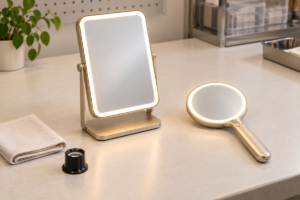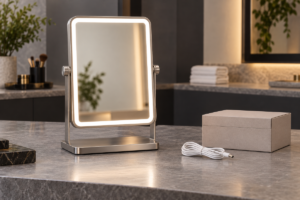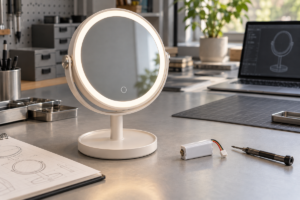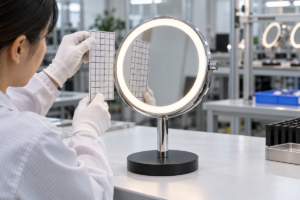

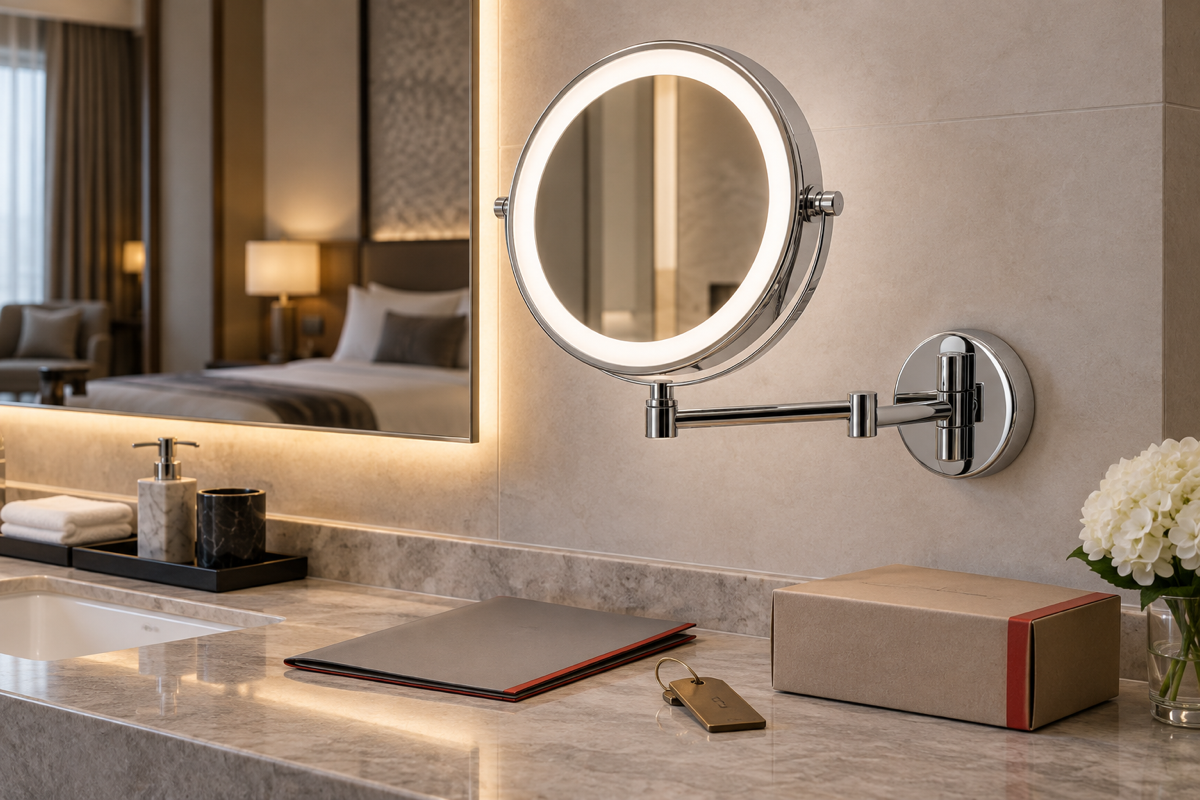
For hotel, apartment, and serviced-residence projects, a wall-mounted LED makeup mirror should be approved as an installed fixture, not as a loose beauty accessory. Buyers should confirm mounting position, arm reach, mirror diameter, lighting comfort, power connection, safety requirements, packaging protection, replacement parts, and room mockup approval before mass production. A room-specific specification helps address three common project problems: mirrors that do not fit the vanity layout, lighting that guests dislike, and installation details that create rework during handover.
Why Hotel Projects Need a Different Mirror Specification
A retail LED makeup mirror is usually judged by shelf appeal and consumer features. A hotel project mirror is judged by installation consistency, guest comfort, maintenance cost, and whether hundreds of rooms can be handed over without repeated site changes. The product must work with the vanity wall, main bathroom mirror, countertop depth, power plan, and housekeeping routine.
Project buyers should therefore avoid approving only a catalog photo or a single quotation line. A proper RFQ should describe the room type, vanity width, mounting surface, distance from sink, electrical plan, finish requirement, packaging route, and replacement policy. When these points are clear, the supplier can recommend a mirror structure that suits the actual project instead of quoting a generic wall mirror.
Mingda Mirror supports hotel and project buyers with LED makeup mirror selection, OEM/ODM customization, packaging review, and sample approval before bulk shipment. Related product categories can also be reviewed on the Makeup Mirrors and Hollywood Mirrors pages when a project needs different room or vanity formats.
Wall-Mounted, Tabletop, or Built-In: Choose by Room Operation
For hotel rooms, the first decision is not only shape. It is how the mirror will be used, cleaned, repaired, and replaced.
| Project option | Best fit | Buyer advantage | Main sourcing risk to control |
|---|---|---|---|
| Wall-mounted LED makeup mirror | Guest bathrooms, vanity corners, premium rooms | Saves counter space and feels fixed to the room design | Wrong arm reach, weak mounting plate, difficult wiring |
| Tabletop rechargeable LED mirror | Suites, beauty counters, flexible apartment rooms | Easy placement and no wall drilling | Theft risk, charging control, countertop clutter |
| Plug-in tabletop mirror | Salon-style vanity, dressing table, long-stay rooms | Stable power and simple replacement | Cable routing and outlet location |
| Built-in magnifying mirror module | Custom bathroom furniture or luxury vanity design | Integrated look and controlled placement | Higher development time and stricter mockup approval |
Wall-mounted LED makeup mirrors can reduce counter clutter and standardize room setup when the wall structure, service access and room layout support that format. However, the arm length and mounting height must be checked carefully. If the mirror cannot reach the guest’s natural standing position, the product will feel inconvenient even if the lighting is good.
Installation Details Buyers Should Lock Before Quotation
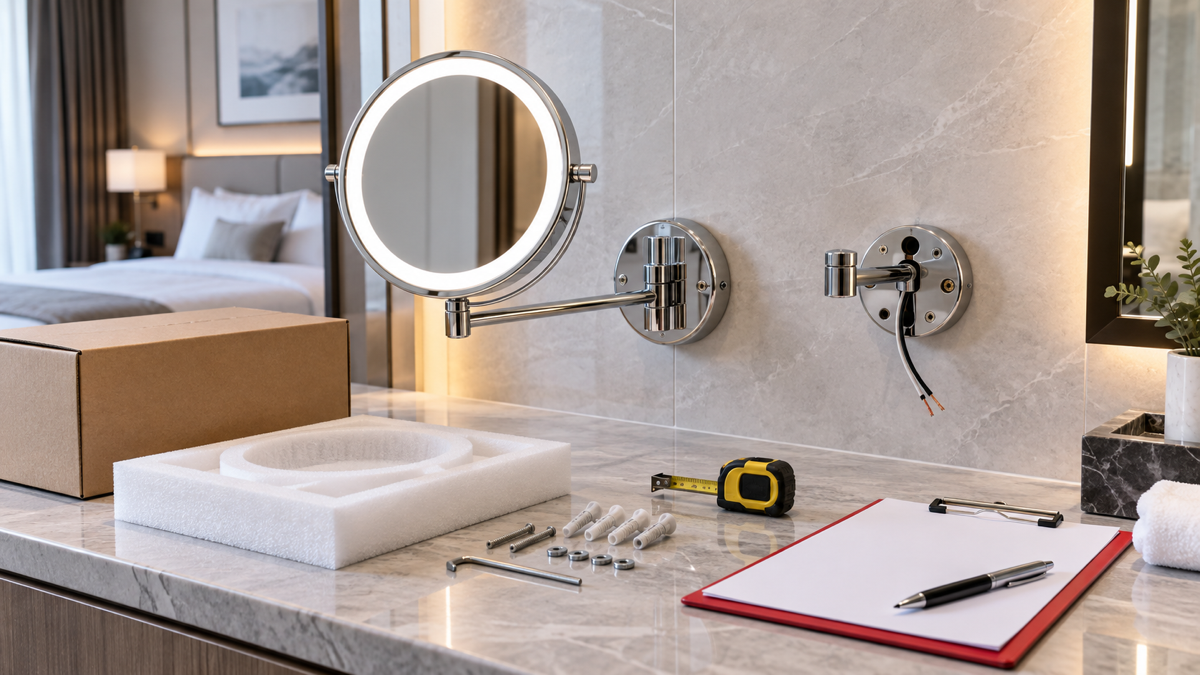
The installation drawing should be part of the buying decision. At minimum, confirm the mounting plate diameter, screw position, wall material, arm extension length, rotation angle, mirror head tilt, and final position relative to the sink and main mirror.
Buyers should ask for product drawings and compare them with the bathroom elevation drawing. A mirror that looks compact in a photo may need more clearance once the arm extends. A round LED mirror may also conflict with towel rails, shelves, faucet handles, or the side frame of the main bathroom mirror.
Before sample approval, prepare these installation checks:
- Room type and vanity layout
- Mounting wall material and tile thickness
- Center height from finished floor
- Distance from sink edge and main mirror edge
- Arm reach when fully extended
- Rotation angle and stop position
- Screw pack, wall plug, and mounting template
- Electrician access if the mirror is hardwired
- Cleaning clearance around the mirror and wall plate
For projects with multiple room types, do not assume one position works everywhere. A standard room, suite, accessible room, and serviced apartment may need different mounting positions or even different mirror formats.
Lighting Comfort: CCT, Brightness, and Glare Matter More Than Maximum Output
Hotel guests judge lighting by comfort and usefulness, not only by brightness. For an LED makeup mirror, buyers should confirm color temperature, diffusion quality, dimming behavior, and whether the light feels comfortable beside the main bathroom lighting.
A common mistake is approving a mirror that looks bright in a dark supplier video but feels harsh in a real bathroom. Project buyers should test samples in a mockup room with the main bathroom light on. The mirror should support makeup, shaving, and detail work without creating sharp glare or unnatural skin tone.
Useful specification points include:
- CCT range, such as warm, neutral, or three-color lighting
- Brightness level and dimming method
- CRI target if color accuracy is important
- LED diffusion material and visible dot control
- Switch position and guest operation logic
- Memory function if required by the brand standard
- Consistency between approved sample and mass production
For luxury hotel rooms, lighting comfort often matters more than adding many modes. For mid-market projects, simple operation and stable output may be more important than advanced controls. The right answer depends on the brand standard and maintenance plan.
Power Source and Safety Planning
Project buyers should decide early whether the LED makeup mirror will be hardwired, plug-in, rechargeable, or battery-operated. Each option changes installation, compliance, maintenance, and packaging.
Hardwired mirrors can create a clean hotel look, but the wiring position must be coordinated with the bathroom construction schedule. Plug-in mirrors are easier to replace, but cable routing and outlet location must look professional. Rechargeable mirrors reduce visible wires but require charging discipline and battery documentation. Battery-operated mirrors may fit some renovation projects, but they are usually less suitable for high-use hotel rooms.
Before ordering, confirm:
- Voltage and market requirement
- Plug type or hardwire plan
- Waterproof or bathroom suitability requirement
- Switch structure and electrical insulation
- Battery documentation if rechargeable
- Label, manual, and installation instruction language
- Replacement policy for drivers, cables, arms, and mirror heads
The supplier should not treat electrical details as an afterthought. These details influence inspection, installer confidence, and future maintenance cost.
Packaging and Site Delivery Requirements
Hotel project mirrors often travel through several handling steps: factory packing, container loading, warehouse storage, site delivery, room distribution, and final installation. A fragile mirror can survive factory inspection but still break if the inner protection, carton strength, or site labeling is weak.
Packaging should protect the mirror head, LED ring, arm, wall plate, cable, and hardware pack separately. The screw pack and manual should not scratch the mirror surface during transport. For multi-room projects, carton labels should help the site team identify room type, finish, voltage, and quantity without opening every box.
Ask the supplier to confirm:
- Individual inner protection and foam or molded insert design
- Master carton quantity and gross weight
- Drop-test or internal packaging review method
- Hardware pack position
- Installation manual and template
- Spare parts packed separately if required
- Pallet or container loading plan for large projects
- Replacement handling for breakage or missing accessories
Packaging is also a commercial issue. Stronger protection may increase carton size or freight cost, but it can reduce project delay, claim handling, and installer downtime.
Sample Approval and Mockup Room Checklist
For hotel LED makeup mirror projects, sample approval should happen in a mockup room whenever possible. The buyer, designer, installer, and purchasing team should check the same sample under the same conditions.
Use this checklist before bulk approval:
- The complete mirror fits the wall position and vanity layout.
- Arm reach and tilt angle work for normal guest use.
- Lighting looks comfortable beside the main bathroom light.
- Switch operation is simple and intuitive.
- Finish color matches faucets, hardware, and bathroom accessories.
- Mounting plate feels stable on the intended wall material.
- Cable or hardwire outlet position looks clean.
- Mirror diameter and magnification match the brand standard.
- Packaging protects the mirror head, arm, wall plate, and accessories.
- Manual, screw pack, and replacement parts plan are approved.
- MOQ, lead time, inspection method, and delivery schedule are confirmed.
If any item changes after mockup approval, the project should record it as a controlled revision. A different arm length, driver, LED strip, finish, or carton insert can change the installation outcome even when the model name stays the same.
Record Room-Type Acceptance Before Production Release
For each room type, connect the sample ID to the drawing revision, arm configuration, finish, power option and packed hardware set. Agree the acceptance criteria before testing. A signed photograph alone does not record whether the sample passed.
| Decision | Evidence to retain | Release condition |
|---|---|---|
| Reach and clearance | Room reference, mounting position, full arm travel and photographs of adjacent fixtures | Installer and buyer confirm the approved configuration fits the room |
| Lighting and magnification | Viewing distance, room lighting, dimming setting, sample revision and observations against agreed criteria | Resolve glare or working-distance concerns before confirming the sample |
| Service and spares | Approved service instructions, access review, part numbers and availability terms | Identify who supplies and replaces each serviceable component |
| Open issues and changes | Issue owner, due date, affected room types, revised drawing, retest result and approver | Hold unresolved configurations and reapprove changes before production release |
Coordinate the makeup mirror with the main mirror using the hotel mockup-room approval checklist. Carry the signed revision and outstanding actions into the site handover record.
Commercial Terms That Should Be Included in the RFQ
A strong RFQ helps a manufacturer quote the right product instead of guessing. For hotel projects, include expected quantity, room types, target installation date, sample deadline, packaging route, market voltage, certification needs, and replacement-parts expectation.
Buyers should also ask about MOQ for custom finish or packaging, sample lead time, mass-production lead time, pre-shipment inspection, carton marking, and how after-sales parts are supplied. If the project has phased delivery, confirm whether the supplier can keep finish and lighting consistency across repeat batches.
For OEM/ODM requirements, Mingda Mirror can help buyers organize specification sheets, sample approval records, packaging artwork, and production checkpoints through its customization service. Project buyers can also review QC process details before confirming inspection points.
One-Week Review: Match the Specification to the Room Record
Once the first mockup feedback arrives, reconcile the approved specification with the room-family record. Record which rooms were checked, which remain unreviewed, and whether the sample, hardware and drawing revisions still match the quotation. A passed standard room does not automatically approve a suite or another layout.
Use the hotel LED makeup mirror placement approval record for measured reach, viewing conditions and open issues. Assign an owner and due date to each exception, keep affected configurations on hold, and confirm revised sample costs and delivery impact before releasing the next project phase.
Bottom-Line Recommendation
For hotel projects, choose an LED makeup mirror only after confirming how it will be installed, powered, used, cleaned, packed, and maintained. A wall-mounted LED makeup mirror suits the project when the arm reach, mounting plate, lighting comfort, finish, electrical plan, packaging, and spare-parts policy match the room design.
Before mass production, approve one complete sample in a mockup-room setting and keep a written checklist for installation, lighting, packaging, and inspection. To discuss hotel LED makeup mirror specifications, share your room layout, quantity, target market, finish requirement, and project timeline through the Contact page.
Request an itemized hotel mirror quotation: send quantities by room type, drawing revision, finish, power option, hardware set and installation deadline. Ask for sample and customization costs, MOQ by finish, spare-parts terms, delivery phases and lead time after signed approval.
FAQ
What size LED makeup mirror is suitable for hotel bathrooms?
The right size depends on vanity width, wall clearance, guest position, and brand standard. Buyers should check mirror diameter, arm reach, mounting height, and clearance against the mockup-room layout before approving bulk production.
Should hotel LED makeup mirrors be hardwired or plug-in?
Hardwired mirrors create a cleaner fixed installation, but they require early coordination with the electrical plan. Plug-in mirrors are easier to replace, but the cable and outlet location must be controlled so the installation still looks professional.
What should buyers test in a hotel mockup room?
Test arm reach, mounting stability, guest viewing distance, lighting comfort, switch operation, finish matching, power connection, cleaning clearance, and whether the packaging and hardware pack support fast installation.
How can project buyers reduce breakage during hotel site delivery?
Use protective inner packaging, separate hardware packs, strong master cartons, clear carton labels, and a replacement-parts plan. The packaging should be checked with the real mirror sample, not only with artwork.
Can Mingda Mirror support custom finishes or packaging for hotel projects?
Yes. Mingda Mirror can support finish selection, OEM/ODM packaging, sample approval, production control, and project-specific inspection planning for LED makeup mirror and other mirror orders.
Social Media Content Ideas
LinkedIn angle: explain why hotel LED makeup mirror approval should start with installation and mockup-room testing, not only price.
Facebook angle: show how lighting comfort, arm reach, and packaging affect guest experience and project handover.
Instagram angle: use the installation review image to highlight the complete mirror, mounting hardware, foam insert, and approval checklist.
Short CTA: Read the full hotel LED makeup mirror specification guide and contact Mingda Mirror for project-ready sourcing support.