
Hotel LED bathroom mirror handover should confirm more than the mirror size and light color. Project buyers should verify the approved sample, anti-fog function, IP and electrical details, installation template, room-by-room packing labels, spare parts, and after-sales documents before bulk delivery. A clear handover checklist helps hotels, contractors, distributors, and project importers avoid mismatched wiring, damaged cartons, missing accessories, and slow maintenance after rooms open.
For Mingda Mirror, a project-ready LED bathroom mirror order should connect product specification, installation reality, packaging control, and maintenance support. The buyer should be able to send one RFQ package, approve one sample standard, and receive goods that the installation team can unpack and fit without guessing.
Why Handover Control Matters for Hotel Bathroom Mirror Projects
Hotel, serviced apartment, and rental renovation projects usually buy LED bathroom mirrors in batches. A single mistake can repeat across many rooms. If the bracket holes are slightly wrong, the electrician receives unclear wiring guidance, or the anti-fog area does not match the guest-use expectation, the project team may face installation delays rather than one small product complaint.
The risk is higher than a retail makeup mirror order because bathroom mirrors interact with the wall, vanity, power source, moisture, room schedule, and maintenance team. Buyers should treat the mirror as a project component, not only as a decorative product.
Mingda’s related project and quality resources can support this decision path:
- LED bathroom mirror solutions
- OEM and ODM mirror customization
- Mingda quality control process
- Contact Mingda Mirror for project RFQ
Project Handover Decision Matrix
| Handover Item | What to Confirm | Why It Affects the Project | RFQ Detail to Send |
|---|---|---|---|
| Mirror size and orientation | Width, height, frame or frameless edge, portrait or landscape use | Prevents mismatch with vanity width, wall tile lines, and lighting layout | Room type, vanity width, wall photos, target mirror size |
| Lighting specification | Front light, backlight, CCT, dimming, brightness comfort | Affects guest grooming experience and bathroom mood | Preferred CCT, voltage, switch type, sample lighting target |
| Anti-fog function | Heated area size, switch logic, warm-up time expectation | Prevents guest complaints in high-humidity bathrooms | Anti-fog area drawing and control requirement |
| IP and electrical details | Rated input, driver location, cable exit, wet-zone suitability | Supports safer installation and local compliance review | Project country, voltage, wiring method, required certificates |
| Mounting system | Bracket type, hole location, installation template | Reduces installer rework across repeated rooms | Wall material, tile thickness, installation drawing |
| Packaging and room delivery | Carton strength, corner protection, labels, room schedule | Controls breakage and mixed-room delivery risk | Quantity by room type, carton label fields, delivery sequence |
| Spare parts and documents | Driver module, brackets, screws, manual, maintenance guide | Speeds up hotel maintenance after opening | Spare ratio, warranty term, document language |
Sample Approval Before Mass Production
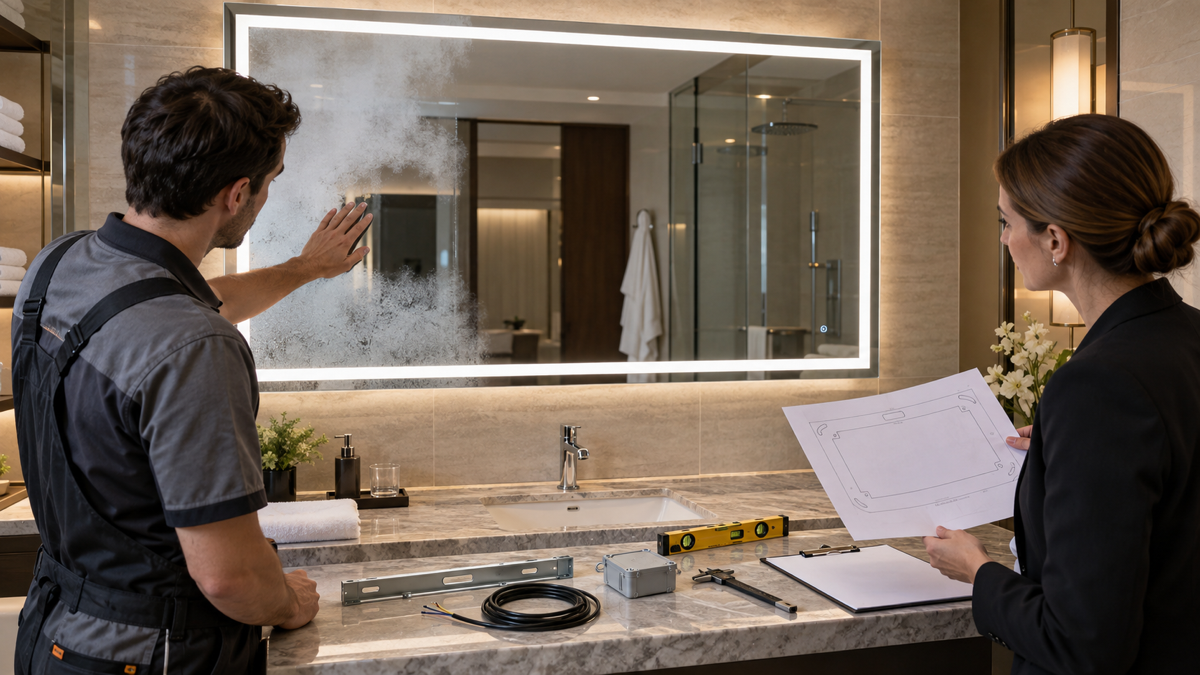
The approved sample should represent the final project version, including mirror size, edge finish, light color, anti-fog area, switch icon, cable position, mounting bracket, packaging method, and accessory set. A beautiful sample is not enough if it lacks the installation template or uses a temporary driver that will change in mass production.
Project buyers should ask the supplier to mark the sample version clearly. The model number, drawing revision, driver specification, carton layout, and accessory list should be locked before deposit or mass-production release. This is especially important for hotel groups, distributors, and contractors that may reorder the same mirror for future phases.
What to Test on the Approved Sample
- Check whether the LED light is comfortable from normal guest standing distance.
- Confirm CCT and brightness do not clash with vanity lights or room lighting.
- Test touch switch response with dry and slightly damp fingers.
- Confirm anti-fog area clears the useful viewing zone, not only a small hidden patch.
- Review cable exit position against the real wall junction box.
- Confirm the bracket keeps the mirror level and stable.
- Open the package and confirm one installer can identify all accessories quickly.
Installation Handover for Contractors
Contractors do not want marketing copy. They need repeatable installation data. A project LED bathroom mirror supplier should provide a clear drawing that shows outside dimensions, bracket location, hole spacing, recommended wall preparation, power cable route, and any safe clearance notes required for the design.
For hardwired mirrors, the buyer should confirm whether the project requires a concealed connection, plug option, wall switch control, touch switch control, or mixed control logic. For export orders, voltage and plug requirements should be agreed before production. The safest project workflow is to let the buyer, contractor, and supplier approve the same installation drawing before bulk manufacturing.
Common Installation Mistakes to Avoid
- Approving a mirror only by front photo, without bracket and cable drawings.
- Changing vanity width or tile layout after mirror size is confirmed.
- Assuming all rooms use the same wiring position.
- Ignoring driver access for future maintenance.
- Letting the supplier ship generic screws that do not match the wall substrate.
Packaging and Room-by-Room Delivery Control
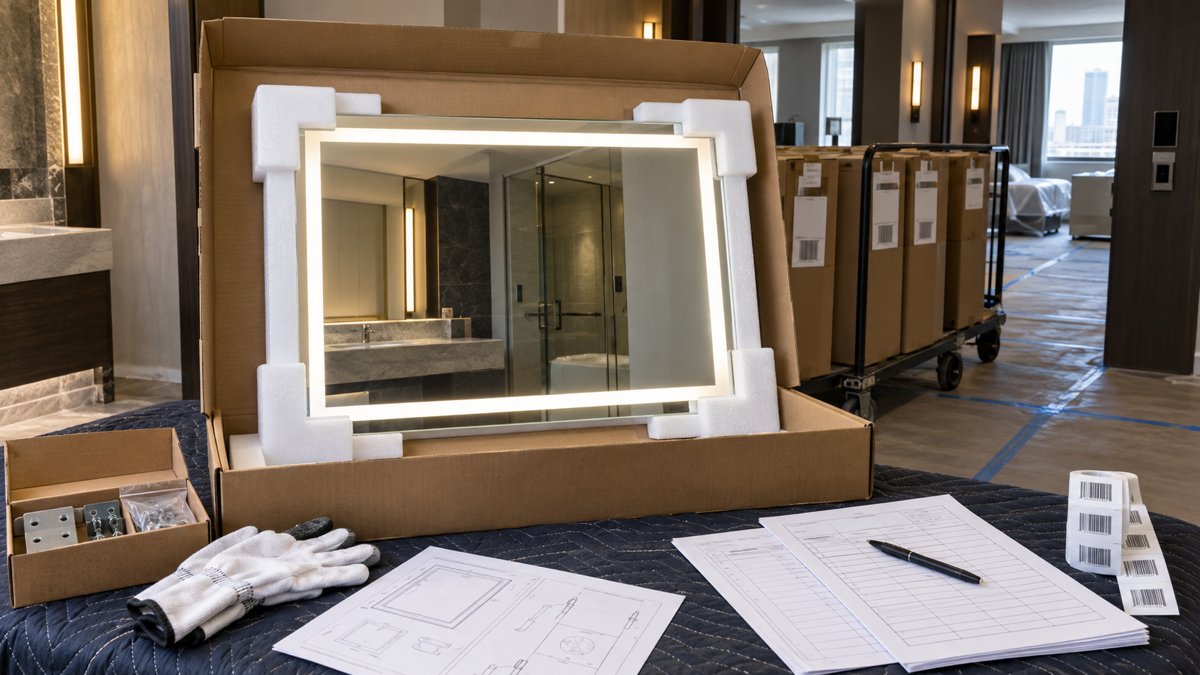
Hotel LED bathroom mirrors are fragile, high-visibility project items. Breakage can delay room turnover, and mixed labels can send the wrong mirror size to the wrong room type. The packaging plan should be reviewed as part of handover, not after production is finished.
For e-commerce parcels, exterior scan labels and carton durability are often the headline issue. For hotel projects, buyers should also confirm room-type labeling, pallet sequence, installation batch grouping, and whether cartons can be opened without damaging instructions or accessory bags.
Packaging Details Buyers Should Lock
- Inner corner protection, foam or molded support, and glass surface protection.
- Carton material, carton size, gross weight, and stacking guidance.
- Blank or buyer-specified exterior label fields for model, room type, PO, and quantity.
- Accessory bag placement so installers do not throw away small parts.
- Pallet or carton sequence aligned with project delivery phases.
- Replacement policy for transit damage and visible defects.
Maintenance and Spare Parts Handover
The hotel does not stop caring about the mirror after installation. Facilities teams need a simple way to identify the model, replace wear items, and contact the supplier for the correct spare part. For LED bathroom mirrors, the most practical spare list usually includes brackets, screws, driver modules when applicable, switch components if serviceable, installation instructions, and a record of the approved electrical version.
Project buyers should agree a spare ratio before shipment. A small spare-parts kit can be less expensive than urgent air freight after opening. The exact ratio depends on project scale, mirror complexity, market distance, and whether the hotel operator has a local maintenance partner.
How Should Buyers Close Handover Defects?
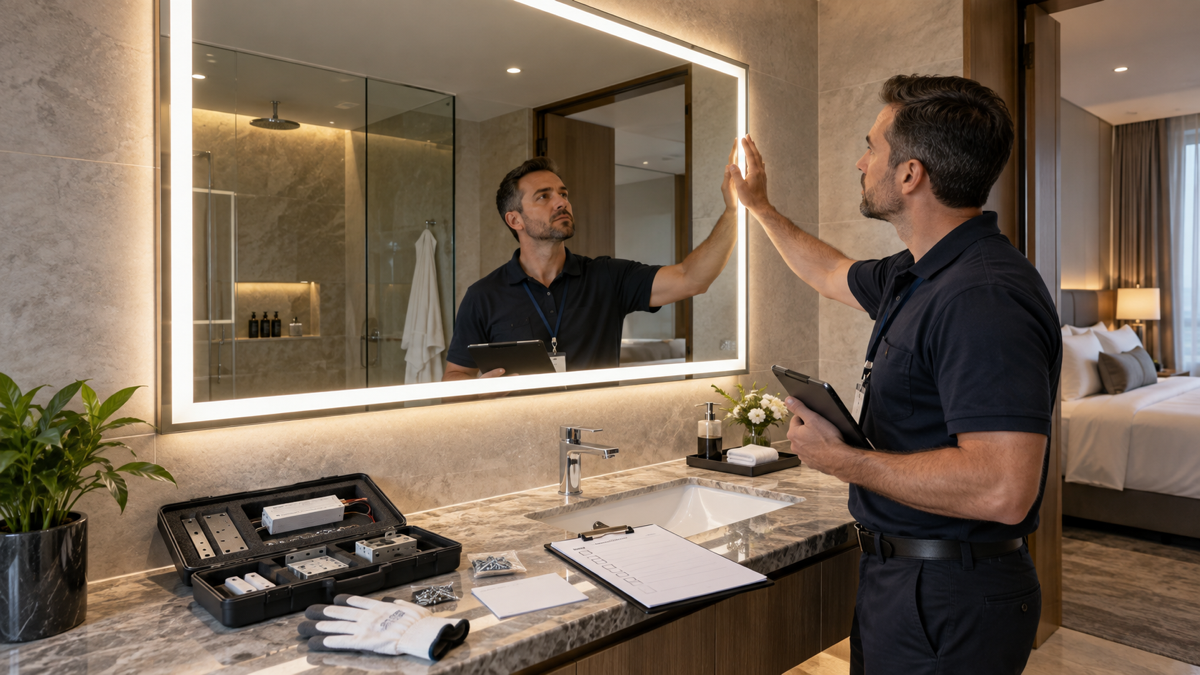
Use a room-by-room handover register with room number, mirror model and revision, carton or batch reference, inspection date, defect photo, responsible party, agreed action date, and recheck result. Keep delivery damage, missing accessories, installation mismatches, and functional defects as separate categories so the team can identify whether a replacement, document correction, or installer review is needed.
Agree acceptance criteria and sign-off responsibilities before delivery. An unresolved item stays open until the responsible party records the corrective action and the buyer or appointed inspector verifies it against the approved sample and drawing. Record approved exceptions separately, including who accepted them; a delivered carton alone is not evidence of room acceptance.
Connect the completed register to the hotel LED bathroom mirror maintenance plan so facilities teams inherit the actual installed model, approved parts list, and unresolved service commitments.
Pre-RFQ Checklist for Hotel LED Bathroom Mirrors
Before requesting a quotation, prepare:
- Project country, voltage, target certification or test-report needs.
- Room count by mirror size and room type.
- Mirror dimensions, frame preference, lighting type, CCT, and switch method.
- Anti-fog requirement, including heated area and control logic.
- Installation method: hardwired, plug-in, wall switch, touch switch, or mixed.
- Wall material, bracket expectation, and cable exit position.
- Packaging requirement for export, site delivery, and room identification.
- Spare-parts request, warranty expectation, and maintenance document language.
- Sample approval timeline, production lead time, and delivery deadline.
Bottom-Line Recommendation
For hotel projects, choose an LED bathroom mirror supplier that can manage the full handover package: approved sample, installation drawing, electrical specification, packaging test, room-label plan, spare parts, and maintenance documents. The best quote is not only the lowest unit price. It is the quote that reduces repeated installation risk across every room.
Mingda Mirror can support hotel, apartment, distributor, and project buyers with customized LED bathroom mirror specifications, packaging plans, QC records, and export-ready communication. Send your room schedule, mirror sizes, lighting and installation requirements, delivery phases, document language, and acceptance responsibilities. Ask for separate product, packaging, spare-part, and sample costs plus the proposed handover document list when you request a project quotation.
FAQ
What should hotel buyers confirm before ordering LED bathroom mirrors?
Confirm size, lighting, anti-fog function, IP and electrical requirements, installation drawing, packaging method, room labels, spare parts, and after-sales documents before bulk production.
Should the anti-fog area cover the whole mirror?
Not always. Many projects use a practical heated area around the main viewing zone to balance function and cost. The buyer should confirm the useful anti-fog area on the sample before production.
What information helps a supplier quote hotel LED bathroom mirrors accurately?
Send room count, mirror sizes, voltage, lighting type, CCT, switch method, anti-fog requirement, installation method, packaging needs, delivery schedule, and any certification or document requirements.
How many spare parts should a hotel project order?
The spare ratio depends on project size, mirror design, market distance, and maintenance plan. For larger projects, ask the supplier to quote a small spare kit together with the bulk order so the hotel can avoid urgent replacement delays.
Can Mingda Mirror customize LED bathroom mirrors for hotel projects?
Yes. Mingda Mirror supports OEM and ODM mirror customization, including size, lighting, anti-fog, packaging, labels, and project documentation for qualified B2B buyers.
Social Media Content Ideas
LinkedIn angle: Treat LED bathroom mirrors as project components, not decorative accessories. A proper handover checklist can reduce installer rework, room delays, and maintenance confusion.
Facebook angle: Hotel mirror projects need more than good lighting. Check anti-fog area, installation drawings, room labels, packaging, and spare parts before approving bulk production.
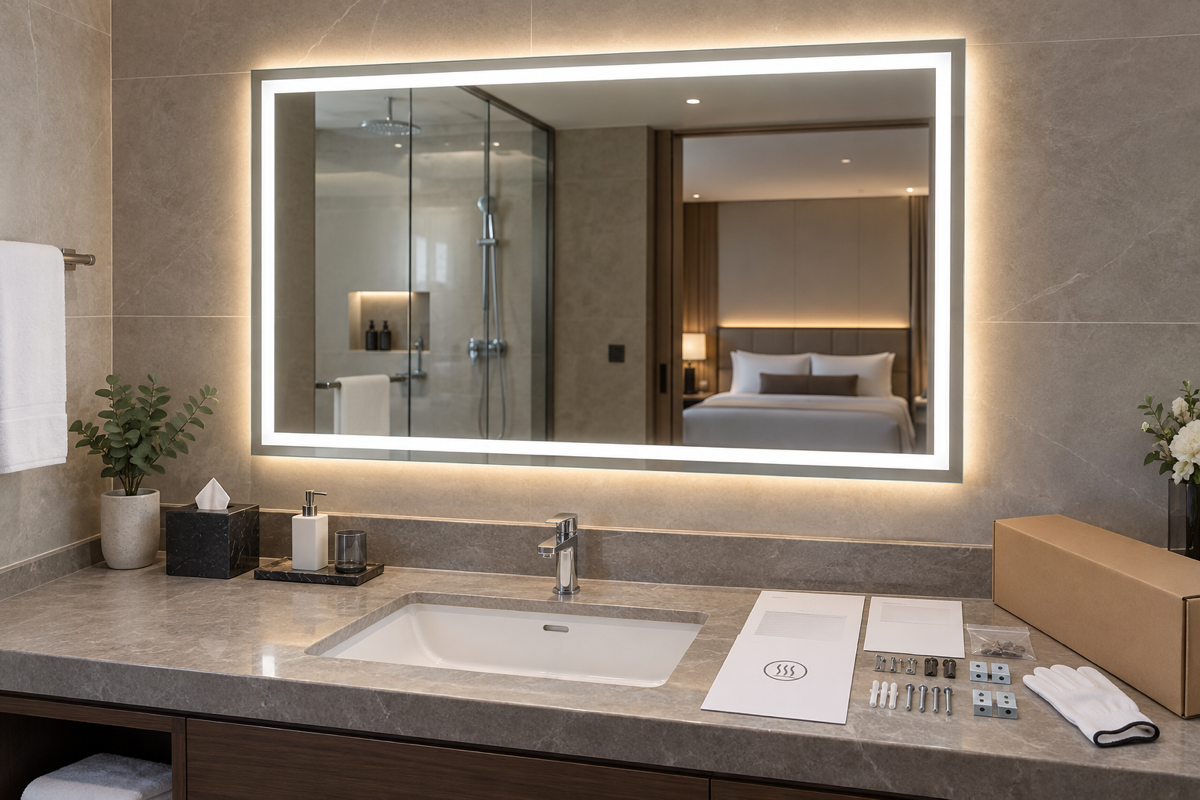
Instagram angle: Use the hotel vanity project image to show a complete LED bathroom mirror with lighting, anti-fog testing, packaging, and maintenance handover details.
CTA: Read the full checklist and send your room schedule to Mingda Mirror for a project-ready quotation.