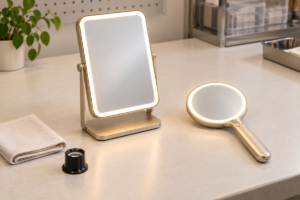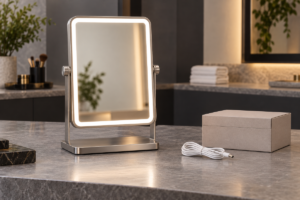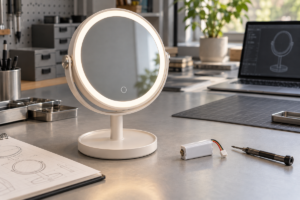

Mirror buyers should choose a supplier by asking questions that expose the real production process, not only the quoted price. The most useful questions cover product specialization, sample control, lighting performance, battery or electrical safety, customization limits, packaging validation, QC standards, lead time, after-sales responsibility, and communication during production. For brands, retailers, Amazon sellers, distributors, and project buyers, these answers reduce launch delays, return risk, and supplier disputes before a bulk order is placed.
This guide is written for buyers sourcing LED makeup mirrors, LED handheld mirrors, Hollywood vanity mirrors, and bathroom mirror products. Use it as a practical supplier-screening framework before sending an RFQ, approving a sample, or moving a private-label project into mass production.
Related Mingda resources: Mirror Products, OEM / ODM Customization, QC Process, and Contact Mingda Mirror.
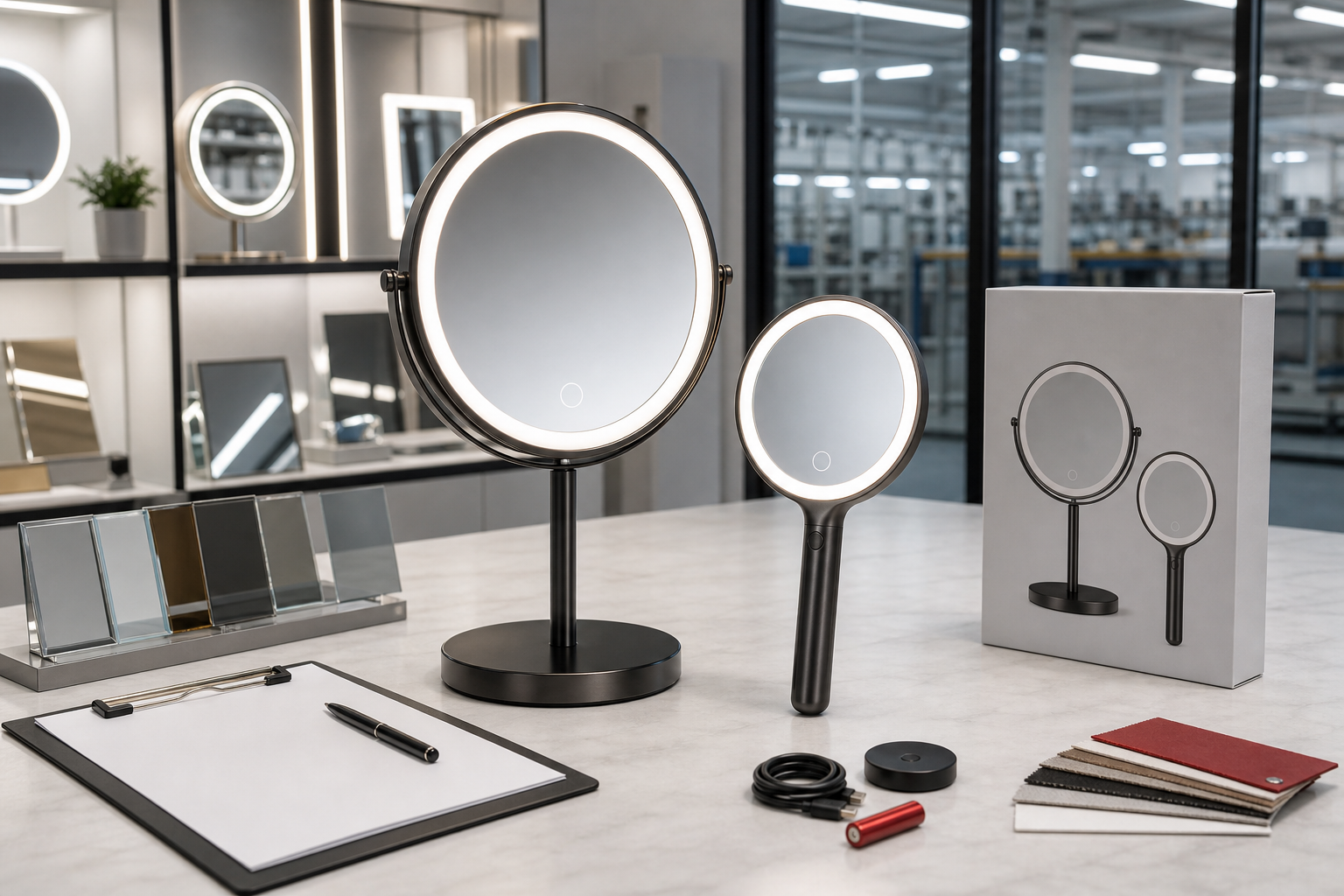
Why supplier questions matter more than a low quotation
A mirror quotation can look attractive while hiding weak sample control, unclear components, poor packaging, limited certification support, or unstable production capacity. These issues usually become expensive after the buyer has confirmed artwork, opened a marketplace listing, promised a retail delivery window, or committed to a project installation schedule.
Good supplier questions help the buyer identify whether the factory understands the mirror category and sales channel. A supplier for rechargeable LED makeup mirrors should understand battery safety, charging performance, magnification consistency, CCT, CRI, dimming, packaging, and private-label artwork control. A Hollywood mirror supplier should understand bulb layout, plug position, frame stability, carton protection, and breakage risk. A bathroom mirror supplier should understand electrical safety, installation environment, and project shipment control.
Supplier screening decision matrix
| Question area | What buyers should ask | Strong supplier answer | Risk reduced |
|---|---|---|---|
| Product specialization | Which mirror types do you manufacture regularly? | Clear focus on LED makeup, handheld, Hollywood, bathroom, or related mirror programs | Mismatched supplier capability |
| Sample control | How do you confirm the approved sample before mass production? | Sample photos, specification sheet, component list, packaging file, and signed approval record | Bulk order differs from approved sample |
| Lighting performance | What CCT, CRI, brightness, dimming, and glare checks are used? | Measurable lighting targets and production inspection points | Poor user experience and bad reviews |
| Battery or power safety | What documents and component controls support rechargeable or plug-in products? | Battery, adapter, wiring, label, and test report linkage to the final SKU | Compliance questions and shipment delays |
| Packaging validation | How do you test mirror packaging for the sales channel? | Packed-product review, drop or transit checks, carton marks, inner protection, and accessory placement | Breakage, returns, replacement cost |
| Production planning | What is the realistic MOQ, sample time, lead time, and reorder timeline? | Timeline separated by sample, material, packaging, production, QC, and shipment stages | Missed launch or retail delivery window |
| After-sales handling | How are defects, spare parts, and replacement claims handled? | Defect classification, evidence requirements, replacement policy, and improvement loop | Unclear responsibility after delivery |
1. What mirror categories does the supplier truly produce?
The first question is not “Can you make this mirror?” Many suppliers will answer yes. A better question is: “Which mirror categories do you regularly manufacture, and which sales channels do they serve?” The buyer should look for category experience that matches the order.
For LED makeup mirrors, ask about tabletop, wall-mounted, rechargeable, plug-in, magnification, foldable, and travel formats. For LED handheld mirrors, ask about handle durability, charging position, lens quality, retail packaging, and private-label options. For Hollywood mirrors, ask about frame material, bulb layout, wiring, plug position, tabletop versus wall-mounted use, and shipping protection. For bathroom mirrors, ask about moisture environment, installation, lighting structure, and project packing.
If the supplier’s examples are too broad or unrelated, the buyer may face hidden development time. A supplier can be reliable in one mirror category and weak in another.
2. How is the approved sample locked before mass production?
Sample approval is where many mirror orders succeed or fail. Buyers should ask how the supplier records the final approved sample: product photos, dimensions, finish, mirror glass, magnification, LED brightness, CCT, CRI, battery capacity, charging method, adapter, switch, cable, logo position, packaging, manual, barcode, and carton structure.
For private-label programs, this record should also include artwork version, color box proof, label file, instruction sheet, and accessory list. If the sample approval file is unclear, the mass-production team may follow an old component, a different packaging version, or an incomplete specification.
3. What lighting specifications are controlled in production?
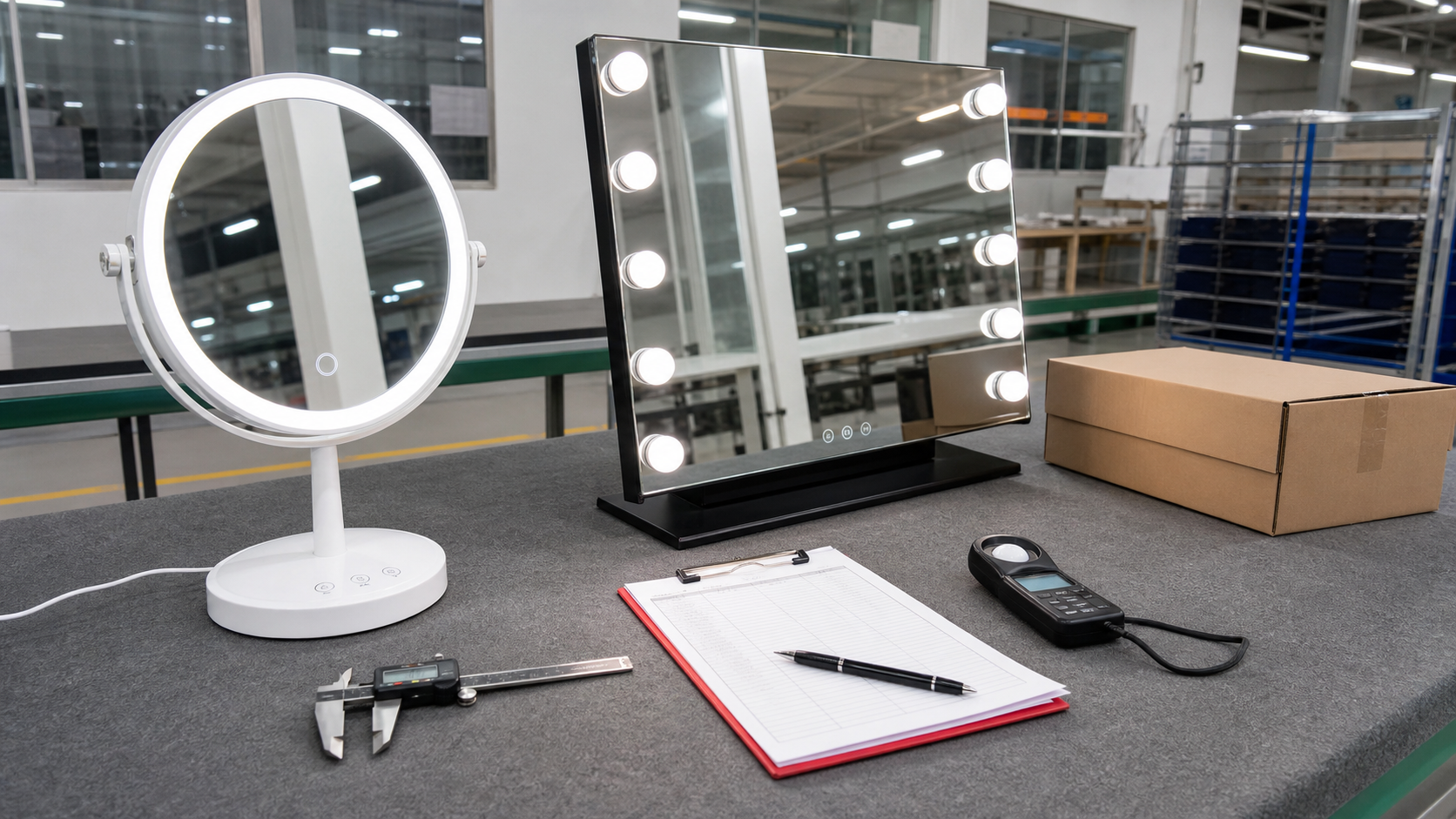
Lighting quality is a major review driver for makeup mirrors and Hollywood mirrors. Buyers should ask for the target color temperature, CRI, brightness range, dimming method, LED diffusion design, glare control, and inspection tolerance. The supplier should be able to explain how production checks avoid inconsistent light color, uneven brightness, flicker, weak dimming, or harsh glare.
For beauty channels, warm, neutral, and cool light settings may be useful only if the levels are practical and repeatable. For retail and Amazon sellers, the specification should match customer expectations and product claims. For hotel or salon use, lighting comfort and durability may matter more than adding too many functions.
4. What battery, adapter, and electrical evidence supports the final SKU?
Rechargeable mirrors and plug-in mirrors need clear component control. Buyers should ask whether the battery, adapter, cable, LED driver, wiring, label, and manual match the final production version. If the supplier changes a battery or adapter after sample approval, the buyer should request updated confirmation before mass production.
The strongest answer links documents to the final SKU, not just to a similar product. Ask which reports are available, what they cover, and whether any new testing or confirmation is required for the destination market or sales channel. This is especially important for marketplace sellers, retail chains, and project buyers with formal vendor approval processes.
5. How does the supplier validate packaging for your sales channel?
A mirror can pass function inspection and still fail in shipping. Packaging questions should be specific: Is the order for retail shelf display, Amazon parcel delivery, wholesale carton shipment, or project installation? Does the packaging protect the full mirror, stand, bulbs, cable, adapter, and accessories? Are cartons strong enough for the logistics route? Are barcode labels, carton marks, and manuals controlled?
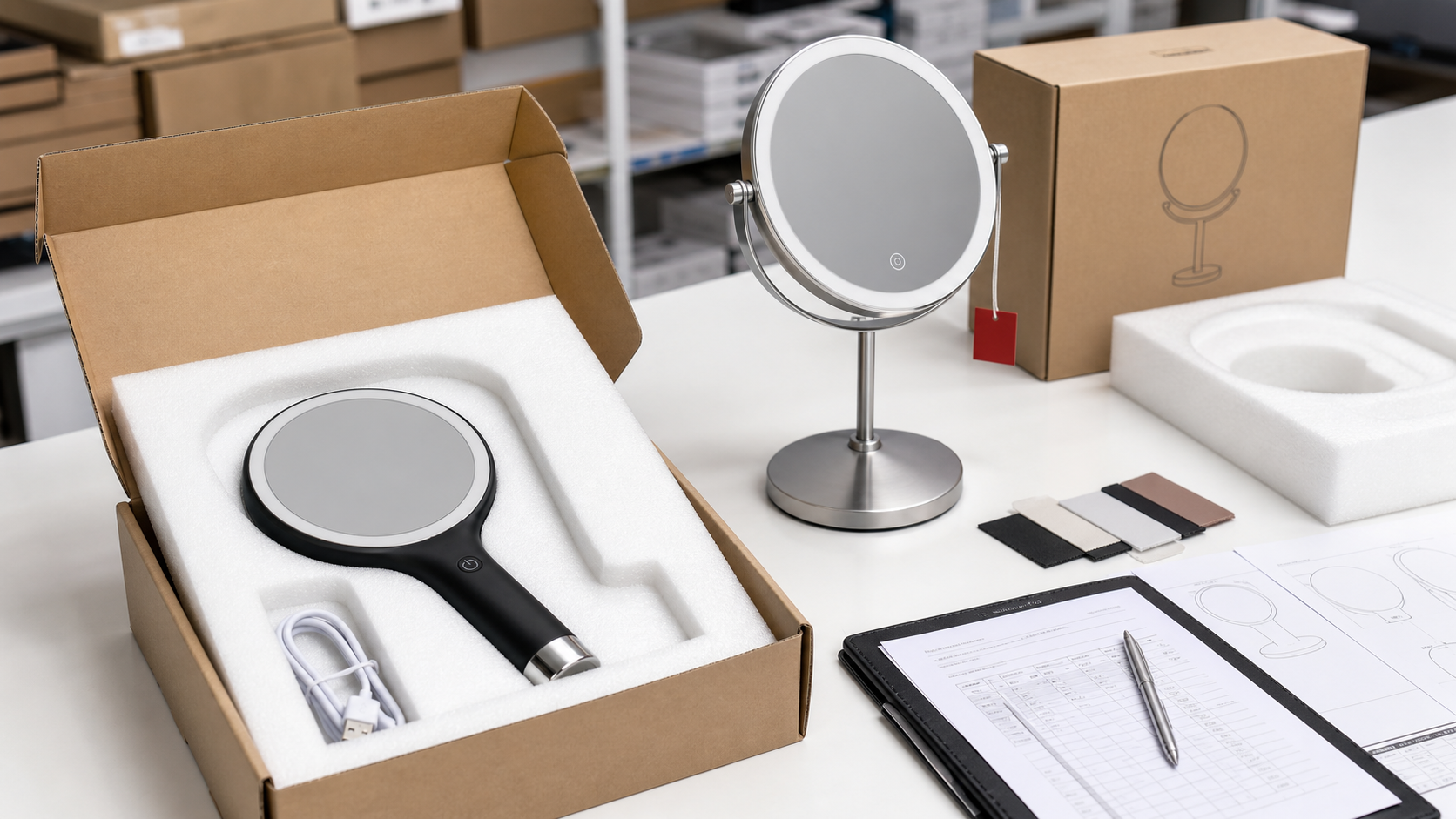
For Hollywood mirrors and bathroom mirrors, buyers should ask for packed-product photos and a clear inner-protection plan. For LED handheld mirrors and tabletop makeup mirrors, buyers should confirm tray fit, cable placement, surface protection, and color box durability. Packaging decisions affect breakage rate, customer reviews, and replenishment cost.
6. What customization limits should the buyer understand before RFQ?
Customization should be discussed before price comparison. Ask what can be customized without new tooling, what requires MOQ, and what affects lead time. Common options include logo printing, product color, finish, packaging artwork, manual, barcode, plug type, cable, charging port, LED color temperature, magnification, accessory set, and display packaging.
The supplier should separate standard options from development options. A simple logo or packaging change may be fast, while mold changes, new electronics, new battery capacity, custom finish, or special packaging structure can require sampling, testing, and extra lead time.
7. What is the real MOQ and lead-time structure?
MOQ is not only a product number. It may be affected by components, packaging, color, finish, printed artwork, accessories, and supplier inventory. Buyers should ask for MOQ by product, packaging, color, and customization layer. A low product MOQ may still be unrealistic if custom packaging has a higher print MOQ.
Lead time should also be broken down. A practical timeline includes RFQ confirmation, sample preparation, sample shipping, sample review, artwork approval, material purchasing, production, QC, packaging, final inspection, and shipment booking. This helps buyers plan product launches, retail windows, Amazon inventory, and reorder timing.
8. How is QC performed before shipment?
Buyers should ask what inspection points are used before shipment and whether the inspection standard can be aligned with their sales channel. For LED mirror products, useful checks include appearance, dimensions, mirror clarity, LED brightness, CCT, dimming, switch response, charging function, battery behavior, adapter match, cable quality, stand stability, magnification, packaging, labels, and carton marks.
Ask whether the supplier keeps inspection records and how defects are classified. For larger orders, buyers may also request pre-shipment photos, sample cartons, or third-party inspection support. The goal is to catch shipment-level problems before the goods leave the factory.
9. What happens if defects or breakage appear after delivery?
A supplier’s after-sales answer should be specific. Ask what evidence is required for claims, how replacements or spare parts are handled, how repeated defects are analyzed, and how corrective actions are applied to the next production batch. For e-commerce sellers, the supplier should understand how defect rate and packaging breakage affect reviews and account health.
For retail and distributor buyers, replacement terms and communication speed matter. For project buyers, the key risk is installation delay. A reliable supplier should discuss the defect categories and responsibility boundaries before the order is shipped, not only after a dispute appears.
10. How does the supplier communicate during production?
Production communication is part of supplier quality. Buyers should ask who will confirm specifications, who will handle artwork, who will report production progress, who will coordinate QC, and who will respond to shipment or claim issues. A clear contact structure reduces misunderstandings when the project includes several products, packaging versions, or delivery batches.
For private-label mirror programs, buyers should request milestone updates: sample ready, sample approved, artwork confirmed, materials prepared, production started, production completed, QC finished, packaging completed, and shipment booked. These updates make the buying process easier to manage internally.
Pre-RFQ checklist for choosing a mirror supplier
- Define the mirror category, target buyer, sales channel, and destination market.
- Confirm whether the supplier regularly produces the exact mirror type.
- Ask for the sample approval process and final specification record.
- Confirm lighting requirements such as CCT, CRI, brightness, dimming, and glare control.
- Review battery, adapter, wiring, report, and label linkage for powered mirrors.
- Ask how packaging is validated for retail, e-commerce, wholesale, or project delivery.
- Separate standard customization from new-development customization.
- Request MOQ and lead time by product, packaging, color, and component level.
- Confirm QC checkpoints and inspection records before shipment.
- Clarify after-sales responsibility for defects, breakage, spare parts, and replacements.
Bottom line
The best mirror supplier is not always the supplier with the lowest first quotation. It is the supplier that can explain product fit, sample control, lighting performance, electrical or battery safety, customization limits, packaging validation, QC standards, lead time, and after-sales responsibility in a way that matches your sales channel. For LED makeup mirrors, LED handheld mirrors, Hollywood mirrors, and bathroom mirrors, buyers should ask these questions before comparing final prices or approving bulk production.
FAQ
What should buyers ask first when choosing a mirror supplier?
Start by asking which mirror categories the supplier regularly manufactures and which sales channels they serve. Category fit is the foundation for reliable samples, pricing, QC, and packaging.
Should buyers choose the mirror supplier with the lowest price?
Not automatically. A low price can be useful only if the supplier also controls components, lighting, packaging, testing, lead time, and after-sales risk. Otherwise the hidden cost may appear as returns, delays, or quality disputes.
What supplier questions matter most for rechargeable LED mirrors?
Ask about battery capacity, charging method, protection circuit, adapter or cable quality, report linkage, labels, manuals, charging test, and shipment documentation. These details affect both compliance and customer experience.
How can Amazon sellers evaluate a mirror supplier?
Amazon sellers should focus on review-sensitive details: lighting consistency, magnification accuracy, charging reliability, packaging strength, defect handling, barcode control, and replenishment lead time.
What should private-label mirror buyers prepare before asking for a quotation?
Prepare the target mirror type, quantity, market, sales channel, logo needs, packaging direction, color or finish, power configuration, certification expectations, and delivery schedule. A clearer RFQ produces a more reliable quotation.
Social Media Content Ideas
LinkedIn: share the supplier screening decision matrix for sourcing managers comparing mirror factories. Facebook: explain why sample approval and packaging validation matter more than a low first quote. Instagram: use the packaging/RFQ review image to show what buyers should prepare before choosing a supplier. CTA: invite readers to review the full checklist and contact Mingda Mirror with their target mirror program.
Request a supplier-ready mirror quotation
If you are comparing suppliers for LED makeup mirrors, LED handheld mirrors, Hollywood vanity mirrors, or bathroom mirror products, contact Mingda Mirror with your target market, quantity, customization needs, packaging requirements, and sales channel. Our team can help you review product fit, sample approval, QC, packaging, and production planning before bulk order.