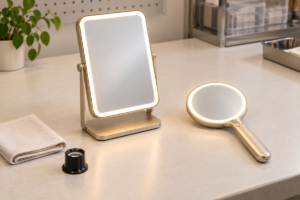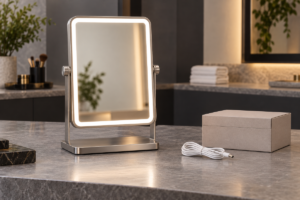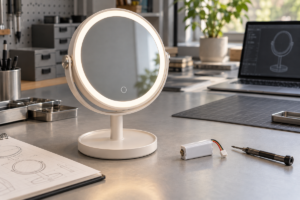

Mirror sourcing should start with a written checklist that connects the target market, mirror type, lighting, magnification, power source, packaging, compliance evidence, QC plan, MOQ, lead time, and after-sales responsibility. For brands, retailers, Amazon sellers, distributors, and importers, the best supplier is not simply the one with the lowest unit price. It is the supplier who can turn your commercial requirements into a repeatable, inspectable, and shipment-ready mirror program.
This checklist is designed for buyers sourcing LED makeup mirrors, handheld mirrors, Hollywood vanity mirrors, and bathroom mirror products. Use it before sending an RFQ, approving samples, or confirming bulk production with a mirror manufacturer.
Useful Mingda Mirror links: Mirror Products, OEM/ODM Customization, QC Process, and Contact Mingda Mirror.
1. Define the Buyer Scenario Before Choosing the Mirror
A mirror that works for a beauty brand launch may not be the right mirror for a hotel project, Amazon FBA program, or retail chain assortment. Start by writing the selling channel and buyer scenario clearly.
For an e-commerce seller, return risk, packaging strength, listing photos, charging reliability, and customer reviews are usually critical. For a retail buyer, shelf display, barcode position, packaging finish, and consistent replenishment matter more. For a hotel or project buyer, installation, electrical safety, waterproof rating, spare parts, and site delivery control become higher priorities.
Do not ask a supplier only for “your best makeup mirror.” Ask for a product recommendation based on the market, user, price band, quantity, destination, and launch schedule.
2. Match Mirror Type to Sales Channel
| Buyer channel | Better mirror direction | Main sourcing risk to control |
|---|---|---|
| Beauty brand launch | LED tabletop makeup mirror with private-label packaging | Sample approval gaps and inconsistent lighting |
| Amazon or marketplace seller | Rechargeable compact or tabletop LED mirror | Returns from weak packaging, battery issues, or unclear instructions |
| Retail chain or distributor | Assorted handheld, compact, and tabletop mirrors | Poor assortment logic and slow replenishment |
| Salon or vanity furniture seller | Hollywood vanity mirror with stable stand or wall option | Bulb brightness, carton damage, and installation complaints |
| Hotel or project buyer | LED bathroom mirror or bathroom mirror light | Safety, waterproof rating, wiring, and site delivery sequencing |
The right mirror type should support the sales channel, not only the product photo. A beautiful sample can still fail commercially if the power system, packaging, carton size, or compliance evidence does not fit the buyer’s channel.
3. Build an RFQ That Suppliers Can Actually Quote
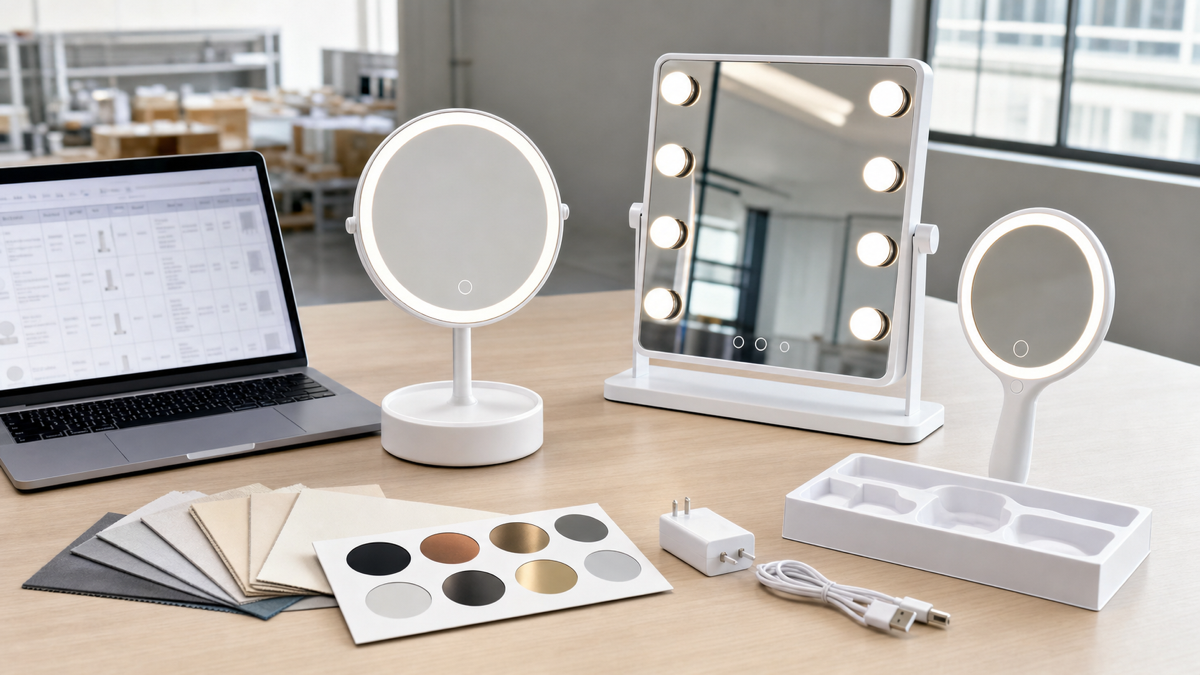
A strong RFQ reduces wrong quotations. Include the mirror category, target dimensions, magnification, lighting style, CCT, CRI, brightness control, power source, charging port, battery capacity if rechargeable, plug or adapter requirement, finish, logo position, packaging type, accessories, manual language, destination market, target quantity, and Incoterm.
If you are still unsure about the final specification, separate the RFQ into “must-have” and “optional” items. For example, a buyer may require 1x/5x magnification and three-color lighting, while treating packaging insert material, USB-C port, or gift-box finish as optional cost comparisons.
This approach lets the supplier explain tradeoffs instead of guessing. It also helps procurement teams compare quotations line by line.
4. Confirm Lighting and Mirror Performance
For LED makeup mirrors and Hollywood mirrors, lighting is often the main reason customers buy, complain, or return the product. Buyers should confirm CCT range, CRI level, brightness, dimming method, glare control, LED diffusion, memory function, and switch reliability.
For magnifying mirrors, confirm the magnification level and working distance. High magnification can be useful for detailed makeup, but it may distort the image if the user stands too far away. For a retail assortment, offering one practical main mirror plus a targeted magnifying option often performs better than overloading every SKU with high magnification.
One common trap is approving a mirror only under factory lighting. Always test the sample in a realistic user environment: vanity desk, bathroom, salon counter, hotel room, or e-commerce photography setup.
5. Check Power, Battery, and Electrical Configuration
Power architecture affects price, compliance, user experience, and shipping. Rechargeable makeup mirrors are attractive for portability and clean countertop use, but buyers need to confirm charging reliability, battery quality, capacity, protection circuit, charging cable, manual warnings, and transport documentation.
Plug-in Hollywood mirrors may provide stronger and more stable light output, but buyers should confirm plug type, adapter, cable length, switch position, rated input, and destination-market evidence. Bathroom mirrors require a stricter discussion around installation method, wiring, waterproof rating, defogger, and wall condition.
Do not approve a sample unless the final power configuration is the same as the version that will be mass produced.
6. Review Materials, Structure, and Finish Durability
Mirror returns are not caused only by broken glass. Buyers also see complaints from loose hinges, unstable bases, scratched finishes, weak handles, poor rotation, uneven coating, yellowing plastic, noisy switches, or accessories that feel low-end.
Ask the supplier to identify the main material for the frame, stand, handle, base, hinge, and packaging tray. For handheld mirrors, pay attention to handle strength, surface finish, weight balance, foldability, and whether the mirror is intended for gift, travel, salon, or everyday retail use. For Hollywood mirrors, check the frame strength, bulb alignment, base stability, tabletop footprint, and wall-mounting option.
Finish approval should use a physical sample or approved swatch, not only a digital rendering.
7. Require Packaging That Matches the Delivery Route
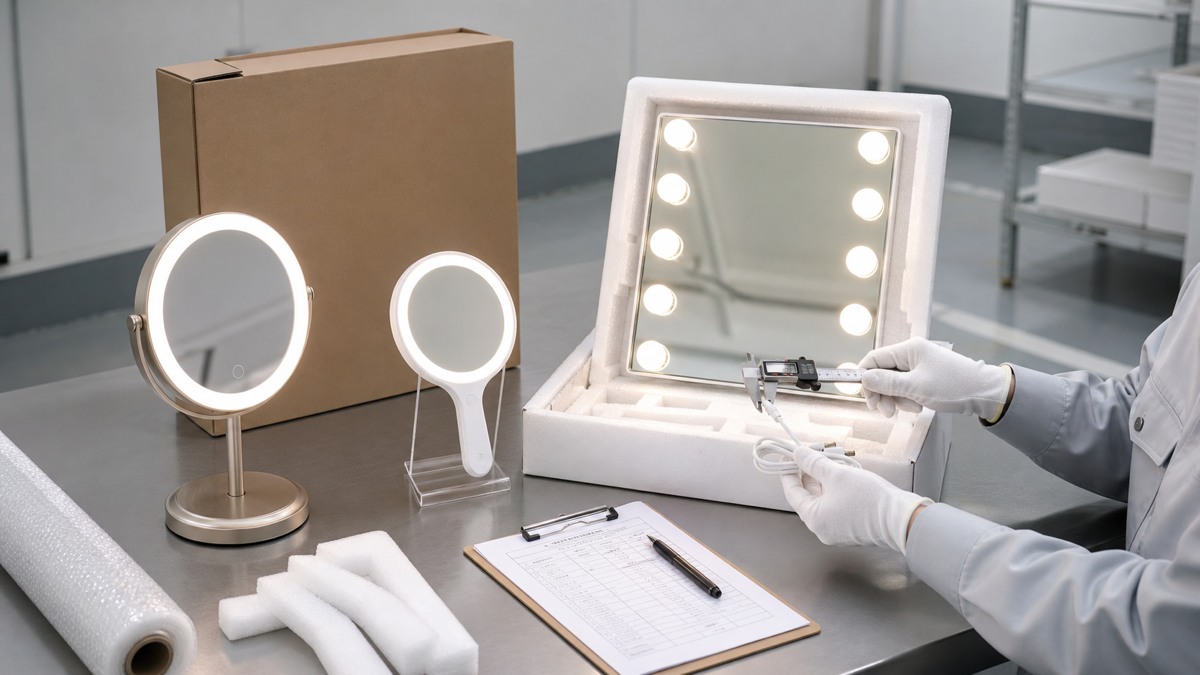
Fragile mirror products need packaging designed around the delivery route. A showroom sample carton may not survive parcel delivery, Amazon FBA handling, or long-distance project shipment.
Confirm inner protection, foam or molded pulp structure, carton strength, drop-test expectations, accessory placement, manual position, barcode or label area, master carton quantity, carton dimensions, gross weight, and pallet plan if needed. For e-commerce, buyers should test the packed product through realistic parcel handling. For retail, packaging must also communicate value on the shelf. For project orders, carton identification and installation accessory control are essential.
Packaging should be approved together with the product, not after production is almost finished.
8. Ask for Compliance and Test Evidence by Exact Model
Compliance evidence must match the exact product configuration. A certificate for a similar mirror is not enough if the battery, adapter, rated input, LED driver, switch, wiring, or model number is different.
For LED and rechargeable mirrors, buyers may need electrical safety, EMC, battery, restricted-substance, adapter, transport, labeling, or marketplace documentation depending on destination and sales channel. For bathroom mirrors, installation and waterproof evidence become more important. For packaging, transit testing is usually commercial validation rather than market-access certification, but it is still critical for reducing breakage and claims.
Ask the supplier to map each document to the SKU, model, component, standard, laboratory, and issue date.
9. Lock the Sample Approval File
The approved sample should create a controlled production reference. The file should include sample photos, final specification, mirror dimensions, lighting data, finish, artwork, logo, packaging drawing, accessory list, manual, labels, inspection criteria, and any approved deviations.
If the buyer changes packaging, color, battery, adapter, finish, or accessories after sample approval, the supplier should confirm whether cost, MOQ, lead time, or test evidence changes. This discipline prevents a common sourcing failure: approving one sample, producing a slightly different product, and discovering the problem only during final inspection.
10. Set QC Points Before Production Starts
Buyers should define what will be inspected, when it will be inspected, and what counts as a defect. Useful QC points include incoming material checks, lighting and switch function, charging function, mirror surface inspection, frame and hinge checks, finish inspection, assembly stability, accessory completeness, packaging drop or fit check, carton label check, and final random inspection.
For LED mirrors, test brightness consistency, CCT change, dimming, touch control response, charging behavior, adapter compatibility, and burn-in where appropriate. For handheld mirrors, check handle strength, foldable structure, mirror clarity, finish scratches, and retail packaging. For Hollywood mirrors, check bulb alignment, frame stability, stand strength, and carton protection.
11. Compare MOQ, Lead Time, and Total Cost
MOQ is not only a number. It may depend on mirror body stock, custom color, logo method, battery, adapter, packaging print, carton structure, and component availability. Lead time may also change after sample approval, packaging approval, certification review, or holiday production schedules.
Ask for separate timing for sample preparation, sample revision, packaging proof, material purchasing, mass production, final inspection, and shipment booking. Then compare total landed cost, not just unit price. A lower quotation can become expensive if it creates more returns, repacking, late delivery, testing gaps, or replacement claims.
12. Pre-Order Checklist for Mirror Buyers
- Target market, sales channel, and buyer scenario are defined.
- Mirror type, size, lighting, magnification, power, finish, and accessories are written.
- RFQ separates required features from optional cost comparisons.
- Packaging is matched to retail, e-commerce, wholesale, project, or FBA handling.
- Compliance evidence is mapped to the exact SKU and destination market.
- Sample approval file includes product, packaging, artwork, manual, and labels.
- QC plan covers function, appearance, structure, accessories, packaging, and carton labels.
- MOQ, lead time, payment, Incoterm, inspection, and shipment milestones are confirmed.
- Replacement responsibility and after-sales support are written before the order.
- Final quotation is compared by total risk and landed cost, not unit price alone.
Bottom Line Recommendation
For professional mirror sourcing, do not start with price alone. Start with the buyer scenario, then define the product, packaging, compliance evidence, sample approval file, QC plan, and delivery responsibility. A mirror supplier who can answer these points clearly is more likely to support repeat orders, stable reviews, and fewer shipment problems.
If your team is preparing a new mirror line, send Mingda Mirror the target channel, product idea, quantity, destination market, and launch timing. We can help review the specification, packaging direction, sample plan, QC points, and RFQ details before bulk production.
FAQ
What should a mirror sourcing checklist include?
It should include product type, size, lighting, magnification, power source, material, finish, packaging, compliance evidence, sample approval, QC plan, MOQ, lead time, shipping route, and after-sales responsibility.
How many mirror samples should buyers approve before bulk production?
At minimum, buyers should approve the product sample and packaging sample. For private-label or channel-specific orders, artwork, manual, label, barcode, accessory layout, and carton protection should also be checked before mass production.
Should Amazon sellers choose rechargeable or plug-in mirrors?
Rechargeable mirrors are often better for portable and clean countertop use, while plug-in mirrors may be better for stronger continuous lighting. Amazon sellers should compare return risk, battery evidence, packaging strength, instruction clarity, and customer review expectations.
What is the most common mistake in mirror sourcing?
The most common mistake is comparing quotations without a controlled specification. Buyers may think they are comparing the same mirror, but the lighting, battery, material, packaging, QC scope, or compliance evidence may be different.
Can Mingda Mirror support private-label mirror programs?
Yes. Mingda Mirror supports OEM/ODM mirror programs including product selection, sample development, logo options, packaging, QC, and production planning for makeup mirrors, handheld mirrors, Hollywood mirrors, and bathroom mirror products.
Social Media Content Ideas
LinkedIn angle: turn the pre-order checklist into a procurement post about reducing mirror sourcing risk before RFQ approval.
Facebook angle: explain why packaging, lighting, and QC affect customer satisfaction more than product photos alone.
Instagram angle: use the sample-review and QC images to show how a mirror program moves from concept to shipment-ready approval.
Short CTA: Read the full mirror sourcing checklist and contact Mingda Mirror for an RFQ-ready review.