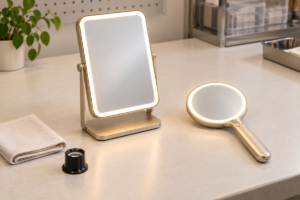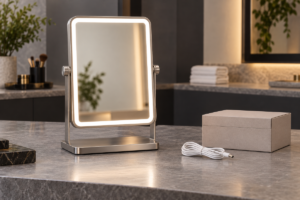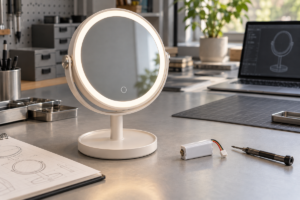

Mirror certifications and test reports should be requested according to the exact mirror type, power system, battery, adapter, destination market, packaging method, and sales channel. A certificate name alone is not enough for business buyers. Brands, retailers, Amazon sellers, importers, distributors, and project buyers should verify whether each document covers the same SKU, construction, model number, electrical rating, critical components, and packaging plan that will be used for bulk production.
This guide focuses on LED makeup mirrors, rechargeable tabletop mirrors, handheld mirrors, Hollywood vanity mirrors, and LED bathroom mirror products. The practical goal is to help buyers reduce compliance gaps, shipment delays, marketplace review risk, and after-sales disputes before placing a production order.
Related Mingda pages: Mirror Products | OEM / ODM Customization | QC Process | Contact Mingda Mirror.
Why certification checking matters before mirror sourcing
Mirror buyers often ask suppliers for CE, UL, ETL, FCC, RoHS, battery, or packaging evidence, but the real commercial question is not simply whether a file exists. The buyer needs to know whether the evidence applies to the product being purchased and whether it supports the target sales channel. A rechargeable LED makeup mirror with a lithium battery has different document needs from a plug-in Hollywood mirror. A bathroom mirror with lighting has different safety and installation concerns from a small non-lighted handheld mirror.
For e-commerce, incomplete evidence can create listing delays, product-compliance requests, customer safety complaints, or forced specification changes. For retail chains, weak document control can delay vendor onboarding or quality approval. For hotel and project buyers, missing electrical or installation evidence can slow site acceptance. The earlier the buyer checks the evidence chain, the easier it is to correct the product, adapter, label, manual, or packaging before production.
Start with the product configuration
Before requesting documents, define the exact configuration: mirror type, dimensions, magnification, lighting system, LED driver, input voltage, plug or USB charging method, battery capacity, adapter model, switch type, cable, finish, accessory set, installation method, packaging, quantity, and target market. If a buyer changes the battery, adapter, LED driver, housing, wire, or plug after receiving documents, the original report may no longer support the final product.
The supplier should be able to map each document to the SKU and explain what it covers. If the report belongs to a similar product, a previous model, or only one component, the buyer should understand the limitation before using it for marketplace compliance, retail onboarding, or customs documentation.
Certification and test report decision matrix
| Document area | When buyers should request it | What to verify | Buyer risk controlled |
|---|---|---|---|
| Electrical safety | Plug-in mirrors, powered LED mirrors, adapters, bathroom mirrors | Model number, rated input/output, standard, laboratory, photos, critical components | Unsafe construction, blocked channel approval, product liability exposure |
| EMC / radio interference | LED mirrors with drivers, touch controls, dimming, electronic modules | Emissions and immunity evidence tied to the final electronics | Marketplace compliance questions and electronic performance complaints |
| Battery and transport | Rechargeable makeup mirrors and portable LED mirrors | Cell or battery report, transport document, capacity, supplier, product linkage | Shipping delay, carrier rejection, overheating concern, after-sales risk |
| Restricted substances | Retail, EU, US, and brand-controlled supply chains | RoHS or chemical evidence covering relevant materials and electrical parts | Retail onboarding delay and regulatory exposure |
| Packaging and transit validation | Fragile mirrors, Amazon/e-commerce parcels, retail distribution, projects | Drop, vibration, carton, foam, pallet, label, and packed-product validation plan | Breakage, returns, replacement cost, poor customer reviews |
Electrical safety: match the document to the real product
For plug-in mirrors and powered LED mirrors, buyers should check whether the evidence covers the complete product or only a component such as an adapter. Confirm the product photo, rated input, adapter output, wiring method, switch, LED module, and model number. If the supplier changes the adapter after sample approval, the buyer should request updated evidence or written confirmation that the approved adapter remains unchanged for mass production.
Bathroom mirror buyers should also review installation conditions, moisture exposure, insulation, wiring, and the target market’s electrical expectations. A bathroom project buyer should not rely on a generic makeup mirror certificate. The application environment and installation method are part of the compliance risk.
Rechargeable mirror battery evidence
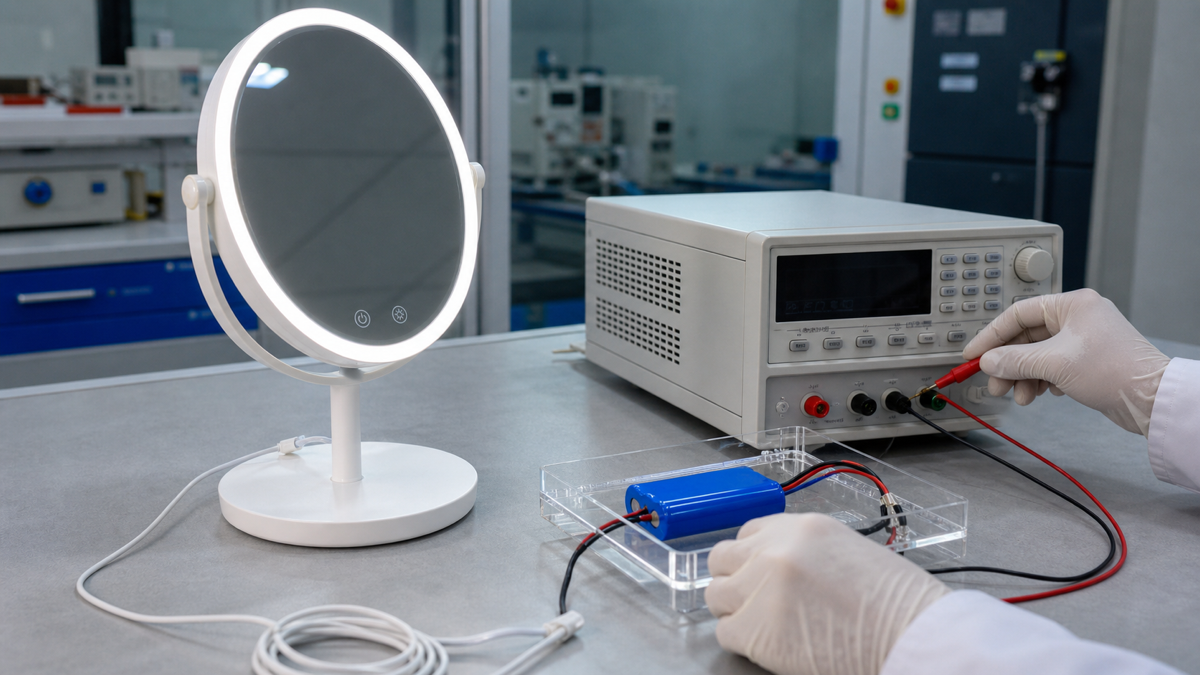
Rechargeable LED makeup mirrors and portable mirrors need extra attention because battery capacity, charging method, cable quality, protection circuit, and transport requirements can affect both safety and delivery. Buyers should confirm the battery supplier, capacity, report owner, issue date, tested model, and whether the document supports the exact battery used in the sample and bulk order.
If the buyer plans to sell through Amazon or another marketplace, battery documentation should be prepared before listing or shipment. A late compliance request can stop a launch even when production is complete. For private-label buyers, battery evidence should be included in the approval file together with product photos, labels, manual, and packaging artwork.
EMC, LED performance, and user experience
EMC evidence matters when the mirror includes LED drivers, touch sensors, dimmers, charging modules, or electronic controls. It helps buyers manage interference and electronic performance risk. Alongside formal evidence, buyers should still check practical user experience: stable brightness, smooth dimming, color temperature consistency, glare control, switch response, charging reliability, and adapter compatibility.
For beauty and makeup channels, lighting quality directly affects reviews. A mirror may pass a basic document check but still disappoint customers if CCT, CRI, brightness, diffusion, and magnification are poorly matched to the target user. For B2B buying, certification is one layer; product performance approval is another.
Packaging validation is commercial risk control
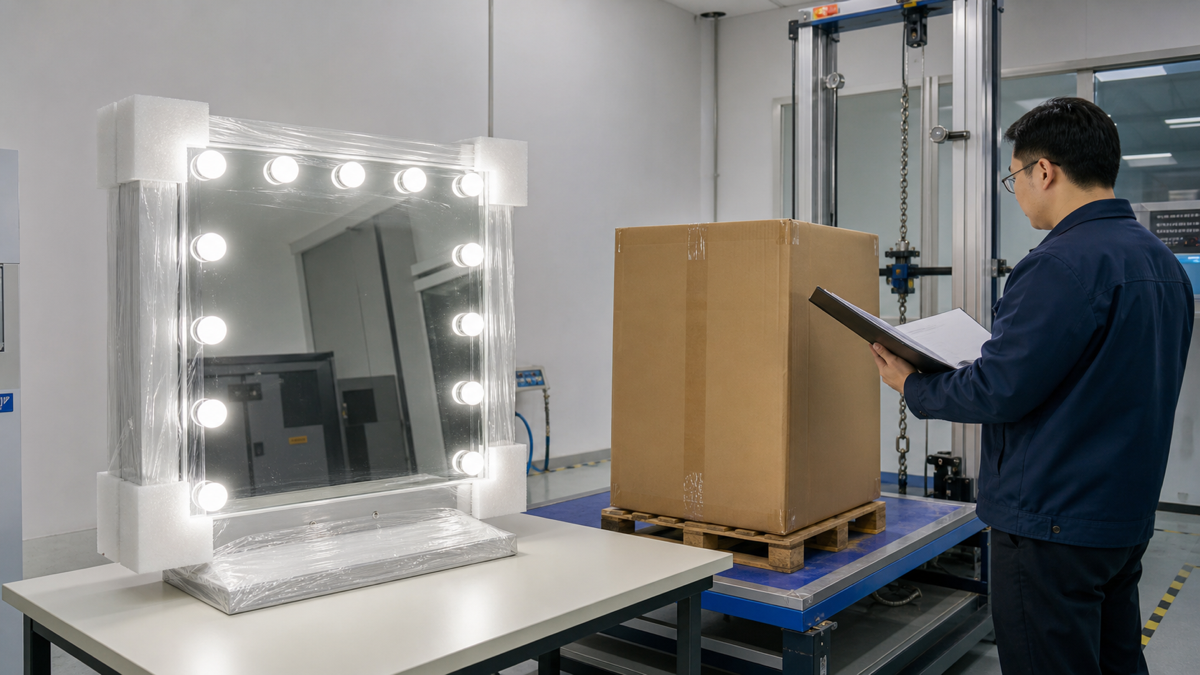
Packaging tests are not always market-access certificates, but they are important commercial evidence for mirrors. A Hollywood vanity mirror, large bathroom mirror, or glass-heavy LED mirror can pass factory function inspection and still fail in parcel delivery if the carton, foam, corner protection, or accessory placement is weak. For e-commerce, the packed product should be reviewed under real shipping assumptions, not only factory handling.
Buyers should request photos or records for the final packed product, inner protection, color box, export carton, carton marks, barcode labels, accessory placement, manual, and pallet plan when needed. If the packaging is custom, confirm whether the packaging MOQ differs from the product MOQ and whether artwork approval affects lead time.
What buyers should check on every report
- Applicant, manufacturer, factory, brand, and model number.
- Product photos and whether they match the approved sample.
- Standard, laboratory, report number, issue date, and revision history.
- Rated input/output, battery capacity, adapter model, and critical components.
- Whether the document covers the complete product, a component, or a similar model only.
- Whether the report supports the destination market and sales channel.
- Whether any post-test design change has affected the evidence chain.
Common mistakes buyers should avoid
The first mistake is accepting a certificate screenshot without checking the full report. The second is assuming a component report covers the complete mirror. The third is changing batteries, adapters, plugs, labels, or packaging after sample approval without reviewing evidence again. The fourth is requesting documents too late, after cartons are produced or a marketplace listing is already under review.
A better approach is to create a compliance and quality file during RFQ and sample approval. It should include the final specification, approved sample photos, component list, packaging drawings, label artwork, manuals, inspection standard, and document checklist. This file helps the buyer, supplier, QC team, laboratory, and logistics partner work from the same production version.
Pre-RFQ checklist for certification-ready mirror orders
- Confirm the mirror category: makeup, handheld, Hollywood, bathroom, rechargeable, plug-in, or non-lighted.
- State the target market and sales channel, including Amazon, retail, wholesale, hotel, salon, or project use.
- Define power architecture: battery, USB, adapter, plug, hardwired, or replaceable batteries.
- Request document coverage by SKU, not only by product family.
- Ask which documents are already available and which require new testing or confirmation.
- Confirm whether packaging validation is needed for parcel delivery, retail distribution, or project shipment.
- Include document delivery in the production timeline before final payment and shipment.
Bottom line
The safest mirror sourcing decision is not to collect the longest list of certificate names. It is to confirm the right evidence for the exact product, market, channel, and packaging plan. For LED makeup mirrors, rechargeable mirrors, Hollywood mirrors, and bathroom mirrors, buyers should verify the model linkage, electrical configuration, battery, adapter, packaging, and final production version before bulk order approval. This reduces launch delays, return risk, and supplier disputes.
FAQ
Do all LED mirrors need the same certifications?
No. Requirements depend on power source, battery, adapter, installation method, destination market, product claims, and sales channel. A rechargeable makeup mirror, plug-in Hollywood mirror, and bathroom mirror should not be treated as the same compliance case.
Can a supplier’s adapter certificate cover the whole mirror?
Not automatically. An adapter certificate may support one component, but buyers should confirm whether the complete mirror construction, wiring, LEDs, switch, label, and final configuration are also covered or separately assessed.
What documents are important for rechargeable makeup mirrors?
Buyers should review battery safety and transport evidence, charging specifications, adapter or cable details, product labels, manual warnings, and final product QC records.
Are packaging tests required for mirrors?
They may not be a legal certification in every market, but they are strongly recommended for fragile mirrors, e-commerce parcels, retail distribution, and large Hollywood or bathroom mirrors because breakage creates direct commercial loss.
When should buyers request test reports?
Request the document list during RFQ, review available evidence before sample approval, and confirm final report linkage before mass production or shipment. Waiting until after production creates avoidable risk.
Social Media Content Ideas
LinkedIn: share the document decision matrix for sourcing teams preparing LED mirror RFQs. Facebook: explain why buyers should verify report model numbers, not only certificate names. Instagram: use the testing-lab image to show rechargeable mirror safety checks before bulk production. CTA: direct buyers to the full checklist and Mingda contact page for RFQ support.
Request a certification-ready mirror quotation
If you are planning an LED makeup mirror, rechargeable handheld mirror, Hollywood mirror, or bathroom mirror order, contact Mingda Mirror with your target market, quantity, power configuration, packaging needs, and sales channel. Our team can help align sample approval, document review, QC, packaging, and mass production before shipment.