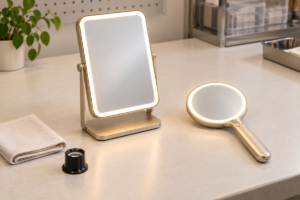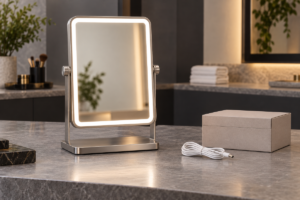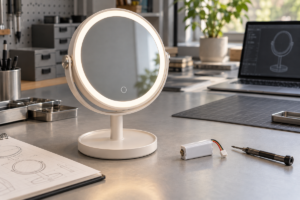

E-commerce LED makeup mirror damage prevention starts before mass production, not after customer complaints. Buyers should approve the complete packed sample, test the mirror with its retail box, protective insert, accessories, barcode labels, and master carton, then confirm that the same structure can survive parcel delivery and warehouse handling. For rechargeable LED makeup mirrors, the best packaging plan protects the mirror surface, hinge or stand, LED ring, USB-C cable, retail box corners, and carton labels at the same time.
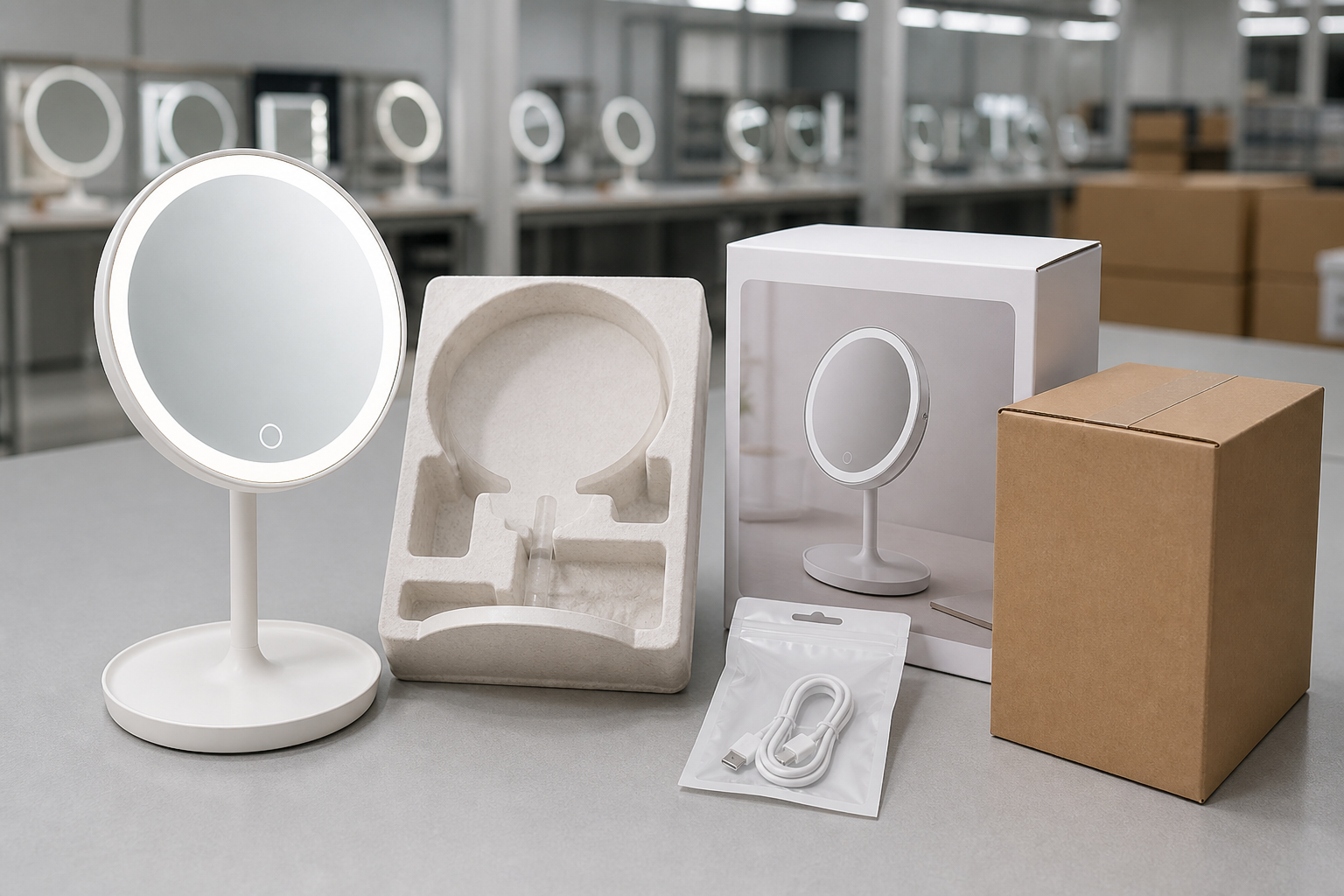
This checklist is written for Amazon sellers, DTC brands, online retailers, distributors, and private-label buyers who need fewer broken units, cleaner reviews, and more predictable replenishment. It is not only a carton decision. It is a sourcing decision that affects MOQ, unit cost, dimensional weight, receiving QC, customer returns, and repeat orders.
Why E-Commerce Packaging Fails More Often Than Retail Packaging
Retail packaging is usually handled by store teams, pallet shipments, and shelf display processes. E-commerce packaging is handled as a parcel. The mirror may move through fulfillment receiving, conveyor belts, sortation, last-mile delivery, customer opening, and possible return handling. A package that looks acceptable in a showroom can still fail when it is shipped one unit at a time.
LED makeup mirrors have several risk points. The mirror face can crack or scratch. The LED ring can be pressed by the front panel. The stand or swivel joint can move inside the box. A USB-C cable, battery notice, manual, or magnifying insert can rub against the mirror surface. If the retail box is also the shipping box, the outer corners can arrive crushed and create a poor customer impression even when the mirror is functional.
For buyers comparing LED makeup mirror products, packaging should be reviewed with the same seriousness as lighting, magnification, and charging performance. A lower unit price can disappear quickly if damage, replacement shipments, negative reviews, and marketplace claims increase.
Packaging Structure Comparison for E-Commerce Mirrors
The right structure depends on the product value, sales channel, carton limits, and customer experience target. A compact LED mirror may need a different insert than a taller tabletop mirror with a stem and base. A premium private-label SKU may justify a stronger retail box and molded pulp tray, while a value SKU may need a simpler but still repeatable structure.
| Packaging option | Best fit | Buyer benefit | Main risk to check |
|---|---|---|---|
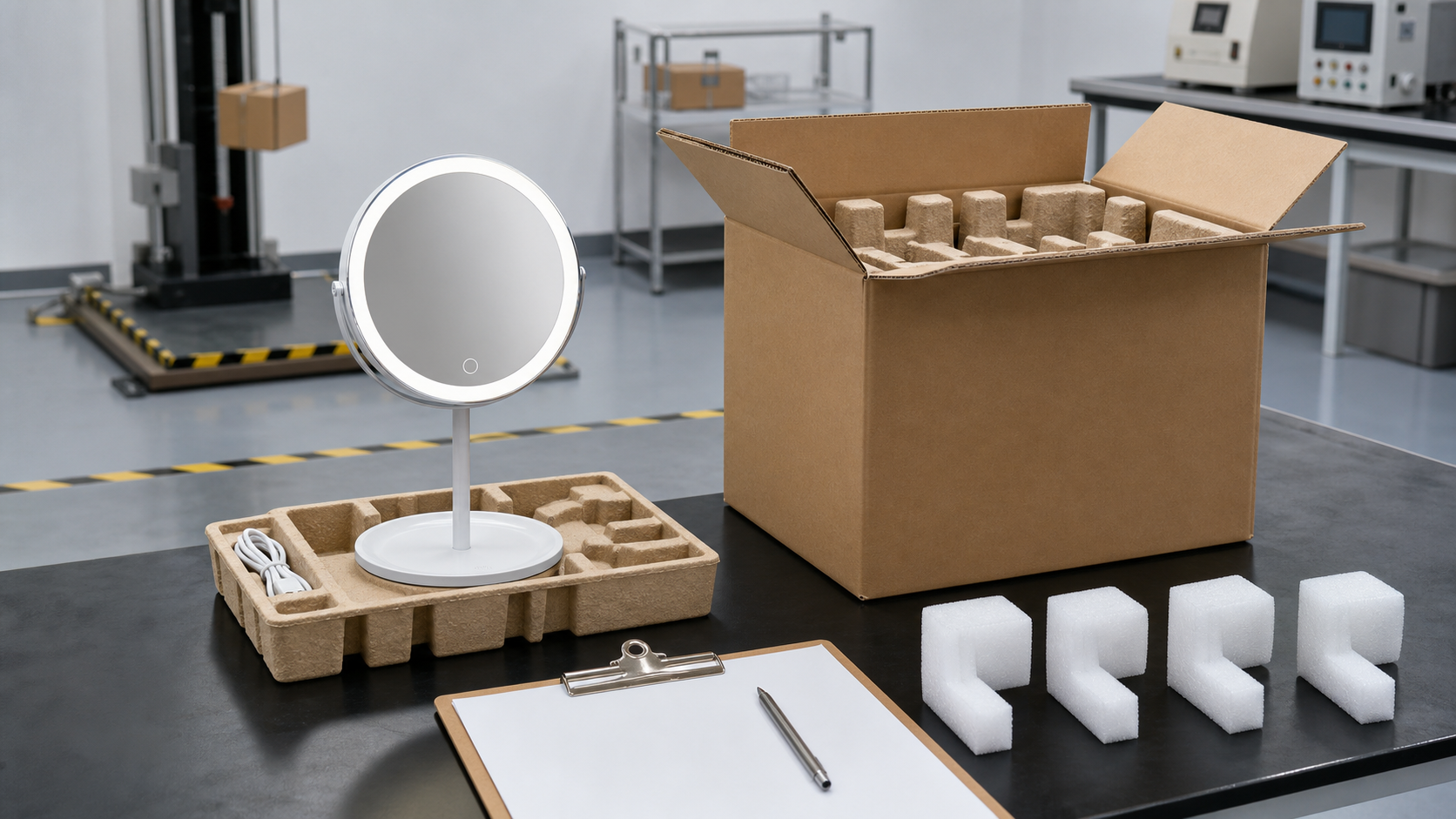
| Molded pulp insert plus retail box | Rechargeable tabletop LED mirrors and premium giftable SKUs | Stronger positioning, better mirror and stand support, more sustainable feel | Insert must lock the mirror and accessories without pressure on LED ring |
| EPE or foam corner protection | Larger mirrors, heavier stands, high-value mirror sets | Good shock absorption and corner protection | Material and density must be consistent in bulk production |
| Retail box inside master carton | Amazon, DTC, distributor replenishment, parcel-ready orders | Keeps customer-facing box cleaner and easier to scan | Carton size can increase dimensional weight |
| Mailer carton around retail box | DTC shipments or small-batch online orders | Better arrival appearance for direct customer delivery | Needs clear approval on taping, label placement, and opening experience |
| Simple retail box only | Low-risk local retail or non-parcel programs | Lower cost and smaller pack volume | Often weak for single-unit parcel shipping |
The practical rule is simple: if the mirror will be sold online and shipped as a single unit, approve the packed sample as the buyer will actually ship it. Do not approve only the loose product or the retail box artwork.
What Buyers Should Test Before Mass Production
Packaging testing does not need to become complicated, but it must be specific. A sourcing team should not accept the answer “standard export packing” without seeing how the actual product sits inside the real box. The goal is to confirm that the protection method is repeatable and commercially suitable.
1. Mirror Surface and LED Ring Protection
The mirror face needs a protective film, soft bag, paper sleeve, or insert spacing that prevents rubbing. The LED ring should not carry direct pressure from the retail box lid. If the design has a magnifying mirror, detachable tray, or accessory pouch, these parts need their own position so they do not move across the glass.
Buyers should ask for a packed-sample photo set before approving production: top view, side view, closed retail box, open insert, accessory placement, and master carton layout. If the product is part of a private-label launch, these photos also become a useful record for receiving QC.
2. Stand, Hinge, and Base Stability
Many LED makeup mirror damage complaints are not only about broken glass. A loose hinge, tilted stem, cracked base, or wobbly stand can create return risk even if the lighting works. The insert should hold the base and mirror head separately when needed, especially for taller tabletop mirrors.
If the product has a rechargeable battery, USB-C port, touch switch, or folding joint, the insert should avoid pushing against these points. Packaging pressure can create defects that appear only after the customer opens the product.
3. Retail Box Corner and Print Protection
For marketplace and DTC sellers, the retail box is part of the customer experience. Crushed corners, dirty cartons, and torn hang tabs can weaken review quality and make a new product look returned. Buyers should confirm carton strength, box coating, corner protection, and whether the retail box will ship alone or inside another mailer.
Mingda buyers preparing custom packaging should decide early whether the retail box is mainly for shelf display, gift positioning, marketplace storage, or direct-to-customer delivery. That decision changes paperboard thickness, insert type, label placement, and MOQ.
Carton, Barcode, and Warehouse Checks
Packaging approval should include the outer carton, not only the retail box. Online channels usually need scannable labels, predictable carton dimensions, clean packing lists, and SKU-level consistency. If the barcode on the retail box, master carton, and product listing do not match, the issue can become a fulfillment delay rather than a product-quality problem.
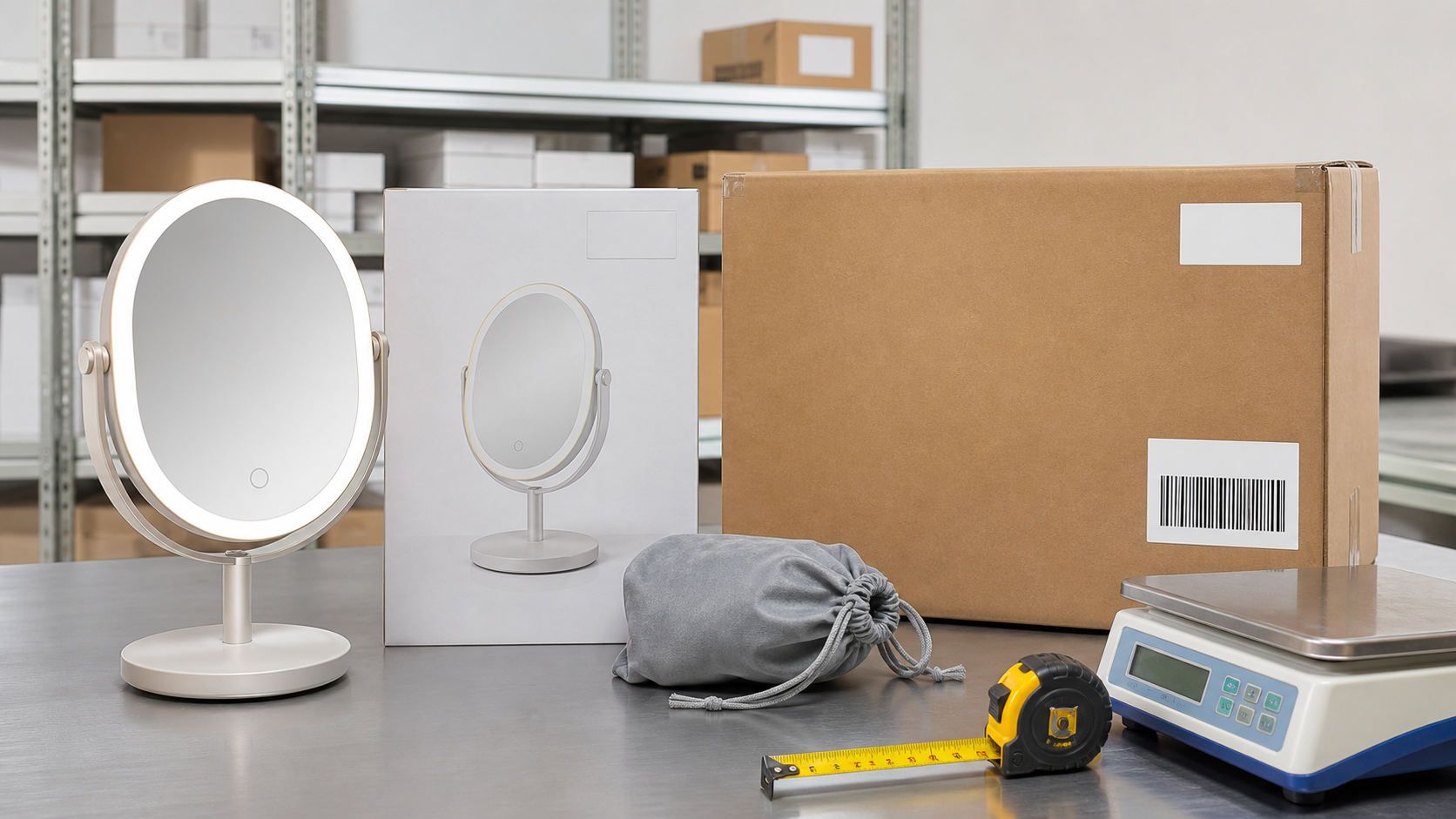
Use this carton approval checklist before placing a bulk order:
- Confirm retail box dimensions, master carton dimensions, and gross weight.
- Check the number of units per carton and whether mixed SKUs are allowed.
- Approve blank label zones for barcode, FNSKU, SKU, carton mark, or distributor labels.
- Confirm accessory placement for USB-C cable, manual, cleaning cloth, and battery-related document.
- Ask whether the same carton can be used for air, sea, and fulfillment warehouse delivery.
- Require packed-sample photos and at least one physical packed sample before production release.
- Keep one approved packed sample for receiving QC comparison.
This process is especially important for rechargeable mirrors because buyers often need to coordinate packaging, product claims, battery documents, and channel-specific labeling at the same time. The packaging team and product team should not work from different versions of the specification.
Damage Prevention Also Reduces Return-Risk Costs
When a mirror arrives damaged, the direct cost is only one part of the problem. The seller may pay replacement freight, lose margin, receive a negative product review, face marketplace claim pressure, or spend time proving whether the damage happened before or after shipment. For wholesale and distributor orders, repeated damage also weakens buyer confidence in the supplier.
A good packaging approval file should include:
- product photos before packing
- insert photos after the product is placed
- closed retail box photos
- master carton loading photos
- carton label photos
- weight and dimension records
- drop or handling test records when required
- receiving QC feedback from the first shipment
This gives both buyer and supplier a shared reference. If a later shipment has higher damage, the team can compare the actual packing against the approved sample instead of arguing from memory.
RFQ Information to Send for Better Packaging Recommendations
Suppliers can make better recommendations when the buyer sends channel and logistics details with the RFQ. A request that only says “quote LED makeup mirror with box” leaves too much room for assumptions. A better RFQ explains the sales channel, shipment method, customer expectations, and packaging constraints.
| RFQ detail | Why it matters for packaging |
|---|---|
| Sales channel: Amazon, DTC, retail, wholesale, distributor | Determines barcode, retail box, and carton handling requirements |
| Mirror type, size, weight, and stand structure | Affects insert design and pressure points |
| Rechargeable or plug-in power | Changes accessory layout and document handling |
| Target market and compliance needs | Helps align labels, manuals, and battery-related documents |
| Expected first order quantity and reorder plan | Affects packaging MOQ and tooling decisions |
| Shipping method and warehouse destination | Influences carton strength, pallet plan, and dimensional weight |
| Private-label artwork requirement | Changes retail box proofing and approval timeline |
If you already have a product concept, compare it with Mingda Mirror’s QC process and related sourcing content such as the LED makeup mirror pre-shipment inspection checklist and right-size packaging guide. These checks help connect the mirror specification, packaging, and shipment plan into one practical approval process.
Receiving QC: Close the Feedback Loop
The first shipment should not be treated as the end of the packaging process. It is the first real-world test. The buyer or warehouse team should record carton condition, retail box condition, mirror condition, accessory placement, barcode scanning, and any repeated damage pattern.
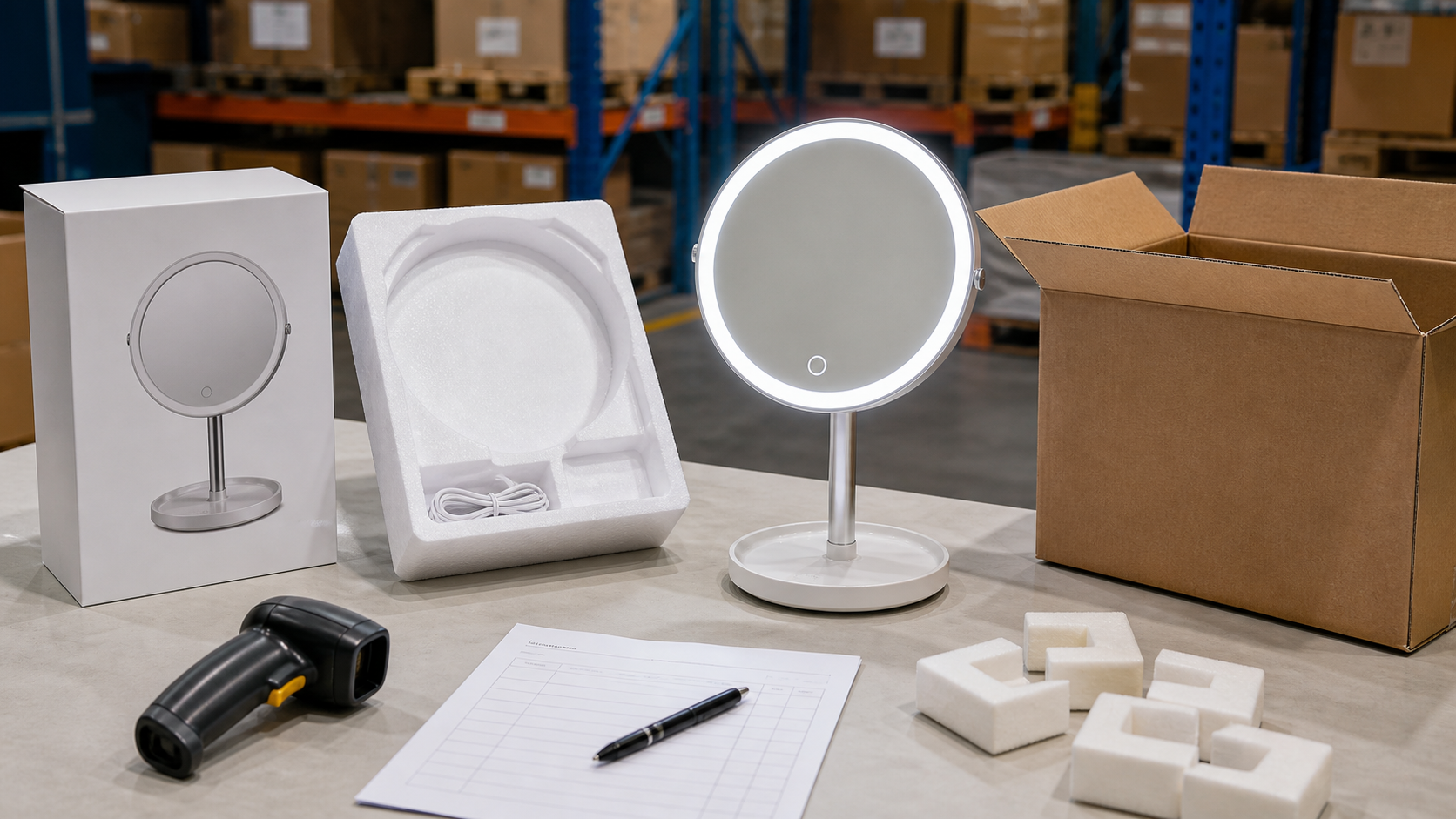
Useful receiving QC questions include:
- Are cartons arriving crushed on the same side or corner?
- Is the retail box clean enough for customer delivery?
- Does the mirror move inside the insert after transit?
- Are accessories still in the approved position?
- Are barcode labels easy to scan and placed away from seams?
- Are customer complaints linked to product damage, box damage, missing accessories, or claim mismatch?
If issues appear, update the packaging specification before the next replenishment order. That may mean changing the insert material, increasing carton grade, adding a mailer, adjusting accessory placement, or improving label protection.
Bottom-Line Recommendation
For e-commerce LED makeup mirror orders, approve packaging as a complete system: mirror, LED ring, hinge, base, accessories, retail box, insert, master carton, barcode labels, and receiving QC records. The best supplier is not only the one that can produce the mirror. It is the one that can help the buyer reduce breakage, protect reviews, keep warehouse handling clean, and repeat the same packing method in every shipment.
FAQ
What packaging should Amazon sellers request for LED makeup mirrors?
Amazon-focused buyers should request a complete packed sample with protected mirror surface, stable insert, clean retail box, scannable barcode area, master carton dimensions, gross weight, and accessory placement. The exact structure depends on the mirror size, weight, battery type, and fulfillment route.
Is molded pulp better than foam for LED makeup mirror packaging?
Molded pulp can be suitable for many tabletop LED makeup mirrors because it supports the product shape and has a stronger sustainable image. Foam can still be useful for heavier or higher-risk points. Buyers should compare protection, cost, MOQ, appearance, and consistency in bulk production.
Should the retail box be used as the shipping carton?
Usually not for premium e-commerce programs. A separate mailer or master carton helps protect the customer-facing retail box. For low-risk channels, a strong retail box may be enough, but buyers should test the actual delivery route before approving it.
What should be included in a packed sample approval?
A packed sample approval should include the product, insert, retail box, accessories, manual, labels, master carton, carton dimensions, gross weight, and photos showing how each part is positioned. Keep one approved sample for future receiving QC.
How can packaging reduce LED makeup mirror return rates?
Packaging reduces return rates by preventing mirror cracks, LED ring pressure, hinge damage, dirty retail boxes, missing accessories, and barcode problems. It also gives the buyer clear evidence when investigating delivery damage or warehouse handling issues.
Request Packaging Support for Your LED Makeup Mirror Order
If you are preparing an e-commerce, Amazon, DTC, wholesale, or private-label LED makeup mirror order, contact Mingda Mirror with your mirror type, target sales channel, shipment method, first order quantity, packaging preference, barcode needs, and destination market. Mingda Mirror can help review the product, packed sample, carton plan, and RFQ details before mass production.
Social Media Content Ideas
LinkedIn angle: explain why e-commerce LED makeup mirror packaging should be approved as a complete system, not as a box afterthought.
Facebook angle: share a buyer checklist for reducing broken mirrors, crushed retail boxes, and missing accessories before online orders ship.
Instagram angle: use the packed-sample approval scene to show how a complete LED mirror, molded insert, retail box, and carton work together.
Short CTA: Read the full packaging test checklist and send Mingda Mirror your mirror type, sales channel, quantity, and packaging plan for RFQ support.