

LED Makeup Mirror Color Temperature Tolerance: Buyer Approval Guide
Direct answer: do not approve an LED makeup mirror simply because its sample can switch between warm, neutral, and cool modes. Put the target correlated color temperature (CCT), the permitted sample-to-sample tolerance, the measurement condition, and the approval method into the RFQ. That turns “looks warm enough” into a repeatable bulk-order requirement.

For beauty brands, retailers, and e-commerce sellers, a color-temperature mismatch can create avoidable reviews: the listing shows a neutral makeup light while the delivered product looks noticeably warm or blue; a three-mode mirror has inconsistent modes from one SKU to the next; or the sample and bulk production are assessed in different ambient light. The issue is not that one CCT is universally best. The procurement task is to define the intended use and make the approved appearance reproducible.
Start with the customer use case, not a generic “three-color” request
Color temperature is measured in kelvin (K). Lower values appear warmer; higher values appear cooler. For a consumer mirror, the commercial question is how the light helps the buyer’s target customer use and perceive the product.
| Buyer use case | Useful starting target | What to approve beyond the number |
|---|---|---|
| Gift or bedroom vanity line | Warm-to-neutral range | Comfort, visual warmth, and repeatability at the low setting |
| Everyday makeup / beauty retail | Neutral daylight-like range | Skin-tone appearance, CRI claim support, and sample consistency |
| Detail work or travel compact | Neutral-to-cool option | Brightness, glare control, runtime, and whether the cool mode is too blue |
| Hotel or project mirror | Project-specified range | Match to room lighting, installation mock-up, and replacement-part consistency |
Do not copy the ranges above into a purchase order without a sample review. The same nominal CCT can look different because of diffuser material, LED binning, dimming level, mirror surround, and the ambient light in which the product is viewed.
Specify a CCT tolerance that production can check
A usable RFQ line names four items: the target for each mode, the allowed deviation, the testing point, and the approved reference. Example: “Neutral mode target 4000 K; measured at rated input and full brightness after stabilization; each approved production sample within the agreed tolerance against the signed golden sample.” The exact tolerance should be agreed with the supplier and should reflect the product position, price point, and the meter used.
Avoid an untestable instruction such as “three colors, no difference.” A three-mode product normally has deliberately different outputs. The important question is whether warm remains warm, neutral remains neutral, and cool remains cool across approved units—and whether each mode stays within the buyer’s specified band.
Ask how and when the result is measured
The same mirror can show a different reading if the measurement conditions change. Add these decision points to the approval sheet:
- Rated input source and battery state for rechargeable models.
- Brightness level and selected CCT mode.
- Warm-up/stabilization time before a reading.
- Meter type, distance, and measurement position.
- Ambient-light condition and whether the diffuser is installed.
- Sample quantity and the pass/fail rule for variation between units.
This is particularly valuable when the product also claims high color rendering. CCT and CRI are related buyer checks, but they answer different questions: CCT describes the apparent whiteness of the light; CRI addresses color-rendering quality. Review both in the same sample session rather than assuming one proves the other. See our LED makeup mirror CRI claim verification guide for the evidence to request.
Compare the three modes under the same approval conditions
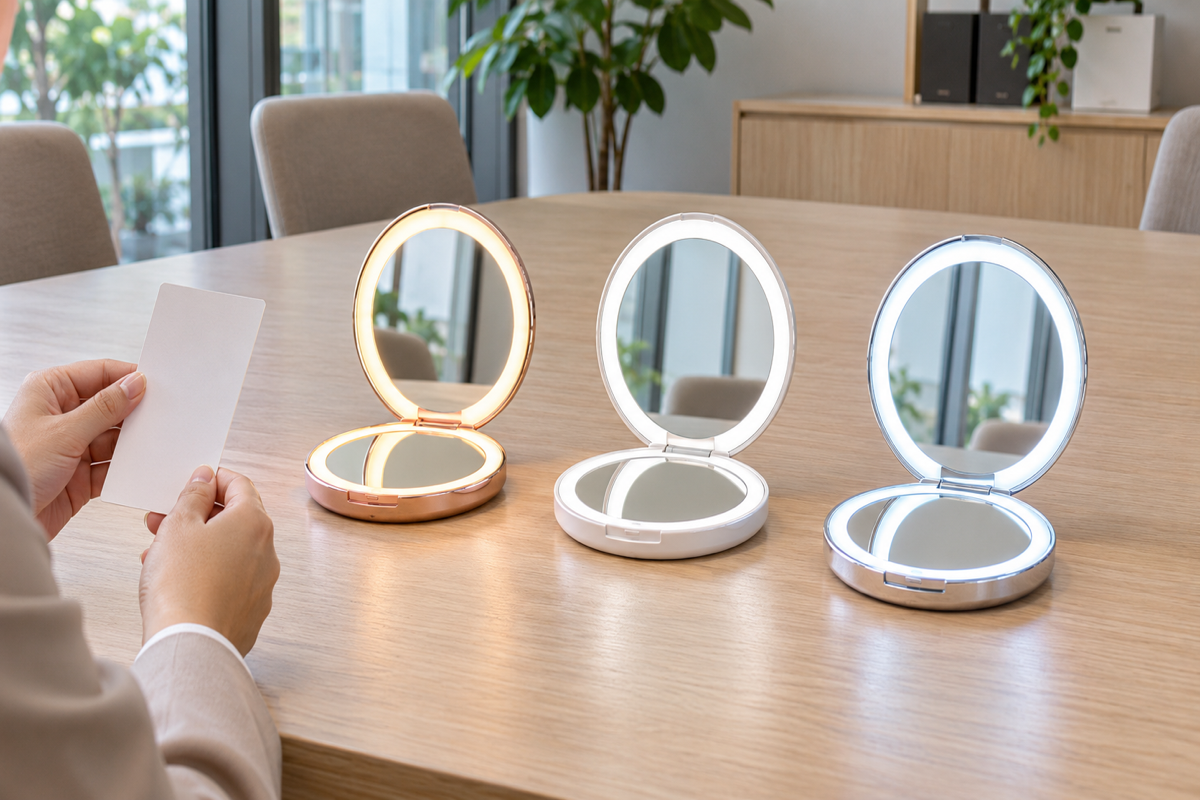
For a mirror marketed with multiple modes, test the full sequence on each sample. A practical buyer review is:
- Select warm, neutral, and cool modes at full brightness after the agreed stabilization time.
- Record the CCT for every mode using the same method and compare it to the signed reference sample.
- Check the transition: no unexpected flicker, obvious color jump within a mode, or memory-function mismatch after power cycling.
- Review appearance through the installed diffuser, not only an exposed LED board.
- Photograph the setup and attach the results to the PP-sample or pre-shipment record.
If you sell across retail and online channels, align this approval with your product page. The lifestyle photo, feature bullets, color-mode icons, manual, packaging, and actual sample must describe the same function. Our e-commerce listing, accessory, and packaging alignment checklist explains why this prevents avoidable returns.
What commonly causes a good sample to drift in bulk production?
The most common root causes are component substitution without re-approval, mixed LED bins, a changed diffuser or light guide, different drive current, inconsistent assembly, or a test performed at a different brightness and power condition. These are controllable only when the buyer has a signed reference and a clear control point.
| Risk signal | Buyer control | Evidence to request |
|---|---|---|
| Modes look different between samples | Define per-mode target and tolerance | Multi-sample CCT record from the agreed test setup |
| Neutral mode looks blue in listings | Approve under neutral ambient conditions | Sample photos plus measured result and reference sample ID |
| Appearance changes after dimming or restart | Test every advertised brightness/memory behavior | Power-cycle and dimming checklist |
| Light looks different after diffuser fitting | Lock the approved optical stack | PP sample, material confirmation, and change-control notice |
| Replacement units do not match earlier stock | Retain a golden sample and component traceability | Model number, revision record, and spare-part plan |
The sample-to-production handover matters as much as the initial visual decision. Use the PP sample approval checklist before authorizing bulk production, then include color-temperature checks in your pre-shipment inspection plan.
RFQ-ready color-temperature checklist
Send the following with your inquiry or sample brief:
- Target customer and selling channel: beauty retail, Amazon/e-commerce, gift, hotel, or distributor line.
- Required CCT mode(s), target value or range, and whether a single color or multi-mode product is needed.
- Required brightness behavior, dimming steps, and memory-function expectation.
- Agreed CCT tolerance per mode, testing point, stabilization time, and sample quantity.
- CRI target or claim, if any, and the report or measured evidence required.
- Approved diffuser/light-guide appearance and whether material changes need written approval.
- Reference to a signed golden sample, PP sample, and pre-shipment test record.
- Listing, packaging, manual, and label wording that must match the final configuration.
FAQ
Is 4000 K always best for a makeup mirror?
No. It is a common neutral reference point, but the best approved range depends on your customer, retail environment, and product claim. The key is to approve the intended look with a measurable tolerance—not to treat one number as universal.
Does a three-color mirror need exactly three Kelvin values?
It needs three clearly defined and repeatable modes. Put target ranges and acceptance conditions in the specification. Avoid relying only on marketing labels such as warm, natural, and cool.
Can a supplier guarantee CCT from a photo?
No. Photos are useful supporting evidence, but camera white balance and ambient light can mislead. Use a controlled sample review and documented meter readings for approval.
Should CCT be checked during pre-shipment inspection?
Yes, where color-temperature consistency is a selling claim or approval point. Define the sampling method and pass/fail criteria before production so the inspection is meaningful.
Bottom line for buyers
Approve an LED makeup mirror’s color temperature as a controlled product specification: target mode, allowable tolerance, fixed test condition, signed reference sample, and repeat check before shipment. That approach protects the product appearance your customers see online and in store, while giving the supplier a clear standard to manufacture and inspect against.
Planning a private-label LED makeup mirror range? Contact Mingda Mirror with your target market, preferred CCT modes, brightness requirement, expected order quantity, packaging needs, and sample timeline. We can turn the brief into RFQ-ready specifications and a sample-approval checklist.