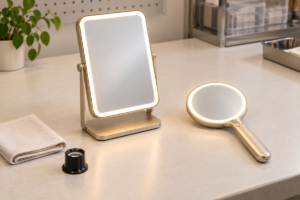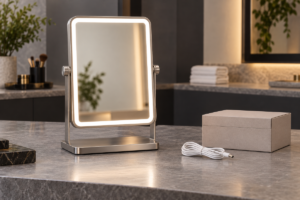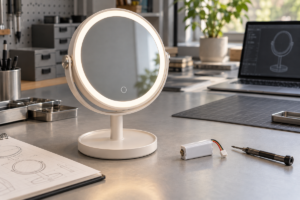

For rechargeable LED makeup mirror orders, product claim and label QC should be checked before mass production, not after cartons are ready. Buyers need to verify lighting claims, battery and charging descriptions, barcode placement, retail box information, instruction sheets, carton labels, and marketplace-ready packaging against the approved sample. This reduces listing mismatch, warehouse rejection, return risk, and customer review problems.
The practical rule is simple: if a claim appears on a product page, retail box, manual, carton label, or sales sheet, the factory sample and inspection record must prove it. A reliable makeup mirror supplier should help buyers connect specifications, packaging artwork, QC testing, and shipment labels into one approval file before production release.
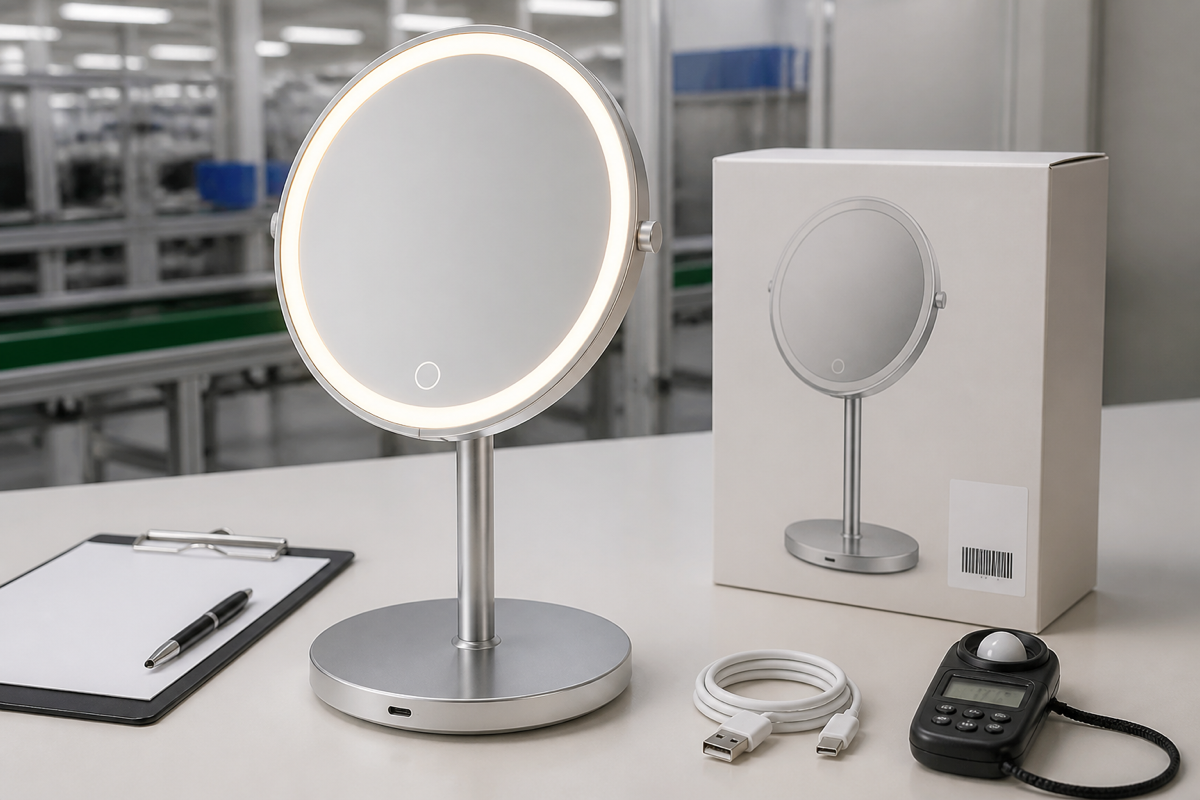
Why Claim and Label QC Matters More in 2026
Beauty and personal-care shoppers now compare products across marketplaces, social commerce, independent stores, and AI-assisted search summaries. That makes product information consistency more important for brands, retailers, Amazon sellers, distributors, and private-label buyers. A rechargeable mirror can look acceptable in a factory photo but still create commercial risk if the product page promises one runtime, the box says another, and the instruction sheet gives incomplete charging details.
For importers, the risk is not only a consumer complaint. Incorrect labels can delay receiving, confuse warehouse scanning, trigger marketplace content edits, or cause retailers to reject cartons because the barcode, model number, color, or set contents do not match the purchase order. On rechargeable LED products, vague battery, cable, brightness, or adapter claims can also create avoidable compliance and after-sales questions.
This is why Mingda Mirror recommends treating claim and label QC as part of the same approval gate as lighting, structure, battery, packaging, and pre-shipment inspection.
What Counts as a Product Claim?
A product claim is any statement that a buyer or end user may rely on when comparing, receiving, using, or reselling the mirror. It can appear in a quotation, sample sheet, online listing, product page, box, manual, carton mark, barcode file, or promotional image.
For rechargeable LED makeup mirrors, common claims include:
- mirror diameter, height, base size, gross weight, and carton size
- magnification, if the item includes a magnifying side or attachment
- color temperature modes, brightness adjustment, CRI, and dimming method
- battery capacity, charging port type, charging time, and runtime
- USB-C cable inclusion, adapter exclusion, and accessory list
- finish color, frame material, hinge angle, and stand structure
- retail box language, barcode, model number, batch code, and warning labels
- packed sample, drop-test expectation, and shipping carton configuration
If the order is for custom makeup mirrors, the approved claim list should be locked before artwork printing and before the first production batch.
Claim-to-QC Matrix for Rechargeable LED Makeup Mirrors
| Buyer-facing claim | What to verify before production | Common failure if skipped |
|---|---|---|
| USB-C rechargeable mirror | Port type, cable fit, charging indicator, and cable included/excluded wording | Listing shows USB-C but sample or manual does not match |
| Battery runtime | Test duration at defined brightness level and mode | Customer reviews say runtime is overstated |
| Three color modes | Warm, neutral, and cool light switching sequence | Product page promise differs from actual touch control |
| Dimmable LED lighting | Brightness range, memory function, and flicker check | Buyers receive inconsistent units across batches |
| Magnification level | Optical distortion and actual magnification area | Beauty shoppers complain that magnification is misleading |
| Retail barcode | Barcode number, placement, scan quality, and SKU mapping | Warehouse receiving or marketplace fulfillment rejection |
| Accessory list | Mirror, cable, manual, pouch, insert, and box content | Return requests because expected accessories are missing |
| Carton mark | PO, model, color, quantity, destination, and carton count | Distributor cannot separate inventory by SKU |
The matrix should be attached to the golden sample approval record. It should also be shared with the packaging vendor if box artwork or labels are printed outside the mirror assembly line.
Step 1: Lock the Specification Sheet Before Artwork
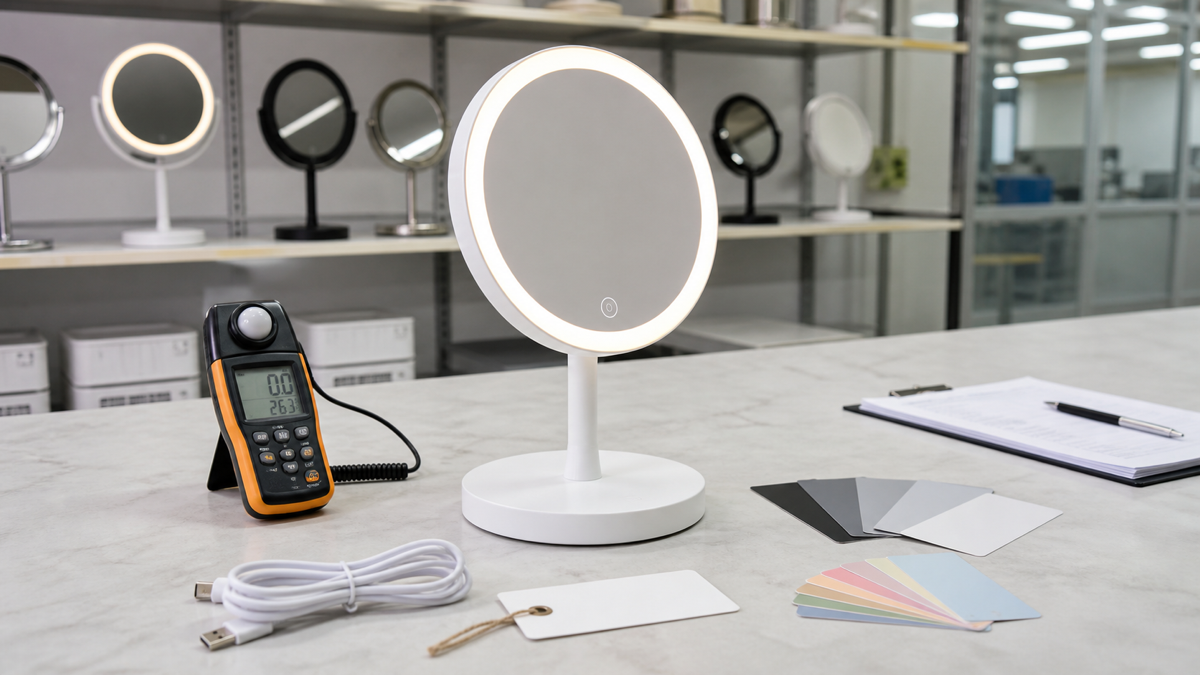
The first control point is the specification sheet. Before approving box artwork or marketplace copy, confirm the exact SKU configuration: mirror size, light source, color temperature modes, magnification, battery capacity, charging port, cable type, material, finish, accessory list, and packaging structure.
For e-commerce sellers, the specification sheet should match the product detail page. For retail buyers, it should match the purchase order and shelf label. For distributors, it should match the model number used in warehouse and after-sales records.
Do not approve packaging copy based only on a prototype photo. A prototype may use a temporary cable, unfinished LED board, sample battery, or non-final packaging insert. The claim file should be updated only after the final sample has passed function and packing checks.
Step 2: Test Lighting Claims Under Defined Conditions
LED makeup mirror claims often become vague: bright, natural daylight, three colors, eye-friendly, high definition, or professional lighting. Buyers should convert those claims into measurable or observable checks.
Useful checks include CCT range, mode sequence, dimming smoothness, minimum and maximum brightness, touch response, glare control, and light uniformity around the ring or panel. If CRI is promoted, request the supporting test basis. If the sales page mentions a specific lighting use, such as makeup application, livestream selling, salon counter use, or travel use, the sample should be tested in that scenario.
For related lighting sourcing details, see Mingda’s guide to LED makeup mirror lighting quality.
Step 3: Verify Battery and Charging Claims Carefully
Rechargeable mirror complaints often come from unclear battery expectations. Buyers should confirm battery capacity, charging time, runtime test condition, charging indicator behavior, cable type, and whether an adapter is included. If the product page says USB-C, the manual, cable, product port, retail box, and online images should all show the same charging standard.
Battery and charging information should be practical rather than inflated. A claim such as up to 8 hours may be acceptable only if the test condition is clear. If runtime changes by brightness level, the buyer should decide whether the product page will use a conservative runtime range instead of a best-case number.
This is especially important for Amazon and social-commerce sellers because reviews often quote the buyer-facing claim directly. For deeper rechargeable product checks, Mingda has a separate article on rechargeable LED makeup mirror charging QC.
Step 4: Approve Retail Box, Manual, Barcode, and Carton Labels Together
Packaging approval should not stop at appearance. A beautiful retail box can still fail if the barcode is hard to scan, the model number differs from the PO, the manual shows the wrong charging port, or the carton mark lacks SKU separation.
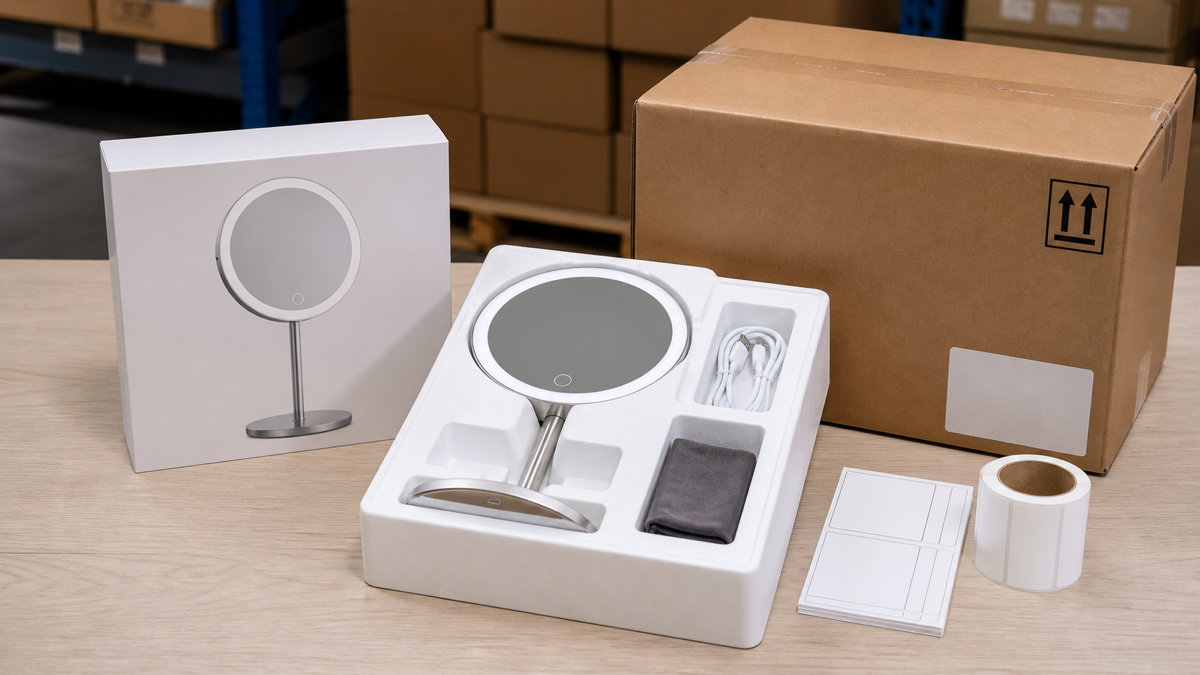
Before mass production, buyers should request a packed sample using the final box, insert, accessories, manual, barcode, and carton label. Scan the barcode. Compare the box claims with the product specification sheet. Confirm that the carton mark separates color, plug/cable option, magnification option, and destination when those variations exist.
E-Commerce vs Retail Claim Control
| Channel | What buyers should prioritize | Best approval evidence |
|---|---|---|
| Amazon or marketplace | Title accuracy, image claims, barcode, accessory list, packed-sample protection, and return-risk wording | Final product page copy matched with sample photos, barcode scan, and packed sample |
| DTC independent site | Brand story, accurate specifications, installation/use explanation, and after-sales clarity | Approved specification sheet, lifestyle photos, and manual review |
| Retail chain | Shelf label, retail box claims, tester consistency, barcode, replenishment SKU, and carton mark | Retail-ready sample set with carton label and replenishment plan |
| Distributor or wholesaler | SKU separation, carton count, model number, replacement policy, and reorder consistency | SKU matrix, master carton photos, and receiving QC checklist |
For wholesale or distributor programs, claim control should also connect to replenishment planning. A buyer may reorder the same SKU months later, so Mingda recommends keeping a master specification sheet and approved packaging file for every active mirror model.
Pre-Shipment Inspection Checklist
Before shipment, add a label and claim section to the normal inspection checklist:
- Compare actual product size, finish, stand, hinge, magnification, and light modes with the approved specification sheet.
- Test charging function with the final cable and confirm USB-C or Micro-USB wording is consistent.
- Check runtime claims against the buyer-approved test condition or conservative claim range.
- Confirm retail box artwork, model number, barcode, color option, and accessory list.
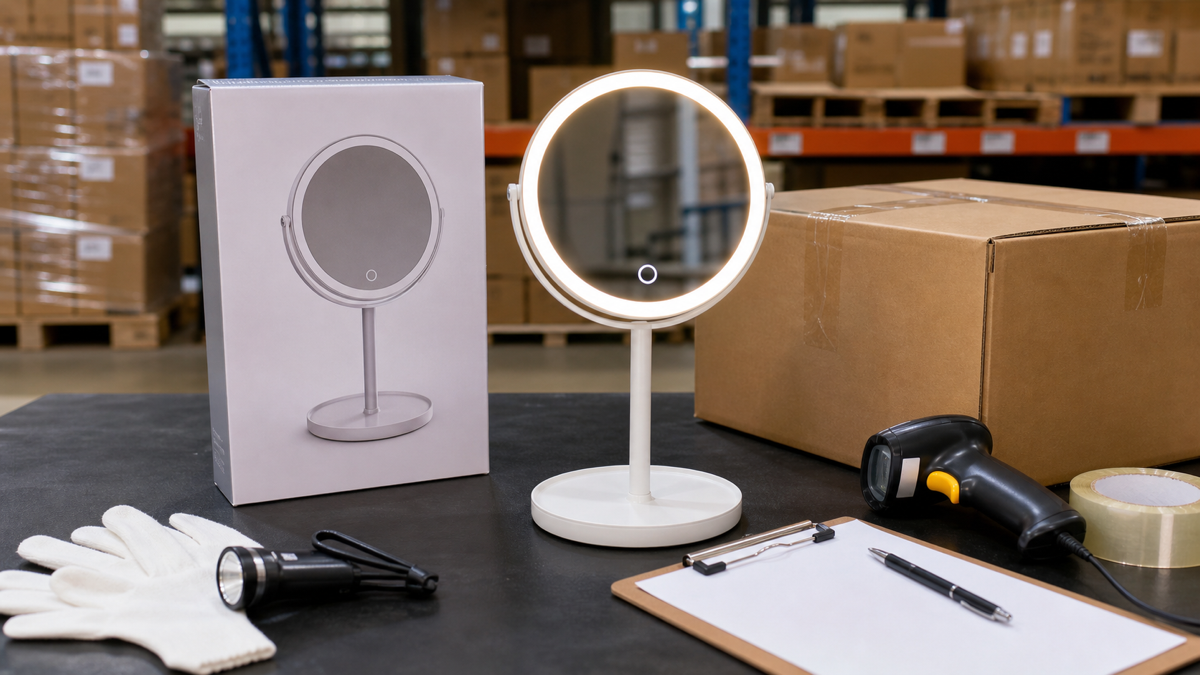
- Scan barcodes from multiple cartons, not only the top sample.
- Verify manual language, warning information, and charger/adapter wording.
- Open packed samples from the beginning, middle, and end of production.
- Confirm master carton quantity, carton mark, gross weight, and destination label.
- Photograph approved packing, label, and carton evidence for the buyer’s QC record.
This checklist should be added to the buyer’s normal pre-shipment inspection workflow.
Common Mistakes Buyers Should Avoid
The most common mistake is approving online copy separately from the factory sample. Marketing teams may write attractive claims before the final LED board, battery, cable, or packaging has been confirmed. When production changes later, the listing is not always updated.
Another mistake is treating barcode and carton labels as warehouse details only. For retail and e-commerce fulfillment, label accuracy is a selling and delivery issue. If a carton contains white mirrors but the label says silver, or if a barcode maps to an old SKU, the problem becomes expensive after arrival.
A third mistake is using aggressive runtime or brightness claims without specifying test conditions. It is better to use a defensible claim that protects reviews and after-sales service than a higher number that creates disputes.
RFQ Details to Send Mingda Mirror
To quote and prepare samples efficiently, buyers should send:
- target sales channel: Amazon, retail, DTC, wholesale, distributor, or project
- mirror type, size, magnification, finish, and lighting requirement
- rechargeable battery expectation, charging port, cable, and adapter policy
- target product claims that must appear on the product page or box
- barcode/SKU requirements and destination-market label needs
- packaging structure: gift box, retail box, mailer carton, master carton, or pallet plan
- target MOQ, launch date, sample approval schedule, and inspection standard
These details help Mingda Mirror align product engineering, packaging, QC, and export documentation before the order becomes urgent. Buyers can also use the custom LED makeup mirror RFQ spec sheet as a starting point.
Bottom-Line Recommendation
For rechargeable LED makeup mirror orders, approve claims and labels as a formal QC gate. The safest approach is to compare every public claim and every packaging label against the final sample, scan-ready barcode, instruction sheet, carton mark, and inspection record before bulk production. This protects marketplace listings, retail receiving, distributor inventory, and customer reviews.
If your team is developing a rechargeable LED makeup mirror line for e-commerce, retail, wholesale, or private label, contact Mingda Mirror with your target channel, product claims, packaging plan, and label requirements. Our team can help prepare samples, packaging, and QC checks for RFQ review.
FAQ
Should product claim QC happen before or after the golden sample?
It should happen with the golden sample. The final approved sample should prove the claims used in the product page, box, manual, barcode file, and carton mark.
What claims are most risky for rechargeable LED makeup mirrors?
Battery runtime, charging port type, light modes, brightness, magnification, included accessories, barcode mapping, and carton quantity are the most common claim and label risk points.
Do Amazon sellers need different checks from retail buyers?
Yes. Amazon sellers should focus on listing accuracy, accessory expectations, barcode consistency, packed-sample protection, and review risk. Retail buyers should also check shelf label, tester consistency, retail box claims, and replenishment SKU control.
Can Mingda Mirror support private-label packaging and label files?
Yes. Mingda Mirror can support OEM/ODM mirror specifications, private-label packaging, barcode placement, carton labels, sample approval, and pre-shipment QC for rechargeable LED makeup mirror orders.
Social Media Content Ideas
LinkedIn angle: show how rechargeable mirror claims should be verified through sample QC, packaging approval, and barcode scanning before production.
Facebook angle: explain why accurate USB-C, runtime, and accessory claims reduce e-commerce returns and customer complaints.
Instagram angle: use the packaging approval or QC bench image to show a behind-the-scenes sourcing check before LED makeup mirrors ship.
CTA: Read the full checklist and send Mingda Mirror your product claims, packaging artwork, and target channel for RFQ review.