
Rechargeable LED makeup mirror warranty terms should define what counts as a defect, how claims are proven, who pays each cost, and which remedy applies. For brands, retailers, Amazon sellers, and distributors, a vague “one-year warranty” is not enough. The commercial risk depends on failure type, claim window, evidence standard, spare-parts availability, return freight, and whether the supplier can trace the affected production lot.
Before placing a bulk order, buyers should agree on a written defect matrix, inspection method, claim workflow, and remedy ladder. This turns after-sales support from an informal promise into a measurable sourcing control.
Why a Warranty Period Alone Does Not Protect the Buyer
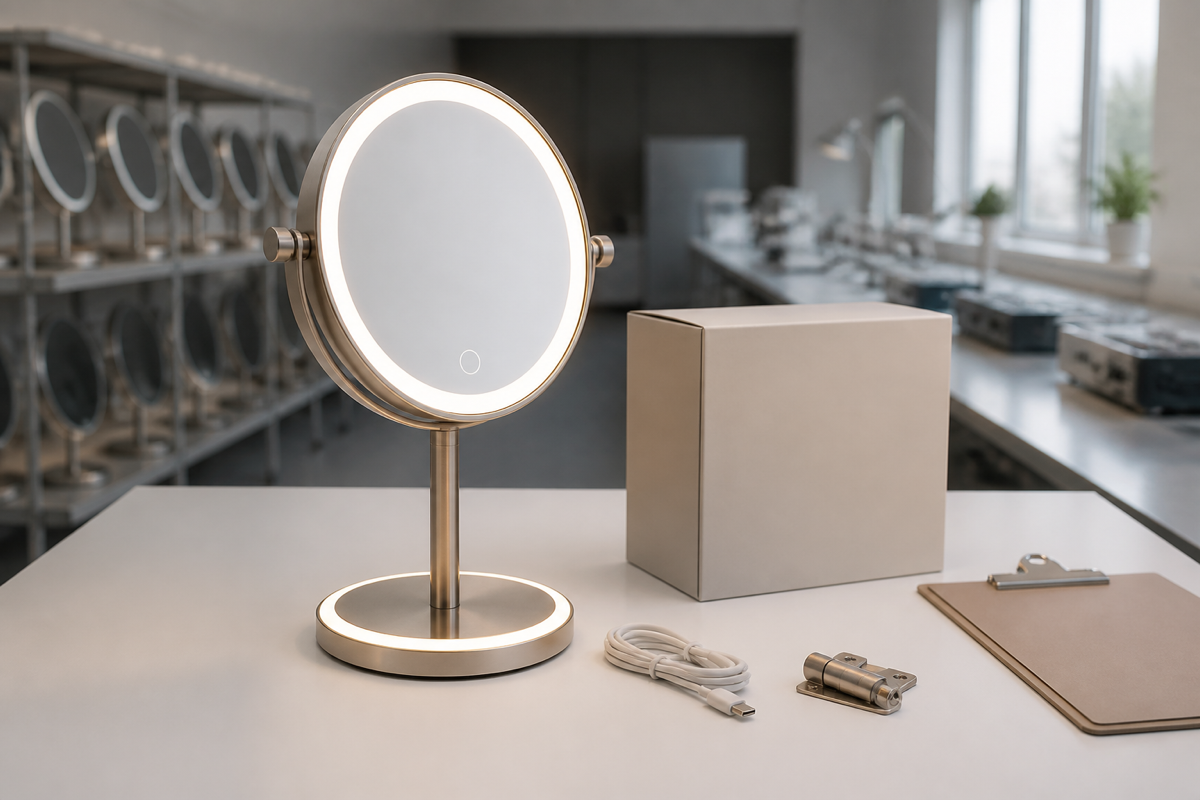
A twelve-month period says when a claim may be submitted, but not whether the claim will be accepted. Rechargeable mirrors combine glass, LED lighting, touch controls, a battery, charging electronics, hinges, finishes, and packaging. These parts do not share the same failure pattern.
A battery that arrives unable to charge is different from gradual runtime loss after repeated use. A loose hinge may be an assembly defect, shipping damage, or wear caused by use beyond the approved angle. Scratched finishes may come from production handling, inadequate packaging, or customer use. Each case needs a defined test and responsibility rule.
The buyer should therefore negotiate warranty language alongside the approved sample, specification sheet, packaging standard, and QC plan—not after complaints begin.
Build a Defect Matrix Before the Purchase Order
The most useful warranty attachment is a defect matrix that connects symptoms to acceptance criteria and remedies.
| Failure type | Evidence buyers should collect | Acceptance rule to define | Practical remedy |
|---|---|---|---|
| Mirror will not charge | Video showing cable, adapter, port, indicator and lot code | Confirm approved input, cable and charging time | Replacement unit, charging board, or credit |
| Battery runtime below claim | Full-charge record and timed runtime test at agreed brightness | Minimum runtime after defined charge cycle | Battery/module replacement or credit |
| LED ring flicker or dead segment | Continuous video at each CCT and brightness level | No visible flicker or failed LED zones | LED board or unit replacement |
| Touch control failure | Video of clean, dry sensor and repeated operation | Response within agreed number of attempts | Control board or unit replacement |
| Loose hinge or unstable stand | Angle-hold video and measured tilt/slip | Hold approved positions without drift | Hinge kit, replacement, or rework credit |
| Glass, finish, or shell damage on arrival | Unboxing video, carton photos and shipping label | Damage-free appearance under agreed inspection light | Packaging corrective action plus replacement/credit |
Avoid subjective phrases such as “good quality” or “normal battery life.” Use the same test conditions that were used during sample approval: charger specification, brightness setting, CCT mode, cycle time, hinge angle, inspection distance, and ambient light.
Separate Manufacturing Defects from Shipping and Use Damage
Responsibility becomes clearer when claims are grouped into three stages.
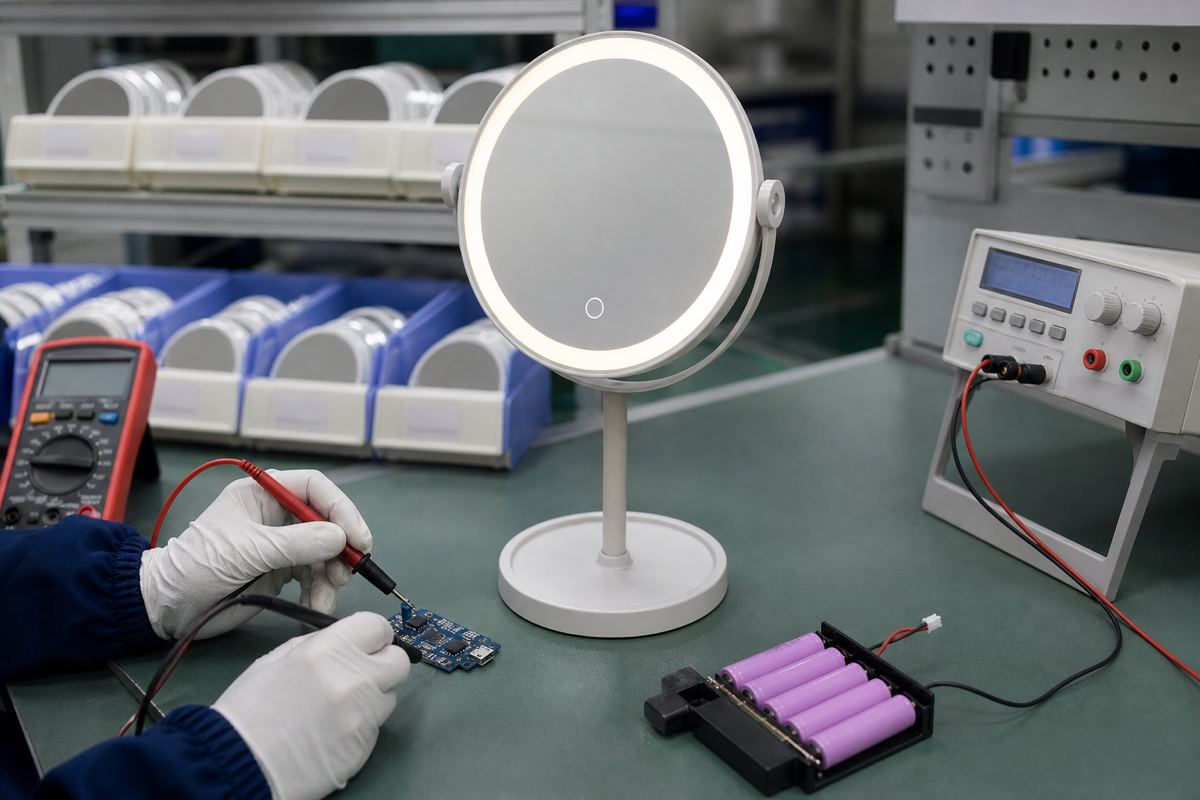
Manufacturing defects include incorrect wiring, failed LEDs, weak solder joints, faulty touch controls, loose fasteners, finish contamination, or components outside the approved specification. These should be covered by the supplier when evidence links them to production.
Transit damage includes broken glass, bent stands, crushed boxes, and abrasion caused by movement inside the package. Responsibility may depend on the agreed Incoterm, freight provider, carton approval, and whether the shipment passed the agreed drop or vibration test.
Use damage includes unsuitable adapters, impact after delivery, liquid exposure, forced hinges, unauthorized repair, and normal cosmetic wear. Buyers should align manuals and marketplace listings with the approved operating limits so customers are not promised more than the product was designed to deliver.
Define Claim Evidence That Both Teams Can Use
An efficient claim should let the supplier identify the product, reproduce the failure, and trace the production lot. Ask for a simple evidence package:
- Purchase order, SKU, production lot, carton mark, and quantity affected.
- Clear product and packaging photos, including the shipping label.
- A short continuous video showing the defect and the test setup.
- Charger, cable, brightness, CCT, and charge-time details for electrical issues.
- A sample count showing whether the issue is isolated or systematic.
- Discovery date, warehouse location, and whether units were sold or only inspected.
For a high-volume incident, retain failed units and unopened control samples. Do not require every consumer to ship a low-value mirror back internationally. A photo/video threshold, retained samples, and supplier inspection of representative units is usually faster and less expensive.
Use a Remedy Ladder Instead of One Default Solution
The remedy should match the failure, channel, and logistics cost. A useful ladder is:
1. Remote troubleshooting for setup, cable, or charging misunderstandings. 2. Replacement parts for trained distributors or service teams. 3. Free replacement units added to the next shipment. 4. Credit note for verified quantities when replacement freight is inefficient. 5. Urgent reshipment for a severe launch-blocking or systemic defect. 6. Corrective-action report and production containment when the same defect repeats.
Buyers should define response time as well as remedy. For example: acknowledgement within two business days, initial technical assessment within five, and a corrective-action plan within ten after receiving complete evidence. Exact timing should match the order scale and market launch risk.
Plan Spare Parts and Replacement Allowance
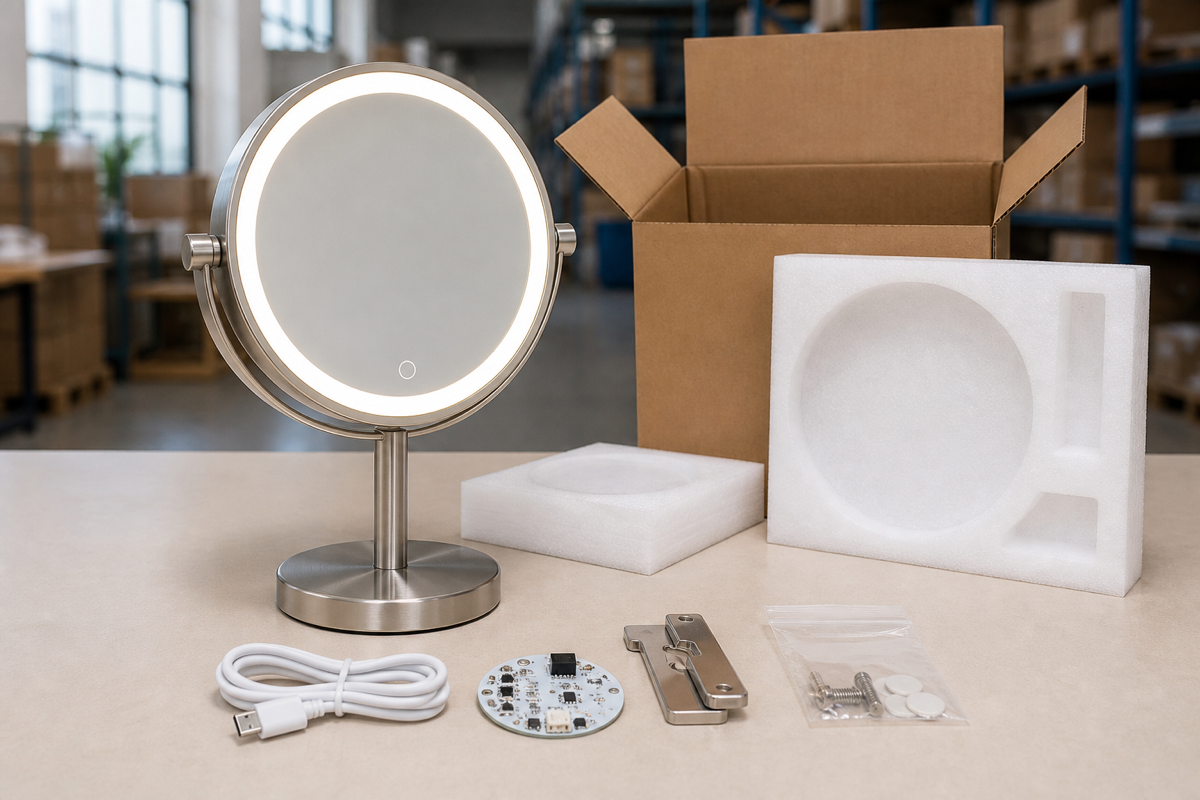
Rechargeable LED mirrors can often be supported with cables, hinges, fasteners, control boards, batteries, or complete replacement units. But parts are useful only when they match the approved revision and can be replaced safely.
Ask the supplier which components are field-replaceable, whether instructions are available, and how long compatible parts will remain available. For retailers without repair capability, a small allowance of complete replacement units may be safer than loose electrical parts. Distributors with technicians may prefer modular kits.
The allowance should reflect product complexity, historical failure data, inspection level, channel expectations, and replenishment lead time. It should not substitute for production QC.
Confirm Cost Responsibility and Commercial Limits
Warranty negotiations should cover product value, replacement freight, duties, local handling, customer refunds, inspection labor, and disposal. Suppliers rarely accept unlimited consequential losses, while buyers should not absorb every cost caused by a verified systemic defect.
A workable agreement can define a claim threshold, responsibility by defect type, approval needed before local rework, maximum reimbursement basis, and how credits are applied. It should also state exclusions and the order of precedence among the purchase order, signed specification, quality agreement, and supplier warranty.
Pre-RFQ Warranty Checklist
Before requesting a quotation, send or ask for:
- Target market and sales channel.
- Required warranty period and expected consumer promise.
- Approved charging input, cable, battery, LED, touch, and hinge requirements.
- Defect classifications: critical, major, and minor.
- Pre-shipment inspection level and retained-sample plan.
- Required lot coding and traceability.
- Claim evidence template and response times.
- Preferred remedy: parts, replacements, credit, or mixed support.
- Spare-unit or spare-parts allowance.
- Packaging and transit-test standard.
- Local compliance, battery shipping, and disposal requirements.
Common Buyer Mistakes
The first mistake is copying consumer warranty language into a factory purchase order. Consumer promises and supplier responsibility are related, but they are not identical.
The second is accepting a long warranty without test conditions. A shorter, measurable agreement can be more valuable than a broad promise with unclear exclusions.
The third is failing to lock component revisions. If the battery, board, hinge, or cable changes without approval, earlier spare parts may no longer fit.
The fourth is waiting for returns before studying the pattern. Review receiving inspection, early reviews, and complaint codes by lot so a repeat issue can be contained quickly.
Review First-Month Claims by SKU and Control Revision
At the first-month review, group reported symptoms by SKU, shipment lot, control-board revision, and sales channel. Keep units sold, units inspected, and units reported faulty as separate counts; a complaint count without its population and observation period cannot establish a comparable failure rate. Record whether a case was reproduced, remained unconfirmed, or was resolved through operating instructions.
For activation complaints, use the touch vs sensor switch LED makeup mirror comparison to separate missed responses, unintended activation, and instruction confusion. Assign an investigation owner, response date, and evidence requirement for recurring symptoms. Confirm the approved revision and corrective-action evidence before choosing a larger reorder.
Bottom-Line Recommendation
For rechargeable LED makeup mirrors, approve warranty terms as a technical and commercial control: defect matrix, evidence package, traceability, response time, remedy ladder, spare-parts plan, and cost responsibility. Brands and e-commerce sellers should prioritize fast replacement and claim evidence. Distributors should prioritize serviceable parts and revision control. Retailers should connect packaging damage rules with receiving inspection.
Mingda Mirror can help buyers align samples, specifications, QC, packaging, and after-sales planning before bulk production. Review Mingda Mirror product categories, OEM/ODM services, and the quality control process, then send your target market, order quantity, channel, and warranty expectations through the Contact page.
FAQ: Rechargeable LED Makeup Mirror Warranty Terms
What warranty period should a buyer request?
The period should match the channel and consumer promise, but the defect definition and remedy matter more than duration alone. Many buyers discuss twelve months, then add clear rules for arrival damage, battery performance, electrical failures, and wear.
Should buyers return every failed mirror?
Usually not. Use videos, photos, lot codes, retained samples, and representative failed units. International returns may cost more than the product and slow root-cause analysis.
Are batteries and hinges covered in the same way?
Not necessarily. Batteries have cycle-related performance change, while hinges have mechanical wear and load limits. Define separate tests, exclusions, and remedies for each component.
What should happen if one defect repeats across a lot?
The supplier should contain the affected production, investigate root cause, report corrective action, and agree on inspection or remedy for remaining stock. Lot traceability is essential.
Can Mingda support private-label after-sales planning?
Yes. Mingda can discuss specification controls, inspection points, packaging tests, spare parts, replacement allowance, claim evidence, and private-label requirements as part of an RFQ and sample plan.