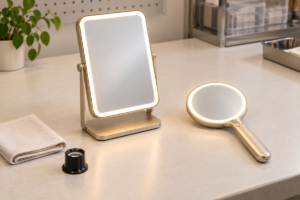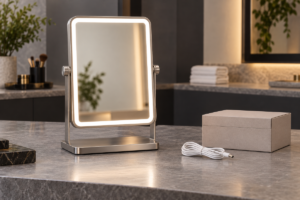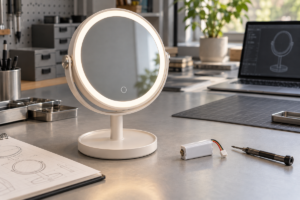

For LED makeup mirror buyers, touch switch and sensor switch designs should be compared by user behavior, control reliability, cleaning conditions, power consumption, packaging instructions, and after-sales risk. Choose touch control when an explicit tap fits the intended use; consider hands-free sensing when that interaction solves a buyer need. Compare the actual samples for intended activation, unintended activation, standby consumption, and instruction clarity before committing to either design.
This comparison is written for beauty brands, Amazon and e-commerce sellers, retailers, distributors, wholesalers, and private-label buyers choosing LED tabletop makeup mirrors, rechargeable makeup mirrors, compact mirrors, and vanity mirror programs.
Why the Switch Type Affects More Than the User Interface
The switch is a small part, but it controls how customers experience the whole mirror. It affects the first demo in a retail store, the product video for an online listing, the wording in the user manual, the power board design, the production test method, and the type of complaints the seller may receive after delivery.
For e-commerce channels, buyers also need the switch behavior to match the product page clearly. If the listing promises dimming, memory function, hands-free control, or easy cleaning, the packed mirror, manual, accessory set, and QC record must support that claim. A confusing control method can create poor reviews even when the LED light and mirror glass are acceptable.
Direct Comparison for B2B Buyers
| Decision Point | Touch Switch LED Makeup Mirror | Sensor Switch LED Makeup Mirror |
|---|---|---|
| Best fit | Retail, Amazon, gift sets, first-time users, cost-sensitive SKUs | Salon, premium vanity, hotel/project, hygiene-sensitive use |
| User learning curve | Low; buyers understand tap and long-press quickly | Medium; users must understand sensing distance and gesture |
| Cost control | Compare the quoted board, assembly steps, and test plan | Request separate module, development, and test costs |
| False trigger risk | Verify against handling, cleaning, and packing conditions | Verify the stated sensing method, environment, and packing mode |
| Cleaning behavior | User may touch the mirror/base often | Less touch on the surface, but sensor area must stay clean |
| QC focus | Touch sensitivity, dimming steps, switch lifetime, water/oil resistance | Sensing distance, response delay, standby power, false triggers, environment test |
| Packaging requirement | Clear button icon and operation wording | Clear sensor area, distance guidance, storage/shipping switch-off notes |
The practical rule is simple: choose touch switch when broad channel clarity and stable cost matter most. Choose sensor switch only when the buyer can justify the premium feature and confirm stricter testing before production.
When a Touch Switch Is the Better Choice
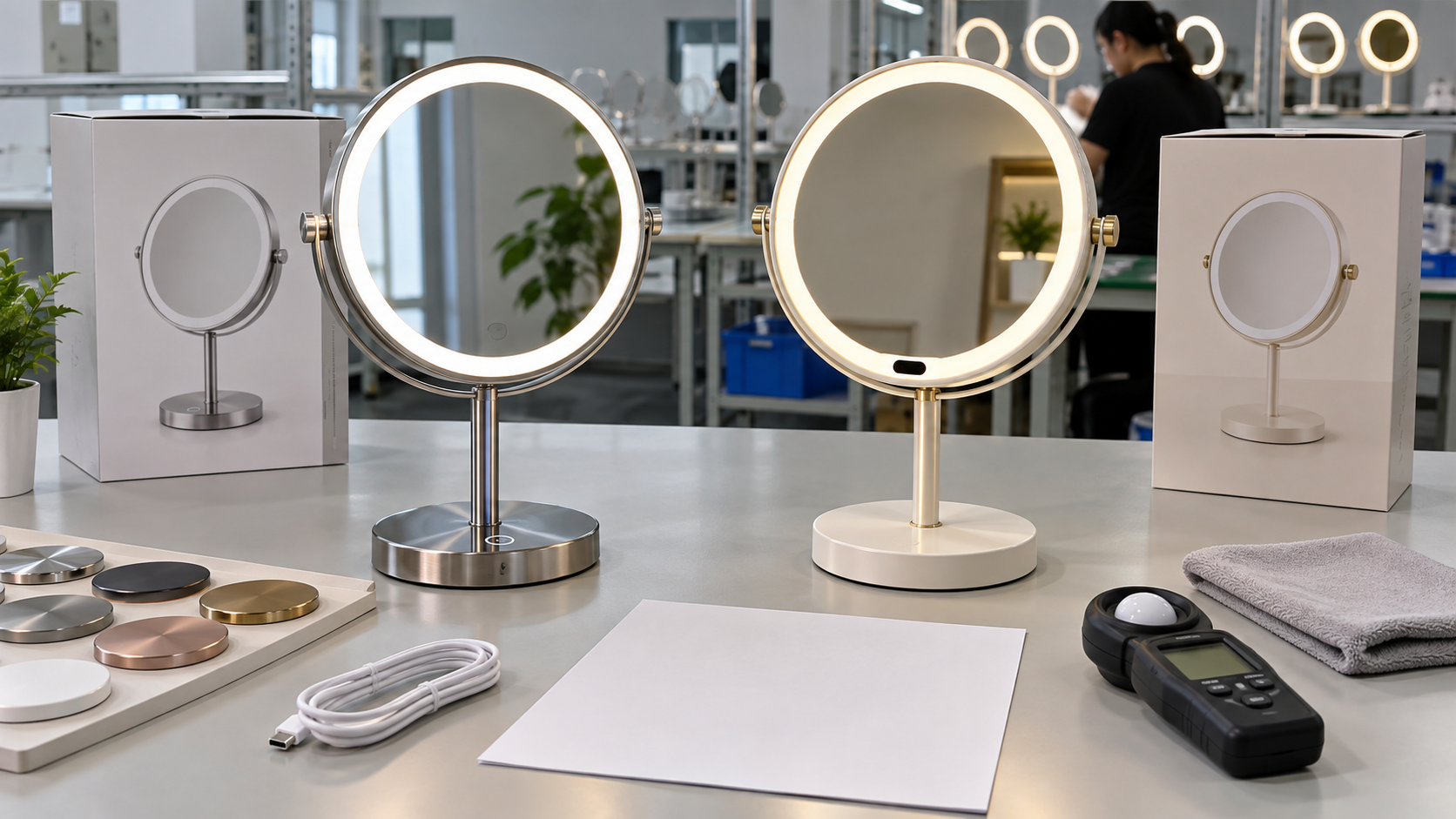
Evaluate touch control for high-volume programs when an explicit tap matches the customer demonstration and instructions; confirm reliability on the actual production configuration. It works well for tabletop mirrors, travel mirrors, retail gift sets, subscription boxes, and Amazon listings where customers want to understand the product within a few seconds.
For many buyers, the biggest benefit is predictability. The user taps to turn the light on, taps again to change light color or brightness, and long-presses to dim if the design supports stepless dimming. This behavior is easy to explain on packaging and easier for customer service teams to troubleshoot.
Touch switch designs are also easier to compare across suppliers. Buyers can ask for the switch IC, PCB version, button location, dimming method, memory function, charging behavior, and aging test result. If the sample and bulk order use the same model number and control board version, the buyer has a clearer path to repeat orders.
Touch switch is usually the right choice when:
- the buyer sells through Amazon, retail chains, gift channels, or wholesale distributors
- the target customer includes first-time LED makeup mirror users
- price tier and stable supply matter more than a premium feature story
- the product page must explain operation with minimal customer education
- the SKU needs consistent reviews across many batches
When a Sensor Switch Can Add Value
A sensor switch can make sense when the mirror is positioned as a premium or semi-professional product. For salons, hotel vanities, makeup counters, and higher-end home use, hands-free control can feel cleaner and more convenient. It may also help when users apply makeup with product on their hands and want to avoid touching the mirror surface.
However, a sensor switch should not be treated as a simple upgrade. It needs a defined sensing distance, stable response time, low standby power, and a clear method to prevent accidental activation during storage, packing, shipping, or display. If a sensor turns on too easily in a retail display or drains battery in a carton, the feature becomes a service problem.
Sensor switch designs are better suited for buyers who can control the selling story, product demo, and after-sales instruction. They are less suitable for low-price marketplace SKUs where customers may not read a manual before leaving a review.
The QC Tests Buyers Should Request
Before approving either control type, buyers should ask the supplier to test the real production version, not only a hand-built sample. The switch board, LED driver, battery, charging port, cable, diffuser, and shell must all match the approved sample.

For touch switch versions, confirm:
- response after repeated tap and long-press operation
- dimming smoothness and brightness memory behavior
- switch sensitivity with dry, slightly oily, and clean hands
- resistance to accidental activation during packing or handling
- charging behavior while the light is on and off
- switch performance after aging test and vibration or transit simulation
For sensor switch versions, confirm:
- sensing distance range in centimeters
- response time from hand movement to light change
- false-trigger rate under showroom, bathroom, and packing-table light
- standby power consumption and battery drain during storage
- sensor behavior near reflective cartons, retail boxes, and mirror surfaces
- clear failure mode if the sensor area is blocked by dust, film, or fingerprints
The QC record should include the sample version, PCB version, test quantity, test environment, acceptance limit, failed units, correction action, and retest result. This is especially important for private-label orders where buyers may reorder the same SKU several months later.
Define the Sensor Before Comparing Test Results
Ask the supplier to identify the sensing technology and intended gesture before comparing two samples. A proximity, motion, or gesture control may respond differently; the word sensor alone does not establish the activation range or immunity to ambient conditions. Record the control-board revision, power state, hand position, approach direction, background, lighting condition, and intended response for each trial.
Separate missed intended activations from unintended activations. Record successful responses out of a stated number of attempts, and unintended activations over a stated observation period. Agree the acceptable range and test conditions before approval. Check the packed product with its intended shipping isolation or lockout in place; a short demonstration cannot establish storage battery life.
Keep the test record tied to LED makeup mirror model-number control. Define the evidence and service route for later failures using the rechargeable LED makeup mirror warranty planning guide.
Recheck Control Behavior Before a Repeat Order
At the first follow-up after delivery, separate reports of missed activation, unintended activation, storage discharge and instruction confusion. Record the buyer SKU, control-board revision, power configuration, shipment, units received or sold and observation cutoff. Report case counts with that denominator; a small early batch or short observation window does not establish a long-term failure rate.
Reproduce each reported behavior on the same power and control configuration before assigning a cause. Compare the customer instructions with the actual tap or gesture sequence, record whether the issue was reproduced, and assign an owner and next review date. Retest changed boards, firmware, sensor windows or manuals against the approved sample before releasing the next batch. Use the cordless versus plug-in comparison to keep runtime, standby and supplied accessories consistent with the control test record.
Packaging, Manual, and Listing Consistency
The control method must be consistent across packaging, user manual, barcode data, marketplace listing, and customer support scripts. A touch model and a sensor model may look almost identical in product photos, but the operation promise is different. Mixing artwork, manuals, or SKU labels can create returns even when the product works correctly.
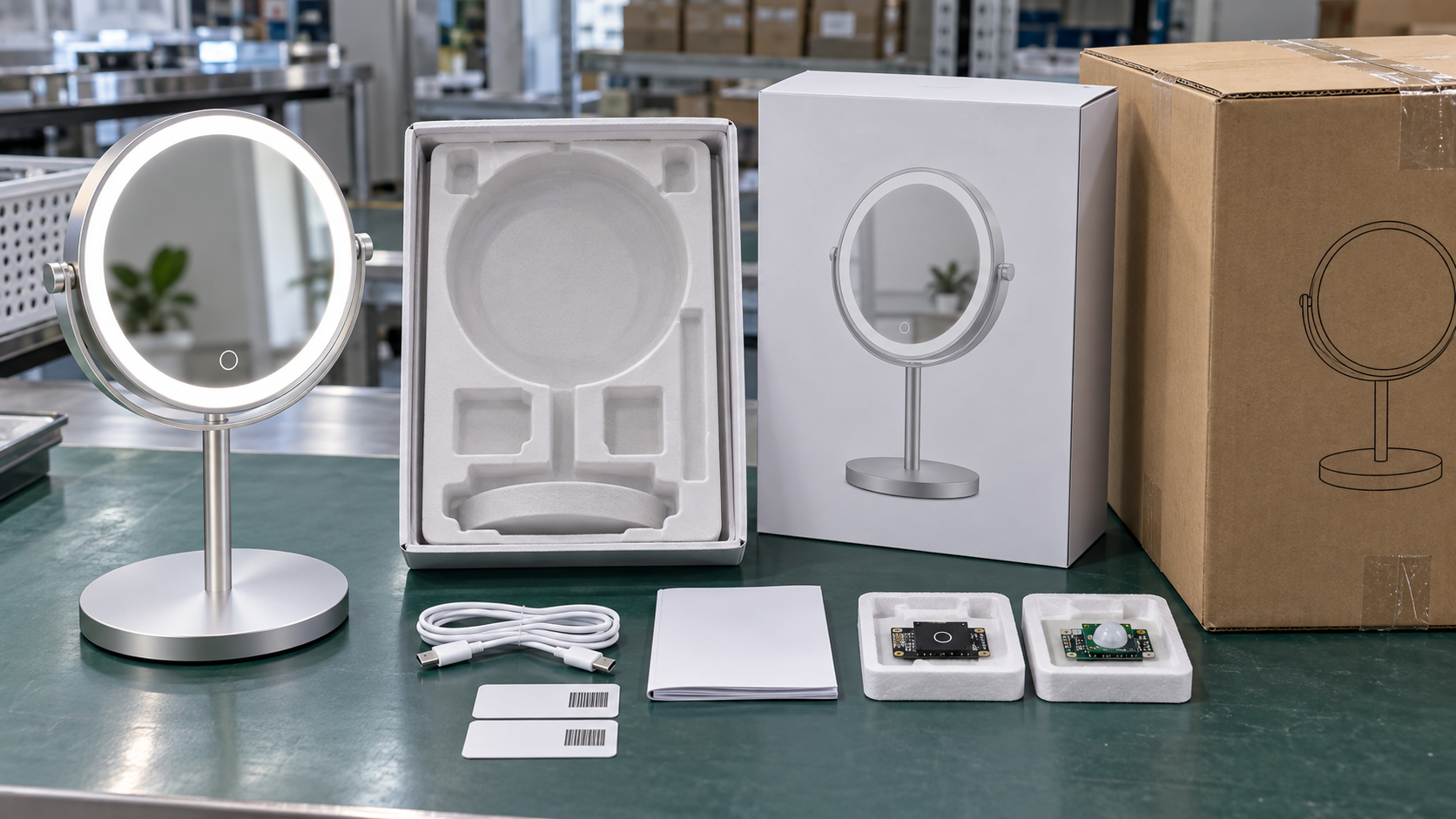
Buyers should confirm these items before mass packing:
- the retail box shows the correct control type
- the manual explains tap, long-press, gesture, or sensing distance accurately
- the product page does not promise hands-free control for a touch-only SKU
- the barcode and carton mark separate touch and sensor versions clearly
- the supplier keeps the approved control board version tied to the model number
- after-sales spare parts or replacement units match the original control type
This is where marketplace discipline matters. Online sellers need product data, labels, and packed goods to agree. Retail buyers need shelf tags, tester units, and replenishment cartons to match. Distributors need model separation so a premium sensor version does not get mixed with a standard touch version in the warehouse.
MOQ, Lead Time, and Cost Tradeoffs
MOQ and lead time depend on the quoted control-board revision, component availability, finish batch, packaging, and customization. Ask for both configurations on the same quotation basis; touch control alone does not establish a lower MOQ or a shorter production schedule.
Sensor switch models may need a higher sample-development effort. The supplier may need to confirm the sensor module position, shell opening or diffuser area, circuit board layout, standby current, and manual wording. For OEM buyers, this can affect sample time, tooling discussion, and pre-production testing. The added cost may be worthwhile, but it should be quoted as part of the product positioning, not hidden in a vague premium feature.
When requesting quotation, buyers should ask suppliers to separate:
- unit price for touch switch and sensor switch versions
- MOQ by finish, packaging, and control-board version
- sample cost and sample lead time
- mass-production lead time after sample approval
- packaging artwork update cost
- spare parts or replacement policy for control-board failures
Common Sourcing Mistakes
One common mistake is choosing sensor control because it sounds more advanced, then selling it into a channel where customers expect a simple button. Another is approving a showroom sample without testing the control behavior after charging, dimming, aging, packing, and storage.
Buyers also sometimes compare two suppliers by unit price only. That can miss the real cost difference: false triggers, battery drain, manual confusion, SKU mix-ups, and higher customer-service time. For LED mirrors, the cheapest control method is not always the lowest-risk control method.
A third mistake is failing to lock the approved version. If the first batch uses one PCB and the repeat order uses another board with a different dimming curve, the buyer may receive complaints even though the product name and appearance did not change.
Pre-RFQ Checklist
Before sending an RFQ for touch switch or sensor switch LED makeup mirrors, prepare:
- target channel: Amazon, retail, salon, hotel, distributor, gift, or private label
- mirror type: tabletop, compact, travel, wall-mounted, or vanity mirror
- control method: touch, sensor, or optional quote for both
- light modes: warm, natural, cool, stepless dimming, or fixed brightness
- power source: USB-C rechargeable, plug-in, battery, or dual power
- expected battery life and standby requirement
- packaging format: retail box, gift box, molded insert, or e-commerce carton
- manual language and control instructions
- MOQ target, sample schedule, and launch date
- QC expectations for switch response, aging test, and packed-product inspection
For private-label buyers, include product photos, desired finish, logo placement, packaging reference, and selling-channel requirements. A complete RFQ helps the supplier quote the real version, not an attractive but incomplete sample.
Bottom-Line Recommendation
Choose touch control when an explicit tap matches the channel demonstration and customer instructions, then verify reliability on the approved production configuration. A sensor switch is a strong option for premium, salon, hotel, or hygiene-led positioning, but only when the buyer approves sensing distance, false-trigger control, standby power, manual wording, and packed-SKU separation before bulk production.
If you are unsure, ask for both samples and test them in the real use environment. The best switch choice is the one your target customer understands quickly and your supplier can reproduce consistently.
FAQ
Is a sensor switch always better than a touch switch?
No. A sensor switch can feel more premium, but it also needs stricter testing and clearer instructions. For either control type, compare customer understanding and observed support issues on the intended channel before claiming an after-sales advantage.
What should buyers test first on a touch switch LED makeup mirror?
Start with on/off response, dimming behavior, light-mode switching, long-press control, charging behavior, and performance after aging. The buyer should confirm the same control board is used for the approved sample and bulk order.
What is the biggest risk of a sensor switch mirror?
The biggest risk is false triggering or inconsistent response. Buyers should test sensing distance, ambient light effects, reflective surfaces, storage behavior, standby power, and customer instruction clarity.
Does switch type affect MOQ?
It can, but confirm MOQ for the actual board, housing, finish, and packaging combination. Ask which component or process sets the minimum and whether an existing approved configuration changes it. Do not infer MOQ from switch type alone.
Should one product line include both touch and sensor versions?
Yes, if the buyer separates the SKUs clearly. Use touch switch for broad-market and cost-controlled products, and sensor switch for premium or professional-use products. Keep packaging, barcode labels, manuals, and replacement units separated.
Work With Mingda Mirror
Mingda Mirror manufactures LED makeup mirrors, compact mirrors, handheld mirrors, Hollywood mirrors, and LED bathroom mirrors for B2B buyers. If you are comparing touch switch and sensor switch LED makeup mirror options, send your target channel, size, finish, power method, packaging goal, MOQ, and launch schedule. Our team can help prepare samples, compare control methods, review packaging, and build an RFQ-ready specification for your next order.
Related sourcing pages:
- Makeup Mirrors
- OEM / ODM Services
- Quality Control Process
- Contact Mingda Mirror
- LED Makeup Mirror Aging Test Checklist
Social Media Content Ideas
LinkedIn angle: Compare touch and sensor controls using intended activation, unintended activation and standby records tied to the production configuration.
Facebook angle: Before ordering LED makeup mirrors, check whether shoppers can understand the control method in seconds. Check instruction-related support cases separately from confirmed control faults.
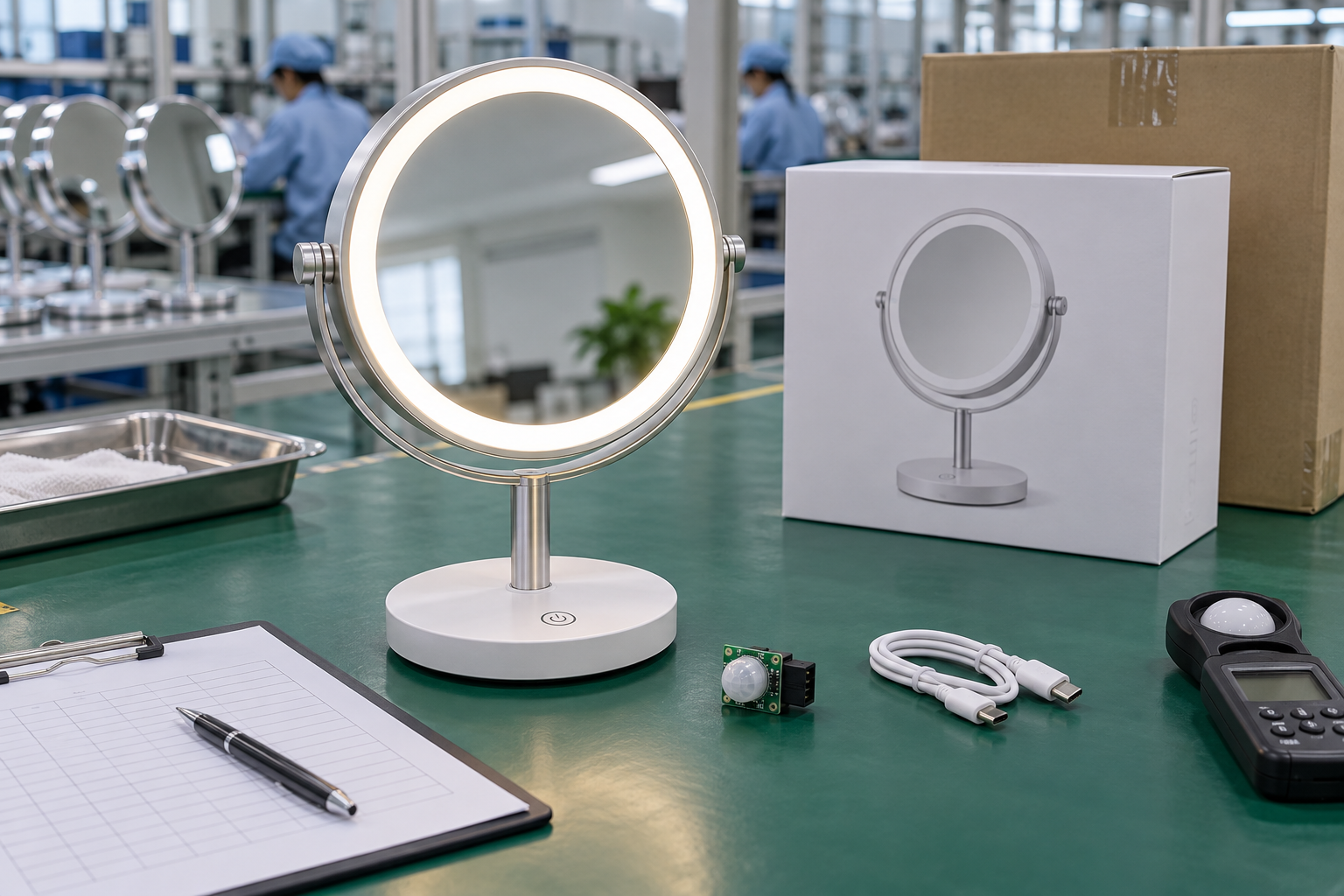
Instagram angle: Use the QC testing image to show how switch response, dimming, charging, and packaging consistency are checked before mass production.
CTA: Read the full comparison and send Mingda Mirror your target channel, control preference, MOQ, and packaging plan for a practical RFQ.