
For rechargeable LED makeup mirrors, most new retail and e-commerce programs should move toward USB-C unless the buyer is managing a very price-sensitive legacy SKU. USB-C is easier for consumers to recognize, better aligned with current charging expectations, and cleaner for future assortment planning. Micro-USB can still work for low-cost or existing replacement programs, but buyers should treat it as a transition option, not the default for a new private-label line.
The sourcing decision is not only about the connector shape. For brands, Amazon sellers, wholesalers, and retailers, the charging port affects product positioning, accessory packing, battery documentation, return risk, after-sales questions, and how long the SKU can stay competitive.
Why the Charging Port Matters to Business Buyers
A rechargeable LED makeup mirror is often sold as a convenience product: portable placement, adjustable lighting, clean dressing-table use, and fewer disposable batteries. If the charging experience feels outdated or confusing, the buyer may see more customer-service questions before the product quality is even judged.
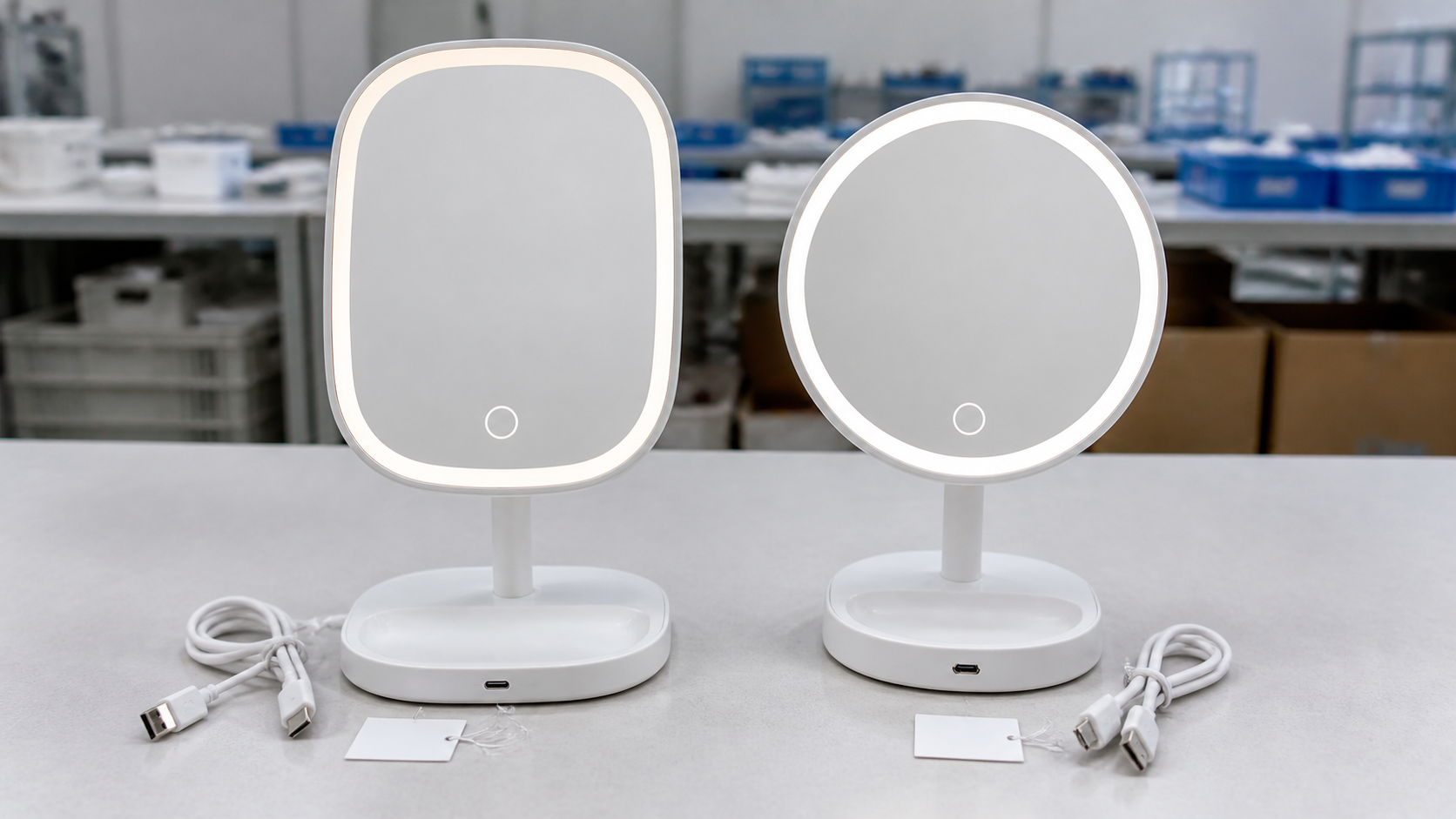
USB-C is now familiar across phones, tablets, beauty devices, and travel electronics. It supports a more modern product message, reduces orientation mistakes when users plug in the cable, and makes the accessory list easier to explain. Micro-USB is still available in many supply chains and can reduce component cost, but it may make a new mirror line look older in markets where consumers already expect USB-C.
For B2B orders, confirm the port choice before mold confirmation, packaging dielines, instruction copy, battery paperwork, and sample approval. Changing from Micro-USB to USB-C late in development may affect tooling, PCB layout, cable sourcing, carton copy, and certification file consistency.
USB-C vs Micro-USB: Procurement Comparison
| Decision Point | USB-C Rechargeable LED Makeup Mirror | Micro-USB Rechargeable LED Makeup Mirror | Buyer Recommendation |
|---|---|---|---|
| Market perception | Modern, expected by many beauty and electronics buyers | Older but still familiar in low-cost accessories | Use USB-C for new retail, DTC, and Amazon SKUs |
| User convenience | Reversible connector reduces plug-in complaints | Connector orientation can frustrate users | Choose USB-C for review-sensitive channels |
| Cost pressure | Usually slightly higher port and cable cost | Often lower component cost | Use Micro-USB only when price tier is the main driver |
| Packaging copy | Easier to communicate as current charging design | May need clearer usage instructions | Keep accessory wording consistent with the approved port |
| Assortment life | Better for future SKU continuity | More suitable for legacy replenishment | Avoid launching a long-term new line with Micro-USB |
| QC focus | Port durability, cable fit, charging current, battery runtime | Port looseness, cable fit, orientation wear, charging current | Test connector insertion, charging stability, and cycle life |
When USB-C Is the Better Choice
USB-C is usually the better choice when the mirror is positioned as a mid-range or premium rechargeable LED makeup mirror. This includes tabletop mirrors for beauty brands, travel LED mirrors for DTC sellers, private-label rechargeable mirrors for Amazon listings, and retail chains that want a modern electronics-style accessory set.
USB-C also makes sense when the buyer wants a longer SKU life. Retailers do not want to redesign the same mirror after one season because consumer expectations moved on. For rechargeable beauty devices, a current-looking charging interface can protect the product from looking outdated on shelf, in listing photos, and in unboxing videos.
Buyers should still specify the charging details clearly. A USB-C port does not automatically mean fast charging or USB Power Delivery. For most LED makeup mirrors, the practical requirement is stable charging with the approved cable and adapter range, safe battery protection, and a runtime claim that matches the real light mode used by consumers.
When Micro-USB Can Still Be Acceptable
Micro-USB may still be acceptable when the buyer is continuing an established low-cost SKU, matching a previous accessory kit, or targeting a promotional price point where every component cost matters. It can also be used when the customer already owns a cable set and does not want to change packaging, instructions, or replacement parts.
However, Micro-USB should not be chosen only because it is available. For new private-label projects, the buyer should compare the small cost saving against possible consumer perception, more plug-in errors, and shorter assortment life. If the mirror will be sold through review-sensitive channels, a low-cost port can create hidden costs through returns, support messages, and weaker product ratings.
The practical rule is simple: Micro-USB is a legacy or budget decision; USB-C is the stronger default for new rechargeable LED makeup mirror development.
Charging and Battery Details Buyers Should Confirm
The charging port is only one part of the rechargeable system. Before bulk production, sourcing managers should confirm the complete electrical and accessory specification:
- Battery capacity and realistic runtime by light mode
- Charging time under the approved input condition
- Cable type, length, color, and packing method
- Port position and whether the cable can be inserted easily after assembly
- Overcharge, over-discharge, short-circuit, and temperature protection design
- Sample test result after repeated plug-in cycles
- Instruction wording for first use, charging, storage, and disposal
- Battery documentation needed for the target sales channel and destination market
For rechargeable mirrors shipped through e-commerce or air freight, battery information must be prepared early; use the rechargeable versus battery-powered makeup mirror guide to align the power choice, runtime statement and logistics brief. Amazon and logistics partners often require accurate battery attributes, product safety details, and packing information before stock can move smoothly. Even when the mirror is not a high-power device, incorrect battery data can delay listing approval, FBA shipment creation, or customs handling.
Common Mistakes That Increase Return Risk
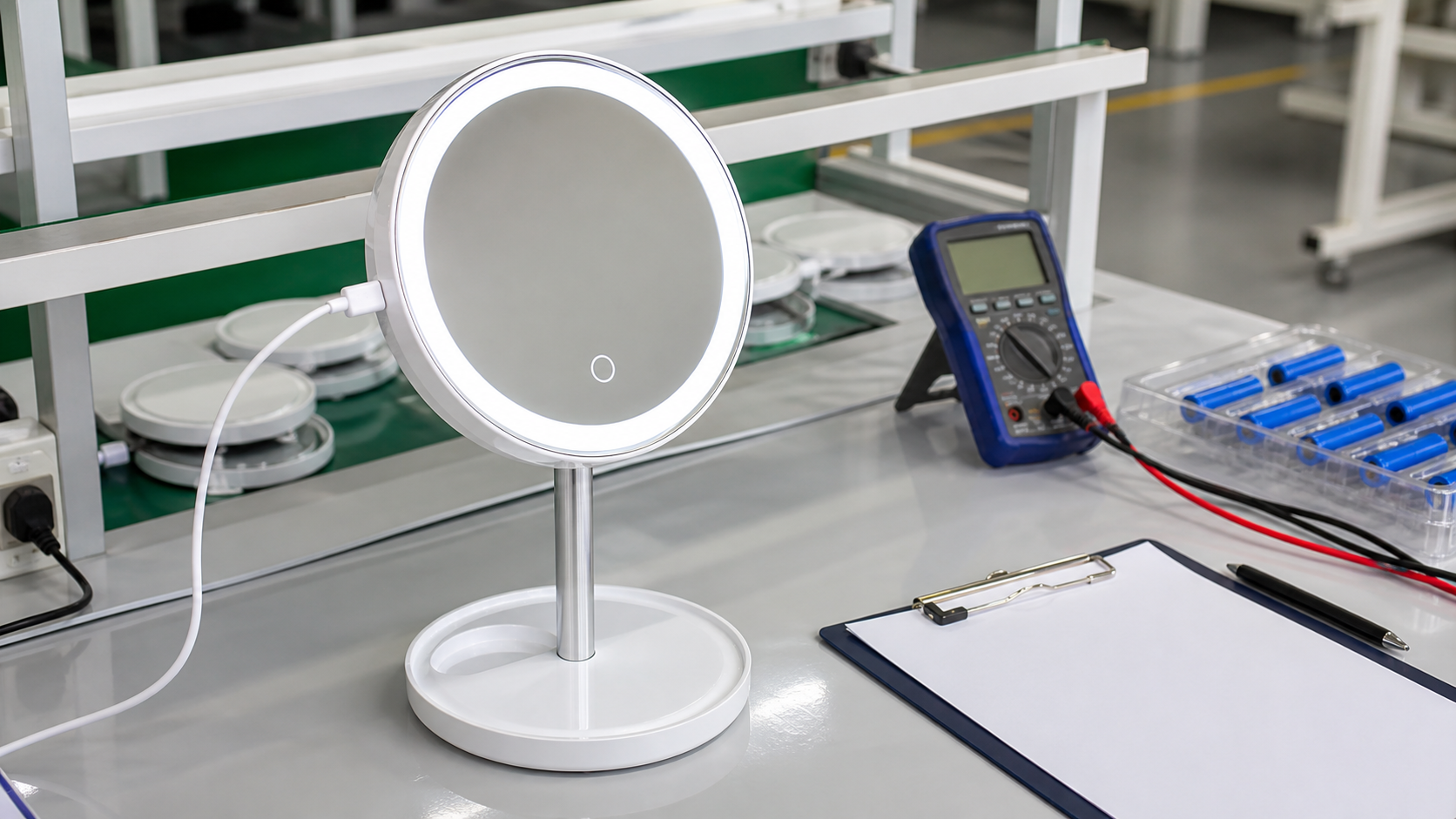
The most common mistake is approving the mirror appearance without testing the full charging experience. A sample may look acceptable in photos, but buyers should actually plug in the cable, check whether the port feels stable, test charging under normal use, and confirm whether the cable fits the packaging insert.
Another mistake is overclaiming battery runtime. If the listing says the mirror runs for many hours but the claim is based on the lowest brightness mode, customers may be disappointed when they use the brightest light setting. The better approach is to define runtime by light mode and confirm the claim with sample testing.
Buyers should also avoid changing the cable or charger accessory after packaging has been approved. A longer cable may not fit the tray. A different connector head may press against the mirror surface during transport. A different accessory pouch may change carton space and drop-test performance.
Packaging and Documentation Checklist
Before issuing a purchase order, ask the supplier to confirm:
- Final port type: USB-C or Micro-USB
- Cable included or not included, plus cable specification
- Battery capacity and battery chemistry shown consistently in the supplier file
- Instruction leaflet text for charging, storage, and safe use
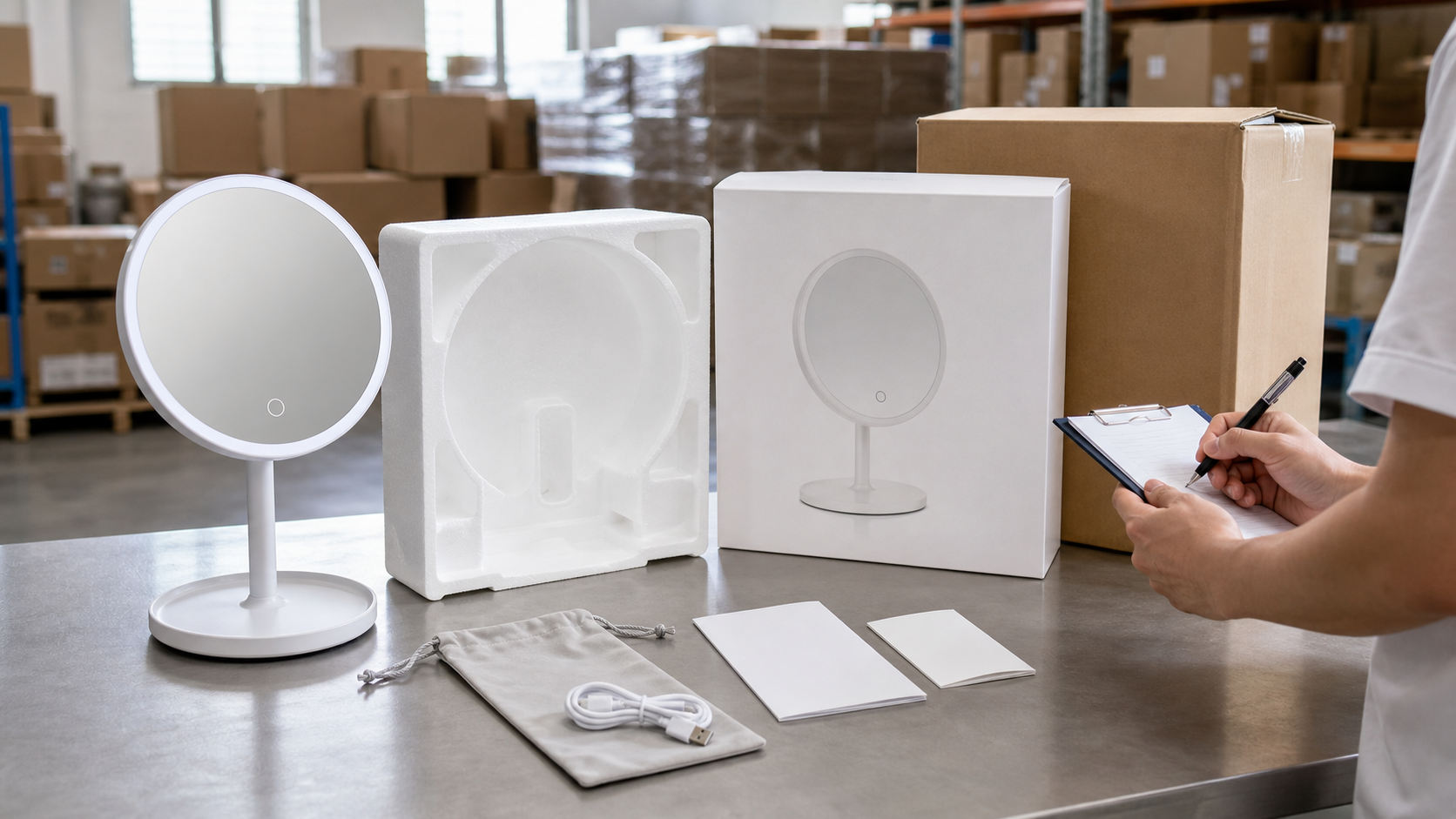
- Inner tray design that protects the mirror, base, port, and cable
- Carton marks and product labels aligned with the approved SKU data
- Sample approval photos for the mirror, accessory set, packaging, and carton
- Spare cable or replacement policy for after-sales support
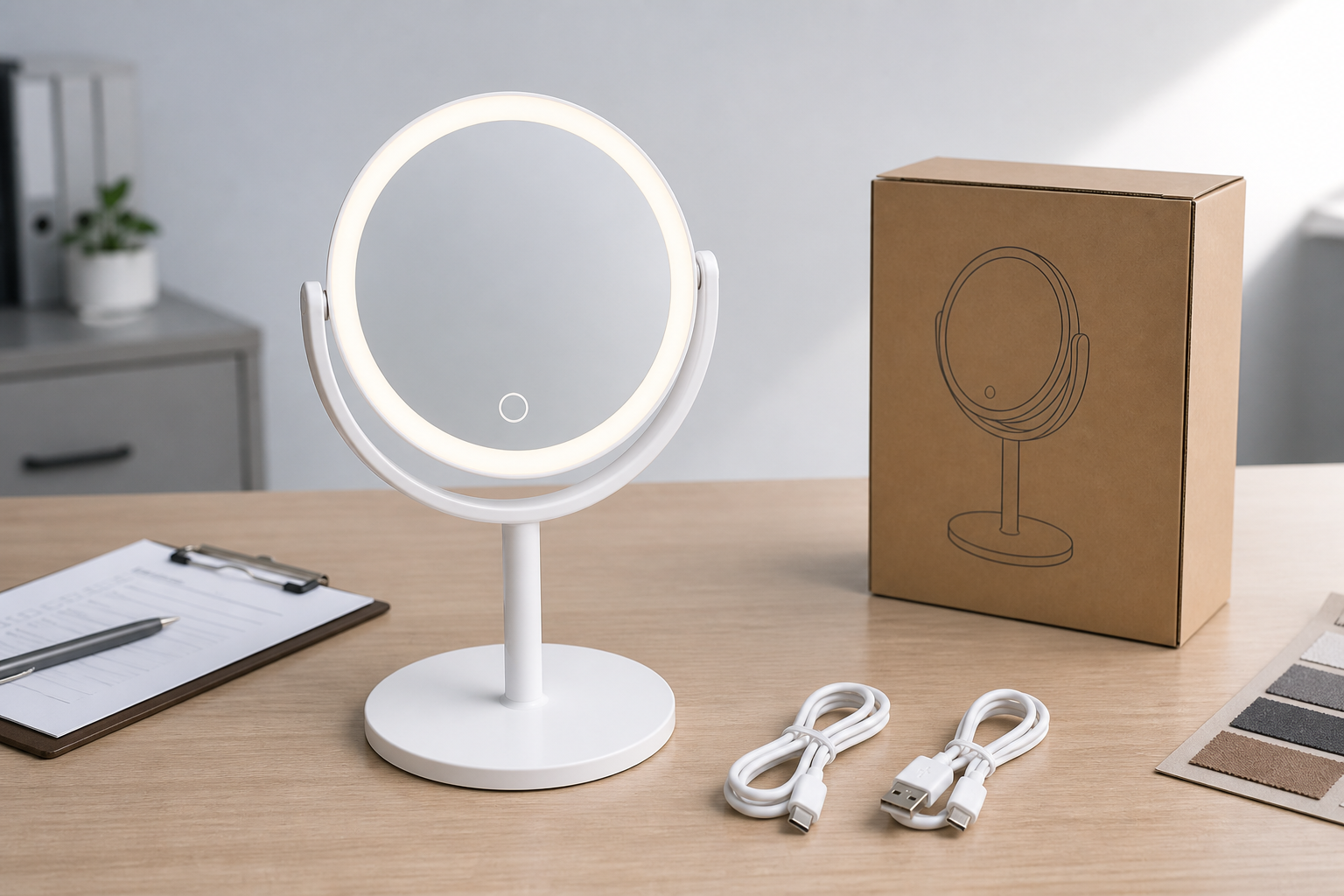
For private-label orders, packaging should not be treated as decoration only; apply the LED mirror shipping and e-commerce packing guide when approving the insert and outer carton. It must help the buyer reduce breakage, wrong-accessory complaints, and marketplace data inconsistencies. The accessory list on the box, instruction leaflet, listing page, and supplier invoice should all match.
RFQ-Ready Decision Points
When requesting a quotation, buyers should send a clear charging brief instead of asking only for “rechargeable mirror price.” A useful RFQ should include:
- Target channel: retail, Amazon, DTC, wholesale, salon, hotel, or gift program
- Preferred port: USB-C, Micro-USB, or both for comparison
- Mirror type: tabletop, travel, compact, wall-mounted, or Hollywood-style
- Battery capacity and expected runtime range
- Lighting requirements: CCT, brightness levels, dimming method, CRI target if needed
- Packaging format: color box, kraft box, mailer box, molded insert, pouch, or gift set
- Destination market and any required safety or logistics documentation
- Target MOQ, sample deadline, and first shipment timeline
This information allows the supplier to quote the correct PCB, port, cable, packaging, testing scope, and lead time. It also reduces the risk that the buyer compares two prices that are not based on the same specification.
Bottom-Line Recommendation
For most new rechargeable LED makeup mirror programs, choose USB-C as the default specification and reserve Micro-USB for legacy, replacement, or very price-sensitive orders. The buyer should approve the full charging system, not just the port: battery capacity, runtime claim, cable, packaging insert, instruction copy, QC testing, and logistics documentation all affect the final product experience.
Mingda Mirror can support brands, retailers, wholesalers, Amazon sellers, and distributors with rechargeable LED makeup mirror sourcing, sample review, OEM/ODM customization, packaging development, and production QC. To prepare a focused quotation, share your target sales channel, mirror size, charging preference, packaging plan, MOQ, and destination market through the Contact page.
FAQ
Is USB-C always more expensive than Micro-USB for LED makeup mirrors?
USB-C usually has a slightly higher component and cable cost, but the difference should be evaluated against market positioning, customer convenience, and return risk. For mid-range or premium rechargeable mirrors, USB-C is often the better commercial choice.
Does USB-C mean the mirror supports fast charging?
No. USB-C describes the connector type, not automatically fast charging. Buyers should specify charging input, battery capacity, charging time, safety protection, and test method before confirming the sample.
Should Amazon sellers choose USB-C rechargeable makeup mirrors?
For most new Amazon SKUs, USB-C is easier to explain and better aligned with current consumer expectations. Sellers should also confirm battery attributes, instruction wording, packaging protection, and realistic runtime claims before FBA shipment.
Can Mingda Mirror customize the charging port and packaging?
Yes. Mingda Mirror can discuss USB-C or Micro-USB design, cable packing, private-label packaging, instruction inserts, sample approval, and QC checks based on the buyer’s target market and order quantity.
What should buyers test before bulk production?
Test connector fit, repeated plug-in durability, charging stability, battery runtime by light mode, packaging drop protection, accessory packing, and whether all documents match the approved product specification.
Social Media Content Ideas
LinkedIn angle: Explain why a charging port decision can affect SKU life, customer reviews, and logistics documents, not only component cost.
Facebook angle: Share a buyer checklist for choosing between USB-C and Micro-USB rechargeable LED makeup mirrors before confirming samples.
Instagram angle: Use the sample comparison or packaging approval image to show what a complete rechargeable mirror approval set should include.
CTA: Read the full sourcing comparison and send your rechargeable LED makeup mirror specification to Mingda Mirror for RFQ support.