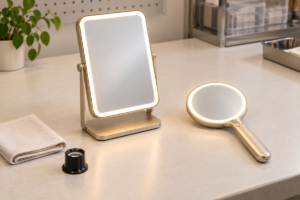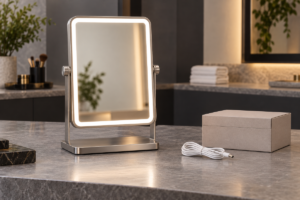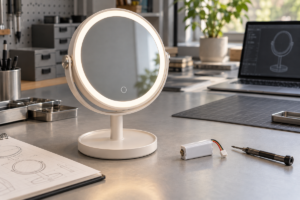

Amazon sellers usually win with LED makeup mirrors that photograph clearly, feel reliable out of the box, and match buyer expectations for lighting, magnification, charging, packaging, and finish quality.
The purchasing decision should be made around review risk, not only unit price. A low-cost LED mirror can become expensive if it creates complaints about dim lighting, weak hinges, poor packaging, or short battery life.

Direct Answer: What Type of Makeup Mirror Performs Better on Amazon?
For most Amazon programs, the safer choice is a makeup mirror with clear front-facing illumination, a believable magnification story, stable power design, and a parcel-friendly structure. Compact rechargeable mirrors and medium-size tabletop LED mirrors usually perform better than oversized vanity mirrors when the seller is trying to control breakage, confusing claims, and customer-expectation gaps.
In practice, Amazon sellers should not start with style alone. They should start with review risk: what will cause one-star feedback, what will trigger returns, and what will create listing complaints that are expensive to recover from.
Why Amazon Makeup Mirror Reviews Go Bad
Most negative reviews in this category do not come from decorative taste. They come from a mismatch between the listing promise and the real product experience. Buyers complain when the mirror is dimmer than expected, the magnification feels misleading, the hinge or stand feels unstable, the battery drains too quickly, or the mirror arrives damaged after parcel handling.
That is why Amazon sellers should treat makeup mirrors as an operations category, not only a beauty-accessory category. The sourcing decision affects review quality long before the listing goes live. If the seller chooses a fragile structure or unclear lighting specification, customer service problems are already built into the product.
Buyer Framework: Which Mirror Format Is Safer for Amazon?
| Mirror format | Best Amazon use case | Why it can review well | Main risk to control |
|---|---|---|---|
| Compact rechargeable mirror | Travel beauty, gifting, impulse purchase | Easy value story, portable, lower carton size | Battery runtime and hinge durability |
| Tabletop LED mirror | Daily-use beauty, mid-price core SKU | Clear function, easier photography, broader user base | Brightness expectation and stand stability |
| Tri-fold magnifying mirror | Detail makeup and skincare routines | Strong feature story if magnification is honest | Overclaiming magnification and fragile side panels |
| Large vanity or Hollywood mirror | Premium niche offer | High perceived value when protected well | Breakage, oversize shipping cost, return complexity |
For most sellers, the core assortment should start with one dependable tabletop SKU and one portable rechargeable SKU. That is a more controllable strategy than launching several overlapping mirrors that differ only slightly in shape. Mingda’s earlier makeup mirror sourcing guide for beauty brands and retailers is useful for the broader category structure, while this article focuses specifically on Amazon review outcomes.
Choose Lighting Specs That Match Listing Claims
Lighting is one of the fastest ways to create review problems. If the listing implies professional brightness but the mirror only works in already bright rooms, buyers feel misled. Amazon sellers should ask suppliers for clear lighting details: color temperature range, dimming method, diffusion quality, and whether the brightness level is comfortable for close makeup use instead of just visually dramatic in product photos.
For a mainstream Amazon listing, three adjustable light tones and smooth dimming are usually more useful than aggressive brightness claims. A softer, even light often creates fewer complaints than a harsher high-output light with visible hotspots. Sellers who are also deciding between power systems can compare rechargeable vs. plug-in makeup mirrors before finalizing the sample.
Be Conservative With Magnification and Size
Magnification causes complaints when sellers chase an attention-grabbing claim instead of a usable product. A high-magnification insert may look attractive in a bullet point, but if the main mirror experience feels awkward or too specialized, the product review profile suffers. For Amazon, a practical magnification story is usually safer than an extreme one.
Size should also match the user promise. A compact mirror should feel intentionally portable, not undersized. A tabletop mirror should offer enough visible area for everyday makeup routines without becoming too large for parcel delivery. Sellers targeting broad demand usually do better with moderate dimensions that fit dorm rooms, apartments, and standard vanities rather than oversized statement pieces.
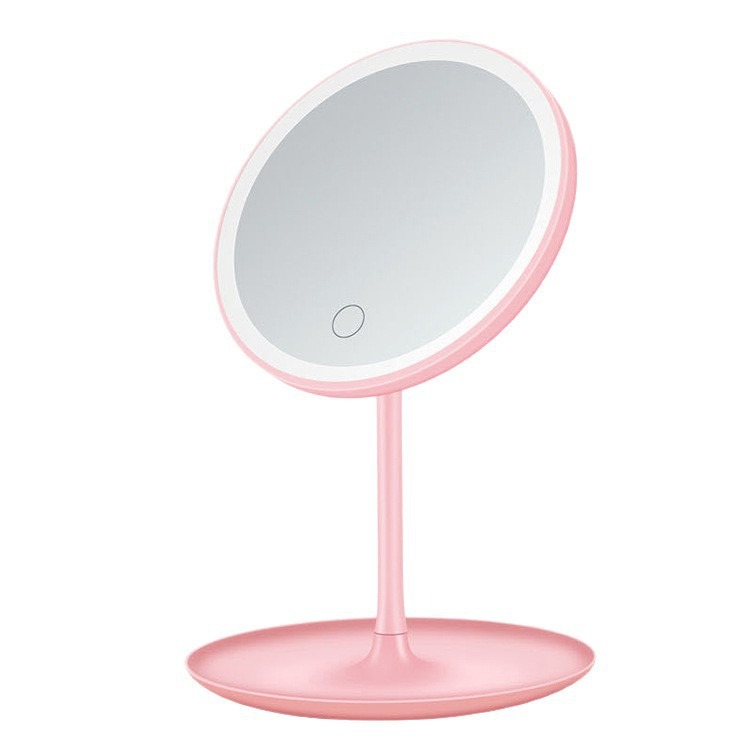
Power Reliability Matters More Than Trend Language
Rechargeable power is popular because it supports a cleaner listing story and a more modern user experience, but it only helps if the charging function is stable and the runtime expectation is realistic. Amazon sellers should confirm charging time, battery protection, cable fit, and whether the sample uses the final battery solution. If the supplier sends a development sample with temporary components, the seller cannot judge true review risk.
Plug-in mirrors can still work for Amazon when the format is designed for fixed vanity use and the packaging is strong enough for larger cartons. But sellers should avoid assuming that a plug-in mirror will automatically reduce complaints. A bulky plug-in mirror with poor parcel protection can perform worse than a compact rechargeable model with stable electronics.
Packaging Is a Review-Control Tool, Not a Back-End Detail
For Amazon, packaging must be approved as part of the product, not after the product. Many poor reviews begin with cracked glass, scratched surfaces, loose stands, or damaged outer cartons. Sellers should ask for parcel-drop protection logic, internal cushioning structure, accessory placement, and how the supplier prevents movement inside the box.
A sourcing manager should also confirm whether packaging changes affect MOQ, carton quantity, and lead time. If the seller wants a more giftable presentation or stronger e-commerce protection, that decision should be locked before quotation approval. Mingda’s Packaging & Logistics and QC Process pages are useful checkpoints here.
Sample Approval Checklist Before You Launch the Listing
- Test the mirror in normal indoor light, not only under studio conditions.
- Confirm the actual magnification user experience, not only the spec sheet wording.
- Check charging speed, cable connection feel, and battery consistency across samples.
- Press the buttons repeatedly to confirm touch response and dimming stability.
- Review the stand, hinge, or fold point for wobble, looseness, or cosmetic gaps.
- Inspect packaging after simulated parcel handling or drop testing.
- Make sure the instruction card and listing copy do not overpromise professional-grade lighting if the product is positioned as daily-use beauty convenience.
Common Amazon-Seller Mistakes
The first mistake is sourcing by competitor appearance only. A mirror that looks similar to a top seller may still fail if the power system, hinge quality, or packaging standard is weaker. The second mistake is forcing too many features into one SKU. More panels, more accessories, and more moving parts often create more return points.
The third mistake is ignoring channel fit. A mirror that works in store display or salon use may not be the right Amazon product if it creates oversize shipping costs or a difficult unboxing experience. The fourth mistake is approving a mirror without a clear after-sales spare-part or replacement plan. Amazon buyers judge the whole ownership experience, not only the first impression.
Pre-RFQ Questions Amazon Sellers Should Send Suppliers
- What buyer scenario is this mirror designed for: travel, countertop daily use, gifting, or vanity setup?
- What is the real lighting range, and how should it be described honestly in a listing?
- What magnification options are available, and which one is safest for mainstream users?
- What packaging standard is recommended for parcel shipping?
- Do logo, color, insert card, or gift-box changes affect MOQ and lead time?
- What QC checkpoints are used for hinge stability, lighting, charging, and cosmetic inspection?
- Can the supplier support Amazon-focused development through E-Commerce & Amazon Seller Solution or Product Design Support?
Bottom Line
Amazon sellers should choose makeup mirrors that are easy to understand, easy to ship, and hard to disappoint. That usually means reliable tabletop or portable LED mirrors with honest lighting claims, practical magnification, stable power design, and packaging built for parcel handling. If the product spec reduces surprises, the listing has a better chance to collect stronger reviews and lower return rates.
FAQ
What makeup mirror size is safest for Amazon sellers?
Medium tabletop mirrors and compact rechargeable mirrors are usually the safest starting point because they balance usability, parcel efficiency, and lower breakage risk.
Are rechargeable makeup mirrors better for Amazon?
Often yes, but only when charging reliability, runtime clarity, and packaging protection are properly controlled during sampling and QC.
Why do magnification claims cause bad reviews?
Because shoppers often expect the main mirror experience to stay comfortable. If magnification is overemphasized or described unclearly, users may feel the product is misleading or awkward to use.
What should Amazon sellers verify before bulk production?
They should verify lighting consistency, hinge or stand stability, charging performance, packaging survival, labeling accuracy, and whether the approved sample reflects final production components.
Can Mingda support private-label Amazon mirror development?
Yes. Mingda can support category selection, packaging planning, product design adjustment, and private-label requirements for sellers building Amazon-focused mirror assortments.
CTA
If you are building a makeup-mirror range for Amazon and want lower review risk from the start, contact Mingda Mirror with your target price band, product format, packaging route, and branding needs for a cleaner RFQ and sample plan.