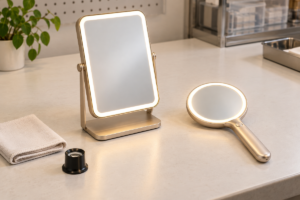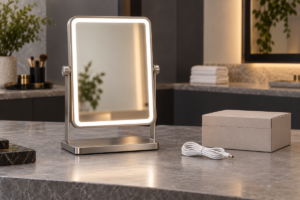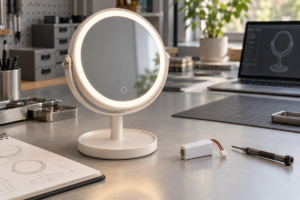

Online retailers should plan LED makeup mirror assortments around buyer use cases, not only around price. Choose the fewest distinct SKU roles that fit the trial budget, MOQ by finish and target customer. Entry, rechargeable hero and premium models are one possible framework, not a required three-model launch. This structure helps e-commerce teams control review risk, test demand with manageable MOQ, and reorder the styles that actually convert instead of spreading budget across too many similar mirrors.

Why assortment planning matters before an online mirror launch
For Amazon sellers, Shopify brands, marketplace operators, and online beauty retailers, the first LED makeup mirror order is rarely just a product purchase. It decides listing structure, review expectations, packaging cost, return exposure, and the cash tied up in slow-moving SKUs.
The common mistake is to choose five or six mirrors because the catalog looks attractive. In practice, several SKUs often target the same customer, use similar claims, and compete with each other in paid ads. A better approach is to define the customer scenario first: daily tabletop makeup, travel, gift, dorm room, salon counter, or premium vanity setup. Then each SKU should earn its place by serving a different search intent or price point.
A practical SKU framework for online retailers
Use distinct commercial roles to screen product ideas before committing to a SKU count. This makes the first order easier to test and gives the sourcing team clearer inspection standards.
| SKU role | Best buyer intent | Typical feature focus | Procurement risk to control |
|---|---|---|---|
| Entry traffic SKU | Price-sensitive shoppers and promotion traffic | Stable LED light, simple touch switch, compact tabletop size | Low brightness, weak hinges, unclear accessory claims |
| Rechargeable hero SKU | Main listing for repeatable sales and reviews | USB-C charging, 3-color lighting, dimming, 5X or 10X detail option | Battery runtime mismatch, charging-port failures, adapter confusion |
| Premium feature SKU | Gift, beauty brand, or higher-AOV shoppers | Larger mirror, better finish, memory dimming, stronger packaging | Overpromised functions, higher breakage cost, slow turnover |
This structure gives the merchandiser a clean test: which price band attracts traffic, which feature set drives conversion, and which model earns repeat orders. It also helps the supplier quote more accurately because each SKU has a clear role.
What specifications should separate each LED makeup mirror SKU?
Online buyers compare listings quickly, so different SKUs must have visible and measurable differences. Useful separation points include mirror size, lighting mode, magnification, power source, base design, finish, accessory pack, and packaging level.
Avoid building an assortment where every product says the same thing: LED light, touch control, adjustable brightness, and rechargeable. That makes listings hard to position and makes reviews more sensitive to small defects. Instead, decide what each SKU is meant to win.
For example, an entry SKU can focus on reliable single-color light and a lower retail price. The hero SKU can carry 3-color light, USB-C charging, and stronger product photography. The premium SKU can add a larger face area, improved surface finish, upgraded carton protection, or private-label gift packaging.
How to choose lighting and magnification for e-commerce reviews
Lighting complaints are one of the fastest ways to damage mirror reviews. Buyers should define CCT, brightness range, dimming behavior, and light diffusion before sample approval. For beauty and skincare customers, 3-color lighting is useful only if the modes are meaningfully different and easy to switch. If the warm, neutral, and cool modes look too similar, the listing promise can become a review liability.
Magnification should also match the use case. Evaluate a 5X detail option at the intended viewing distance with representative users; suitability depends on the mirror and task. A 10X option may help close-up tasks, but it generally requires a shorter viewing distance and can feel distorted if the mirror size or focal distance is poorly explained. Retailers should avoid adding high magnification only because it sounds premium. The better question is whether the target customer understands how to use it.
MOQ and trial order planning
For a first online launch, the safest MOQ strategy is usually a focused trial order with clear reorder rules. Instead of buying equal quantities of every SKU, allocate more volume to the hero model and smaller quantities to experimental styles.
Ask the factory to quote MOQ by finish, packaging version, logo method, and accessory set. A mirror body may have one MOQ, while a custom color box, barcode label, manual, or charging cable set may create another MOQ. This matters for online retailers because packaging variation can quietly increase inventory complexity.
A practical trial structure might be:
- One hero SKU with the highest quantity and complete private-label packaging
- One entry SKU with simpler packaging for promotion or bundle testing
- One premium SKU with smaller test quantity and stronger carton protection
- One reserved reorder plan based on 30-60 days of sales and review feedback
Packaging and listing claims must match
E-commerce mirror packaging should protect glass, LEDs, hinges, charging ports, and accessories through courier handling. It also needs to match the claims shown on the listing. If the listing says rechargeable, the package should make the charging cable and manual easy to find. If the product has magnification, the label and instructions should explain the magnification distance clearly.
For Amazon, DTC, and marketplace channels, buyers should confirm drop-test expectations, inner tray material, retail box strength, master carton count, barcode placement, and replacement-part policy. A small saving on foam, corner protection, or manual quality can become a larger cost through returns and low-star reviews.
Pre-RFQ checklist for LED makeup mirror assortment planning
Before requesting a quotation, prepare the assortment logic as well as the product specs. This helps Mingda or any qualified supplier respond with a realistic cost and timeline.
- Target sales channel: Amazon, brand website, retail marketplace, gift channel, or distributor
- SKU role: entry, hero, premium, bundle, travel, or gift
- Mirror size, magnification, lighting modes, dimming method, and power source
- Battery capacity, charging port type, cable or adapter inclusion, and runtime target
- Surface finish, color options, logo placement, and private-label packaging needs
- Inner packaging, drop-test expectation, barcode requirements, and carton marks
- Sample approval items: lighting comparison, charging test, hinge/base stability, packaging fit
- Forecast quantity, first-order MOQ, reorder trigger, and spare-parts expectation
Common mistakes online retailers should avoid
Do not choose too many similar LED makeup mirrors in the first order. Similar SKUs split traffic and make inventory harder to manage. Do not rely on supplier catalog photos alone; request samples and check lighting in a realistic room. Do not approve packaging before confirming the final accessory set. Do not make listing claims about brightness, runtime, or magnification unless the sample and QC checklist support those claims.
Another mistake is ignoring after-sales data. Review comments about dim light, short battery life, unstable stand, unclear instructions, or damaged cartons should become the next sourcing checklist. The best online assortments improve after the first sell-through cycle because the buyer turns marketplace feedback into product requirements.
Translate assortment roles into approval criteria
Record CCT, CRI, brightness at an agreed working distance, dimming range and diffusion for each sample. Compare glare and flicker under the same room lighting and power condition. A higher brightness claim alone does not establish better face lighting. Agree the acceptance method before ordering and retain the approved sample for repeat orders.
Use the MOQ planning guide to separate product and packaging commitments, compare three-color and single-color lighting, and review e-commerce packaging damage controls. Match the resulting brief to the mirror product range before requesting samples.
Set a Reorder, Hold or Exit Rule for Each SKU
Before the trial order, agree a review date, responsible buyer and evidence requirements for each SKU. Record saleable units received, units sold, days in stock, promotion periods and returns reported by the cutoff. Do not compare raw sales between a promoted SKU and an unavailable SKU as if they had equal selling conditions.
| Trial outcome | Evidence to review | Purchasing decision |
|---|---|---|
| Demand meets the agreed target | Comparable selling days, net sales, unresolved returns and cost after discounts, freight and service | Reorder only after confirming saleable stock, open purchase orders, MOQ and replenishment timing |
| Sales are limited by an execution issue | Stockouts, listing mismatch, missing accessories or packaging damage linked to the delivered lot | Hold expansion; assign corrective action and verify the corrected sample or listing before another trial |
| Two models serve the same buyer need | Comparable channel exposure, distinct feature value and remaining finish or packaging commitments | Consider consolidating the range; agree residual-material ownership and costs before cancelling a variant |
Early sales are provisional while return windows remain open. Record the decision owner and next review date rather than treating a short trial as proof of future demand. Use the channel-fit pilot guide when the same model is sold through both stores and parcel e-commerce.
Bottom-line recommendation
For online retailers, the best LED makeup mirror assortment is narrow, testable, and easy to explain. Build around one dependable hero SKU, add one price-accessible option, and test one premium feature product only when the packaging and QC plan can support the claim. This keeps MOQ under control while giving the brand enough product range to learn what customers will reorder.
Mingda Mirror helps brands, retailers, and e-commerce sellers develop LED makeup mirror assortments with lighting, charging, packaging, logo, and inspection requirements aligned before mass production. Share your target channel, price band, quantity per SKU, sample acceptance criteria, packaging version and launch date. Request itemized sample, tooling, packaging and spare-part costs plus MOQ by finish and repeat-order lead time through the Contact page to request an RFQ-ready assortment recommendation.
FAQ
How many LED makeup mirror SKUs should an online retailer start with?
There is no universal starting SKU count. Begin with distinct buyer needs that fit the trial budget, MOQ and support capacity. Entry, hero and premium roles are examples; add a role only when it has a different use case and a measurable trial objective.
Is 3-color lighting always better for e-commerce listings?
3-color lighting is useful when the modes are visibly different, easy to switch, and supported by stable brightness. If the color modes are weak or confusing, a reliable single-color SKU may earn better reviews in a budget line.
Should rechargeable LED makeup mirrors be the main SKU?
Rechargeable mirrors often work well as the hero SKU because shoppers understand the convenience. Buyers should still verify USB-C port quality, runtime, battery labeling, charging cable quality, and packaging instructions before bulk orders.
What should buyers send before requesting a mirror assortment quotation?
Send the target sales channel, desired price bands, mirror sizes, lighting and magnification requirements, packaging style, logo needs, forecast quantity, and any platform requirements such as barcode labels or drop-test expectations.
How can online sellers reduce return risk before launch?
Approve real samples, test lighting and charging, check hinge and base stability, confirm packaging protection, and make sure listing claims match the final product. A clear QC checklist should be part of the purchase order.
Social media content ideas
LinkedIn angle: Explain why online mirror retailers should launch with entry, hero, and premium SKU roles instead of a wide catalog.
Facebook angle: Share a buyer-friendly checklist for choosing rechargeable LED makeup mirrors before a new product launch.
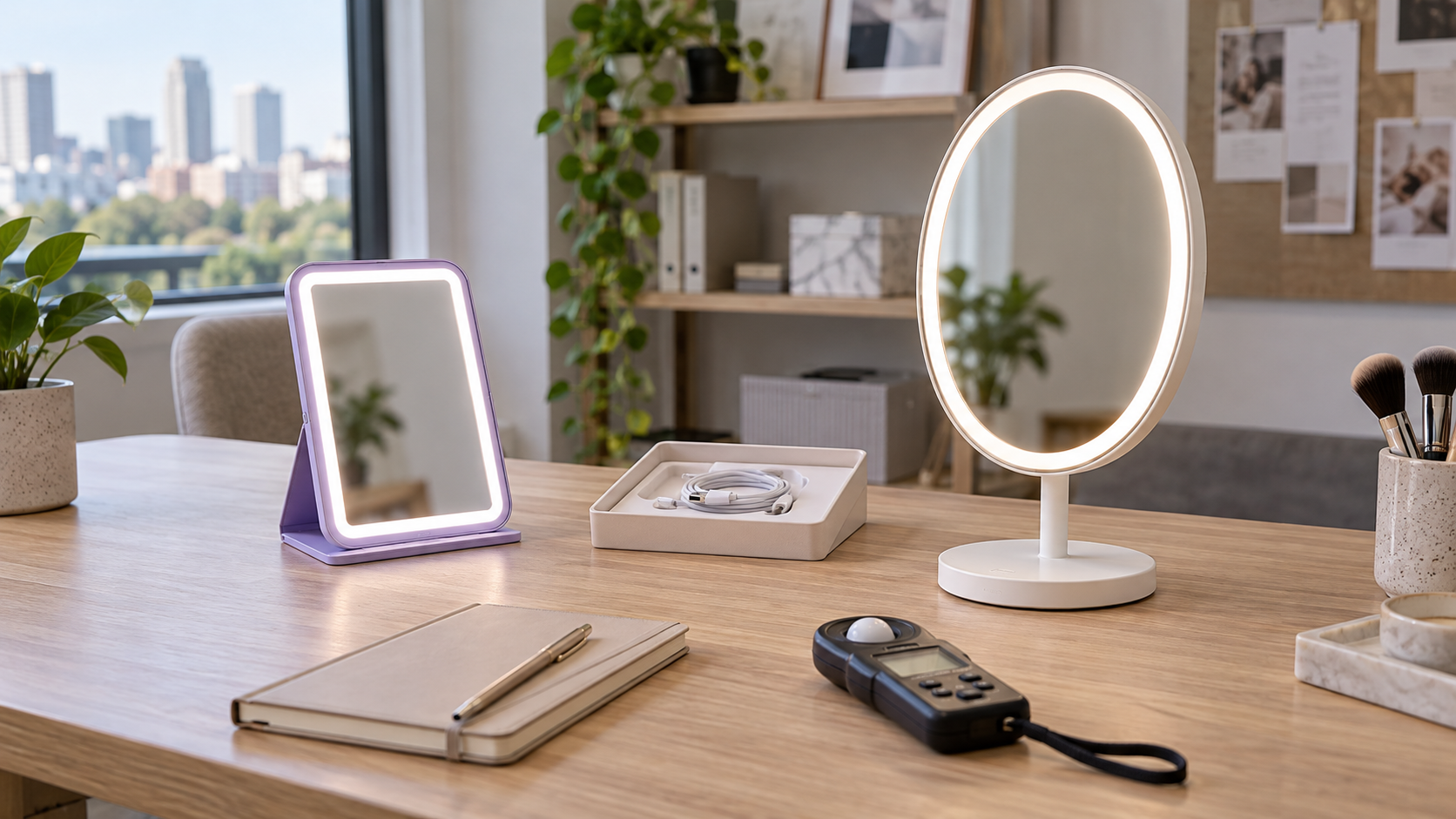
Instagram angle: Use the SKU planning image to show a clean three-product mirror assortment with packaging and sample notes.
CTA: Read the full LED makeup mirror assortment guide and contact Mingda Mirror for a channel-ready quotation.