
For LED makeup mirror orders, an aging test should confirm that the lights, driver, switch, battery or USB-C charging circuit, dimming memory, and heat behavior stay stable before goods leave the factory. A short power-on check only proves that one sample works at that moment. For bulk buyers, the safer approach is to define the aging time, tested functions, sampling level, defect rules, records, and packed-goods inspection before mass production starts.
Why aging tests matter for bulk LED makeup mirror orders
LED makeup mirrors combine cosmetic appearance with electrical performance. A buyer may approve the mirror shape, finish, magnification, and packaging, then still receive complaints if the light flickers, the touch switch responds inconsistently, the charging port is loose, or the battery runtime does not match the product claim. These issues often appear after the mirror has been powered for a longer period, not during a quick visual inspection.
For beauty brands, Amazon sellers, distributors, and retail chains, aging test requirements also protect the launch plan. A failure found during production can still be corrected with component replacement, extra sorting, or shipment adjustment. A failure found after the goods reach a marketplace warehouse becomes return cost, bad reviews, replacement claims, and delayed reorders.
The practical decision is not whether the supplier says “we test quality.” Buyers should ask what is tested, how long the mirror is powered, how results are recorded, what defect level triggers sorting, and whether the final packed order is checked again before shipment.
What should be included in an LED makeup mirror aging test?
An effective aging test should check the working system, not only the LED ring. For a rechargeable LED makeup mirror, the test scope should normally include LED light stability, CCT switching, dimming, touch or sensor switch response, charging indicator, USB-C or Micro-USB port fit, battery charging behavior, heat around the driver or battery area, adapter compatibility when supplied, and final appearance after the unit has run.
For plug-in tabletop or Hollywood-style mirrors, the supplier should also check the plug, cable strain relief, switch, bulb or LED strip uniformity, driver noise, flicker risk, and whether brightness remains consistent after warm-up. For wall-mounted or hotel-use mirrors, installation hardware, anti-fog function, power connection, and moisture-related requirements may need a separate project checklist.
| Test item | What buyers should define | Why it matters before shipment |
|---|---|---|
| Power-on aging time | Example: sample-level long run or batch-level agreed run time | Finds early LED, driver, wiring, and switch instability |
| Lighting consistency | CCT mode, dimming range, visible flicker, dark spots, color difference | Protects product listing claims and customer experience |
| Charging behavior | Port fit, indicator light, charge current, cable quality, runtime sampling | Reduces battery and charging complaints |
| Heat check | Surface warmth, driver area, battery area, abnormal smell or deformation | Catches unsafe or unstable electrical behavior |
| Function sequence | On/off, long press, CCT switch, memory, sensor response if used | Confirms the sample logic is repeatable in bulk |
| QC record | Lot number, test time, result, defect type, operator, corrective action | Makes the shipment traceable if a problem appears later |
Align the test plan with your charging QC criteria, approved reference sample and packaging revision controls.
How aging testing fits into the full QC flow
Aging should not replace incoming material inspection, in-process checks, final inspection, or carton inspection. It is one part of the quality-control chain.
Before production, the buyer and supplier should approve the final sample, product specification, LED color temperature range, power source, cable or adapter, packaging method, and inspection standard. During production, the factory should control LED components, mirror glass, frame finish, plastic or metal parts, switches, batteries, cables, and printed materials. After assembly, aging and function testing should screen unstable units before the products are packed.
At final inspection, the buyer or third-party inspector should still open cartons, check the packed goods, scan barcodes when required, verify accessory sets, inspect visual defects, and run a functional sample check. This is especially important for e-commerce and retail orders where packaging, manuals, label information, and product-page claims must match the finished goods.
Buyer decision: 100% function check or AQL sampling?
Buyers often ask whether every unit needs to be tested. The answer depends on the product risk, order size, channel, and customization level.
For core electrical functions, many buyers prefer 100% basic function checking during production because it is faster to catch a dead light, switch failure, or charging problem before packing. For longer aging, appearance inspection, and packed-goods checks, the buyer may use an agreed sampling plan, especially when a third-party inspection is involved.
The key is to separate the test types. A quick 100% power-on screen can catch obvious failures. A longer aging test can reveal unstable components in a controlled sample or production lot. A final sampling inspection supports the agreed lot-acceptance decision; it does not prove that every untested unit is defect-free. Mixing these into one vague requirement creates arguments when defects appear.
Common mistakes buyers should avoid
The first mistake is asking only for a certificate or general QC statement. A certificate does not prove that this exact shipment passed functional testing. Buyers should request shipment-level QC records, production photos, inspection results, and, when needed, a short function-test video for the approved model.
The second mistake is approving a sample without defining tolerance. If the sample has three color modes, the buyer should define acceptable CCT range, brightness expectation, dimming behavior, and whether mode memory is required. If the mirror is rechargeable, define charging port type, battery capacity claim, runtime test method, and cable inclusion.
The third mistake is checking the loose mirror but ignoring the packed product. A mirror can pass lighting tests and still fail commercially if the accessory bag is missing, the manual language is wrong, the barcode cannot scan, the carton mark is inconsistent, or the foam insert presses against the switch during shipping.
Turn Aging Results into a Batch Release Decision
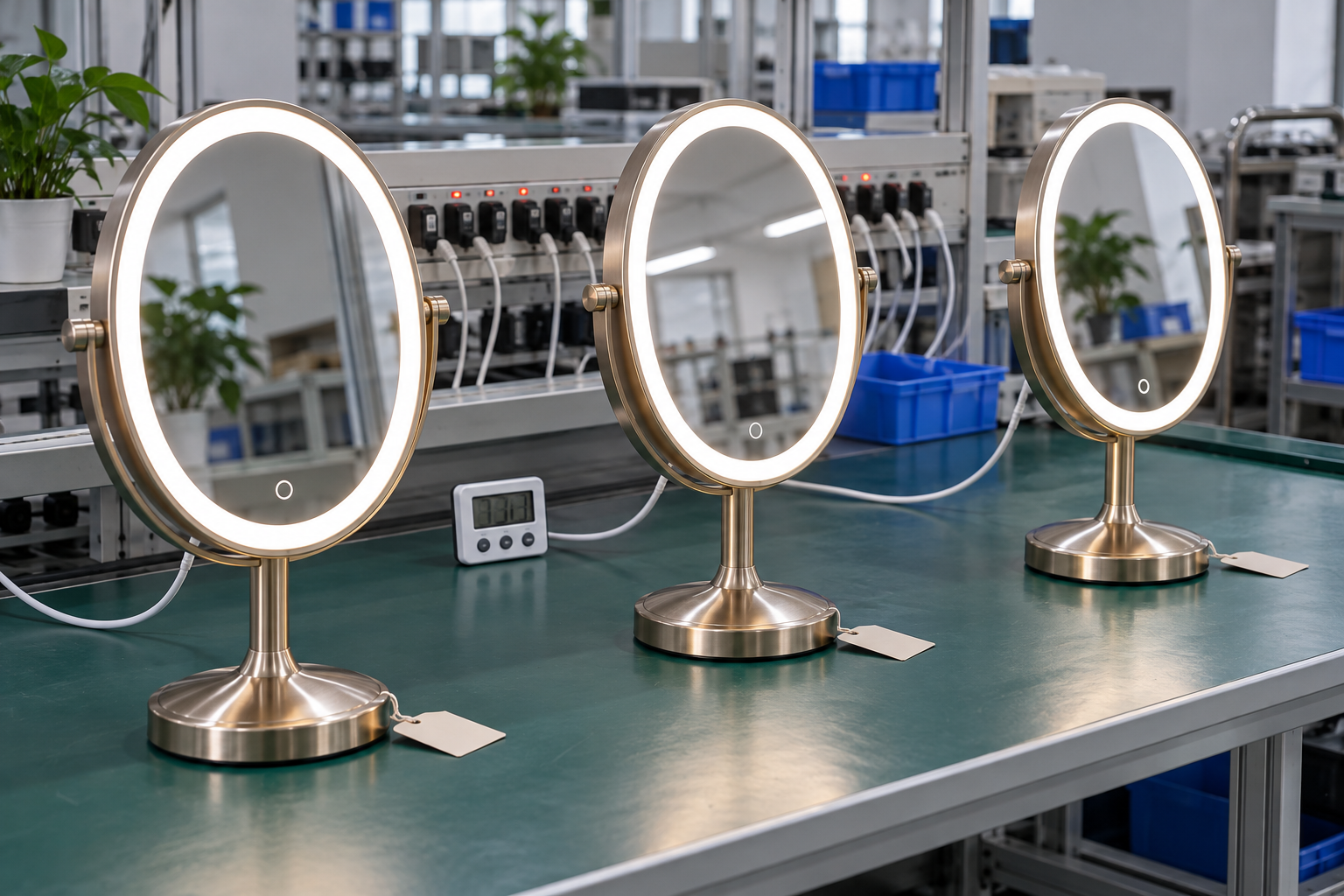
Before testing, record the buyer SKU, component revision, lot size, tested quantity, sample IDs, power accessory, lighting mode, ambient conditions and agreed duration. Agree the acceptance criteria and release authority before the run. A timer photograph alone cannot connect a passed test to the units being shipped.
| Result | Required record | Buyer decision |
|---|---|---|
| Planned checks pass | Original readings, test conditions, tested quantity and reviewer | Continue to packed-goods inspection; retain the lot record |
| Failure or interrupted run | Unit ID, elapsed time, symptom, affected component revision and containment scope | Hold affected stock for technical review; agree correction and retest scope before release |
| Repaired units pass retest | Original failure count, repair action, retest IDs, results and approval | Keep first-pass and retest results separate; obtain written release for the affected lot |
Do not average a failed mode into an overall pass. Keep failed units and evidence identifiable, and ask the supplier to itemize sorting, replacement, repeat inspection and shipment-delay implications. Routine aging records do not establish service life or replace the evidence in the rechargeable mirror document register. Use the earlier aging-test planning checklist to define test scope; use this release matrix to decide what happens after results arrive.
RFQ checklist for aging test and pre-shipment QC
- Target product type: tabletop LED makeup mirror, travel mirror, Hollywood mirror, wall-mounted mirror, or bathroom mirror.
- Power design: rechargeable battery, USB-C cable, plug-in adapter, replaceable batteries, or hardwired project use.
- Function list: CCT modes, dimming, memory, touch switch, sensor switch, magnification, anti-fog, or storage function.
- Aging requirement: test time, sample size or production lot rule, acceptable failure action, and record format.
- Final inspection rule: AQL level or buyer-defined sampling method, critical defects, major defects, and minor defects.
- Packaging check: retail box, insert, carton, labels, manuals, accessory bag, barcode, drop-test or transit-test requirement.
- Documentation: inspection report, photos, video evidence when needed, defect sorting record, and corrective-action summary.
Bottom-line recommendation
For LED makeup mirror buyers, aging test requirements should be written into the RFQ and purchase order before mass production. Do not rely on a general promise that the factory will check quality. Define the product version, functions, aging scope, sampling rule, defect response, and final packed-goods inspection. This gives the supplier a clear standard and gives the buyer evidence if the shipment needs sorting, repair, or delay before export.
FAQ
Is an aging test necessary for every LED makeup mirror order?
It is strongly recommended for LED mirrors, especially rechargeable, dimmable, multi-CCT, plug-in, or customized models. The exact test time and sampling level can vary by product risk and order size, but the buyer should define it before production.
Does aging testing replace pre-shipment inspection?
No. Aging testing checks functional stability before or during final QC. Pre-shipment inspection should still verify packed goods, appearance, accessories, labels, barcode, quantity, carton condition, and shipment documents.
What defects can an aging test reveal?
It can reveal flickering, dead LEDs, unstable drivers, inconsistent touch response, abnormal heat, charging issues, weak cables, and function failures that may not appear during a short power-on check.
What should buyers request from the supplier after testing?
Ask for lot-based records, failure quantity, defect descriptions, repair or sorting action, final pass quantity, inspection photos, and confirmation that packed samples were checked after the aging process.
How should Amazon or retail buyers use this checklist?
Use it to align product claims, listing information, packaging files, manuals, and inspection criteria before bulk order approval. For review-sensitive channels, prioritize lighting stability, charging reliability, accessory completeness, and packed-product consistency.
Inquiry CTA
If you are preparing an LED makeup mirror, rechargeable vanity mirror, Hollywood mirror, or custom private-label mirror order, Mingda Mirror can help review your function list, aging test needs, packaging plan, and pre-shipment QC standard before bulk production. Explore makeup mirror options, review OEM/ODM customization, or contact Mingda Mirror with your SKU revision, quantity per batch, destination, launch date and proposed test scope. Request itemized sample, testing, sorting and retest costs, plus the lead-time effect of a failed lot.
Social Media Content Ideas
LinkedIn angle: explain why buyers should separate quick function checks, aging tests, and final AQL inspection before approving LED makeup mirror shipments.
Facebook angle: educate brand and retail buyers on the hidden return risks behind flicker, charging failure, and inconsistent switch response.
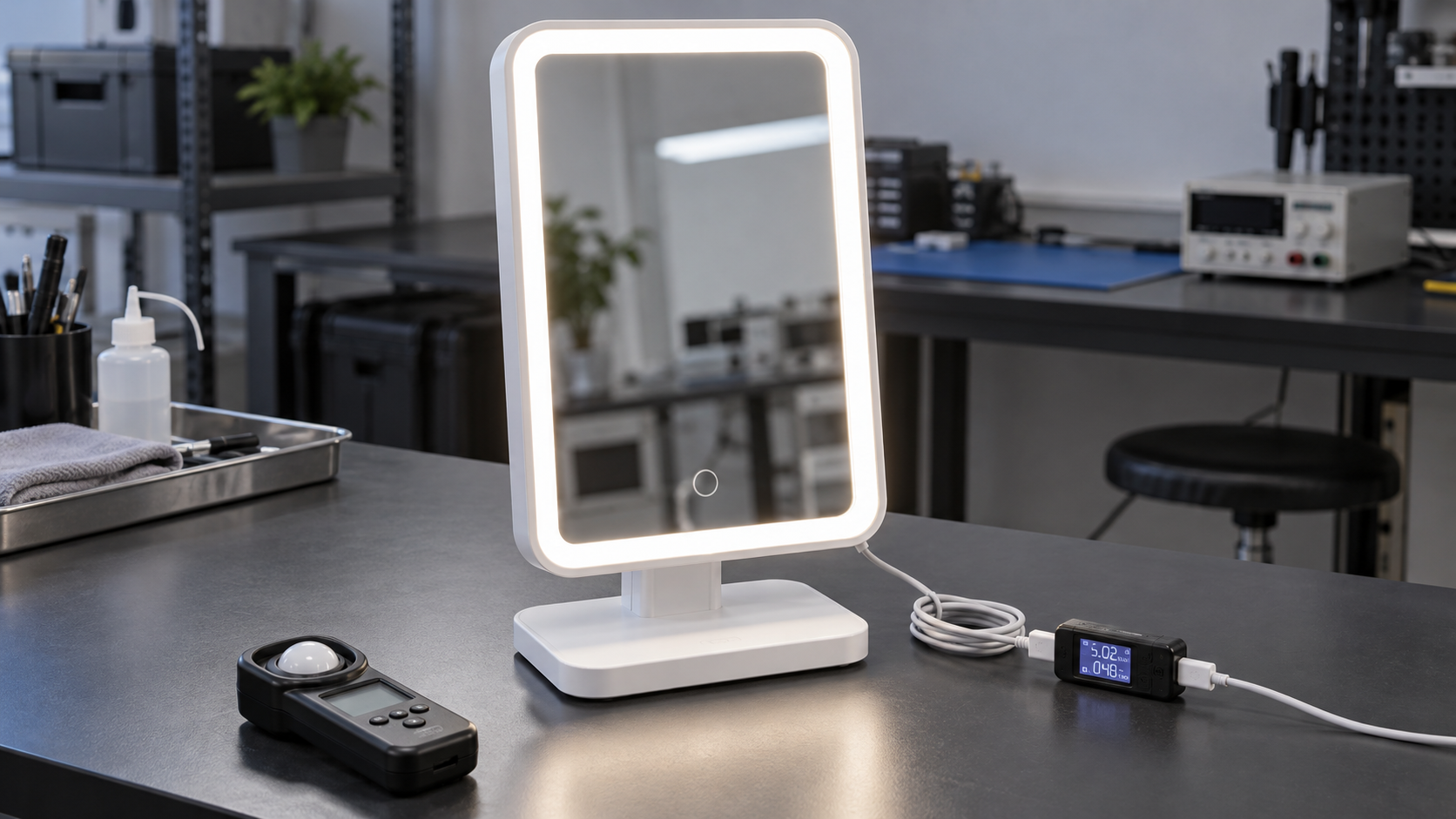
Instagram angle: show the QC bench image with a caption about testing real LED mirror functions before shipment.
Short CTA: Read the full aging test checklist and send Mingda your LED mirror RFQ for review.