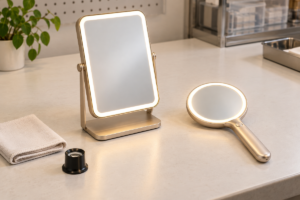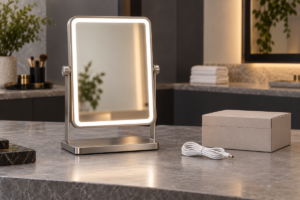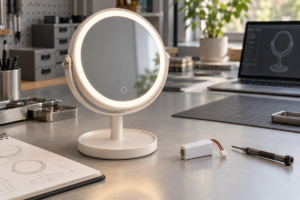

LED makeup mirror MOQ planning should start from sales channel, packaging version, color/finish, accessory set, and reorder rhythm, not from the lowest number a supplier can accept. For beauty brands, retailers, Amazon sellers, and distributors, a practical approach is to separate sample approval, trial order, first bulk order, and replenishment quantities. This helps buyers control cash flow, avoid mixed specifications, and keep packaging, labels, batteries, cables, and inspection records consistent across production batches.
This guide gives sourcing teams a practical framework for setting order quantities before requesting a quotation from an LED makeup mirror manufacturer.
Why MOQ Is a Product Planning Decision
MOQ is often treated as a negotiation number, but for LED makeup mirrors it is tied to real production work. The supplier may need to purchase LED rings, mirror glass, plastic or metal frames, batteries, PCBs, touch switches, retail boxes, molded inserts, manuals, barcode labels, adapters, and master cartons. If the buyer changes color, logo, charging port, packaging artwork, or accessory set, the supplier may need to hold separate materials and inspection records.
That is why a very small first order can become expensive if it requires too many customized versions. At the same time, ordering too much before channel validation can lock the buyer into the wrong magnification level, color temperature, packaging size, or price tier.
For Mingda Mirror, good MOQ planning usually means choosing one clear hero SKU for the first order, approving the sample and packaging carefully, then scaling into color, magnification, or channel variants after sales data is available.
MOQ Planning Matrix for LED Makeup Mirror Buyers
Use this matrix before asking for the final unit price. It helps the buyer and supplier discuss quantity based on production reality instead of only asking, “What is your MOQ?”
| Order stage | Buyer goal | Recommended quantity logic | What to confirm before moving forward |
|---|---|---|---|
| Engineering sample | Confirm function, lighting, size, charging, and finish | Agree quantities by test plan and model variation | Mirror structure, LED CCT, brightness, magnification, battery, cable, adapter, stand stability |
| Packaging sample | Confirm retail box, insert, manual, label, and carton | Agree packed-sample quantities and any destructive-test needs | Artwork, barcode position, accessory cavity, drop-protection concept, carton marking |
| Trial order | Test market response and operational fit | One focused SKU or one channel package | Listing claims, retail shelf plan, FBA/carton rules, after-sales terms, inspection checklist |
| First bulk order | Build inventory for launch or seasonal sales | Quantity matched to forecast, packaging MOQ, and material MOQ | Lead time, payment schedule, spare parts, defect handling, final AQL plan |
| Reorder | Improve cost and supply stability | Based on actual sell-through and defect records | Component continuity, packaging version control, forecast window, delivery split |
Start With One Hero SKU Instead of Too Many Variants
Many buyers want to launch several LED makeup mirror variants at once: round and square, white and black, 1x and 5x, USB-C and plug-in, standard packaging and gift packaging. That can make the first order look more complete, but it also divides the MOQ across too many material sets.
A better first order usually starts with one hero SKU that matches the primary sales channel. For example, an Amazon seller may prioritize a rechargeable tabletop mirror with strong packaging protection, clear instruction manual, and review-risk control. A beauty retailer may prioritize shelf display, retail box finish, and color consistency. A distributor may prioritize replenishment stability, carton efficiency, and a balanced price tier.
Once the first SKU proves demand, the buyer can add variants with clearer data: a travel size, higher magnification option, different finish, or private-label gift set.
What Affects MOQ More Than Buyers Expect
MOQ is not only about the mirror body. These factors often affect the real order quantity and price:
- Frame finish and color: custom color matching may require separate paint, plating, or material setup.
- Magnification level: 1x, 3x, 5x, 10x, and 20x mirrors may use different glass and inspection standards.
- Power system: rechargeable battery, USB-C cable, adapter, plug-in design, and market plug type all affect component planning.
- Packaging structure: custom retail box, molded pulp, EVA, foam insert, and master carton quantities may each have separate minimums.
- Private-label artwork: logo printing, manual language, barcode label, and warning label versions need clear version control.
- Inspection depth: stronger QC, aging tests, charging tests, and packaging tests need time and documented samples.
For related technical decisions, buyers can review Mingda’s Makeup Mirrors category and the QC Process page before finalizing the RFQ.
Trial Order vs First Bulk Order
The trial order should reduce uncertainty. The first bulk order should improve efficiency. Mixing these two goals often creates sourcing mistakes.
A trial order should answer practical questions: will the product fit the target channel, will the packaging survive the delivery route, will the lighting and magnification match customer expectations, and will the listing or retail display create the right value perception? Buyers should keep the trial SKU focused and measure feedback before adding more versions.
A first bulk order should then lock the approved specification and improve consistency. This is where the buyer should confirm component continuity, master carton plan, inspection criteria, spare parts, and expected reorder date. If the buyer changes the packaging or accessory set after the first bulk order, the supplier should update the specification sheet and keep old and new versions separated.
Separate Order Quantity from Material Commitments
Ask for a written breakdown by SKU and packaging revision. The assembly MOQ, component purchase minimum and custom-box minimum may differ. If the trial consumes only part of a material batch, agree who owns the remainder, who pays for storage, the reuse deadline and what happens after an artwork or component change.
| Decision | Evidence to request | Before release |
|---|---|---|
| Trial quantity | Forecast by channel, approved sample revision and itemized setup costs | Confirm the committed quantity and any paid unused materials separately |
| Split delivery | Total production commitment, shipment quantities, storage terms and payment dates | Do not assume a smaller first shipment reduces the total purchase obligation |
| Reorder timing | Weekly sell-through, usable stock, confirmed incoming stock and replenishment lead time | Review stock against expected demand during lead time plus the buyer’s chosen buffer; exclude quarantined stock |
| Variant release | Issue log, corrective-action evidence, packed sample and listing revisions | Close unresolved configuration issues before increasing quantities or adding colors |
Use the custom sample approval guide to freeze the purchase specification. Review the return-risk buying guide before converting trial results into a reorder.
MOQ Questions to Send Before RFQ
Instead of asking only for the lowest MOQ, buyers should send a short but complete RFQ. Include:
- Target sales channel: Amazon, DTC, retail chain, distributor, salon, hotel, or gift program.
- Mirror type: tabletop, compact, foldable, wall-mounted, or Hollywood-style vanity mirror.
- Key specification: size, lighting modes, CCT, dimming, magnification, charging method, battery requirement, and finish.
- Packaging plan: retail box, gift box, e-commerce insert, master carton, barcode, and manual language.
- Branding needs: logo position, private-label artwork, color matching, label claim, and compliance file.
- Quantity plan: sample quantity, trial order, first bulk order, expected reorder window, and delivery split.
- Inspection request: sample approval, charging test, aging test, packaging check, AQL level, and photo/video records.
When this information is clear, the supplier can explain which MOQ comes from mirror assembly, which comes from packaging, and which comes from customized accessories.
Common MOQ Mistakes Buyers Should Avoid
The first mistake is choosing the lowest MOQ without checking whether the supplier will use the same approved components in mass production. A cheap small order is not helpful if the next shipment uses a different LED ring, cable, stand, or retail box.
The second mistake is splitting the first order into too many colors or packaging versions. This increases artwork checks, label risk, component mixing, and inspection complexity.
The third mistake is treating packaging MOQ as an afterthought. For e-commerce LED makeup mirrors, the retail box, insert, and master carton can decide whether the product arrives safely and whether the unboxing experience supports the price.
The fourth mistake is ignoring lead time. If a buyer places a small launch order but does not reserve reorder time, a successful listing can run out of stock before the second batch is ready.
One-Week Review: Reconcile the Trial Budget Before Release
When sample quotations arrive, reconcile the trial-order budget by SKU and packaging revision. Separate the assembly quantity from prepaid custom materials, tooling, sample freight and packaging proofs. Record paid amounts, remaining commitments and conditional credits; a promised future credit does not reduce cash due today.
Use the LED makeup mirror sample cost and tooling fee checklist to connect each charge to a deliverable and approval milestone. Assign an owner and due date to missing evidence. If a changed sample or packaging version increases costs or delays launch, update the quantity plan and obtain approval before releasing the affected order.
Bottom-Line Recommendation
For LED makeup mirror MOQ planning, buyers should approve one clear hero SKU, confirm packaging and QC before bulk production, and use a phased order plan: sample, packaging sample, focused trial order, first bulk order, and reorder. The best MOQ is not always the smallest number. It is the quantity that keeps the approved specification stable while giving the buyer enough inventory to test, launch, and replenish without unnecessary risk.
Mingda Mirror can support brands, retailers, e-commerce sellers, and distributors with LED makeup mirror product selection, OEM/ODM customization, packaging review, and pre-shipment inspection. To prepare a quotation, send your target channel, mirror type, packaging requirement, branding needs, and expected first order quantity through the Contact page.
Request an itemized MOQ proposal: send quantities by SKU and finish, packaging revision, launch date and proposed delivery splits. Ask for assembly and material minimums, sample and tooling charges, unused-material terms, lead-time trigger and reorder pricing separately.
FAQ
What is a reasonable MOQ for a private-label LED makeup mirror?
It depends on the mirror structure, color, packaging, and accessory set. Buyers should ask the supplier to separate the mirror MOQ, packaging MOQ, and customization MOQ so the decision is transparent.
Should buyers place a trial order before a full launch?
Yes, especially for e-commerce and new retail programs. A focused trial order helps check lighting satisfaction, packaging performance, customer feedback, and operational fit before scaling.
Can buyers mix several colors in one first order?
Sometimes, but it may increase cost and version-control risk. For a first launch, one main color and one approved packaging version are usually easier to manage.
How does packaging affect MOQ?
Custom retail boxes, inserts, manuals, barcode labels, and master cartons can each have their own production minimum. Packaging should be discussed early, not after the mirror sample is approved.
What should buyers prepare before asking Mingda Mirror for a quotation?
Prepare the target sales channel, mirror style, size, lighting, magnification, power source, packaging plan, branding needs, inspection requirements, and expected sample, trial, and bulk-order quantities.
Social Media Content Ideas
LinkedIn: Share one sourcing lesson from the article: MOQ should be planned by SKU, packaging version, and reorder rhythm, not only by the lowest order number.
Facebook: Educate brand and retail buyers on why too many first-order variants can increase cost and inspection risk.
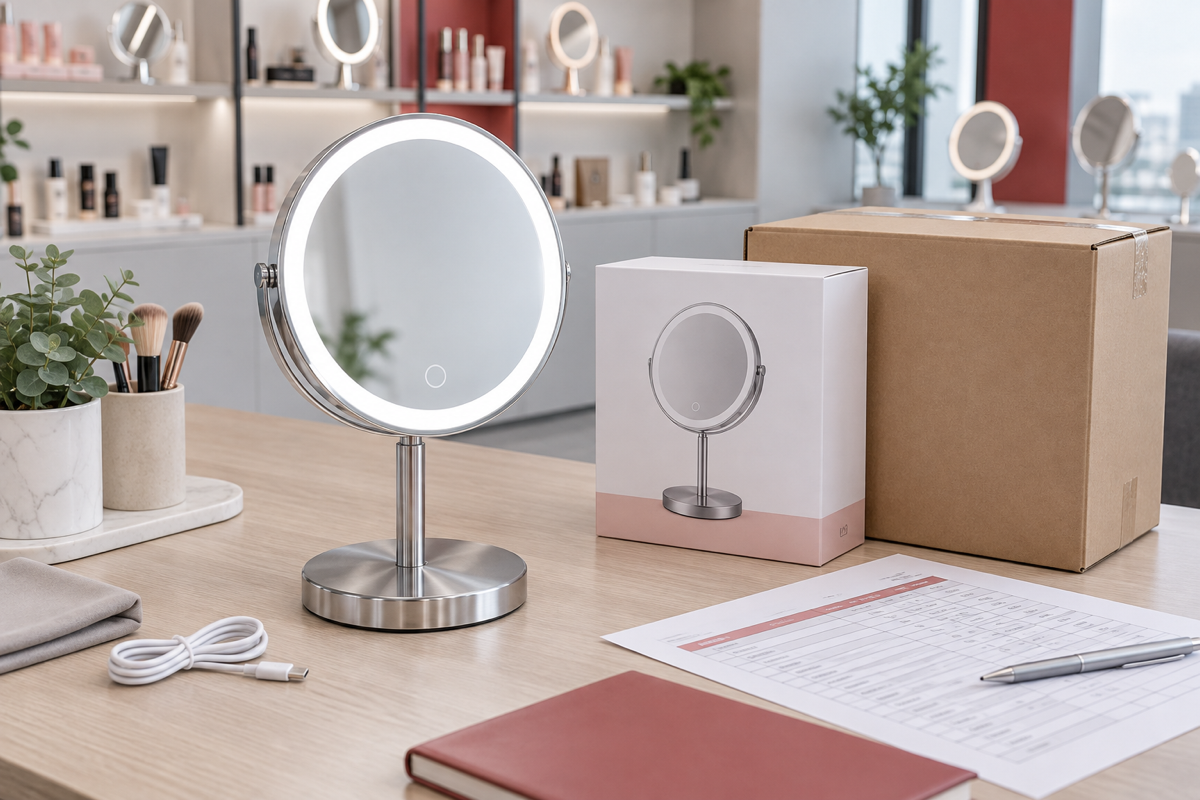
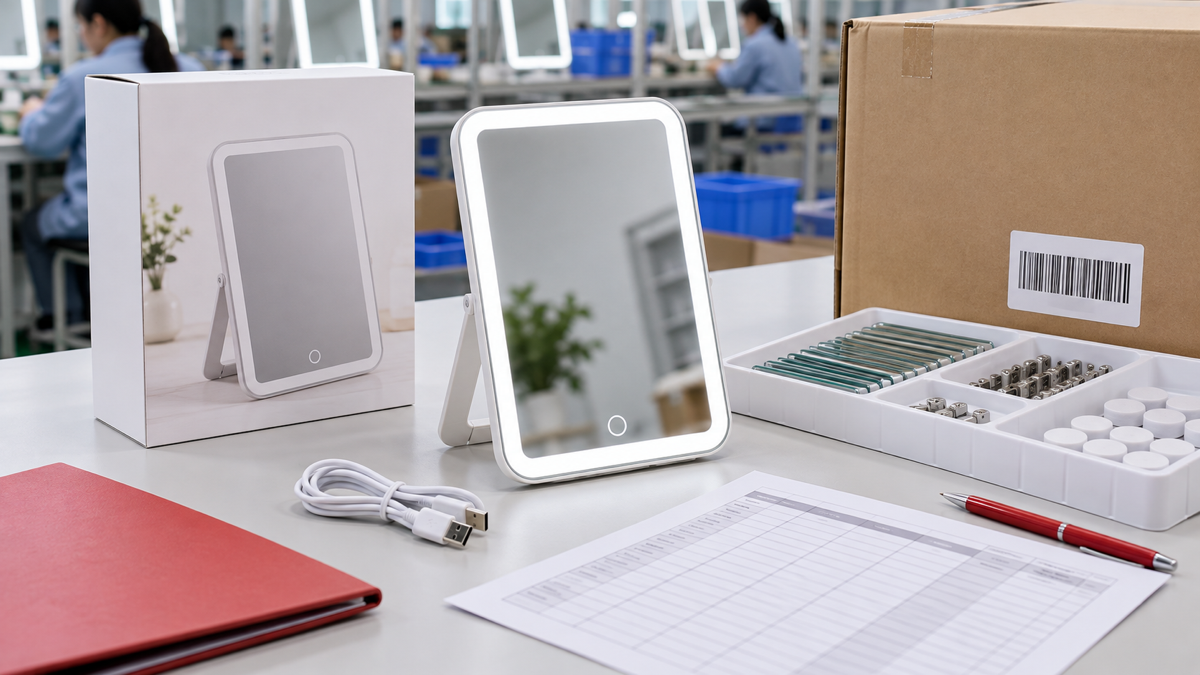
Instagram: Use the complete tabletop mirror, retail box, and quantity planning desk image to show what a professional LED makeup mirror launch plan looks like.
CTA: Read the full MOQ planning guide and contact Mingda Mirror with your target channel and first-order quantity for an itemized RFQ.