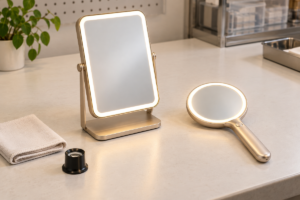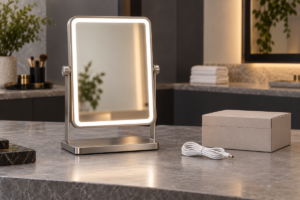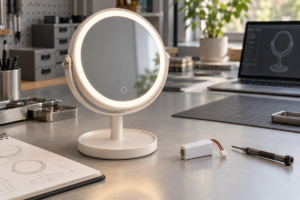

E-commerce sellers should not choose an LED makeup mirror only by appearance, price, or a supplier’s short feature list. A practical buying method is to translate the most common review risks into measurable specifications before placing the order: lighting comfort, magnification accuracy, charging reliability, stand stability, accessory completeness, packaging protection, and instruction clarity. When these points are confirmed during sampling, sellers can reduce avoidable negative reviews, replacement requests, and listing-performance problems after launch.
Why Review Risk Starts Before the Listing Goes Live
For Amazon, marketplace, DTC, and retail-channel sellers, buyer complaints usually appear after delivery, but many of the causes are created during sourcing. A mirror that looks attractive in supplier photos may still create poor reviews if the LED ring is too dim, the color temperature feels harsh, the USB-C cable is missing, the stand wobbles, or the box does not explain charging clearly.
That is why LED makeup mirror sourcing should connect the product specification sheet with the future review page. A procurement team should ask: what will the end user expect to be true on day one, after charging, during makeup use, and after receiving the parcel?
For Mingda Mirror, the strongest e-commerce mirror programs are built around sample approval, repeatable production control, and clear packaging details, not only around the first quoted price.
Convert Common Complaints Into Buyer Specifications
Use this table before requesting quotation or approving a final sample.
| Review risk buyers want to avoid | Specification to confirm before bulk order | What to check during sample approval |
|---|---|---|
| Light feels too weak or too harsh | LED brightness range, CCT options, diffusion quality, dimming steps | Test under normal room lighting and makeup-table distance |
| Battery drains too quickly | Battery capacity, charging time, runtime at high brightness, standby behavior | Run a full charge-discharge test and record the result |
| Charging cable or adapter confusion | USB-C or other port type, cable length, adapter policy, charging label | Confirm accessories, label wording, and instruction manual |
| Mirror looks smaller than expected | Mirror diameter, full product height, usable reflective area, package photos | Compare sample dimensions with listing image claims |
| Product tips, shakes, or rotates poorly | Base weight, hinge torque, neck stability, anti-slip pad | Test tilt angles and repeated adjustment |
| Returns caused by missing parts | Cable, pouch, insert, user manual, retail box, warranty card | Use a packing checklist during pre-shipment inspection |
| Listing mismatch complaints | Actual finish, magnification, light color, button behavior | Match final sample to product page and carton label |
This matrix is especially useful for sellers who source one LED tabletop makeup mirror for several channels. The same product may need different packaging, accessories, or listing claims for Amazon, TikTok Shop, retail shelves, and wholesale distribution.
Lighting: Confirm the Use Conditions Behind Each Claim
Lighting should be evaluated under the intended use conditions. For an LED makeup mirror, buyers should confirm three points before mass production: color temperature, brightness control, and glare diffusion.
Warm and cool settings change the viewing appearance, but CCT alone does not establish color rendering, brightness or comfort. Compare the sample at a recorded distance, ambient light level and dimming setting. For e-commerce channels, a 3-color lighting option often helps because customers can choose a comfortable mode for different use scenarios. However, more modes only help if the switch logic is simple and the light output is consistent across production.
Ask the supplier to define:
- CCT range and tolerance
- Dimming method and memory function
- LED diffusion material
- CRI target if color accuracy is part of the sales claim
- Minimum and maximum brightness behavior
One common sourcing trap is accepting a sample that looks bright in a dark video but not testing it in normal indoor light. E-commerce sellers should approve lighting in the same environment the customer will likely use: a desk, vanity table, bathroom counter, or bedroom corner.
Charging and Accessories: Small Details That Create Large Return Costs
Rechargeable LED makeup mirrors can be very strong for online sales because buyers like cable-free use. But charging details must be controlled carefully. Negative reviews often come from missing cables, unclear charging indicators, short runtime, incompatible adapters, or a port that feels loose after repeated use.
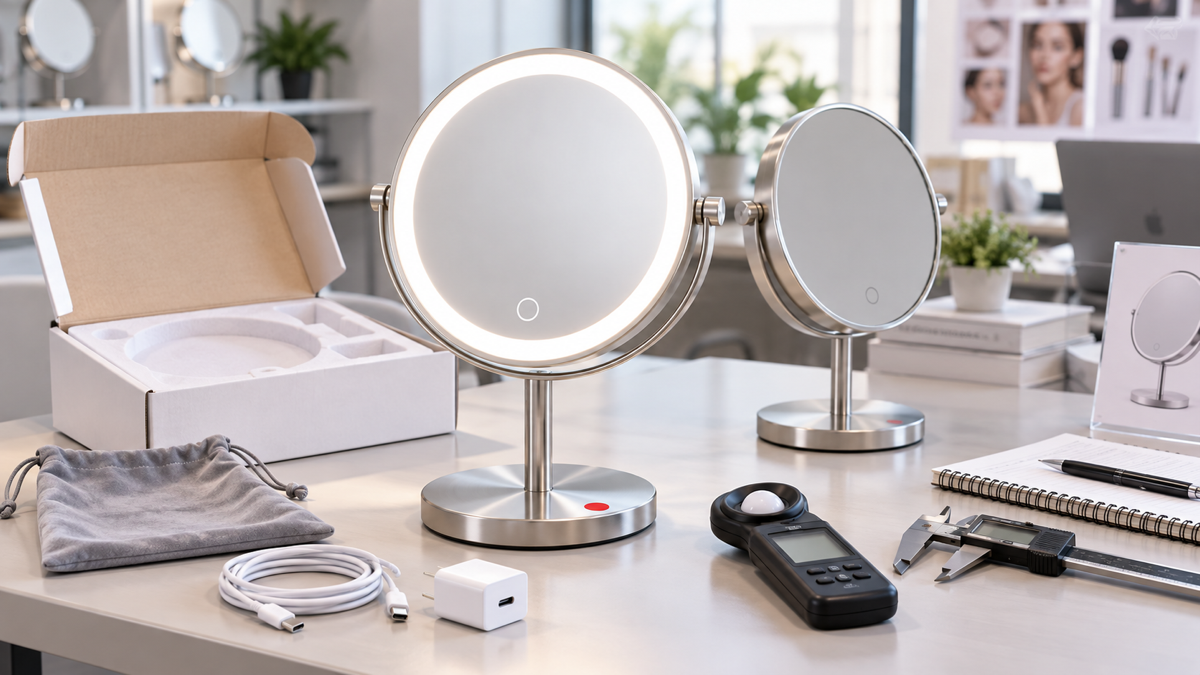
Before bulk order, confirm whether the product includes only a USB cable or also an adapter. Many markets require careful adapter and battery compliance review, so some sellers prefer cable-only packaging while making the charging input clear on the product page and manual. If the retail box shows the wrong accessory expectation, the product can still receive bad reviews even when the mirror itself works well.
For RFQ clarity, include:
- Port type and cable length
- Battery capacity and target runtime
- Charging time
- Indicator-light behavior
- Adapter inclusion or exclusion
- Battery label and manual language
- Replacement policy for charging failures
Size, Magnification, and Stability Should Match the Channel
A mirror that performs well in one channel may not be right for another. Amazon and marketplace buyers often compare size, magnification, and brightness against product photos. Retail buyers may care more about shelf presentation and gift-ready packaging. Wholesale buyers may prioritize stable repeat orders and a consistent finish.
For a tabletop LED makeup mirror, sellers should avoid exaggerated listing images that make the mirror look larger than the actual reflective area. Instead, confirm the mirror diameter, full product height, base diameter, net weight, and package dimensions. These numbers should match the product page, user manual, carton label, and inspection report.
Magnification also needs clear positioning. A 1x main mirror is suitable for general makeup use, while 5x or 10x magnification can be useful for detail work. High magnification should be described carefully because users must keep the correct distance to avoid distortion. If the product includes a detachable magnifying area or double-sided design, the sample approval sheet should record the exact configuration.
Packaging and Listing Claims Must Say the Same Thing
Yesterday’s packaging problem becomes today’s review problem when the parcel arrives. Even when the carton protects the product well, bad reviews can still appear if the manual, accessories, and listing do not match.
Buyers should align four documents before shipment:
- final approved sample record
- e-commerce listing feature claims
- user manual and warranty card
- packing list and carton mark
If the listing says USB-C rechargeable, the cable and manual must support that claim. If the listing says three light colors, the button behavior must be easy to explain. If the product image shows a pouch or adapter, the package must include it or the listing must state otherwise.
This is where an OEM/ODM supplier can add value. Instead of only shipping products, the supplier should help check whether the product, packaging, accessory set, and buyer-facing claim are aligned before mass production.
Turn Early Complaints Into a Release Decision
After launch, group feedback by SKU, product revision, shipment lot, channel and delivery period. Count unique affected orders separately from messages, reviews and replacement shipments. A review count alone is not a defect rate: use delivered units in the same cohort and observation window for delivery complaints, and record inspected units separately for warehouse findings. Keep unverified complaints separate from reproduced faults.
| Signal | Evidence to capture | Buyer action |
|---|---|---|
| Runtime or charging complaint | Sample revision, cable and power-source combination, light setting, charging time, runtime endpoint and reproduction result | Compare with the approved test conditions; correct unsupported claims or investigate the affected configuration |
| Missing part or size mismatch | Listing version, packed-unit contents, measured dimensions and customer expectation | Separate a packing omission from a misleading image; assign the relevant correction owner |
| Transit damage | Parcel and insert photographs, route, packaging revision and delivered-unit denominator | Review the actual parcel configuration and retain the original failure with the retest result |
| Reorder approval | Issue owner, due date, affected stock, corrected revision, verification evidence and approver | Hold unresolved configurations; approve changes against agreed acceptance criteria |
Keep claims and assets aligned with the e-commerce listing kit, and use the parcel packaging evidence checklist for delivery damage. Ask for feedback neutrally and handle support issues consistently; this review process measures product and information quality, not a guaranteed improvement in ratings.
Pre-RFQ Checklist for E-commerce LED Makeup Mirror Orders
Send these points when requesting quotation:
- Target channel: Amazon, retail chain, DTC, wholesale, gift set, or distributor
- Mirror type: tabletop, compact, handheld, wall-mounted, or travel-size LED mirror
- Lighting: CCT modes, dimming requirement, CRI target, touch or sensor switch
- Power: rechargeable, plug-in, battery-operated, USB-C, adapter policy
- Size: reflective diameter, total height, base size, package size
- Magnification: 1x only, 5x, 10x, double-sided, detachable spot mirror
- Finish: chrome, brushed metal, ABS, color matching, private-label surface
- Packaging: retail box, mailer protection, insert, pouch, manual, barcode, carton mark
- Compliance: battery, adapter, labeling, market-specific documentation
- QC: charging test, lighting test, appearance check, drop/carton test, accessory count
- Commercial terms: MOQ, sample time, mass-production lead time, spare parts and after-sales support
Bottom-Line Recommendation
For e-commerce LED makeup mirror programs, the best supplier is not simply the supplier with the lowest unit price. The best partner helps the buyer convert future review risks into clear product specifications, sample tests, packaging rules, and inspection records. Before placing a bulk order, buyers should approve a real sample under normal use conditions, confirm every accessory and listing claim, and keep a written QC checklist for repeat orders.
Mingda Mirror supports beauty brands, retailers, e-commerce sellers, and distributors with LED makeup mirror sourcing, OEM/ODM customization, packaging planning, and pre-shipment quality control. Buyers can review related product options on the Makeup Mirrors page, explore OEM/ODM services, and send project details through the Contact page.
Request an itemized e-commerce mirror quotation with your channel, destination, SKU revision, quantity, accessory set, packaging configuration and launch date. Ask for separate sample, test, artwork and packaging costs, MOQ by variant, approval milestones and lead time after final sign-off.
FAQ
What LED makeup mirror specifications matter most for e-commerce reviews?
The most important specifications are lighting comfort, battery runtime, charging method, mirror size, stability, accessory completeness, packaging protection, and whether the listing claims match the delivered product.
Should e-commerce sellers include an adapter with rechargeable LED makeup mirrors?
It depends on the market, compliance plan, price target, and packaging strategy. Confirm the exact included cable and supported power-source combinations, then make the adapter inclusion or exclusion explicit in the listing, manual and box. Cable-only supply does not establish that the complete product meets destination-market requirements.
How can buyers reduce LED makeup mirror return risk before shipment?
Approve the sample with real-use testing, confirm packaging and accessories, run charging and lighting checks, align the product page with the final sample, and require a pre-shipment inspection report.
What should buyers ask Mingda Mirror before requesting a quotation?
Share the target sales channel, preferred mirror type, lighting requirements, power method, package style, compliance market, MOQ target, and any private-label or retail-box needs.
Social Media Content Ideas
LinkedIn angle: turn common e-commerce mirror complaints into a sourcing checklist before bulk order.
Facebook angle: explain why brightness, charging clarity, and complete accessories affect customer satisfaction.
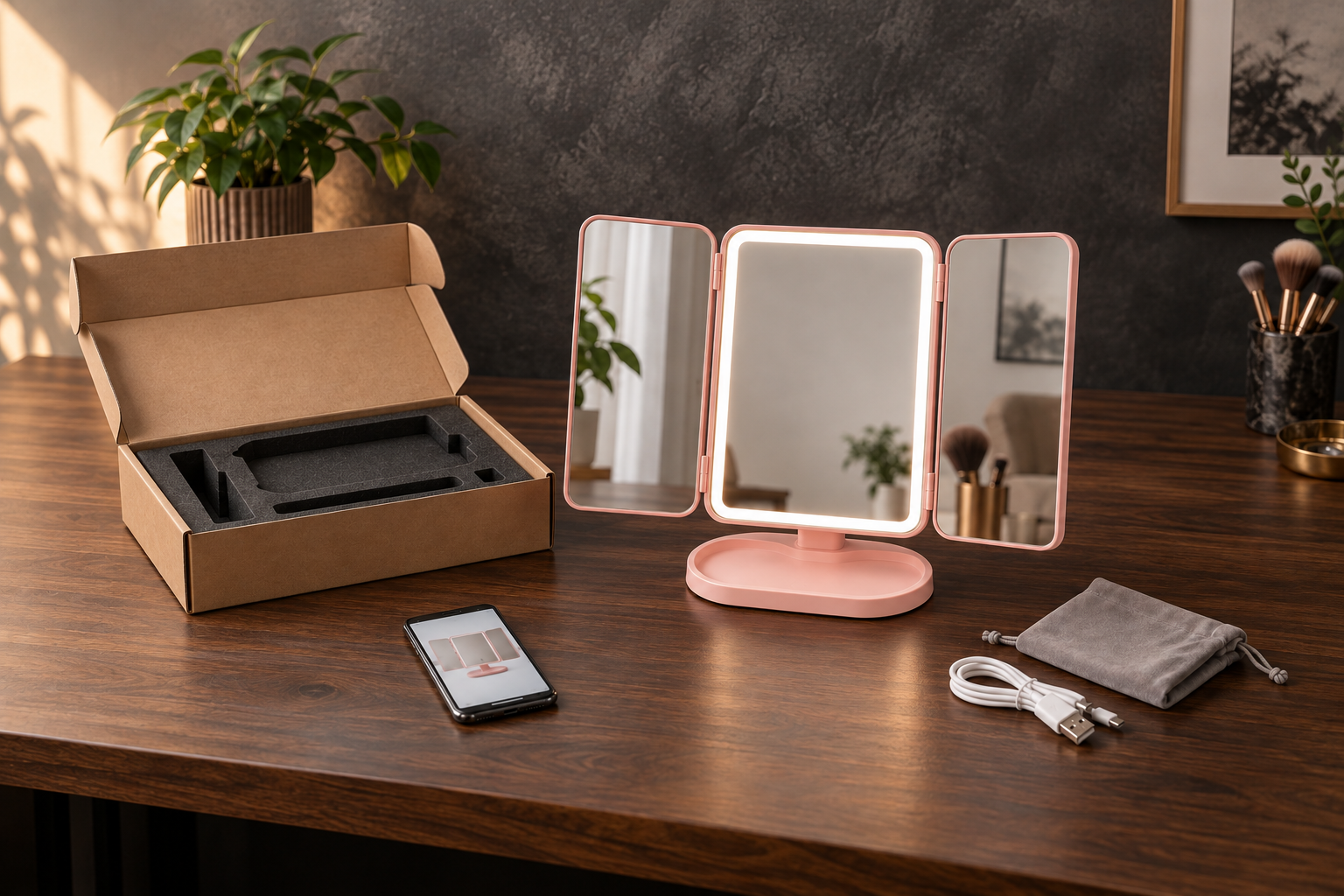
Instagram angle: use the sample review image to show a complete LED mirror, USB-C cable, packaging insert, and QC tools.
Short CTA: Read the full LED makeup mirror e-commerce review-risk guide and contact Mingda Mirror for RFQ-ready specifications.