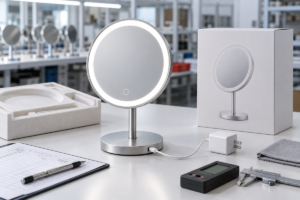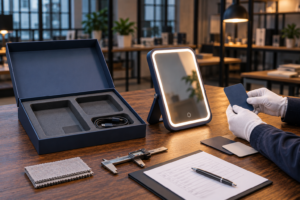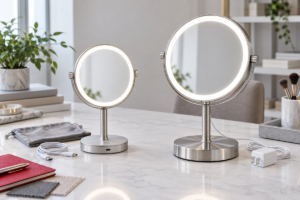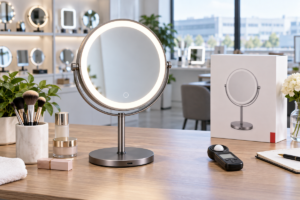

For most retail and e-commerce buyers, cordless rechargeable LED makeup mirrors are better for portable, gift, travel, and compact vanity lines, while plug-in LED makeup mirrors are better for larger vanity, salon, hotel, and long-use positions where stable brightness matters more than mobility. The right choice is not only a design decision. It affects battery compliance, charging accessories, packaging tests, retail price band, after-sales risk, and what your team must approve before bulk production.
This guide compares cordless vs plug-in LED makeup mirrors from a B2B sourcing perspective so beauty brands, retailers, Amazon sellers, distributors, and project buyers can choose the right power structure before requesting samples.
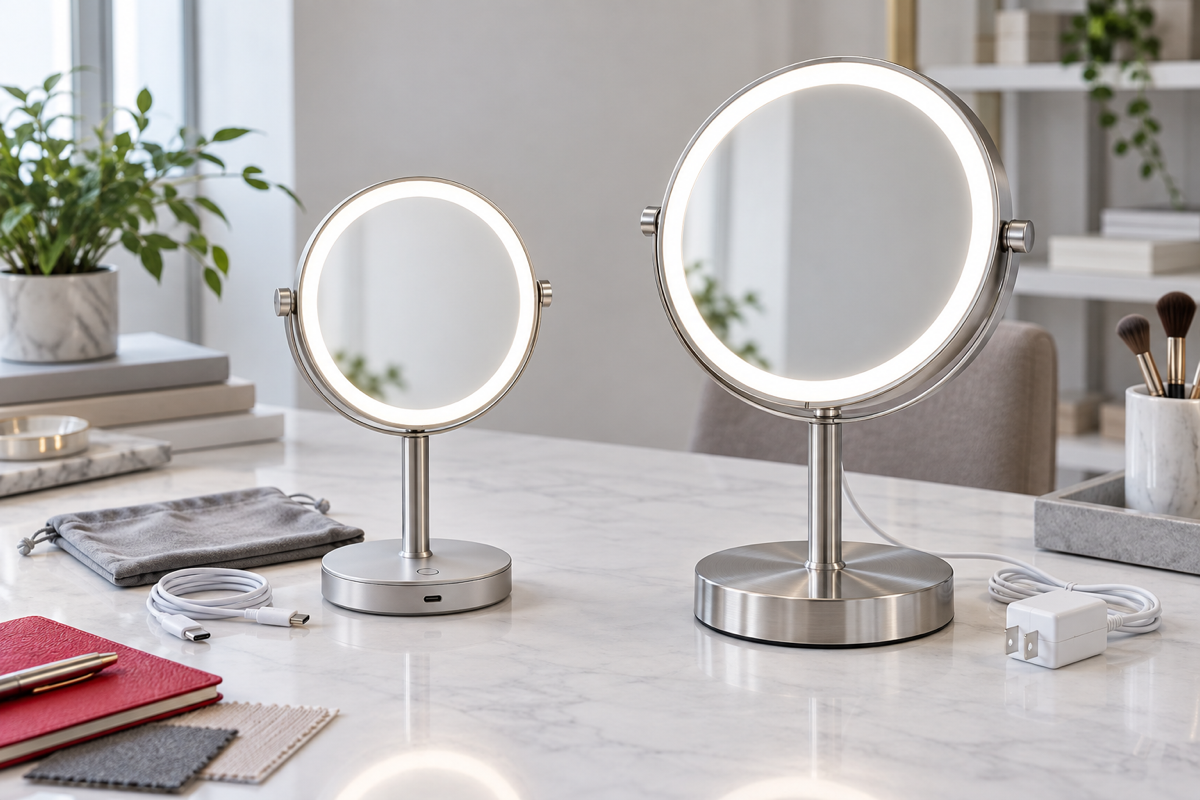
Quick Comparison: Cordless vs Plug-In LED Makeup Mirrors
| Decision Point | Cordless Rechargeable LED Makeup Mirror | Plug-In LED Makeup Mirror |
|---|---|---|
| Best channel fit | E-commerce, gift, travel, beauty retail, compact vanity lines | Salon, hotel, larger vanity, professional retail, project use |
| Main buyer value | Portable use, cleaner listing story, flexible placement | Continuous external power; verify brightness over the intended session |
| Key QC focus | Battery capacity, USB-C charging, cycle life, charging temperature | Adapter, cable strain relief, plug type, continuous lighting test |
| Packaging risk | Battery labeling, accessory fit, drop protection, instruction clarity | Adapter protection, cable packing, carton compression, plug-market matching |
| Common complaint risk | Short runtime, slow charging, weak brightness at low battery | Cable inconvenience, wrong adapter, less portable user experience |
| Better choice when | Your buyer needs mobility and a compact SKU story | Your buyer values stable brightness and fixed vanity placement |
Buyer Scenario: Start With the Sales Channel
A cordless mirror usually performs best when the product story depends on flexible placement. Beauty brands and e-commerce sellers can position it for dorm rooms, travel bags, small apartments, gift sets, and compact dressing tables. The feature is easy to explain in listings: rechargeable, cable-free use, portable, and simple to pack with private-label accessories.
A plug-in mirror is stronger when the user expects long sessions, high brightness, and a fixed vanity position. This makes it suitable for larger tabletop mirrors, hotel-room makeup stations, salon counters, and premium vanity sets. For these buyers, stable lighting can be more important than battery convenience.
Lighting and Brightness: Do Not Compare Only Lumens
Both formats can use LED rings, dimming, warm/neutral/cool CCT settings, and touch controls. The difference is how consistently the product can maintain that lighting. Compare lighting stability on each actual configuration. Cordless performance depends on battery condition and power management; plug-in performance also depends on the driver, thermal design and supplied adapter.
When approving samples, ask the supplier to test brightness at full charge, mid-charge, and low charge for cordless models. For plug-in models, test continuous use with the approved adapter and cable, not a random lab accessory. Buyers should also check glare control, diffusion, CRI, dimming smoothness, and whether the light is comfortable for close-up makeup work.
Approve Runtime and Brightness on the Same Basis
Power format alone does not establish lighting stability. Compare identified samples at the same CCT, brightness setting, viewing geometry and ambient-light condition. For cordless units, record the starting charge condition and elapsed operating time; for plug-in units, identify the supplied adapter and cable. Agree the point at which runtime ends: automatic shutdown and falling below an agreed usable brightness are different endpoints.
| Approval item | Record for each power configuration | Release decision |
|---|---|---|
| Lighting over time | Sample and board revision, setting, sensor position, initial reading and readings at agreed intervals | Compare with buyer-agreed limits; do not infer brightness from battery capacity or power format |
| Charging and accessories | Actual cable, adapter input/output specification, permitted operating modes and observed charging behavior | Confirm whether use while charging is supported; a USB-C connector alone does not establish accessory compatibility |
| Storage and controls | Off-state or standby mode, observation duration, shipping isolation and restart behavior | Hold the sample if unintended activation or unclear instructions remain unresolved |
| Production handover | Approved mirror, accessory set, manual, packed sample and revision reference | Assign an exception owner and retest date before release; reassess changes before a reorder |
Use the brightness range guide to define a repeatable lighting record. For standby behavior and unintended activation, compare the touch and sensor control checks. Record results rather than treating a showroom demonstration as proof of runtime, charging compatibility or long-session performance.
Battery and Charging Risk for Cordless Models
Rechargeable LED makeup mirrors create a stronger e-commerce story, but they also add compliance and after-sales work. Buyers should confirm battery capacity, charging port type, charging cable specification, overcharge protection, charging temperature, battery cycle expectations, and market-specific document needs. USB-C is now common in consumer electronics, so many buyers prefer it for easier accessory matching and listing clarity.
The most common sourcing mistake is approving only the appearance sample. For cordless mirrors, the packed sample should include the actual cable, manual, warning labels, retail box, and any battery documentation needed for the destination market. If the buyer sells through Amazon or a major retail chain, these details should be confirmed before bulk production.
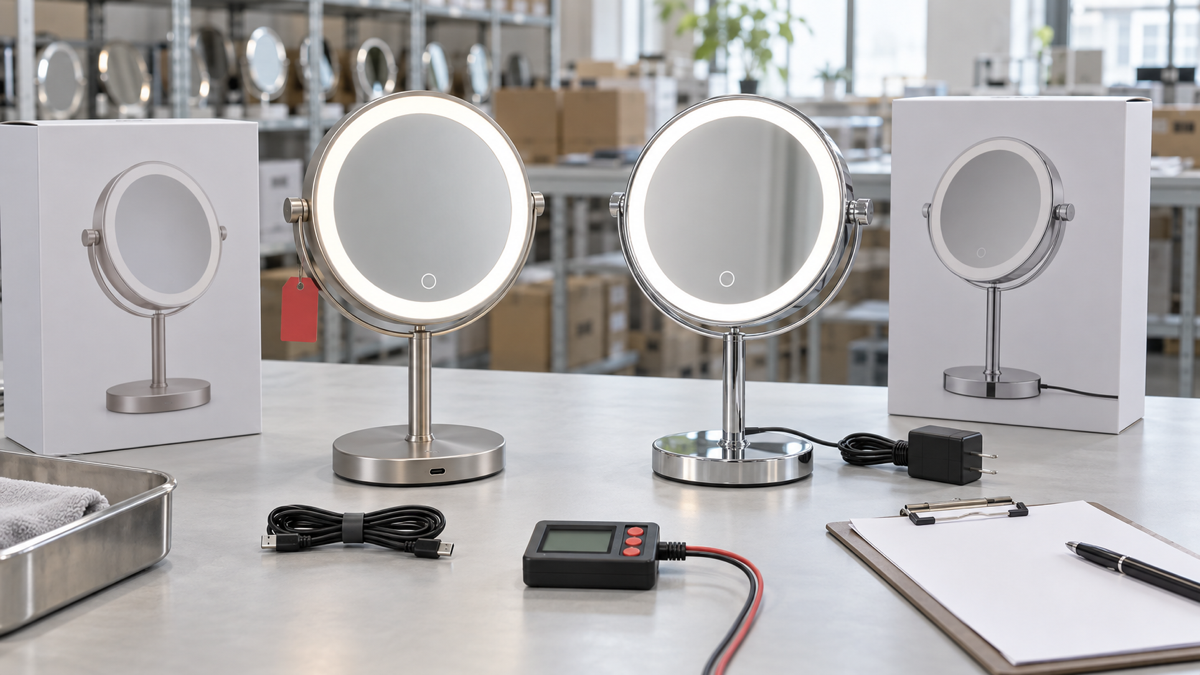
Plug-In Models: Stable Power, But Accessory Accuracy Matters
Plug-in LED makeup mirrors reduce battery-related risk, but they still require careful specification. Buyers should confirm the adapter output, plug type, cable length, cable color, connector strength, strain relief, and whether the adapter is included or sourced locally. The wrong plug or weak accessory packing can turn a good mirror into a customer-service problem.
For hotel, salon, and project buyers, plug-in mirrors also need installation and placement review. The buyer should confirm where the outlet will be, how the cable exits the base, whether the mirror is tabletop or wall-mounted, and how replacement accessories will be handled after delivery.
Cost, MOQ, and Packaging Implications
Cordless rechargeable mirrors usually require a wider approval scope because the battery, charging system, cable, warning labels, and shipping documents are part of the product. This can influence sample timing, compliance records, and packaging design. Buyers should ask whether the MOQ changes when selecting a different battery capacity, finish, mirror size, magnification level, or custom package.
Plug-in models may have simpler electronics from a battery perspective, but adapter quality and plug-market matching still affect cost. For both formats, Mingda recommends approving the final packed sample before bulk production, including the mirror, accessories, inner tray, retail box, master carton, barcode position, and instruction manual.
Pre-RFQ Checklist for Buyers
- Target channel: retail, Amazon/e-commerce, gift, salon, hotel, or distributor line
- Power structure: rechargeable cordless, plug-in, or dual-use if required
- Mirror format: tabletop, compact, folding, wall-mounted, single-sided, or double-sided
- Lighting requirement: CCT, CRI target, brightness range, dimming method, and diffusion
- Magnification: normal mirror only, 3x, 5x, 7x, 10x, or detachable magnifying area
- Battery details for cordless SKUs: capacity, charging port, cycle expectations, and documentation
- Adapter and plug details for plug-in SKUs: market plug, cable length, certification, and replacement plan
- Packaging: retail box, gift box, drop-test target, inner protection, labels, and master carton
- Sample approval: lighting test, charging test, accessory fit, packed sample review, and photo record
- Commercial details: MOQ, lead time, private-label options, spare parts, and after-sales support
Which Format Should You Choose?
Choose a cordless rechargeable LED makeup mirror when your buyer values mobility, clean countertop use, travel/gift appeal, and e-commerce storytelling. Choose a plug-in LED makeup mirror when stable brightness, fixed placement, longer sessions, and professional or project use matter more. For a full product line, many brands use both: cordless compact mirrors for entry and gift SKUs, and plug-in mirrors for premium vanity or salon-oriented SKUs.
The best supplier should help you compare both formats with real sample data, not only catalog photos. Mingda Mirror manufactures LED makeup mirrors and OEM/ODM mirror solutions for brands, retailers, distributors, and project buyers. You can review makeup mirror options, explore custom OEM/ODM support, and send the RFQ team your target market, quantity, mirror format, power preference, required operating session, packaging route and launch date. Request separate sample costs, MOQ by configuration, the included cable or adapter, agreed acceptance tests and production lead time.
FAQ
Are cordless LED makeup mirrors better than plug-in models?
Cordless LED makeup mirrors are better for portable, gift, travel, and compact retail use. Plug-in models are better when the buyer needs stable brightness, longer use time, and fixed vanity or salon placement.
What should buyers test before ordering rechargeable LED makeup mirrors?
Buyers should test battery runtime, charging speed, brightness at different battery levels, USB-C cable quality, charging temperature, accessory packing, labels, and the final retail box.
Do plug-in LED makeup mirrors have lower return risk?
They can have lower battery-related return risk, but buyers still need to confirm adapter quality, plug type, cable length, lighting stability, and packaging protection.
Can Mingda customize both cordless and plug-in LED makeup mirrors?
Yes. Custom options can include mirror size, magnification, lighting, finish, base design, charging port, adapter selection, logo, packaging, and sample approval records.
What information should we send for a clear quotation?
Send your target channel, product size, power preference, magnification, lighting requirements, packaging needs, market, expected quantity, and launch timeline.
Bottom Line
For procurement teams, the right power structure should match the sales channel, user behavior, compliance burden, and packaging plan. If you are building a retail or e-commerce assortment, request side-by-side samples and approve both the product performance and the packed accessory set before bulk production.
Social Media Content Ideas
LinkedIn can focus on reducing power-related sourcing risk. Facebook can explain the difference for brand and retailer education. Instagram can use the side-by-side mirror scene to show portable versus stable vanity positioning, then link back to this full buying guide.