
For e-commerce LED makeup mirror programs, return risk should be controlled before the purchase order, not after customer complaints appear. Buyers can reduce avoidable returns by matching mirror size, magnification, lighting, charging, accessories, packaging, product photos, manual language, and QC tests to the real sales channel. The safest buying process is to approve one packed sample that represents the final online SKU, then use that sample to lock the listing information, inspection report, and packaging standard before mass production.
This guide is written for Amazon sellers, DTC beauty brands, marketplace retailers, wholesalers, and private-label buyers sourcing tabletop LED makeup mirrors for online sales.
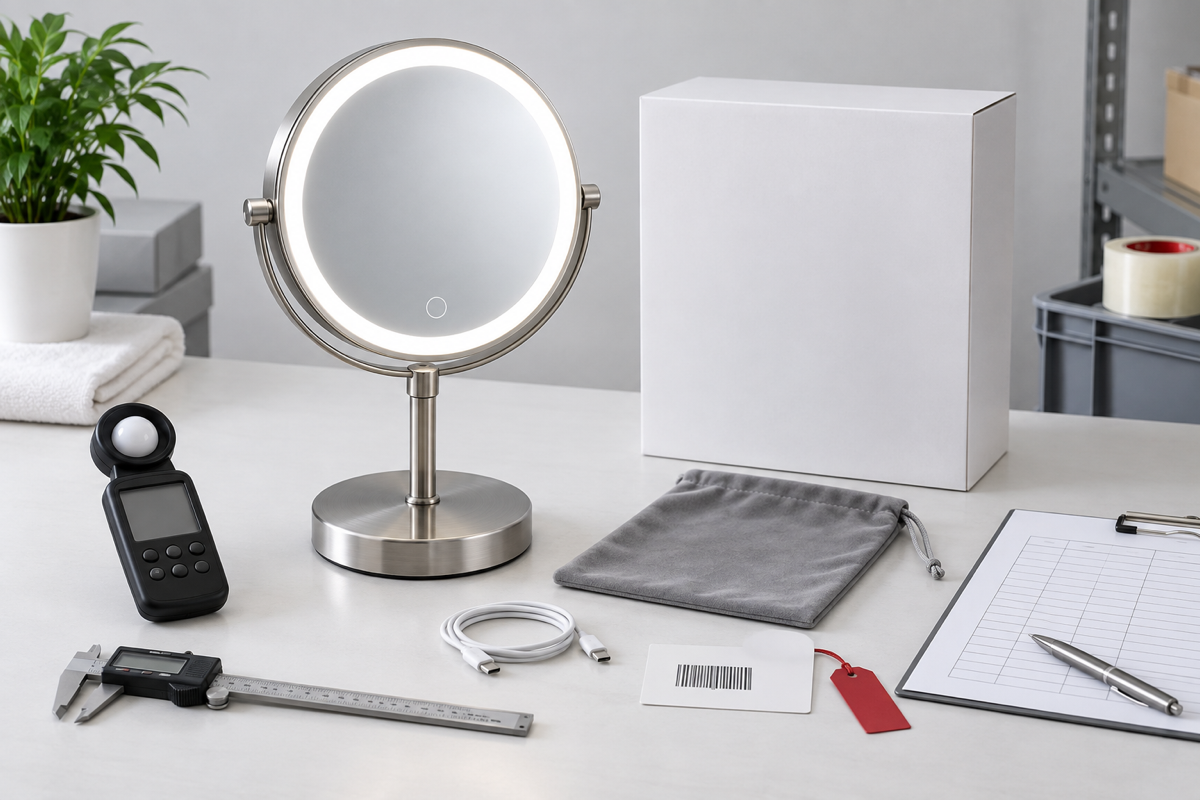
Why Return Risk Starts During Product Selection
Many LED makeup mirror returns look like customer-service problems, but the root cause often begins during sourcing. The buyer may approve a mirror that looks attractive in a catalog but is too small for the advertised use, too unstable for a vanity table, too dim for makeup application, too confusing to charge, or packed with accessories that do not match the product page.
For online channels, the customer cannot touch the mirror before purchase. The product page, packaging, manual, and actual mirror must therefore tell the same story. If a listing says “portable vanity mirror” but the mirror is heavy and fragile, returns increase. If photos show a pouch or adapter that is not included, customers may report missing parts. If the product claims three light modes but the switch logic is unclear, reviews can mention defective lighting even when the circuit works.
The buyer’s goal is not only to choose a nice LED makeup mirror. The goal is to choose a mirror configuration that can survive online selling: clear specifications, accurate listing content, stable packaging, simple instructions, and repeatable factory QC.
Return Drivers Buyers Should Control Before RFQ
Return risk usually comes from a small group of controllable gaps. A sourcing team can use the table below to connect each buyer decision with the return problem it prevents.
| Return driver | Buying decision to control | What to confirm before production |
|---|---|---|
| Size expectation mismatch | Mirror diameter, total height, base size, product weight | Compare real sample size with listing photos, scale images, and target price point |
| Lighting complaints | CCT, brightness, dimming, LED diffusion, switch logic | Test light comfort in warm, neutral, and cool modes if offered |
| Magnification confusion | 1X, 5X, 10X, removable magnifier, double-sided structure | State exactly what magnification is included and how it is used |
| Charging problems | USB-C or Micro-USB, battery capacity, cable quality, indicator logic | Test charging, runtime claim, cable fit, and manual instructions |
| Missing accessory claims | Cable, pouch, adapter, manual, spare magnifier, cleaning cloth | Match final packing list to product photos and customer-facing copy |
| Breakage or cosmetic damage | Molded insert, retail box, master carton, drop-test expectation | Approve packed sample and carton protection before mass production |
| Wrong warehouse data | Barcode, SKU, carton mark, packed size, unit weight | Confirm label placement, scanability, and carton data with the final package |
This is why a low unit price can become expensive after launch. A cheaper mirror may save cost at purchase, but if the hinge loosens, the base feels unstable, or the packaging does not protect the LED ring, the buyer pays later through returns, replacements, discounts, and poor reviews.
Approve the Physical Sample Like an Online Customer Would
Sample approval should not be limited to appearance. For e-commerce, buyers should open, assemble, charge, switch, dim, tilt, clean, pack, and photograph the mirror as the end customer would.
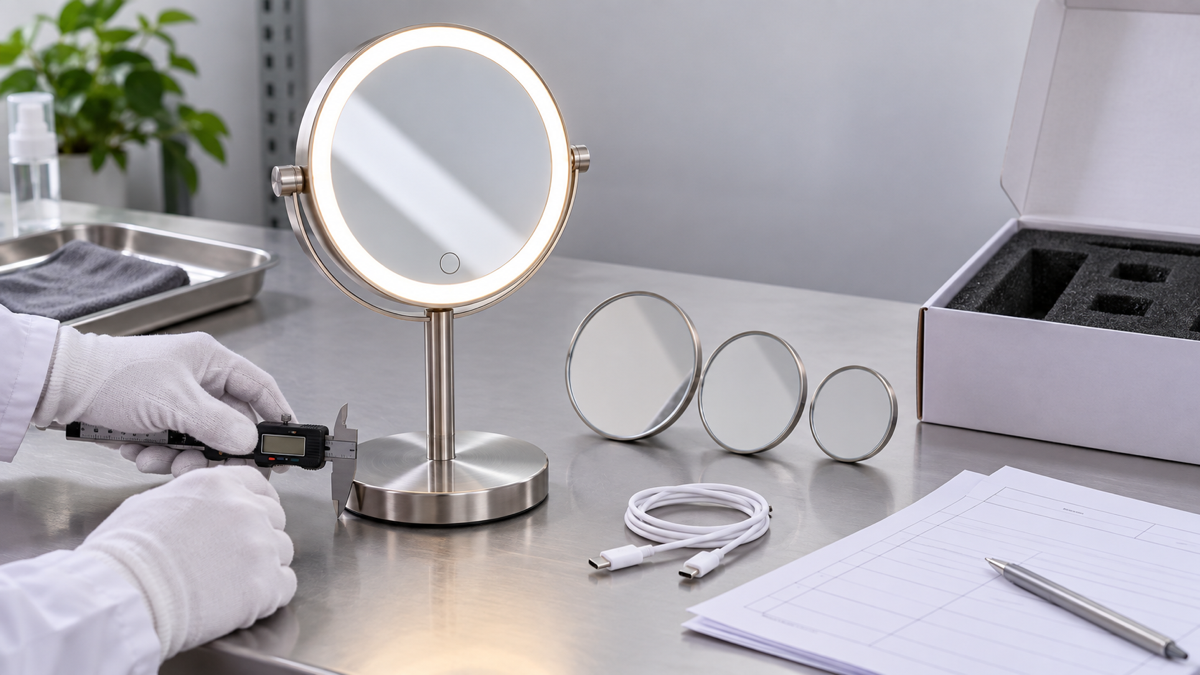
Start with the basic user experience. Place the mirror on a normal vanity table and check whether the height, mirror diameter, base stability, and tilt angle feel natural. If the mirror includes magnification, confirm whether the user can understand where the magnifying area is and whether the magnification level fits the target buyer. A 10X option may be useful for detail work, but it can also create complaints if the product page does not explain the required viewing distance.
Next, test the lighting. Online customers often buy LED makeup mirrors for lighting comfort, so the buyer should check brightness, color temperature, LED diffusion, glare, and dimming smoothness. A strong LED ring is not automatically better if it creates harsh reflection or uneven light on the face. If the mirror has multiple CCT modes, ask the supplier to define the approximate CCT range and confirm that the manual explains how to switch modes.
Then check charging and daily operation. For rechargeable models, confirm the charging port type, cable quality, charging indicator, battery claim, and whether an adapter is included. If the product only includes a cable, the listing and manual should not imply that a wall adapter is inside the box. Buyers should also check whether the switch is too sensitive in transit or too hard for users to understand.
For RFQ and sample approval, ask the supplier to confirm:
- complete product dimensions and packed dimensions
- mirror diameter, total height, base diameter, and product weight
- magnification level and whether it is fixed, removable, or double-sided
- lighting modes, dimming method, CCT range, and switch type
- charging port, cable type, battery capacity if specified, and adapter policy
- included accessories and excluded accessories
- finish, frame material, base material, and surface defect tolerance
- packaging structure, barcode position, carton mark, and drop-test expectation
The final approved sample should become the reference for mass production, listing photos, manual copy, inspection report, and customer-service script.
Match Product Photos, Accessories, and Packaging
Many online return disputes begin with small inconsistencies. A product image shows one accessory set, the manual describes another, and the retail box contains a third. For a private-label LED makeup mirror, the buyer should treat packaging and listing content as part of the product specification.
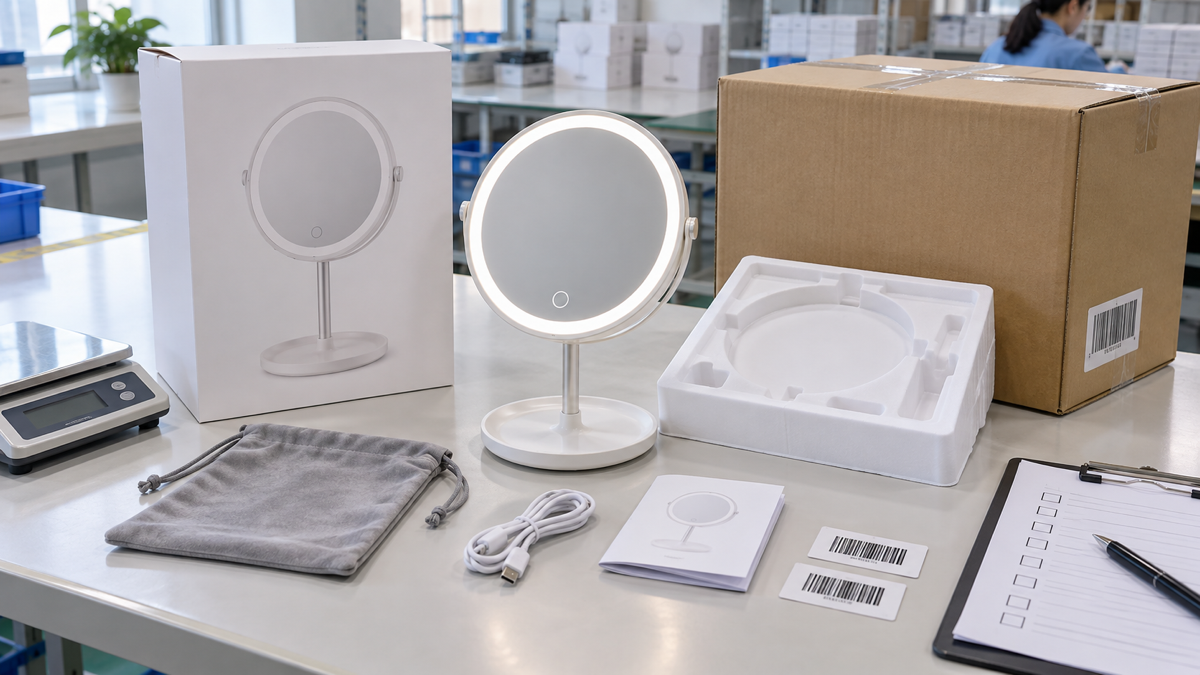
For every SKU, create a final packing list and connect it to the product page. If the mirror includes a USB-C cable, pouch, manual, cleaning cloth, removable magnifying mirror, or adapter, show only the items that are actually included. If an accessory is optional, separate it in the quotation and listing plan instead of leaving it vague.
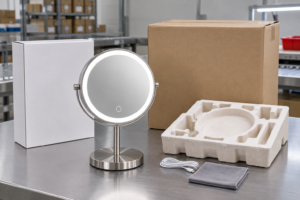
Packaging should also match the sales channel. A retail shelf program may need a stronger printed box and display-facing artwork. An Amazon or warehouse program may need barcode placement, FNSKU or EAN planning, carton data, and stronger molded inserts. A DTC brand may care more about unboxing feel, but the box still needs to protect the LED ring, mirror surface, hinge, base, cable, and finish.
Buyers should approve:
- retail box size and artwork version
- molded insert or inner protection structure
- accessory placement inside the box
- barcode area and label responsibility
- master carton size, quantity, gross weight, and carton mark
- packed sample photos from the supplier
- manual language, charging instructions, and warranty card
- replacement policy for damaged mirror, battery issue, cable issue, or cosmetic defect
This packaging approval should happen before mass production. If the buyer waits until goods are ready to ship, changing the box, insert, barcode, or manual can delay delivery and increase cost.
QC Tests That Help Prevent Common Returns
Quality control for online LED makeup mirrors should focus on the failures customers actually notice: lighting not working, charging problems, loose hinge, unstable base, scratches, missing accessories, wrong labels, and damaged packaging.
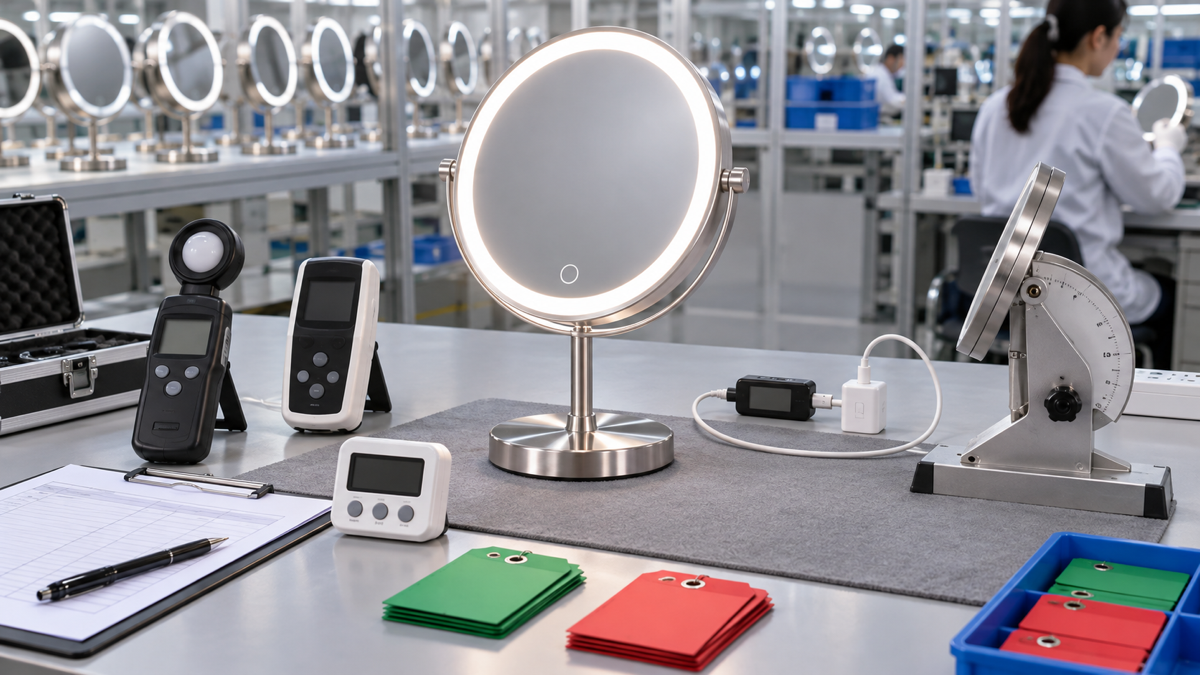
A practical inspection plan should combine function, appearance, packaging, and listing consistency. The factory should not only check whether the light turns on. It should check whether the approved light mode sequence, dimming behavior, charging indicator, hinge resistance, base stability, accessory set, label, and retail box all match the approved sample.
For higher-risk e-commerce orders, buyers can request:
- incoming material checks for mirror surface, frame finish, LED strip, switch, battery, cable, and adapter if included
- assembly checks for hinge tightness, stand alignment, base stability, and visible glue or gap defects
- lighting checks for CCT, brightness, dimming, LED uniformity, and glare
- charging checks for port fit, charging indicator, cable connection, and sample runtime
- aging tests for lighting and electronic components
- packed-sample checks for accessory count, manual, barcode, box, molded insert, carton mark, and gross weight
- drop or transport simulation based on the buyer’s channel and packaging requirement
The inspection report should be connected to the real SKU. If the order includes different colors, magnification levels, plugs, packaging versions, or accessory sets, each version needs its own approval and sampling logic. Treating multiple SKUs as one generic item is a common cause of warehouse mismatch and customer complaints.
How to Choose the Right Mirror Configuration by Channel
Different online channels do not need the same LED makeup mirror configuration. A premium DTC beauty brand may choose a heavier metal-base mirror with strong packaging and refined finish. A marketplace seller may prioritize clear product data, strong protection, fast replenishment, and simple customer instructions. A gift retailer may care about box presentation, pouch quality, and color consistency.
| Buyer type | Safer configuration | Return-risk focus |
|---|---|---|
| Amazon or marketplace seller | Stable tabletop LED mirror, clear magnification claim, USB-C cable, molded insert, barcode-ready box | Accurate listing, packaging protection, accessory consistency |
| DTC beauty brand | Premium finish, comfortable lighting, strong unboxing package, clear manual | Brand perception, reviews, customer support clarity |
| Retail chain or distributor | Durable base, shelf-ready box, reliable carton mark, reorder consistency | Store receiving, display quality, batch consistency |
| Gift channel buyer | Attractive finish, pouch or gift box, simple operation, safe battery handling | Presentation, easy use, low complaint rate |
| Wholesale importer | Balanced cost, repeatable QC, clear MOQ, spare parts policy | Margin control, batch defect prevention, after-sales support |
For buyers building a wider assortment, do not make every SKU similar. A practical LED makeup mirror line can include one compact travel option, one core tabletop SKU, one premium metal-base SKU, and one model with stronger magnification or larger diameter. Each SKU should have a clear reason to exist in the range.
Pre-RFQ Checklist for E-Commerce Buyers
Before requesting a quotation, send the supplier a brief that defines both product requirements and online selling requirements:
- target sales channel: Amazon, DTC, marketplace, retail chain, distributor, or gift program
- target retail price range and product positioning
- mirror diameter, total height, base requirement, and finish preference
- lighting modes, CCT expectation, brightness expectation, and dimming method
- magnification requirement and whether it should be removable or fixed
- rechargeable, plug-in, battery, USB-C, or other power configuration
- required accessories and items that must not be included
- retail box style, barcode needs, carton mark, and warehouse data
- manual language, warranty copy, and after-sales support scope
- sample deadline, artwork deadline, mass-production lead time, and replenishment plan
- inspection requirements for lighting, charging, hinge, surface, packaging, and accessory count
The more clearly the buyer defines the online channel, the easier it is for the supplier to recommend the correct mirror structure, packaging method, MOQ, sample plan, and lead time. A vague request for “one LED makeup mirror for e-commerce” usually creates avoidable rework later.
Bottom-Line Recommendation
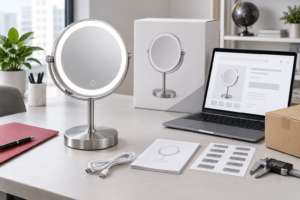
To reduce LED makeup mirror e-commerce returns, buyers should approve the mirror as a complete sellable SKU, not just as a product photo. The approved sample should include the final mirror, lighting function, magnification, charging method, accessories, manual, retail box, barcode plan, carton data, and inspection standard.
The strongest buying workflow is simple: define the sales channel, approve the physical sample, approve the packed sample, align the product page with the packed SKU, test the functions customers notice, and keep the inspection report tied to the exact order. This makes the mirror easier to sell, easier to receive, and easier for customers to understand.
FAQ
What causes most LED makeup mirror e-commerce returns?
Common causes include inaccurate product photos, unclear magnification claims, lighting that does not match customer expectations, charging confusion, missing accessories, weak packaging, loose hinges, cosmetic defects, and product data that does not match the packed SKU.
Should buyers choose USB-C for rechargeable LED makeup mirrors?
USB-C is usually easier for modern online buyers to understand, but the buyer should still confirm cable quality, charging indicator logic, battery claim, manual language, and whether a wall adapter is included. The listing should not imply accessories that are not packed.
How many samples should be approved before mass production?
At minimum, approve one working product sample and one packed sample that represents the final SKU. If the order has multiple colors, magnification versions, plug types, or packaging versions, approve representative samples for each meaningful variation.
What packaging is best for LED makeup mirrors sold online?
Online channels usually need a protective molded insert or equivalent inner structure, a clear accessory layout, barcode-ready retail box, strong master carton, and packed-sample photos. The exact structure depends on mirror size, weight, sales channel, and shipping method.
What should Mingda Mirror receive for an accurate quotation?
Send the target channel, desired mirror size, lighting modes, magnification requirement, power configuration, finish, accessory list, packaging expectation, barcode needs, inspection requirement, order quantity, sample deadline, and destination market. These details help Mingda Mirror prepare an RFQ-ready proposal.
Work With Mingda Mirror
Mingda Mirror manufactures LED makeup mirrors, LED compact mirrors, handheld mirrors, Hollywood mirrors, and LED bathroom mirror products for brands, e-commerce sellers, retailers, distributors, and project buyers. If you are planning an online LED makeup mirror program, share your target channel, SKU list, product positioning, packaging plan, and inspection requirements.
Our team can help align the sample, packed SKU, listing information, packaging, and pre-shipment QC before bulk production. Explore Makeup Mirrors, review OEM/ODM services, check the QC process, or contact Mingda Mirror to request an e-commerce-ready quotation.
Social Media Content Ideas
LinkedIn angle: explain why LED makeup mirror return risk should be controlled during sample and packed-sample approval, not after shipment.
Facebook angle: show how accurate product photos, accessory lists, manuals, and packaging reduce customer confusion for online mirror buyers.
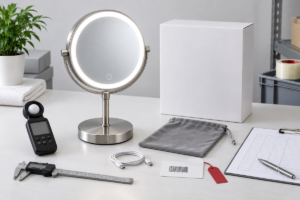
Instagram angle: use the QC test bench image to show lighting, charging, hinge, and accessory checks before bulk production.
CTA: Read the full LED makeup mirror return-risk buying guide and send Mingda Mirror your SKU list, channel requirements, and packaging plan for an RFQ-ready review.