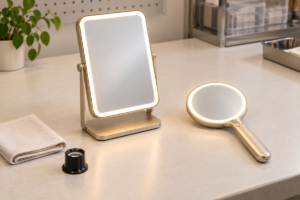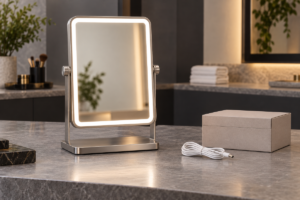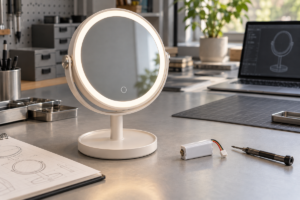

For private-label and e-commerce buyers, a USB-C rechargeable LED travel makeup mirror should be sourced by checking battery documentation, charging design, lighting consistency, hinge stability, packed dimensions, and return-risk controls before confirming bulk production. The product looks simple, but small specification gaps can create charging complaints, broken hinges, dim LEDs, oversized cartons, or shipment delays. A clear RFQ should define the target channel, mirror size, LED settings, battery capacity, packaging structure, logo method, test requirements, and replacement policy.
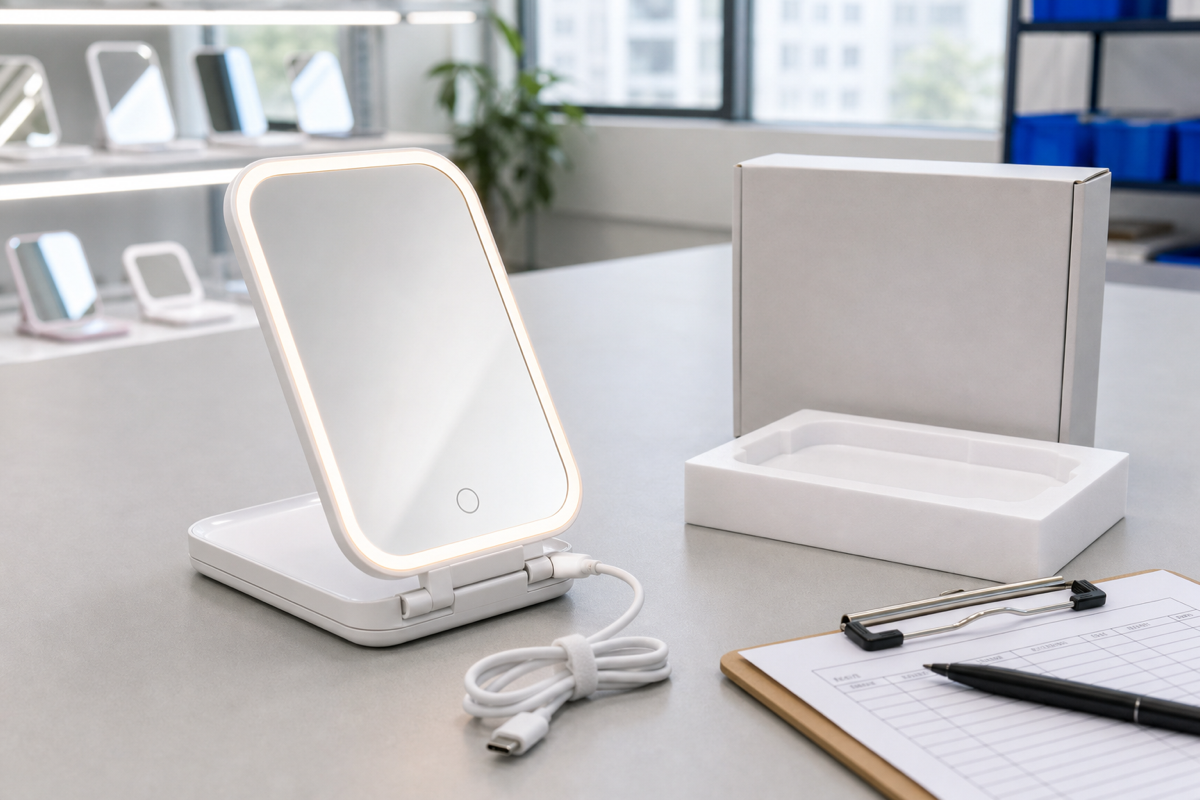
Why This SKU Needs a More Specific RFQ
USB-C rechargeable travel makeup mirrors are attractive because they combine portability, lighting, gifting, and private-label packaging in one compact product. They can fit Amazon, beauty retail, travel accessories, salon counters, promotional gift programs, and cross-border e-commerce. That also means buyers often ask for many features in a small structure: foldable housing, LED lighting, rechargeable battery, touch switch, slim packaging, logo, manual, barcode, and sometimes magnification.
The sourcing risk is that a low-cost sample may look acceptable in photos but fail in real use. The hinge may loosen after repeated folding, the light may be uneven, the battery may not support the claimed runtime, or the carton may be too weak for parcel delivery. For marketplace sellers, these issues become reviews and returns. For retail buyers, they become shelf complaints, replacement claims, and lost margin.
The best RFQ is therefore not only a price request. It is a product-control document that helps the supplier quote the right structure and helps the buyer compare factories on the same basis.
RFQ Specification Matrix
| RFQ item | What to specify | Why it affects bulk order results |
|---|---|---|
| Target channel | Amazon, retail gift box, beauty brand, travel kit, salon, distributor | Determines packaging strength, price tier, and feature priority |
| Mirror format | Foldable square, round compact, slim rectangular, tabletop travel style | Affects usable viewing area, carton size, hinge design, and shelf appeal |
| Lighting | CCT options, brightness range, CRI target, dimming method, memory function | Prevents weak light, glare, color mismatch, and poor makeup-use reviews |
| Battery and charging | Battery capacity, USB-C port, cable spec, charging time, runtime, indicator behavior | Controls compliance documents, shipping readiness, and customer complaints |
| Material and hinge | ABS, metal trim, hinge torque, open angle, base stability | Reduces wobble, loose hinges, cracking, and perceived low quality |
| Packaging | Gift box, mailer box, insert material, manual, barcode, carton marks | Protects the mirror and supports retail or FBA-style delivery |
| Branding | Logo position, printing method, box artwork, manual language | Avoids late artwork changes and sample rework |
| QC standard | Lighting test, charging test, hinge cycle, drop-pack check, AQL level | Makes sample approval repeatable before mass production |
Buyer Scenarios and Product Priorities
For Amazon and e-commerce sellers, the strongest priorities are clear product photos, reliable charging, protective packaging, compact carton size, and a feature set that is easy to explain in the listing. A rechargeable LED travel mirror with USB-C, tri-color lighting, touch dimming, and a stable foldable stand can support a better listing story, but only if the product survives parcel delivery and works consistently after arrival.
For beauty brands and retailers, the priorities are slightly different. The product must feel giftable, match the brand’s color and finish direction, and present well in a box. Buyers should confirm finish consistency, logo placement, box texture, manual language, and shelf display needs before finalizing artwork. A travel mirror with weak packaging may look cheaper than expected even when the mirror itself is acceptable.
For wholesalers and distributors, assortment flexibility matters. A supplier should be able to discuss different sizes, colors, battery capacities, packaging tiers, and MOQ options. Distributors should ask whether the same base model can support multiple regional packaging versions without restarting the full sample process.
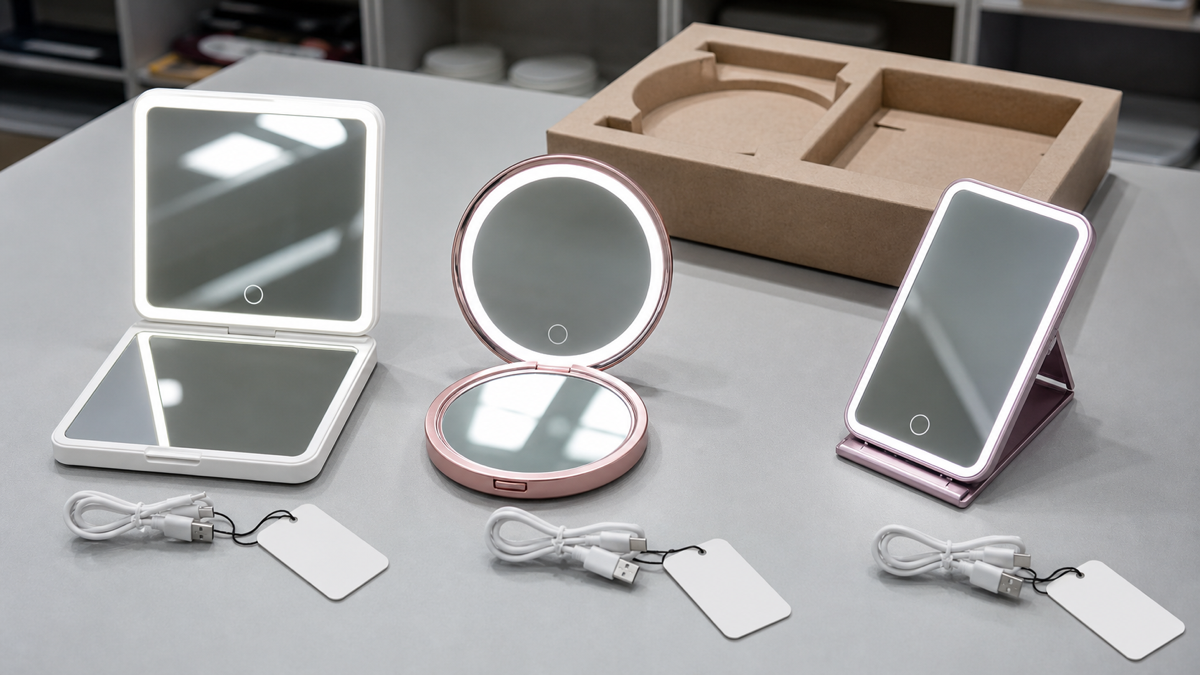
Charging and Battery Details Buyers Should Confirm
Rechargeable design is often the main selling point, but it is also one of the most common sources of after-sales problems. Before approving a sample, buyers should confirm the battery capacity, expected runtime at different brightness levels, charging time, USB-C port quality, charging cable specification, overcharge protection, and indicator behavior.
For international shipments, ask what battery documentation can be provided. Depending on the market and transport route, buyers may need documentation such as UN38.3-related battery transport information, MSDS-style battery documents, or other shipment support from the supplier or forwarder. The supplier should clearly state what is available before the order enters mass production.
Do not approve a rechargeable mirror based only on maximum brightness. Test real user behavior: charging from low battery, using medium brightness for a practical period, folding and unfolding while the cable is disconnected, and checking whether the light output drops sharply as the battery runs down.
Lighting Quality: What Separates a Good Sample From a Return Risk
For makeup use, light quality is more important than an aggressive LED count. Buyers should evaluate color temperature options, brightness smoothness, diffuser quality, glare, color rendering, and consistency from unit to unit. A travel mirror can be compact, but the LED ring or frame still needs even diffusion.
Tri-color lighting can help sell the product, especially for e-commerce listings, but it must be intuitive. If touch control is confusing, too sensitive, or inconsistent, customers may think the product is defective. Ask the supplier to define the switch logic: short press, long press, color change, dimming, memory, and power-off behavior.
One common trap is approving a sample in bright office light only. Test the mirror in low light, daylight, and normal bathroom or vanity conditions. If the reflection is acceptable but the LED creates glare or uneven color, the product may still perform poorly with real makeup users.
Structure, Hinge, and Travel Durability
A travel makeup mirror needs to open smoothly, stay at the chosen angle, and close without pinching the cable, scratching the mirror surface, or stressing the hinge. The hinge should be checked after repeated opening and closing, not only on the first sample.
Buyers should confirm the expected open angle, hinge torque, base stability, housing thickness, mirror panel protection, and whether the charging port is exposed to impact during packing. For slim designs, the supplier should explain how the hinge and frame are reinforced. A beautiful thin mirror can create returns if the hinge loosens during use or the frame cracks during shipping.
For gift and travel channels, surface finish also matters. Glossy plastic, matte coating, metallic trim, and color finishes can all work, but they should be tested for scratches, color consistency, fingerprints, and packaging abrasion.
Packaging and Compliance Checks Before Bulk Production
Packaging must be designed for the real route to the customer. A retail gift box may need better shelf presentation, while an Amazon or parcel-delivery box needs stronger impact protection. Buyers should ask for packed dimensions, gross weight, carton quantity, insert material, cable placement, manual placement, barcode label position, and outer carton marks.
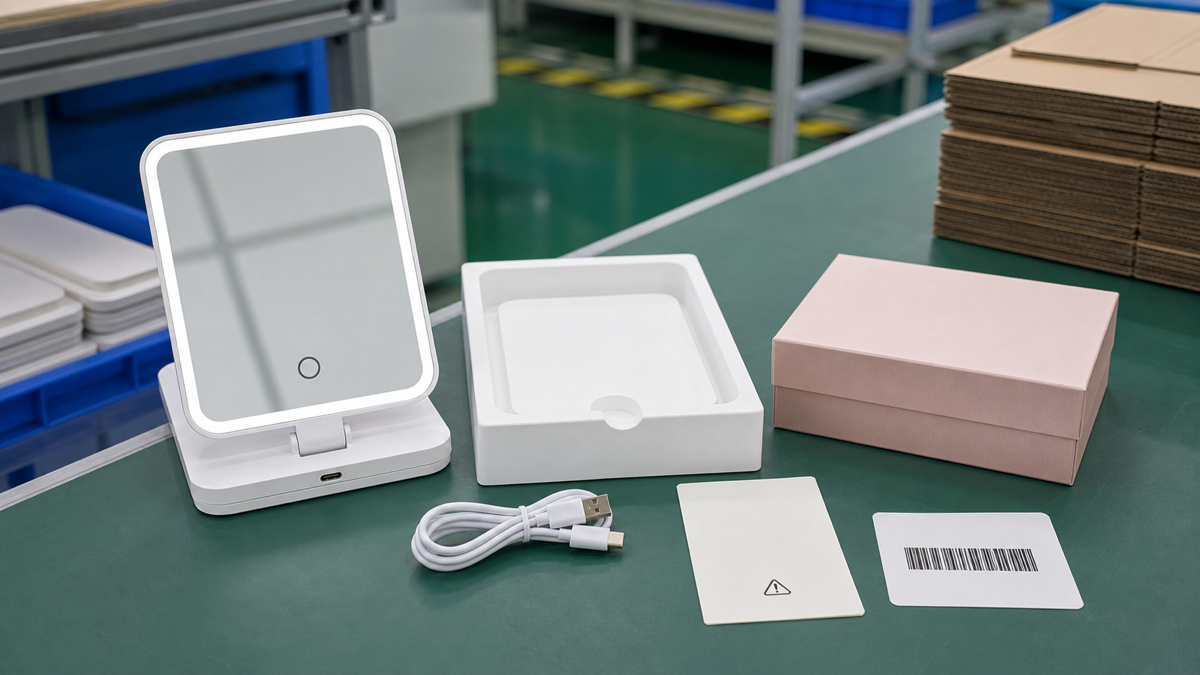
For rechargeable products, packaging should also support battery and charging documentation. The manual should explain charging, use time, safety notes, and switch operation in natural English. If the same product will be sold in multiple countries, confirm manual language versions and regional labeling before mass production.
The pre-shipment QC plan should include appearance inspection, LED function test, charging test, battery indicator check, hinge and opening-angle test, cable/accessory count, packaging drop or handling review, barcode scan check, and carton mark verification.
Pre-RFQ Checklist for USB-C Rechargeable Travel Mirrors
- Define the buyer channel: Amazon, retail, beauty brand, travel gift, salon, distributor, or promotion.
- Confirm the product format: foldable square, round compact, slim rectangular, size, thickness, and open angle.
- Specify lighting: CCT options, brightness range, dimming method, diffuser quality, CRI target, and switch logic.
- Specify charging: USB-C requirement, battery capacity, runtime target, charging time, cable length, and indicator behavior.
- Confirm structure: hinge torque, base stability, housing material, surface finish, mirror panel protection, and scratch resistance.
- Confirm packaging: gift box or mailer box, insert material, packed dimensions, carton quantity, barcode, manual, and carton marks.
- Confirm branding: logo position, print method, color finish, box artwork, manual language, and approval timeline.
- Ask for test support: charging test, lighting test, hinge cycle check, drop-pack review, battery shipment documents, and pre-shipment inspection plan.
- Discuss commercial terms: MOQ by color, sample cost, sample lead time, production lead time, packaging proofing time, replacement policy, and payment schedule.
Bottom-Line Recommendation
Choose a USB-C rechargeable LED travel makeup mirror only after the sample passes charging, lighting, hinge, packaging, and documentation checks. For Amazon and e-commerce, prioritize reliable charging, parcel-ready packaging, and clear listing features. For retail and private label, prioritize finish, gift-box presentation, logo execution, and repeatable QC. The best supplier is the one that can quote the mirror as a controlled commercial SKU, not only as a low unit price.
FAQ
What should buyers include in a USB-C rechargeable travel mirror RFQ?
Include target market, sales channel, order quantity, mirror size, lighting settings, battery capacity, USB-C requirement, packaging type, logo needs, certification or battery documents, sample timeline, and expected shipment date.
Is USB-C better than Micro-USB for travel makeup mirrors?
USB-C is usually more attractive for current retail and e-commerce buyers because customers recognize it as a modern charging interface. Buyers should still confirm cable quality, port strength, charging behavior, and documentation before approving the sample.
How many lighting colors should a travel makeup mirror offer?
Many buyers request warm, neutral, and daylight settings because they are easy to explain online and useful for makeup. The key is not only the number of colors. The buyer should test brightness, diffusion, glare, and color consistency.
What packaging is best for Amazon or parcel delivery?
Amazon and parcel-delivery channels usually need stronger inserts, secure cable placement, clear barcode labeling, and carton handling checks. A gift box alone may not be enough unless it is protected by a suitable mailer or shipping carton.
Can Mingda Mirror support private-label USB-C rechargeable travel mirrors?
Yes. Mingda Mirror can discuss mirror size, lighting, battery, USB-C charging, logo placement, color finish, packaging, sample approval, and QC requirements for private-label and bulk-order programs.
Request a Quote
If you are sourcing USB-C rechargeable LED travel makeup mirrors for Amazon, retail, gift, or private-label programs, Mingda Mirror can help review product structure, battery and charging details, packaging, MOQ, and sample approval points before mass production. Explore makeup mirror options, review OEM/ODM customization, or contact Mingda Mirror with your RFQ details.