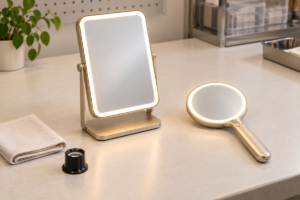

To pack Hollywood mirrors safely, buyers should approve the full packaging system before bulk production: glass surface protection, bulb clearance, corner foam, accessory separation, inner box, outer carton strength, pallet logic, and replacement rules. Hollywood mirrors are heavier and more fragile than many small cosmetic mirrors, so a low-cost carton can quickly become a return-cost problem. The right packing method depends on whether the order ships to retail shelves, e-commerce customers, distributors, salons, hotels, or project sites.
This guide is written for importers, retailers, Amazon sellers, salon suppliers, hotel project buyers, and distributors sourcing Hollywood vanity mirrors from overseas suppliers.
Why Hollywood Mirror Packing Needs Its Own Plan
A Hollywood mirror combines glass, a frame, bulbs or LED modules, wiring, switches, plugs, and sometimes a tabletop base or wall-mounting kit. Damage can happen even when the mirror looks well protected in a sample room. Long-distance export shipping, warehouse stacking, parcel drops, pallet movement, and final-mile handling all create different pressure points.
For buyers, the commercial risk is not only the broken unit. Breakage can create refund costs, replacement freight, delayed project installation, poor online reviews, and extra after-sales work. Buyers comparing Hollywood mirror suppliers should review product options on Mingda’s Hollywood Mirrors page and treat packaging as part of the product specification, not as a separate afterthought.
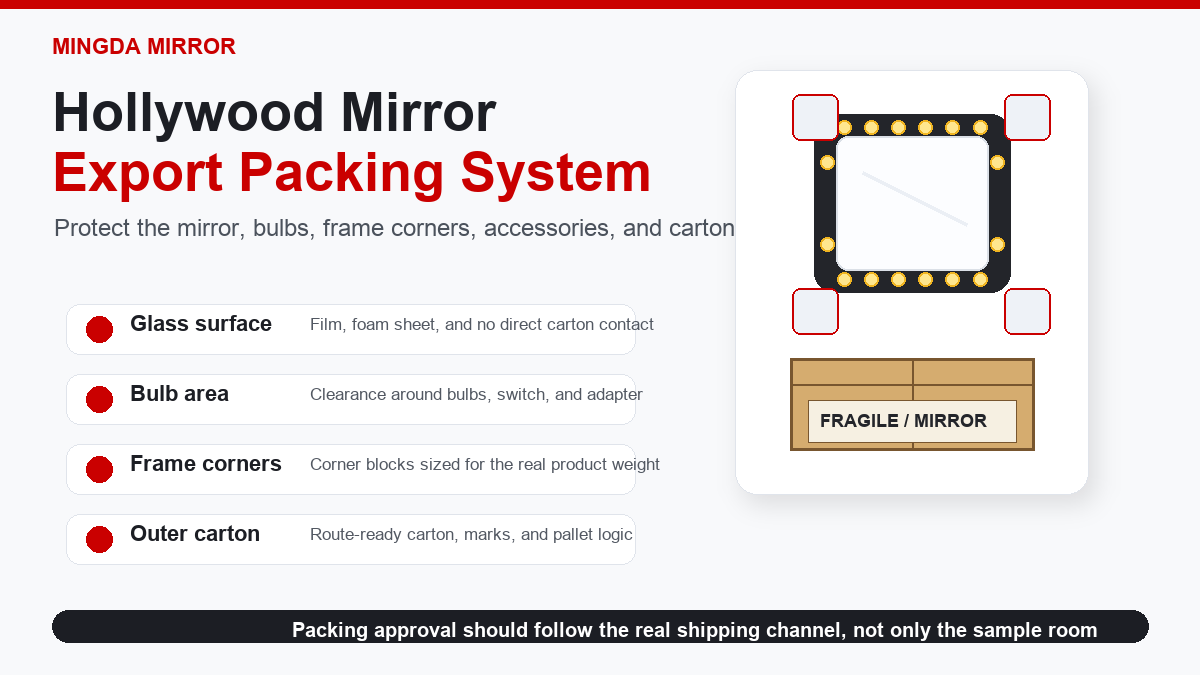
Hollywood Mirror Packaging Layers Buyers Should Confirm
| Packaging layer | Purpose | Buyer check |
|---|---|---|
| Glass surface protection | Prevents scratches, pressure marks, and direct carton contact | Confirm film, foam sheet, and safe spacing from hard parts |
| Bulb and switch clearance | Protects raised bulbs, touch switches, sockets, and adapters | Check empty space and foam shape around fragile components |
| Corner and frame blocks | Absorbs impact at the most common breakage points | Review foam density, thickness, and fit for the actual mirror weight |
| Accessory separation | Stops screws, plugs, manuals, and bases from scratching glass | Require labeled accessory bags or compartments |
| Outer carton and pallet | Supports stacking, handling, marks, barcode, and export movement | Approve carton strength, size, gross weight, marks, and pallet loading |
The most important rule is simple: approve the packed sample, not only the loose mirror. If the approved sample does not include the same foam, carton, accessories, manual, plug, and labeling that will be used in mass production, the buyer has not approved the real shipping product.
Match Packing to the Sales Channel
E-commerce and Amazon sellers usually need stronger parcel-drop protection because units may be handled one by one. The outer carton must survive courier handling, and the inner retail box should still look clean when the customer opens it. This is different from container-loaded distributor orders where pallet stability, carton consistency, and warehouse stacking may matter more.
Retail chains often care about shelf presentation, barcode readability, color box quality, and clean carton surfaces. Salon and hotel project buyers care about job-site handling, accessory accuracy, installation timing, and replacement planning. A wall-mounted Hollywood mirror for a hotel project may need clearer screw kits and spare-part logic than a tabletop consumer SKU.
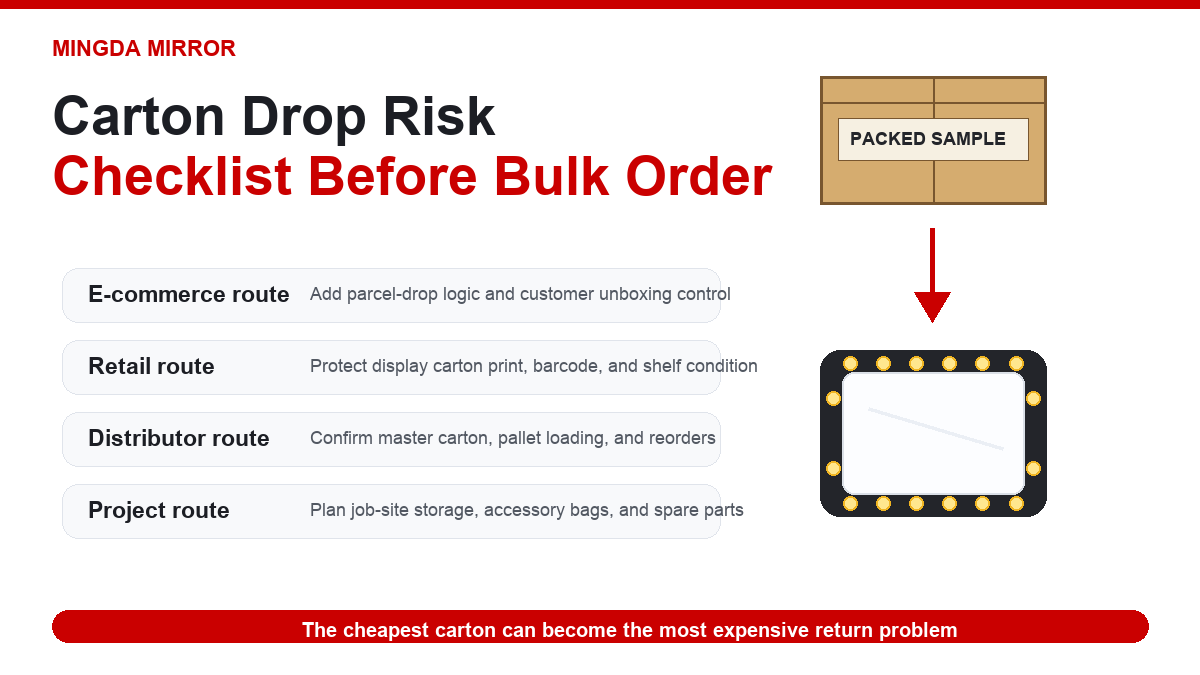
Common Breakage Points in Hollywood Mirror Orders
Many breakage claims start from predictable weak points. The glass can crack when the mirror face is pressed against a hard surface inside the carton. Bulbs or bulb sockets can loosen if foam presses directly against raised components. Frame corners can deform if the foam is too soft or too thin for the product weight. Accessories can scratch the mirror when screws, anchors, adapters, or bases are packed loosely.
Buyers should also check the relationship between carton size and product weight. A carton that is too tight may transfer impact directly to the mirror. A carton with too much empty space may allow movement during transit. For heavier Hollywood iron-framed mirrors, the packing design should be reviewed together with the frame structure, bulb layout, base or mounting hardware, and shipping route. Mingda’s Hollywood iron-framed mirror sourcing guide gives broader context on structure and buyer-use scenarios.
Pre-Order Packing Checklist for Buyers
- Request packed-sample photos from multiple angles before approving bulk production.
- Confirm foam type, corner block thickness, glass surface protection, and accessory placement.
- Check whether the same packing works for tabletop, wall-mounted, or dual-use mirror designs.
- Define carton marks, barcode position, product label, user manual language, and private-label packaging needs.
- Ask whether drop-test, vibration-test, or internal transport checks are available for the target channel.
- Confirm how replacement claims will be handled when glass, bulbs, switches, plugs, frames, or cartons are damaged.
- Review carton size, gross weight, master carton plan, pallet quantity, and container-loading assumptions.
These details affect quotation. A cheaper quote may exclude the stronger foam, improved carton, barcode label, inner retail box, or channel-specific accessories that the buyer actually needs. For private-label or project orders, packaging requirements should be sent with the RFQ so the supplier can calculate MOQ, sample cost, lead time, and carton material correctly.
What Sourcing Managers Should Ask Before RFQ
| Question | Why it matters commercially |
|---|---|
| What is the destination sales channel? | Retail, e-commerce, distributor, and project orders need different carton priorities. |
| Will the order use custom color boxes or neutral export cartons? | Private-label packaging can change MOQ, printing cost, and approval time. |
| Is the mirror tabletop, wall-mounted, or dual-use? | Base, screws, anchors, and hanging parts must be packed without scratching glass. |
| What breakage rate is acceptable? | The answer determines whether stronger packing and testing are worth the cost. |
| Who pays for replacements? | Clear rules prevent disputes after goods arrive or project installation starts. |
Pre-Shipment Inspection Should Include Packing
Inspection should not stop after checking the mirror surface and lighting function. A useful pre-shipment QC process verifies CCT, dimming, switch response, plug standard, adapter, cable, bulb condition, frame finish, mounting holes, tabletop base stability, accessory kit, labels, carton marks, and packed-carton condition. The inspector should open packed samples and confirm that the packing matches the approved version.
For larger orders, buyers can define an inspection sampling standard and request photos of packed units, accessory bags, carton labels, pallet loading, and any rejected units. Mingda’s QC Process and Packaging & Logistics pages are useful references for building this checklist into the order workflow.
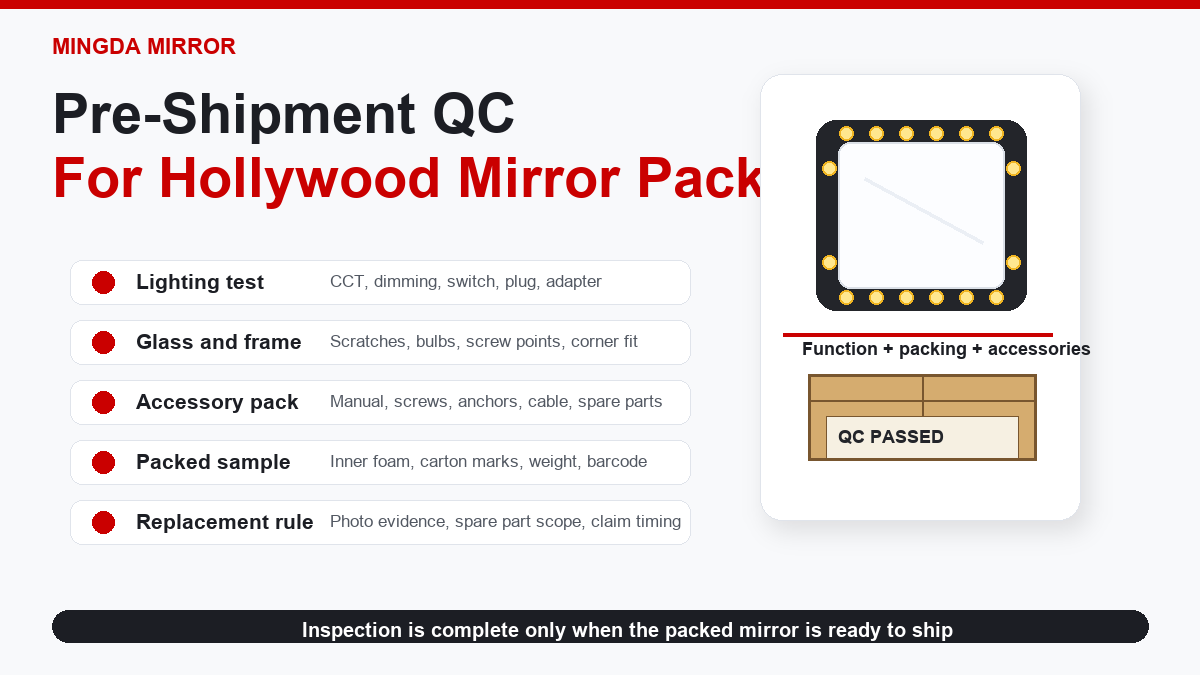
Common Mistakes Buyers Should Avoid
The first mistake is approving product appearance without approving the packed sample. The second is using the same packaging for retail, e-commerce, distributor, and project shipments without considering handling differences. The third is treating accessories as minor items. Loose screws, plugs, adapters, or bases can damage the mirror surface and create customer complaints even when the glass is not broken.
Another mistake is comparing quotations without equal packaging assumptions. If one supplier quotes a stronger carton, better foam, printed color box, barcode label, and clearer accessory kit while another quotes basic export packing, the lower unit price may not be the lower landed cost. Buyers should compare packaging specification, not only mirror specification.
Bottom Line
Buyers should pack Hollywood mirrors according to channel risk, product structure, and after-sales cost. For e-commerce orders, prioritize drop protection and clean unboxing. For retail chains, protect the display carton and label system. For distributor orders, control carton consistency and pallet movement. For salon, hotel, and project buyers, focus on installation accessories, spare parts, and job-site handling. The best purchasing decision is a mirror and packaging system approved together before bulk production.
FAQ
What is the most important packing check for Hollywood mirrors?
The most important check is the packed sample. Buyers should approve the mirror, foam, accessory placement, inner box, outer carton, labels, and carton marks as one complete shipping unit.
Do Hollywood mirrors need different packing from small makeup mirrors?
Usually yes. Hollywood mirrors are larger, heavier, and include bulbs, frames, wiring, and accessories. They need stronger corner protection, better glass spacing, and clearer accessory separation.
Should buyers request drop testing?
For e-commerce, Amazon, courier, and high-return-risk channels, drop-test or internal transport checks are useful. For palletized distributor or project orders, stacking and job-site handling may be equally important.
Does better packaging increase MOQ or lead time?
It can. Custom color boxes, printed labels, special foam, barcode systems, and stronger cartons may affect MOQ, sample timing, and bulk production lead time.
How should replacement responsibility be defined?
Buyers should define what evidence is required, which parts are covered, how replacement parts are shipped, and whether claims apply before or after installation.
CTA
If you are sourcing Hollywood mirrors for retail, e-commerce, salon, hotel, or distributor channels, contact Mingda Mirror with your target market, mirror size, structure, bulb layout, packaging style, shipping route, and order quantity. Mingda can help review the packing plan before bulk production.
Home | Hollywood Mirrors | Packaging & Logistics | QC Process | Hollywood Iron-Framed Mirror Sourcing Guide | Contact