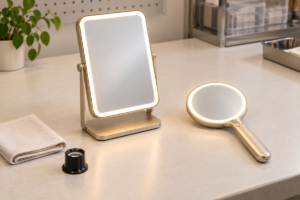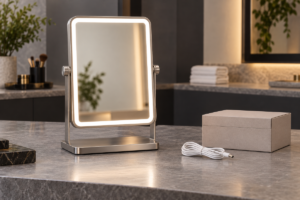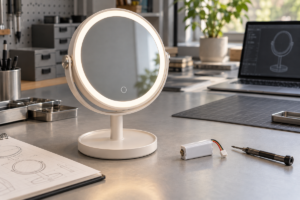

For e-commerce and private-label LED makeup mirror orders, touch sensor and dimming quality should be checked before bulk shipment because these functions directly affect reviews, returns, and repeat orders. Buyers should confirm touch response, brightness range, CCT consistency, CRI, charging stability, aging-test results, packaging protection, and production tolerance on approved samples and random mass-production units. A mirror can look attractive in photos but still fail commercially if the light flickers, the touch button feels unreliable, or the brightness differs between batches.
Rechargeable LED makeup mirrors are popular because shoppers want 3-color lighting, adjustable brightness, USB-C charging, compact placement, and a clean tabletop design. Recent marketplace listings often highlight touch screens, dimmable lighting, multiple color modes, and rechargeable batteries. For brand buyers, Amazon sellers, retailers, and distributors, those same selling points become risk points if the supplier does not control electronic consistency during production.
Why Touch and Dimming QC Matters for LED Makeup Mirror Buyers
Touch control and dimming are not decorative features. They shape the buyer’s first product experience. If the touch button reacts too slowly, turns on accidentally, fails after charging, or changes brightness unevenly, customers often judge the full mirror as low quality even when the glass, frame, and packaging are acceptable.
For an LED makeup mirror line, the main sourcing question is not only whether the mirror can turn on. Buyers need to know whether the lighting and control system stays consistent across samples, production lots, and daily use. This is especially important for Amazon and e-commerce sellers because customer reviews often describe functional issues in simple language: too dim, light stopped working, touch button not sensitive, battery does not last, or color modes are inconsistent.
The commercial impact is clear:
- Higher return rate when the mirror does not hold charge or respond reliably.
- Lower review score when brightness feels weaker than listing photos suggest.
- More customer service pressure when the touch button behavior is unclear.
- Batch claims when color temperature or brightness differs between shipments.
- Slower replenishment if every reorder requires new functional corrections.
Key Functions Buyers Should Test Before Approval
Buyers should separate visual appearance from electronic performance. A sample approval should include both.
| QC item | What to check | Why it matters for sales | Practical acceptance point |
|---|---|---|---|
| Touch response | Tap, long press, wet/dry finger simulation, repeated operation | Prevents complaints about hard-to-use controls | Stable response without random switching |
| Dimming range | Minimum, middle, and maximum brightness | Helps product match marketplace claims | Smooth dimming with no flicker or sudden jumps |
| CCT modes | Warm, neutral, and cool light consistency | Supports makeup accuracy and product photos | Each mode visibly different and batch-consistent |
| CRI and light comfort | Color rendering and glare control | Reduces disappointment with skin-tone visibility | Clear face lighting without harsh hotspots |
| Battery and charging | USB-C fit, charging indicator, runtime, heat | Protects rechargeable product reviews | Stable charging and realistic runtime claim |
| Aging test | Continuous lighting and repeated switching | Finds early electronic failures | No overheating, flicker, or control failure |
This table should become part of the buyer’s RFQ and sample checklist, not only an internal factory note.
Touch Sensor Checks for Bulk Production
Touch sensor problems are often caused by small design or assembly differences: sensor position, cover thickness, PCB tolerance, moisture, grounding, or button icon alignment. Buyers do not need to diagnose every electronic component, but they should ask the supplier how touch response is validated during production.
At sample stage, check the following:
- Does a light tap switch the mirror on and off consistently?
- Does long press dim smoothly without skipping?
- Does the sensor still respond after charging?
- Does the button trigger accidentally during packing or cleaning?
- Is the touch area easy for users to find without making the mirror look cheap?
- Is the sensor protected from pressure when the mirror is inside its foam insert?
For marketplace products, user instruction clarity also matters. If one button controls on/off, CCT mode, and dimming, buyers should confirm the user manual explains the operation in natural English. Confusing controls can look like product defects to consumers.
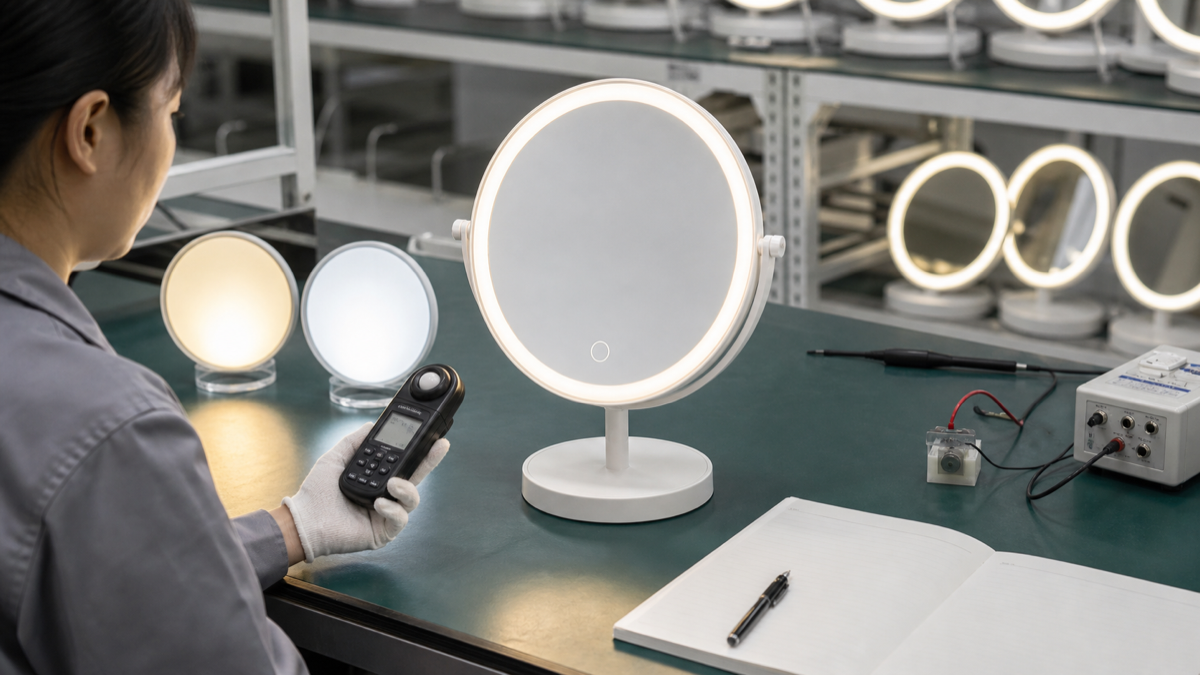
Lighting Quality: Brightness, CCT, CRI, and Glare
LED makeup mirrors need balanced light, not just high brightness. Too much brightness can cause glare; too little brightness makes the mirror feel weak. Poor diffusion can create visible LED spots, while inconsistent CCT can make skin tone look different from one unit to another.
Buyers should confirm four lighting details:
Brightness Range
The mirror should offer a useful low setting for evening use and a strong high setting for makeup application. If the difference between levels is too small, the dimming feature has little value. If the jump is too aggressive, users may think the control is unstable.
CCT Options
Warm, neutral, and cool light are common selling points. For sourcing, the key is consistency. A buyer should approve target ranges and ask whether production is checked against those ranges, especially for repeat orders.
CRI and Skin-Tone Accuracy
Higher color rendering helps makeup users see skin tone, blush, foundation, and eye makeup more accurately. A supplier should be able to explain the LED strip or light source used and how it affects visual comfort.
Diffusion and Hotspots
The LED ring should look even, without obvious dots, shadows, or harsh glare. This is both a product-quality issue and a listing-photo issue because visible hotspots can make product photography look cheaper.
Related buyer checks are covered in Mingda’s guides on rechargeable makeup mirror battery and USB-C safety and LED makeup mirror lighting quality.
Battery, USB-C, and Aging-Test Requirements
Rechargeable LED makeup mirrors should be tested as electronic beauty tools, not only as home decor. A good supplier should check charging input, cable fit, indicator behavior, runtime, heat, and repeated switching before shipment.
For bulk orders, ask the factory to confirm:
- Battery capacity and realistic runtime at high brightness.
- USB-C port fit and cable insertion durability.
- Charging indicator behavior during charging and full charge.
- Whether the mirror can be used while charging, if this is claimed.
- Aging-test duration and sample size from each batch.
- How failed electronic units are isolated before packing.
The buyer should avoid overpromising runtime in marketplace copy. It is better to state a realistic tested range than to create a customer expectation that the product cannot consistently meet.
Packaging Checks That Protect the Touch and Lighting System
Packaging is part of function quality. A well-tested mirror can still fail if the foam insert presses on the touch area, bends the stand, scratches the LED ring, or allows the USB-C cable to move freely during shipping.
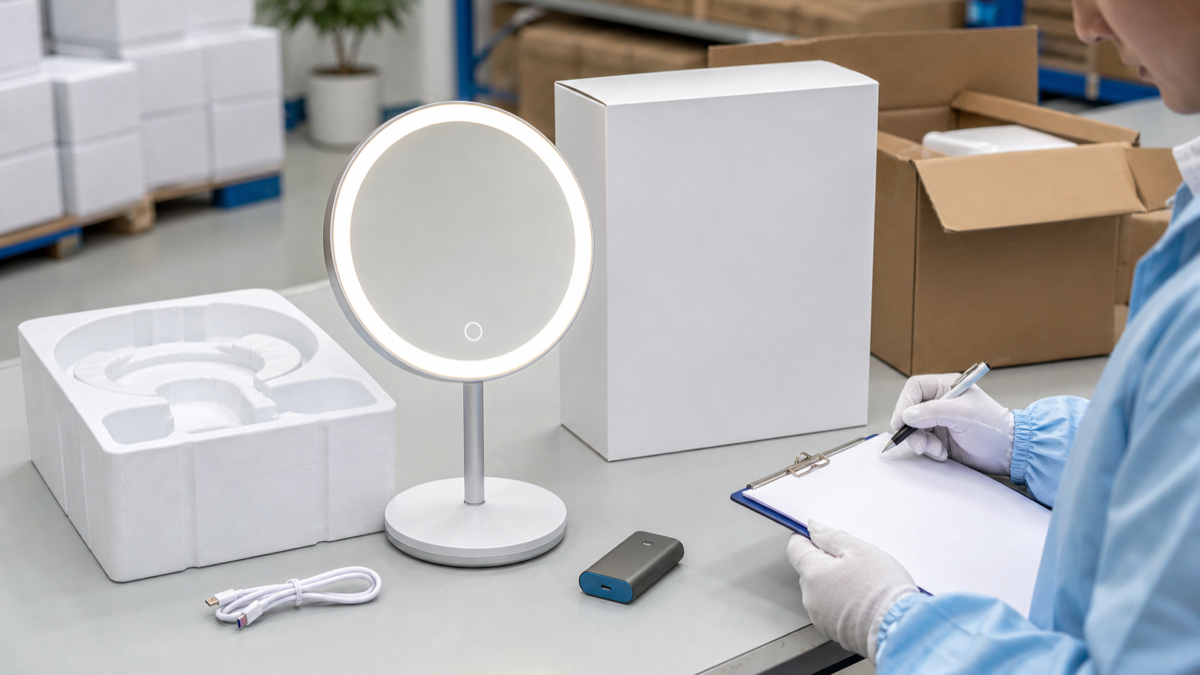
For e-commerce and Amazon FBA orders, buyers should review product protection and accessory layout together:
- Keep the mirror face, LED ring, stand, and base separated from hard accessories.
- Avoid pressure directly on the touch button.
- Confirm the USB-C cable, manual, and accessory bags cannot scratch the mirror.
- Check whether the retail box survives carton compression and drop handling.
- Confirm outer carton marks, barcode labels, and battery-related labels where required.
- Approve one packed sample before mass production packaging begins.
Mingda’s packaging guide for Amazon FBA rechargeable makeup mirrors gives more detail on shipment and review-risk control.
RFQ Checklist for Buyers
Before requesting a quotation for a private-label LED makeup mirror, send the supplier a clear function and QC brief. This reduces vague pricing and helps the supplier recommend the right model.
- Target sales channel: Amazon, retail, wholesale, beauty brand website, distributor catalog, or gift channel.
- Mirror size, magnification, base type, and placement use.
- Required light modes, CCT range, brightness level, and dimming behavior.
- Battery capacity, charging port, cable type, and runtime expectation.
- Touch-control operation: tap, long press, memory function, or separate buttons.
- Sample approval requirements for lighting, touch response, charging, and packaging.
- Packaging type, accessory layout, manual language, and outer carton requirements.
- Expected MOQ, first-order quantity, and reorder plan.
- Required certification or test-report expectations for the target market.
This checklist also helps compare suppliers. A factory that can only quote the mirror price without discussing touch response, lighting consistency, and aging tests may not be the best fit for a branded e-commerce product.
Common Mistakes Buyers Should Avoid
The most common mistake is approving a sample only by appearance. A mirror can look premium in photos but still create return risk if its electronic control system is not stable.
Other avoidable mistakes include:
- Asking for maximum brightness without checking glare and diffusion.
- Selecting a rechargeable model without confirming realistic runtime.
- Ignoring CCT consistency between the golden sample and mass production.
- Forgetting to test touch response after charging and after long operation.
- Letting packaging press directly on the touch sensor or LED ring.
- Using marketplace claims that are stronger than the supplier’s test data.
- Accepting mixed LED components across batches without a control plan.
For e-commerce sellers, small electronic problems become visible quickly because buyers test the mirror immediately after unboxing. The safest approach is to catch these issues before shipment, not after reviews appear.
Bottom-Line Recommendation
For LED makeup mirror buyers, the best sourcing decision is to treat touch control, dimming, CCT, CRI, battery runtime, and packaging pressure as one connected QC system. Do not approve the mirror only because the frame, color, and retail box look attractive. Approve the complete user experience: tap, dim, switch light mode, charge, pack, ship, unbox, and use again.
If you are preparing a rechargeable LED makeup mirror line, send Mingda Mirror your target sales channel, function requirements, expected quantity, packaging plan, and sample approval checklist. Mingda can help review whether the mirror structure, lighting system, touch control, battery, and packaging plan are suitable for bulk production.
For OEM/ODM mirror projects, visit Mingda Mirror services or contact the Mingda team with your model, MOQ, lighting requirements, and target market.
FAQ
What is the most important QC test for LED makeup mirror touch controls?
Buyers should test repeated tap and long-press operation under realistic use conditions, including after charging and after continuous lighting. The control should respond consistently without random switching or missed touches.
Should buyers prioritize brightness or CRI for makeup mirrors?
Both matter. Brightness helps visibility, while CRI and light diffusion affect skin-tone accuracy and comfort. A mirror that is very bright but harsh can still create poor user feedback.
How can Amazon sellers reduce returns on rechargeable LED makeup mirrors?
They should verify touch response, runtime, USB-C charging, packaging protection, English instructions, and realistic listing claims before shipment. The product page should not promise more performance than the tested sample can deliver.
Does packaging affect LED makeup mirror function?
Yes. Poor packaging can press on the touch button, scratch the LED ring, damage the stand, or allow accessories to hit the mirror during shipping. Packed-sample approval is important for e-commerce orders.
What should buyers send before requesting a custom LED makeup mirror quotation?
Send the target model, order quantity, sales channel, lighting requirements, battery/runtime expectation, logo and packaging plan, certification needs, and sample approval checklist.
Social Media Content Ideas
LinkedIn angle: explain why touch response, dimming, battery runtime, and packaging pressure should be checked together before approving a rechargeable LED makeup mirror.
Facebook angle: educate retailers on how lighting quality and touch-control reliability affect customer satisfaction after unboxing.
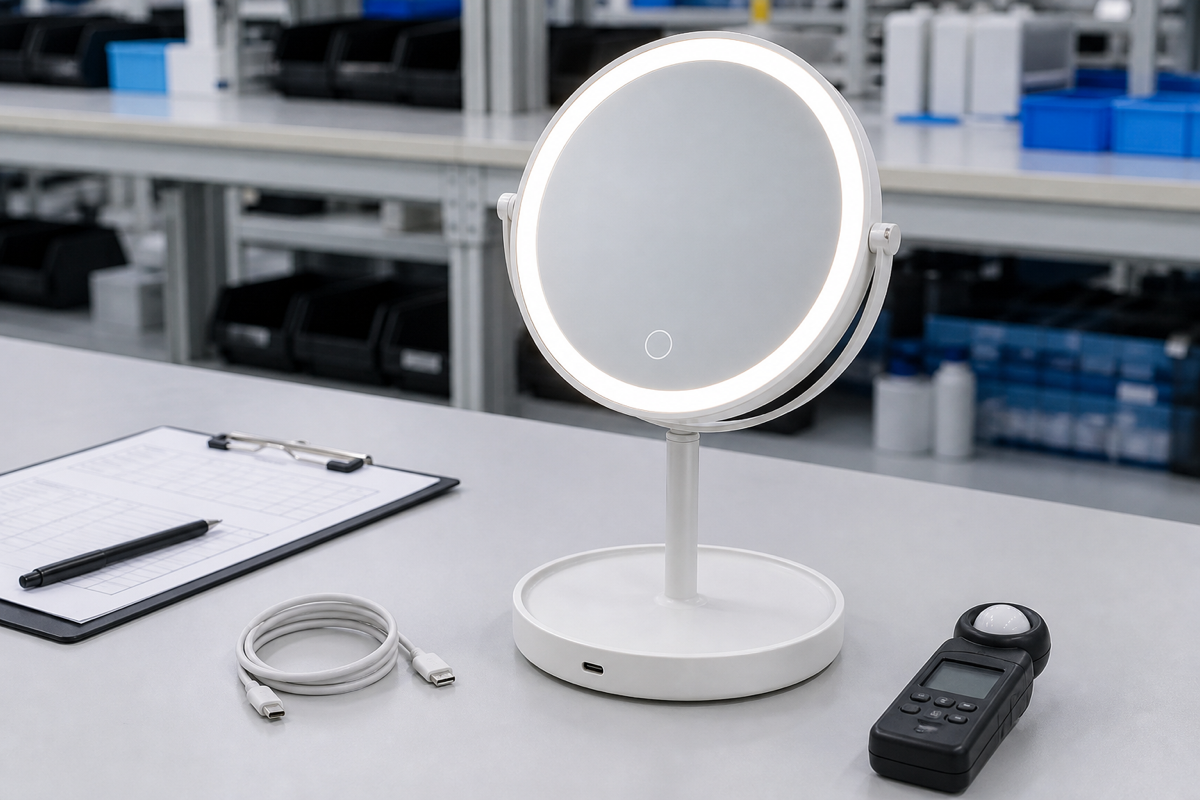
Instagram angle: use a QC bench image showing LED makeup mirror, light meter, USB-C cable, and sample inspection tools.
CTA: Read the full QC checklist and send your LED makeup mirror function requirements to Mingda Mirror for OEM/ODM review.