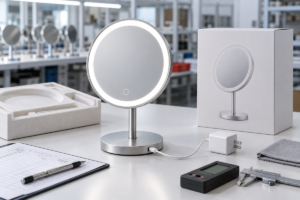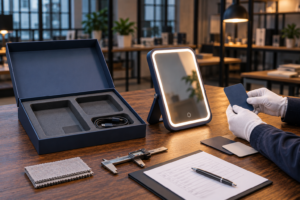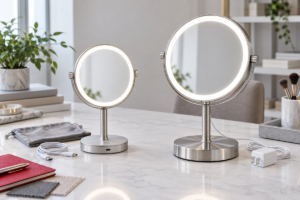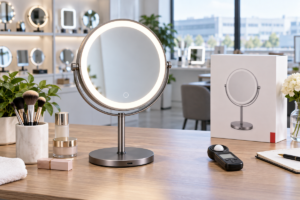

For bulk buyers, LED makeup mirror lighting quality should be checked by CCT range, CRI, brightness consistency, glare control, dimming stability, switch reliability, power configuration, sample-to-production consistency, and packaging protection. A mirror can look attractive in a product photo but still create customer complaints if the light is too harsh, too dim, uneven, color-distorting, or different from the approved sample.
This checklist is written for beauty brands, retailers, Amazon sellers, distributors, and private-label buyers who need LED makeup mirrors that can perform consistently across a full production batch. Use it before approving samples, comparing quotations, or confirming mass production with a mirror manufacturer.
Useful Mingda Mirror links: LED makeup mirror products, OEM/ODM customization, QC process, and Contact Mingda Mirror.
Why Lighting Quality Matters More Than a Bright Product Photo
Lighting is one of the main reasons consumers choose an LED makeup mirror. It is also one of the main reasons they complain. Buyers often focus on shape, finish, magnification, packaging, and unit price, but the lighting system decides whether the user can actually apply makeup comfortably.
For retail and e-commerce channels, poor lighting can become a review problem. For brand buyers, inconsistent color temperature between batches can damage product-line trust. For distributors, unstable dimming or weak touch switches can create after-sales claims. For private-label programs, lighting quality should be treated as a controlled specification, not a vague feature.
1. Define the User Scenario Before Setting Lighting Specs
Start with the target user and sales channel. A travel compact mirror, a tabletop vanity mirror, and a salon counter mirror should not use the same lighting decision by default.
An Amazon seller may need user-friendly three-color lighting, stable rechargeable performance, clear instructions, and strong packaging because returns are expensive. A retail chain may care more about easy demo function, shelf appeal, and consistent replenishment. A beauty brand may require specific finish, logo, packaging, and a lighting tone that matches brand positioning.
Do not ask only for “bright LED light.” Ask what lighting experience the customer should receive in the real use environment: bedroom vanity, bathroom counter, dressing room, salon station, travel bag, or retail display.
2. Compare CCT Options by Market Need
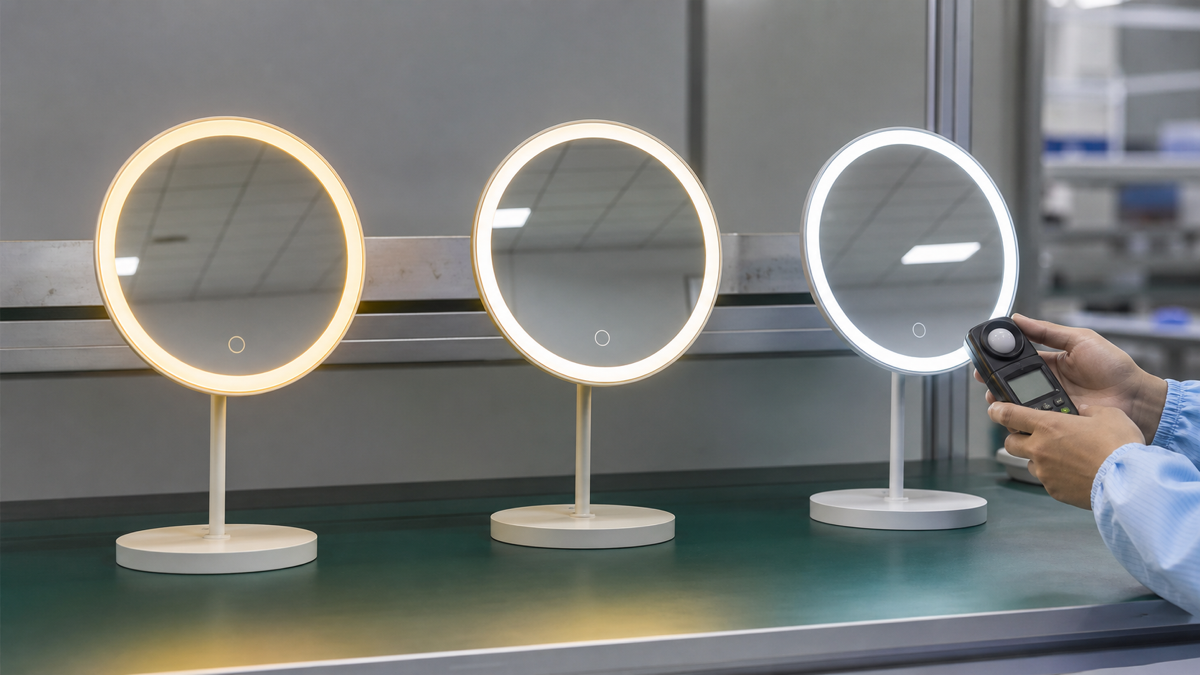
CCT, or correlated color temperature, describes whether the light feels warm, neutral, or cool. Many makeup mirror buyers now prefer adjustable lighting because users may apply makeup for office, evening, daylight, or photo situations. However, more modes are not automatically better if the light is unstable or confusing.
| Lighting option | Better for | Buyer risk to control |
|---|---|---|
| Warm light | Evening makeup, hotel-style vanity, soft beauty atmosphere | May look too yellow if CCT is not controlled |
| Neutral light | Daily makeup, retail demos, broad consumer use | Must avoid weak brightness and uneven ring diffusion |
| Cool/daylight light | Detailed makeup, e-commerce selling points, bright bathroom use | Can feel harsh if glare and brightness are not managed |
| Three-color adjustable | Beauty brands, Amazon sellers, higher-value retail sets | Requires stable switching, memory logic, and clear instructions |
For most private-label LED makeup mirror programs, a practical three-color setting is useful when the supplier can control the CCT tolerance and switch behavior. If the supplier cannot provide stable samples, a simpler but more reliable lighting configuration may create fewer complaints.
3. Check CRI and Skin-Tone Accuracy
CRI, or color rendering index, affects how naturally skin tone and makeup colors appear under the mirror light. A mirror may look bright but still distort foundation, lipstick, or eyeshadow color if the LED quality is poor.
For buyer evaluation, CRI should be discussed early with the supplier. Higher CRI usually supports better visual quality, but it may also affect component choice and cost. The key is not to request the highest number blindly. The buyer should confirm whether the final LED components, driver, diffuser, and sample actually match the intended product level.
For beauty brands and mid-to-premium retail products, color rendering should be part of the approved sample file. Buyers should photograph and evaluate the sample with skin-tone cards, cosmetic products, or realistic user conditions instead of checking brightness only.
4. Test Brightness, Dimming, and Glare Together
Brightness alone does not define quality. A mirror that is very bright can still be uncomfortable if the LED ring creates glare, visible hot spots, or sharp reflection. A mirror that is soft can still fail if it is too dim for detail work.
Buyers should test:
- Minimum and maximum brightness levels.
- Smoothness of dimming from low to high.
- Whether brightness jumps suddenly during adjustment.
- Whether the LED ring has visible dots or uneven diffusion.
- Whether the touch switch responds reliably.
- Whether brightness changes after repeated charging or long use.
For Amazon and e-commerce sellers, dimming behavior should be especially clear because customers often test the mirror immediately after unboxing. If the switch is confusing or the light does not match the listing promise, reviews can suffer even when the mirror structure is acceptable.
5. Confirm Rechargeable and Plug-In Power Behavior
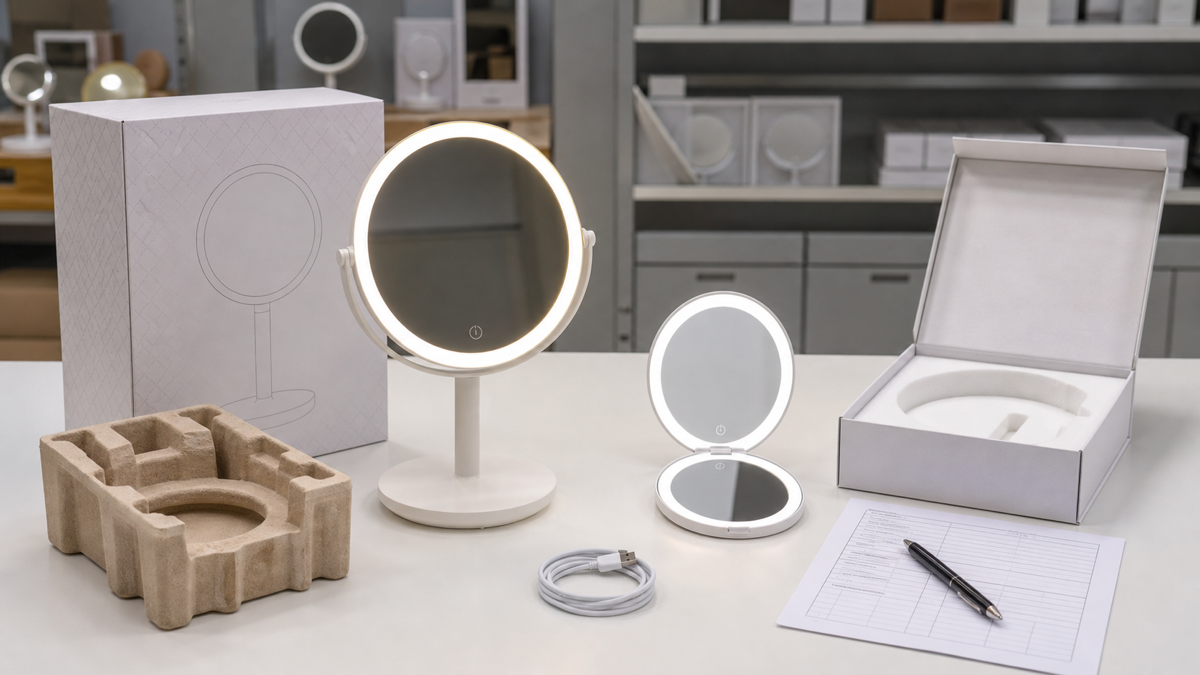
Power configuration affects lighting stability. Rechargeable LED makeup mirrors are attractive for clean countertop use, portability, and gift channels, but buyers should confirm battery capacity, charging time, usable lighting time, charging cable type, protection circuit, manual warnings, and transport documentation.
Plug-in mirrors may support stronger continuous light output, especially for larger vanity or Hollywood-style products. However, buyers need to confirm plug type, adapter quality, cable length, rated input, switch position, and destination-market requirements.
Do not approve lighting performance on a prototype with one power configuration and then mass produce a different battery, adapter, or LED driver without retesting. That is a common reason the production batch behaves differently from the approved sample.
6. Build a Sample Approval File for Lighting
Lighting approval should be documented, not remembered. A complete sample approval file should include the product model, mirror size, magnification, LED type, CCT modes, CRI target, brightness range, dimming method, switch behavior, power configuration, battery or adapter details, packaging, manual, and approved photos or videos.
Buyers should also record the test environment. A mirror checked under a bright factory ceiling may feel different in a bedroom or bathroom. If the product is sold online, the approved sample should be tested in the kind of environment customers will use when they write reviews.
When the supplier later changes LED components, diffuser material, battery, driver, switch, or packaging, the buyer should require a clear confirmation of whether sample approval, cost, MOQ, lead time, or test evidence changes.
7. Add Lighting Checks to Incoming and Final QC
A lighting specification is only useful if it appears in QC. For LED makeup mirrors, buyers should define how many units will be checked and what counts as a defect before mass production starts.
Useful QC points include:
- CCT mode sequence matches the approved sample.
- Brightness is within the agreed range.
- LED ring is even, with no obvious dark section.
- Touch switch and dimming function pass repeated operation.
- Rechargeable units charge and discharge normally.
- Mirror surface has no scratches, distortion, or stains.
- Stand, hinge, base, and rotation feel stable.
- Accessories, cable, manual, labels, and packaging match the approved file.
- Packed product survives the expected delivery route.
For private-label orders, QC should also include logo position, gift-box color, barcode or label placement, manual language, and carton marking. Lighting quality and packaging quality should be checked together because both affect customer satisfaction after delivery.
8. Avoid These Common Buyer Mistakes
The first mistake is comparing quotations without equal lighting specifications. Two suppliers may both quote an LED makeup mirror, but one may use weaker LEDs, lower CRI, thinner diffusion, smaller battery capacity, or a less reliable switch.
The second mistake is approving the look of the sample without testing real use. Buyers should test makeup application distance, glare, dimming, charging, and mirror angle. A mirror that looks premium on a table can still feel awkward when the user sits too close or too far away.
The third mistake is changing components after approval without retesting. Small changes in LED strip, diffuser, driver, battery, adapter, or switch can change the user experience.
The fourth mistake is treating packaging as separate from lighting. If the mirror arrives damaged, with a loose cable, scratched surface, or unclear instruction manual, the lighting benefit does not protect the order from returns.
Pre-RFQ Checklist for LED Makeup Mirror Lighting
- Target channel is defined: retail, Amazon, beauty brand, salon, distributor, or gift program.
- Mirror type, size, magnification, stand, finish, and packaging direction are written.
- CCT modes and expected user scenarios are clear.
- CRI and skin-tone accuracy expectations are discussed.
- Brightness, dimming, glare, and diffusion are tested together.
- Rechargeable or plug-in power configuration matches the final production version.
- Sample approval file records lighting, power, packaging, manual, and accessories.
- QC plan includes lighting function, switch reliability, charging, structure, and packaging checks.
- MOQ, lead time, component availability, testing, and replacement responsibility are confirmed before order.
Bottom Line Recommendation
For LED makeup mirror bulk orders, treat lighting quality as a measurable product specification, not a decorative feature. The strongest buying process starts with the user scenario, then locks CCT, CRI, brightness, dimming, power, sample approval, QC, and packaging before mass production.
If your team is developing a private-label LED makeup mirror line, send Mingda Mirror your target channel, mirror size, lighting preference, power requirement, packaging direction, quantity, and destination market. We can help review the lighting specification, sample plan, QC checklist, and RFQ details before bulk production.
FAQ
What is the best CCT for LED makeup mirrors?
There is no single best CCT for every channel. Warm light is useful for soft evening makeup, neutral light is practical for daily use, and cool daylight helps detailed makeup. Many buyers choose three-color adjustable lighting when the switch and LED consistency are reliable.
Should buyers require high CRI for makeup mirrors?
For beauty brands and mid-to-premium retail programs, CRI should be discussed because it affects skin-tone and cosmetic color accuracy. Buyers should confirm the final LED components and sample performance, not only request a number in the quotation.
Amazon sellers should test brightness, dimming, charging, instructions, packaging, and real-use comfort before bulk orders. The product listing should match the actual sample so customers do not feel misled after unboxing.
What lighting defects should be checked during QC?
Common lighting defects include uneven LED rings, wrong CCT sequence, weak brightness, harsh glare, flicker, unstable dimming, poor touch response, short battery life, charging failure, and differences from the approved sample.
Can Mingda Mirror customize LED makeup mirror lighting?
Yes. Mingda Mirror supports LED makeup mirror customization including lighting modes, brightness, magnification, power configuration, finish, logo, packaging, sample development, and QC planning for private-label and bulk orders.
Social Media Content Ideas
LinkedIn angle: explain why LED makeup mirror lighting should be specified by CCT, CRI, dimming, power, and QC instead of only by brightness.
Facebook angle: turn the buyer mistakes section into a short education post for retailers choosing lighted mirrors.
Instagram angle: use the CCT testing image to show warm, neutral, and cool light comparison in a factory QC setting.
Short CTA: Read the full LED makeup mirror lighting checklist and contact Mingda Mirror for an RFQ-ready sample review.